Best photo spots in Iceland — the definitive list with practical access notes
Reykjavik: South Coast Diamond Beach Jokulsarlon
What are the best photo spots in Iceland?
The South Coast is the most concentrated area for photography — Seljalandsfoss, Skógafoss, Reynisfjara, and Jökulsárlón are all within the same driving corridor. For mountain photography, Kirkjufell on Snæfellsnes is Iceland's most-photographed peak. For northern lights, any dark rural location with minimal light pollution works, with Þingvellir (near Reykjavík) and the South Coast the most accessible dark-sky areas.
| Highest concentration | South Coast corridor, Reykjavík to Jökulsárlón |
| Best single foreground | Kirkjufell, Snæfellsnes — works for both daylight and aurora |
| Least crowded, high reward | East Iceland, Westfjords (Dynjandi, Stokksnes) |
| Best crowd-avoidance tactic | Arrive before 08:00 at any South Coast stop |
| Gear note | Wide-angle for foreground drama, telephoto for icebergs and puffins |
How to use this guide
This is not a ranked list — Iceland’s photo spots are not a hierarchy. Different locations suit different photographers depending on season, weather, and personal vision. Each entry includes honest access notes: whether it is crowded in peak season, what the actual photography conditions are like, and what most online content gets wrong about the location.
All spots are accessible from Route 1 (the Ring Road) or within a reasonable detour unless marked as requiring a 4WD or specific access road.
South Coast corridor (Reykjavík to Höfn)
The South Coast is Iceland’s highest-concentration photography corridor. Nearly every entry-level Iceland itinerary includes this road, which means heavy tourist traffic at the main stops in summer.
Seljalandsfoss
Access: Route 1 east of Reykjavík, 126 km. Paved access road. Large parking area (parking fee 700 ISK). Open year-round.
What nobody tells you: The walk-behind-the-falls path is open only in summer (June–September typically) and is frequently icy and closed in winter. Without the behind-the-falls perspective, Seljalandsfoss is less compelling than Skógafoss for pure photography. Check current path status before making it your primary destination in winter.
Best time: Late afternoon in summer when sun shines through the falls from the west. Winter: the falls themselves in the morning, from outside.
See also: Seljalandsfoss guide
Skógafoss
Access: 149 km east of Reykjavík off Route 1. Free parking. Year-round access.
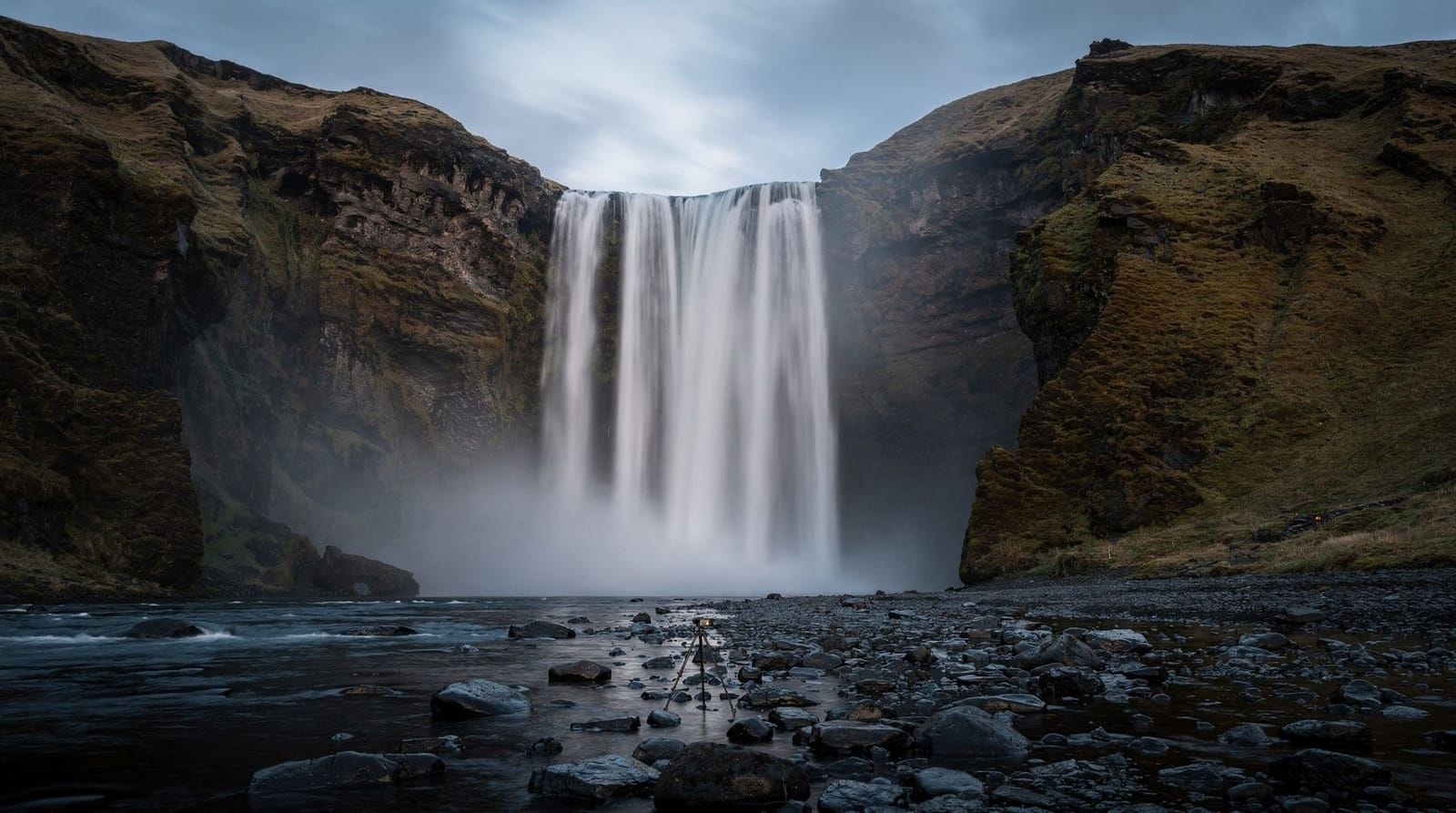
What nobody tells you: The lower viewpoint is extremely crowded in summer with tour buses stopping all day. Climb the 370 stairs to the elevated platform for an uncrowded view over the falls and river valley. At sunset, this elevated viewpoint is worth the climb.
Best time: Overcast days for evenly lit falls (no harsh shadows). Golden hour from the elevated platform for valley shots.
Reynisfjara black sand beach
Access: Route 215 off Route 1, 180 km east of Reykjavík. Free parking. Open year-round.
IMPORTANT: Sneaker waves at Reynisfjara kill visitors every year. Do not turn your back to the sea. Do not approach the water line even during apparent calm. The beach’s photography value is real; the safety hazard is real and not exaggerated.
Photography: The basalt column sea stacks (Reynisdrangar) photograph well in both overcast and dramatic stormy conditions. The cave entrance on the far left has stacked hexagonal columns for abstract compositions.
Jökulsárlón glacier lagoon
Access: 375 km east of Reykjavík on Route 1. Free parking. Year-round access.
What nobody tells you: The lagoon photograph that went viral (icebergs at sunset) requires specific weather conditions and the right season. In overcast light, the lagoon is impressive but flat. In January–February with aurora: extraordinary. In late September with autumn light: very good. In July with flat grey sky: uninspiring despite the scale.
Photography tips: Arrive at golden hour for colour. Use a telephoto (70–200mm) to isolate single icebergs. Wide-angle (16–24mm) for the full lagoon scene with mountains behind. Winter aurora above icebergs: see northern lights photography.
South Coast, Diamond Beach, and Jökulsárlón day trip — useful if you want a full day at the lagoon without self-driving the 750 km round tripDiamond Beach
Access: Directly across Route 1 from Jökulsárlón. Free. Year-round.
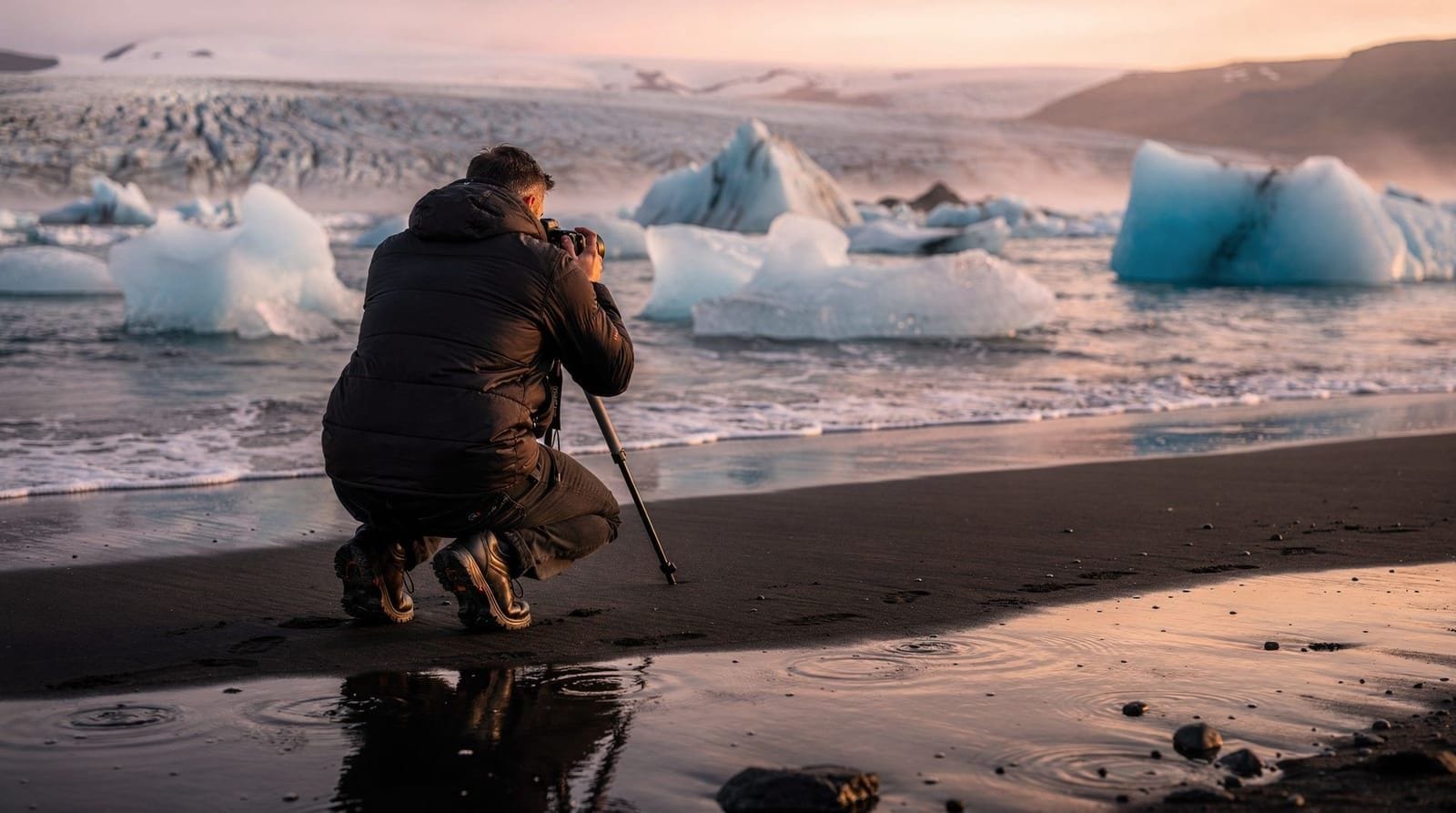
Photography: Long lens (70–200mm) to compress perspective and make ice chunks appear large against the black sand. A wide lens at wave level (ground-level shooting) produces impact. Time with wave recessions for clear sand around the ice.
West Iceland and Snæfellsnes Peninsula
Kirkjufell mountain and Kirkjufellsfoss
Access: Route 54 on Snæfellsnes Peninsula, 120 km north of Reykjavík. Small free parking area.
What nobody tells you: Every Iceland photography account shows the same frame — waterfall in foreground, mountain behind. This shot requires a specific lens length (around 24mm) from a specific standing position that everyone uses. Explore further up the stream or use a longer lens to isolate the mountain without the waterfall for something less seen.
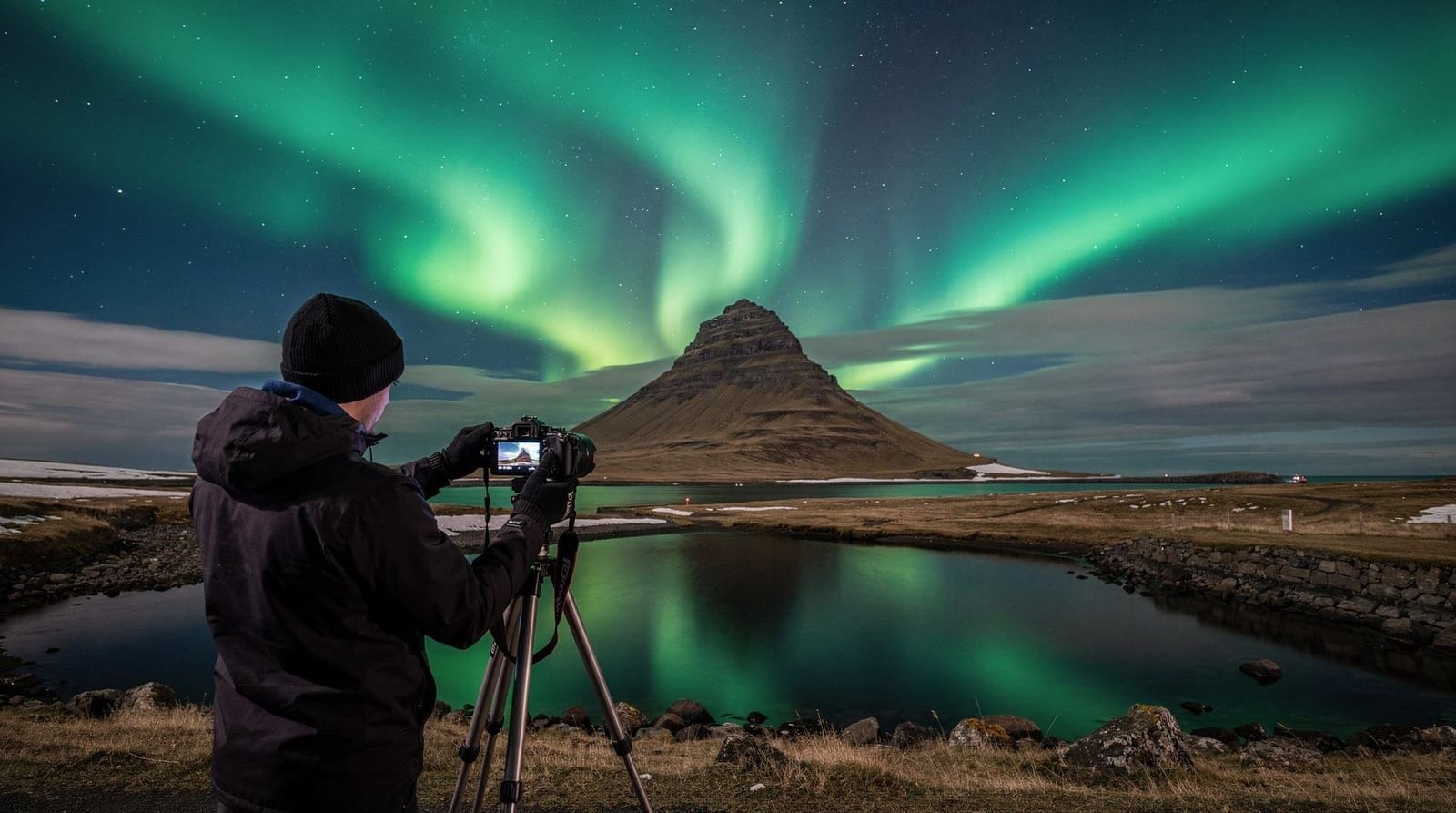
Aurora photography: Kirkjufell faces roughly north, making it an excellent aurora foreground. The mountain is lit by reflected aurora light during strong events. This is genuinely one of the best aurora foregrounds in Iceland.
Best time: September–October golden hour, winter for aurora (ideally with snow on the mountain), spring for dramatic cloud and light.
Snæfellsjökull glacier
Access: Route 574, Snæfellsnes tip. The glacier cap of Snæfellsjökull National Park is visible from many points on the peninsula.
Photography: The glacier at the tip of a peninsula surrounded by water — photographed from Arnarstapi looking west — provides an almost surreal geometry. In clear conditions, Reykjavík is barely visible 150 km to the southeast.
North Iceland
Godafoss waterfall
Access: Route 1 near Akureyri, 490 km from Reykjavík. Free parking. Year-round.
Photography: A wide, semicircular falls best photographed from the east bank at mid-morning. The falls photograph well in both overcast and partial sun. Goðafoss is distinctive in shape — the horseshoe arc is wider and more symmetrical than most Icelandic falls.
Dettifoss
Access: Route 862 or 864 from Route 1. East bank (Route 862, gravel) is recommended in summer for better viewpoints. 4WD recommended for Route 862.
Photography: Europe’s most powerful waterfall by volume. The grey glacial water and sheer force produce a different feel than the clear-water falls of the South Coast. Overcast light evens out the harsh contrasts. Spray reaches the viewpoint — lens protection essential.
Lake Mývatn pseudocraters and lava
Access: Route 1 junction east of Akureyri. Year-round access on main roads.
Photography: Lake Mývatn offers volcanic landscape photography unlike anywhere else — pseudocraters, lava columns (Dimmuborgir), and the lake itself at golden hour. The Hverfjall volcano crater rim (accessible on foot) provides an elevated perspective over the landscape.
Westfjords (seasonal access, high reward)
Dynjandi waterfall
Access: Route 60 in Westfjords. Accessible late May to October. 4WD recommended in early season.
Photography: The tiered waterfall complex — five smaller falls leading to the main Dynjandi — rewards the significant drive. Few tourists compared to South Coast falls. The full cascade with mountain framing is a compelling vertical composition.
See Dynjandi destination guide for access details.
Látrabjarg bird cliffs
Access: Route 62, western tip of Westfjords. Summer only (June–August for puffins).
Photography: Iceland’s most accessible puffin photography. Birds nest in burrows at head height — approach to within 2–3 metres without disturbing them. A 50–85mm equivalent focal length fills the frame. Late afternoon light hits the cliff face from the west.
See Látrabjarg destination guide.
Around Reykjavík
Þingvellir National Park
Access: Route 36, 45 km from Reykjavík. Parking fee 750 ISK.
Photography: The rift valley and Þingvallavatn lake at golden hour. The Öxará river in autumn with coloured leaves. Aurora reflections in the lake in winter. The Almannagjá rift canyon on foot for abstract rock textures.
Grótta lighthouse (Seltjarnarnes)
Access: Ægissíða road, Seltjarnarnes, 5 km west of Reykjavík centre.
Photography: Sunrise from the lighthouse with the city behind you. Winter aurora with Reykjavík glow as a warm backdrop. Long exposure of ocean waves around the lighthouse rocks. One of the most accessible coastal photography spots in Iceland.
What to skip (or calibrate expectations for)
Geysir and Strokkur: Geysir-Haukadalur is Iceland’s most visited non-urban attraction and very crowded. Strokkur erupts every 6–10 minutes, making eruption shots relatively easy. The surrounding landscape is unremarkable. Worth a stop on the Golden Circle; not worth a dedicated photography trip.
Hallgrímskirkja church, Reykjavík: The church’s geometric façade has been photographed from every angle. Visually distinctive but heavily photographed. Shoot early morning when the plaza is empty.
Blue Lagoon exterior: The steam-over-a-lit-lagoon shot is overrepresented in Iceland photography. The Blue Lagoon is a commercial facility designed for bathing, not photography. Authentic geothermal landscapes elsewhere are more compelling photographic subjects.
East Iceland photo spots
East Iceland sees a fraction of the photography traffic of the South Coast and Snæfellsnes, yet it contains some of the country’s most distinctive and visually diverse landscape photography opportunities. For photographers willing to invest the driving time, the rewards are uncrowded locations and compositions that do not appear in every Iceland photography compilation.
Seyðisfjörður: The fjord village of Egilsstaðir-Seyðisfjörður connects by the dramatic Route 93 mountain pass. The village itself has a distinctive blue church and colourful wooden buildings from the Norwegian settlement era. The pass above the village, descending in sharp hairpin bends to the fjord, provides one of Iceland’s most dramatic road photography perspectives. The waterfall Gufufoss near the top of the pass adds a natural foreground element. Morning mist in the fjord below from the pass viewpoint is a late September and October signature.
Eastfjords coastline: Routes 96 and 92 along the eastern fjords pass a series of fishing villages — Djúpivogur, Breiðdalsvík, Fáskrúðsfjörður — with harbour scenes and mountains behind that photograph strongly in afternoon and evening light. The mountains here are steeper and more dramatic than the South Iceland glacial plains — a different visual vocabulary entirely.
Hengifoss waterfall: The hike to Hengifoss (about 2.5 km from the car park above Lake Lagarfljót) passes Litlanesfoss first — a smaller waterfall framed by vertical basalt columns in a near-perfect geometric arrangement. This is one of Iceland’s most composed waterfall scenes and sees far fewer visitors than Skógafoss or Seljalandsfoss. Hengifoss itself is one of Iceland’s tallest waterfalls (128 m) with distinctive red clay layers in the basalt cliff.
Stokksnes headland and Vestrahorn mountain: Near Höfn, Vestrahorn mountain (454 m) rises dramatically from a narrow sand spit at Stokksnes. The mountain’s jagged ridgeline reflects in the tidal pools and sand at the base — a scene completely unlike anything on the South Coast or Snæfellsnes. Access requires a small fee at the nearby Viking Café. In winter with snow on the peaks and possible aurora: one of Iceland’s most spectacular photography compositions.
Lónsöræfi wilderness: East of Höfn, the Lónsöræfi highland reserve has dramatic rhyolite mountain formations accessible on a summer 4WD track. The landscape has similarities to Landmannalaugar but sees almost no visitors. The coloured mountains at sunset with the low-angled East Iceland light are outstanding.
Composition tips for Iceland landscapes
Iceland’s landscape is so visually abundant that photographers often default to simply recording “what was there” rather than crafting images with deliberate compositional thinking. A few specific principles improve Iceland landscape photography outcomes significantly.
The separation principle. Iceland’s most famous subjects — Kirkjufell, Jökulsárlón icebergs, Reynisdrangar sea stacks — have been photographed from the same positions thousands of times. Seek separation: a slightly different angle, a different focal length, or a different time of day that separates your photograph from the canonical version. For Kirkjufell, this means exploring the east shore of the stream (not the west where everyone stands) or using a longer focal length (85–135mm) to compress the mountain against the sky without the waterfall in front.
Foreground at or near ground level. Wide-angle lenses used at standing height produce a predictable perspective. Getting the camera close to the ground (within 30 cm) dramatically increases foreground impact. Ice chunks at Diamond Beach, basalt columns at Reynisfjara, river rocks at Gullfoss — all become powerful foreground elements at ground level that are merely decorative details at standing height.
The sky-to-ground ratio as a compositional decision. Iceland’s skies are frequently dramatic — storm clouds, aurora, midnight sun, lenticular cloud formations over glaciers. When the sky is exceptional, move the horizon to the lower third of the frame and give 70% to sky. When the foreground is exceptional and the sky is flat grey, move the horizon to the upper third and give 70% to ground. Most Iceland landscape photographs sit with the horizon in the middle, which is the weakest compositional choice.
Using weather as a photographic element. Many photographers pack up when rain or mist arrives. In Iceland, atmospheric weather produces some of the most distinctive images: mist obscuring the base of a waterfall while the top is clear, sunlight breaking through storm clouds to illuminate a single section of lava field, rainbow arcs over Skógafoss during passing rain showers. Keep shooting through the weather rather than waiting for “ideal” conditions — ideal conditions in Iceland often means flat, boring, uniform light.
Camera gear notes specific to Iceland conditions
Iceland’s environment is harder on camera gear than most destinations photographers visit regularly, and a few equipment considerations are worth planning around:
Weather sealing matters more than usual: Iceland’s combination of waterfall spray, sea spray at coastal locations, and frequent rain showers means unsealed camera bodies and lenses face real risk. A rain cover or a weather-sealed body is a reasonable investment for a dedicated photography trip.
Lens changes in the field: dust and sand at locations like Reynisfjara and Diamond Beach can enter a camera body during lens changes. Changing lenses inside a car, a covered bag, or with your back to the wind reduces this risk considerably.
Battery life in cold weather: winter photography (aurora, ice caves, snow-covered landscapes) drains batteries faster than temperate conditions. Carry at least two spare batteries and keep them in an inside pocket close to body heat between uses.
Filters: a polarising filter cuts glare from wet rock and water surfaces at nearly every South Coast location. Neutral density filters extend exposure times for smoothing waterfall water — useful at Skógafoss, Gullfoss, and Goðafoss in particular.
Lens cloth and spray protection: waterfall spray on the lens is a near-constant issue at Seljalandsfoss and Skógafoss. A dedicated microfibre cloth, checked and used before every shot, avoids the soft, hazy images that spray-covered lenses produce.
Memory cards and backup: bring more storage than you think you’ll need, and back up to a laptop or portable drive each evening if the trip is dedicated to photography — Iceland’s landscape density means it’s easy to shoot far more than expected in a single day, and losing a card mid-trip is a genuinely painful way to lose irreplaceable images.
Logistics for reaching remote locations
Iceland’s most rewarding photography locations often require more logistical preparation than the well-documented South Coast stops. Understanding the access realities prevents wasted trips and positions you to make the most of limited time.
4WD requirement assessment. The Icelandic road classification is a reliable guide: F-roads (prefixed with F, gravel highland tracks) are explicitly 4WD-required and rental contracts typically void insurance coverage for 2WD vehicles on F-roads. Regular numbered gravel roads (2xx, 3xx series) are legally passable with 2WD but are rougher and benefit from 4WD. Paved roads (Route 1 and major regional roads) are 2WD accessible in summer and in winter on main routes.
For photography specifically: Dettifoss east bank (Route 862) is recommended in summer for its superior viewpoint but is a rough gravel road that benefits from 4WD. Dynjandi in the Westfjords requires 4WD in early season (May–June) when snow is still present on the pass road. The Vatnajökull National Park interior is F-road only and summer-only — photography access to the highland glacier margins requires proper 4WD with river-crossing capability.
Time investment for remote locations. Dynjandi in the Westfjords is a 3.5–4 hour drive from Reykjavík. Dettifoss in North Iceland is a 5–6 hour drive. These locations are not practical as day trips from Reykjavík unless you are willing to drive 7–8 hours round trip for a 1–2 hour photography session. Building overnight stays into the itinerary near these locations produces far better results — you have golden hour, return for different conditions, and are not driving exhausted.
Seasonal access windows. The Westfjords via the main Route 60 are accessible year-round on the main road but some branches require snow-free conditions. Plan Dynjandi and Látrabjarg visits for June through September. The Highlands open in late June and close by early October. East Iceland is fully accessible year-round on the Ring Road but some fjord-road extensions require summer conditions.
Arriving early at popular locations. For South Coast locations, “early” means before 08:30. After 09:00, coach tours begin arriving at Seljalandsfoss and Skógafoss, and the viewing areas fill rapidly. In summer, these locations have virtually no crowding before 08:00 and can have 200+ visitors by 10:00. Winter brings smaller overall visitor numbers but tour buses still arrive from 09:30. Early arrival transforms a crowded tourist stop into a private photography session.
Frequently asked questions about Iceland photo spots
Can I access Iceland’s best photo spots without a 4WD?
Most locations on this list are accessible with a 2WD on paved roads in summer and on Route 1 in winter. 4WD becomes necessary for Dettifoss east bank (Route 862), early-season access to Dynjandi in the Westfjords, and any off-paved-road exploration. For standard photography itineraries, a 4WD is not mandatory on the primary spots.
Which photo spots require the most early start to beat crowds?
Seljalandsfoss, Skógafoss, and Reynisfjara are busy from 09:00–18:00 daily in summer. Arriving before 08:00 or after 19:00 gives you empty locations. Jökulsárlón is less visited before 08:00 but tour buses arrive from 09:30. In winter, crowds are dramatically lower at all locations.
Are there photography locations in Iceland that are genuinely uncrowded?
Dynjandi in the Westfjords, the Westfjords coastline generally, East Iceland (Eastfjords), and Asbyrgi canyon in the north all see significantly fewer visitors than the South Coast. Inland Highland locations in summer are wilderness photography territory with minimal human presence.
Building a photography-focused itinerary
If photography is the primary purpose of the trip rather than a byproduct of sightseeing, the itinerary logic differs from a standard first-time visit. Rather than covering the most destinations, prioritise fewer locations with more time at each — arriving for one golden hour and leaving is far less productive than staying two nights near a location and shooting it in three different light conditions.
A practical structure for a 10-day photography trip: 3 nights South Coast (Vík area) working Seljalandsfoss, Skógafoss, Reynisfjara, and Jökulsárlón across multiple visits and light conditions; 2 nights Snæfellsnes for Kirkjufell and the peninsula’s coastal light; 2–3 nights East Iceland for Stokksnes, Vestrahorn, and the Eastfjords villages with almost no other photographers present; remaining nights flexible for weather-chasing. This mirrors the standard Ring Road guide route but with far more time built in at fewer stops.
Top experiences
Best-rated activities across GetYourGuide and Viator.