Reynisfjara — Iceland's iconic black-sand beach
Everything you need to visit Reynisfjara safely — basalt columns, sea stacks, puffins, wave dangers, parking, and the best time to come without the crowds.
Reykjavik: South Coast highlights small group
Quick facts
- Best time
- May–Aug for puffins; early morning year-round to avoid crowds
- Days needed
- 1–3 hours (combined with nearby Vík)
- Getting there
- ~2h 30min from Reykjavík; 5 km west of Vík off Route 1
- Budget per day
- Free entry; budget 15,000–20,000 ISK / €100–130 for the day with stops
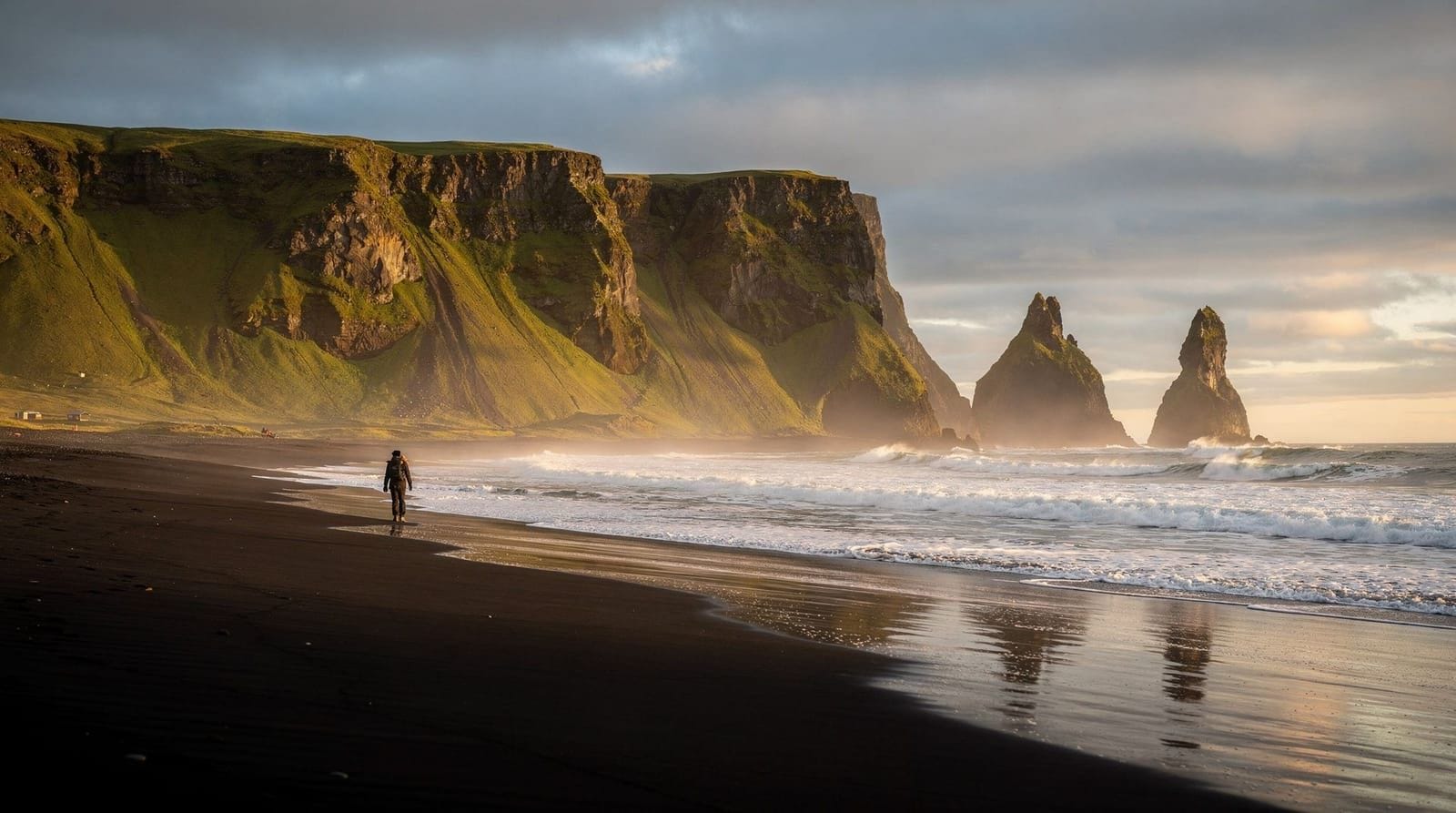
Reynisfjara is the beach on which Iceland’s reputation for otherworldly landscapes was largely built. Black volcanic sand, hexagonal basalt columns stacked floor to ceiling in a cave, and three dramatic sea stacks (the Reynisdrangar) rising from a white-frothed Atlantic — this one kilometre of shoreline has appeared on more travel magazine covers than any other spot in the country.
It is free to visit, has no opening hours, and lies just 5 km west of Vík í Mýrdal. It is also the site of multiple visitor fatalities due to sneaker waves — a fact that must be the starting point of any honest description.
| Facilities | Toilets and a small café at the car park; no other infrastructure |
| Mobile signal | Reliable at the car park and beach; unaffected by weather |
| Parking | Free lot at the end of Route 215 |
| Wheelchair access | Car park is paved and flat; the beach itself is loose black sand, difficult for wheelchairs |
| Families | Supervise children closely near the waterline at all times — sneaker waves are the primary risk |
The wave danger — read this first
Reynisfjara’s geology creates a specific hazard. The beach slopes steeply, the sand is coarse and heavy, and waves arrive with little warning across a long, exposed fetch from the open Atlantic. What locals and guides call “sneaker waves” — large waves that appear at irregular intervals and surge much further up the beach than normal — have swept multiple people into the sea, sometimes fatally.
The rules are straightforward but need to be followed consistently:
- Never stand within 30 metres of the waterline unless you have watched the wave pattern for at least two to three minutes.
- Never turn your back on the ocean.
- If a wave starts to pull you back, drop to the ground and spread your weight rather than trying to run — wet sand offers almost no traction at an angle.
- Heed all signage. The red warning signs are not decorative.
- Do not let children run to the water’s edge unsupervised.
Icelandic coast guards and park rangers have repeatedly warned that the danger is most acute when the sea looks calm — the sneaker waves come precisely during lulls, not during obviously rough surf.
The basalt columns
The main visual attraction beyond the beach itself is the formation of hexagonal basalt columns on the cliffside at the north end of the beach, inside and around a shallow cave called Hálsanefshellir. The columns formed as thick lava flows cooled slowly and contracted, cracking in a geometric pattern. The result looks deliberately architectural — like a cathedral organ front made from stone.
The cave itself is accessible on foot during dry conditions, but be aware that the floor can be slippery and waves can reach the cave entrance during high surf. Standing well back is the sensible approach.
The columns at Reynisfjara are not unique to this beach — you can see similar formations at Dyrhólaey and at several sea cliffs along the east coast — but this location has the most dramatic accessible concentration in Iceland.
The Reynisdrangar sea stacks
The three sea stacks visible from the beach have a specific origin in Icelandic folklore: they are said to be trolls who were caught at sea trying to drag a ship ashore, and turned to stone when the sun rose before they could return. Modern geology is less romantic — they are remnant volcanic plugs, the harder core of an ancient crater that remains after the surrounding rock eroded away.
On and around the stacks in summer, guillemots, razorbills, and kittiwakes nest in large numbers. From the beach with binoculars (you won’t get closer on foot — the stacks are in the sea) you can see significant bird activity throughout the morning.
Puffin watching
Between mid-May and mid-August, Atlantic puffins nest in the grassy clifftop above and behind the beach. The best viewing point is the raised grassy area above the cave formation, accessible via a short path. Puffins are not shy but they are easily disturbed during nesting, so stay on the path and do not approach burrow openings.
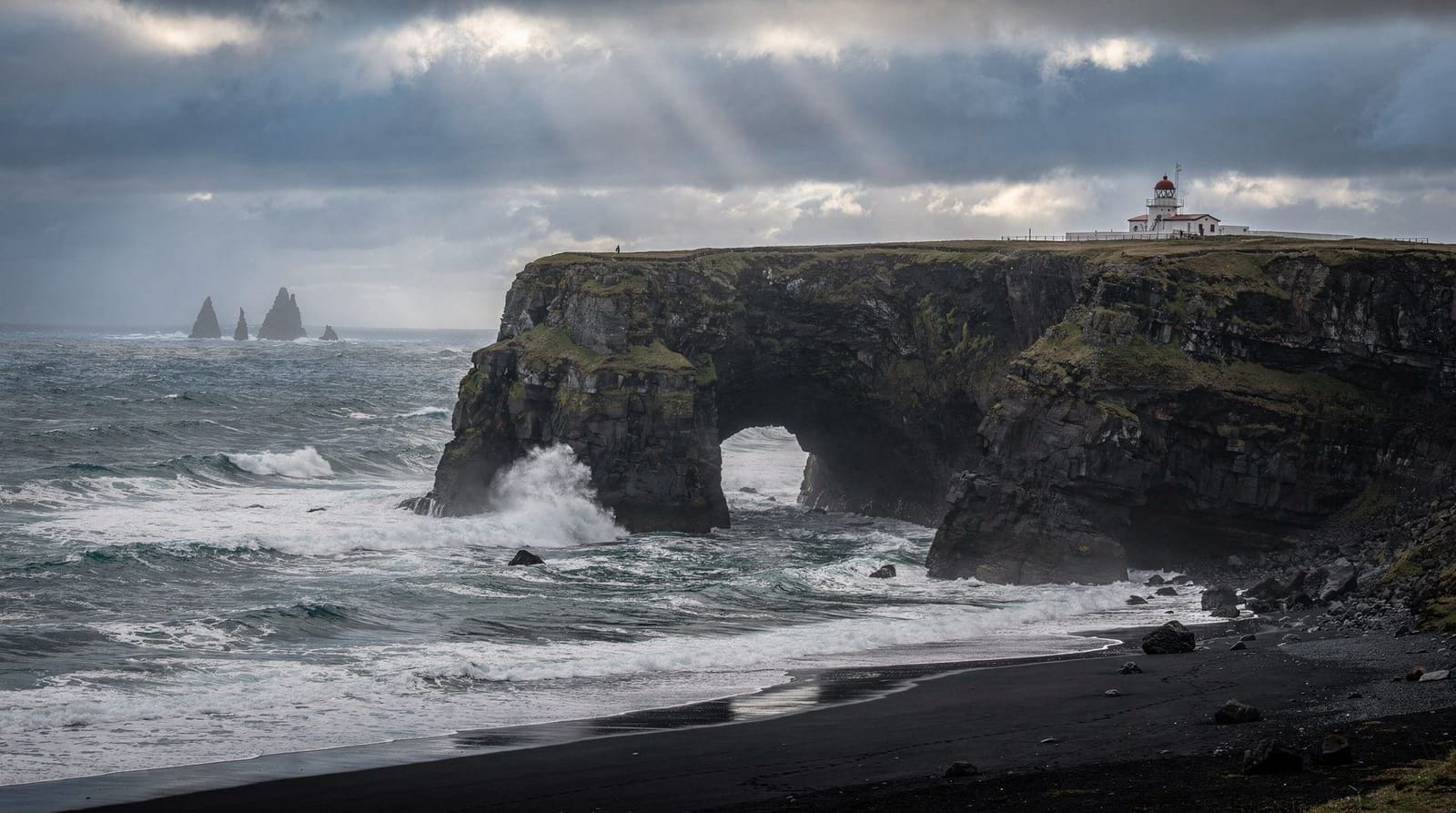
For the most concentrated puffin activity around Vík, Dyrhólaey promontory a few kilometres west offers arguably better access to nesting colonies, and a lighthouse with unobstructed views.
Crowds and the best time to visit
Reynisfjara is one of the most-visited sites in Iceland and receives dozens of tour buses daily during peak season (June–August). The parking area fills to capacity by mid-morning on clear summer days.
The practical solution: arrive before 8:30am or after 6pm. The light is better at both ends of the day anyway — the low-angle sun illuminates the basalt columns and brings out the texture of the black sand in a way that midday flat light does not. In summer, you have full daylight past 11pm, which gives you real flexibility.
In winter (November–March), the crowd problem mostly disappears. The dramatic weather — dark skies, crashing waves, occasional snow dusting the columns — makes for better photography than any summer afternoon. The wave danger does not diminish in winter; if anything, Atlantic swells are larger and less predictable.
Full-day South Coast tour from Reykjavík including Reynisfjara, Seljalandsfoss, and Skógafoss — small groupGetting to Reynisfjara
By car: From Reykjavík, drive Route 1 east for approximately 175 km, then turn right onto Route 215 at the sign for Reynisfjara. The car park (free) is at the end of the road, about 2 km from the turnoff. From Vík village, it is a 5-minute drive west. There is no fee to park or enter.
On a guided tour: Every South Coast day trip from Reykjavík includes a stop at Reynisfjara. Expect 30–60 minutes allocated, depending on the operator. Small-group tours generally allow more time and more flexible stops than large-bus tours.
By public transport: There is no direct bus to the beach. The Ring Road bus (Strætó 51) stops in Vík, from which you would need a taxi or bicycle to reach the beach. This is impractical for most visitors without a car.
What’s nearby
Within a 10-minute drive: Vík í Mýrdal village (petrol, food, accommodation), Dyrhólaey promontory with its sea arch and lighthouse.
Within 30 minutes: Skógafoss waterfall, Seljalandsfoss, the Sólheimajökull glacier trailhead.
Within 60 minutes: Fjaðrárgljúfur canyon, Skaftafell in Vatnajökull National Park.
The most efficient routing if you are self-driving westbound from Jökulsárlón is to visit Reynisfjara and Vík, then continue to the waterfalls on the way back to Reykjavík — this avoids backtracking on Route 1.
Horseback riding on the black sand near Reynisfjara — 1.5-hour guided ride along the volcanic shorelineFacilities and practicalities
Toilets: Available at the car park (small fee in peak season; bring coins or card).
Café: The Black Beach Restaurant at the car park is mediocre at best — the food is overpriced relative to quality. A packed lunch from Reykjavík or from the Krónan supermarket in Vík is a better option.
Photography: The beach faces roughly south-south-west, so the best light is morning (east-facing cliff side) and late evening. A polarising filter reduces glare on the wet sand. Tripod users should note that the black sand gets into everything; rinse equipment thoroughly after the visit.
Accessibility: The car park is paved and mostly flat. The beach itself involves loose black sand, which is difficult for wheelchairs. The basalt cave area is accessible on foot but uneven.
The geology of the beach and stacks
Reynisfjara’s black sand is not volcanic ash — it is eroded basalt. The lava flows that created the South Coast landscape here came from the Mýrdalsjökull volcanic system (the Katla volcano beneath the glacier). As the lava cooled, fractured, and was attacked by wave erosion over thousands of years, the rock broke down into the angular, coarse-grained black particles underfoot.
The Reynisdrangar sea stacks are not simply erosional remnants — they are the product of a specific geological process. Where a volcanic vent hardened into a dense plug of basalt, the surrounding rock eroded faster than the core, leaving the harder columns standing. The three stacks are at different stages of this erosion process; over geological time (many thousands of years), even the stacks will be reduced to sea level.
The hexagonal columns in Hálsanefshellir cave formed as a thick, slow-cooling lava flow contracted. Slow cooling produces large columns (up to a metre across); fast cooling at the surface produces smaller, less regular fractures. The regularity of the columns at Reynisfjara indicates the lava here cooled exceptionally uniformly. The same process produced the columns at Svartifoss and at the Giant’s Causeway in Northern Ireland.
Horseback riding on the black sand
A somewhat unusual but memorable way to experience the Reynisfjara area is on horseback. Several operators run guided rides along the black sand coastal plain — on the Icelandic horse, which has a smooth additional gait (tölt) that makes beach riding more comfortable than it would be on a continental breed.
Rides of 1–2 hours operate from farms near Vík, with routes along the coastal plain parallel to the beach. The Icelandic horse is small but sturdy, and the combination of black sand, basalt cliffs, and a sea stack backdrop makes for striking scenery from horseback.
Cost is approximately 12,000–16,000 ISK (€78–105) for a 1.5-hour ride. Advance booking is recommended in July and August.
Safety culture at Reynisfjara: what has changed
Following several fatalities at Reynisfjara over the past decade, the site has undergone significant safety improvements. Better signage, closer monitoring during high surf, and periodic temporary closures of the beach during extreme wave events are now in place.
The Icelandic Coast Guard issues surf warnings for the South Coast regularly in autumn and winter. On days when orange or red wave warnings are active, beach access is inadvisable and rangers may physically restrict access to the waterline.
The safety improvements have not eliminated the risk — the fundamental physics of the beach have not changed — but the awareness level of both guides and visitors has improved. Tour operators now routinely brief groups about wave danger before approaching the beach, whereas this was not consistently done before the fatalities attracted public attention.
Visiting independently (without a guide) is completely normal but requires self-discipline. The warning signs are clear; the risk is real; the consequences of ignoring them have been demonstrated repeatedly.
Eating near Reynisfjara
There are no restaurants at the beach itself. The Black Beach Restaurant at the car park has been consistently mediocre and overpriced for several years running — the reputation has not improved. Options within 10 minutes’ drive in Vík:
Smiðjan Brugghús — pizza and local craft beer; reliable and reasonably priced at 3,500–5,000 ISK (€23–33) for a main.
Strondin Bistro — soups and light meals; good for lunch.
Krónan supermarket — the most budget-conscious option; bring a picnic from here to eat at the beach viewpoint.
Reynisfjara versus Diamond Beach
Visitors planning a full South Coast trip often ask how Reynisfjara compares to Diamond Beach near Jökulsárlón, roughly 2.5 hours further east. Both are black-sand beaches with dramatic Atlantic surf, but the character differs: Reynisfjara has the basalt columns, sea stacks, and easy access from Vík; Diamond Beach has ice chunks from the glacier lagoon washing ashore, a genuinely different visual. Both carry the same sneaker-wave risk and the same rule — never turn your back on the ocean. If your itinerary only allows one, Reynisfjara is more accessible for a shorter South Coast trip; Diamond Beach requires committing to the full drive to Jökulsárlón.
Frequently asked questions about Reynisfjara
Is Reynisfjara beach free to visit?
Yes. There is no entrance fee. Parking at the main lot is free; toilet facilities sometimes charge a small coin fee (around 200 ISK). No pre-booking is needed to visit the beach itself.
Can I swim at Reynisfjara?
Swimming is strongly discouraged and effectively impossible without serious risk. The waves are powerful and unpredictable, the water temperature even in summer is around 8–12°C, and the currents are dangerous. There are no lifeguards. The beach is for viewing, not swimming.
Are there any facilities at the beach?
A car park, toilet block, and a small café/restaurant at the entrance. That is the full extent of facilities. Bring your own food and water if you want to spend time there without relying on the café.
Why is the sand black?
The sand is composed of ground-down basalt — volcanic rock. Iceland sits on the Mid-Atlantic Ridge and has extensive volcanic activity; the lava flows that created the landscape around Vík eroded into the fine black grains you see on the beach. It is not ash, but weathered rock.
Is Reynisfjara safe to visit in winter?
Yes, provided the usual wave precautions are followed with extra care. Winter swells from the Atlantic are often larger and less predictable than summer conditions, and the Icelandic Coast Guard issues surf warnings that occasionally restrict beach access entirely during orange or red alert days. Winter also brings the reward of far fewer visitors and dramatic dark-sky, crashing-wave photography that summer’s calmer, brighter conditions don’t offer. Check safetravel.is before a winter visit and heed any posted closures.
How long should I budget for a visit?
A minimum of 45 minutes to do the beach and cave justice at a relaxed pace. If you want to sit and observe the sea stacks, watch for puffins, or wait for the right light for photography, plan 1.5–2 hours. Most day tours allocate 30–45 minutes, which is tight but workable if you move efficiently.
Is the beach open at night in summer?
There are no official opening hours; the beach is accessible 24 hours. In summer, the midnight sun gives you full light even past 11pm and the crowd is gone. The walk from the car park takes about 5 minutes. If you are sensitive about personal safety at night, note that the car park is isolated but generally safe.
What other stops combine well with Reynisfjara on a day trip from Reykjavík?
The classic South Coast combination is Seljalandsfoss, Skógafoss, Reynisfjara, and Vík — achievable in one long day. Adding Sólheimajökull glacier pushes the day to 12–13 hours and requires an early start. The South Coast day trip guide has a detailed timing breakdown.
Are there guided tours specifically to Reynisfjara?
Reynisfjara is included on nearly every South Coast day tour from Reykjavík, but there’s no need to book one solely for the beach — self-driving the roughly 2.5-hour route via Route 1 is straightforward for most visitors with a rental car. A guided tour makes more sense if you want the beach combined with Skógafoss, Seljalandsfoss, and a glacier hike handled logistically in one booking; see the South Coast day tour for a typical full-day format.
Is it worth visiting Reynisfjara more than once on a longer trip?
If your itinerary loops back through the South Coast — for example on both the outbound and return legs of a Ring Road trip — a second, quieter visit (early morning or evening, off-peak) can be worthwhile purely for the light and the reduced crowds, especially if the first visit was during a busy midday tour-bus window.
Top experiences
Bookable activities with verified prices and instant confirmation on GetYourGuide.
Top-rated experiences in Reynisfjara — Iceland's iconic black-sand beach
Best-rated activities across GetYourGuide and Viator.