Skógafoss — the thundering South Coast waterfall
Complete guide to Skógafoss — 60m wide South Iceland waterfall, the staircase to the top, the Fimmvörðuháls hiking trail, and practical visitor tips.
Reykjavik: South Coast highlights small group
Quick facts
- Best time
- Year-round; June–Aug for hiking; Oct–Mar for rainbows and fewer crowds
- Days needed
- 1–3 hours (standalone); half-day if hiking the gorge above
- Getting there
- ~1h 55min from Reykjavík (148 km east); 25 km east of Seljalandsfoss
- Budget per day
- Free entry; parking free; combine with South Coast for 12,000–18,000 ISK / €80–120
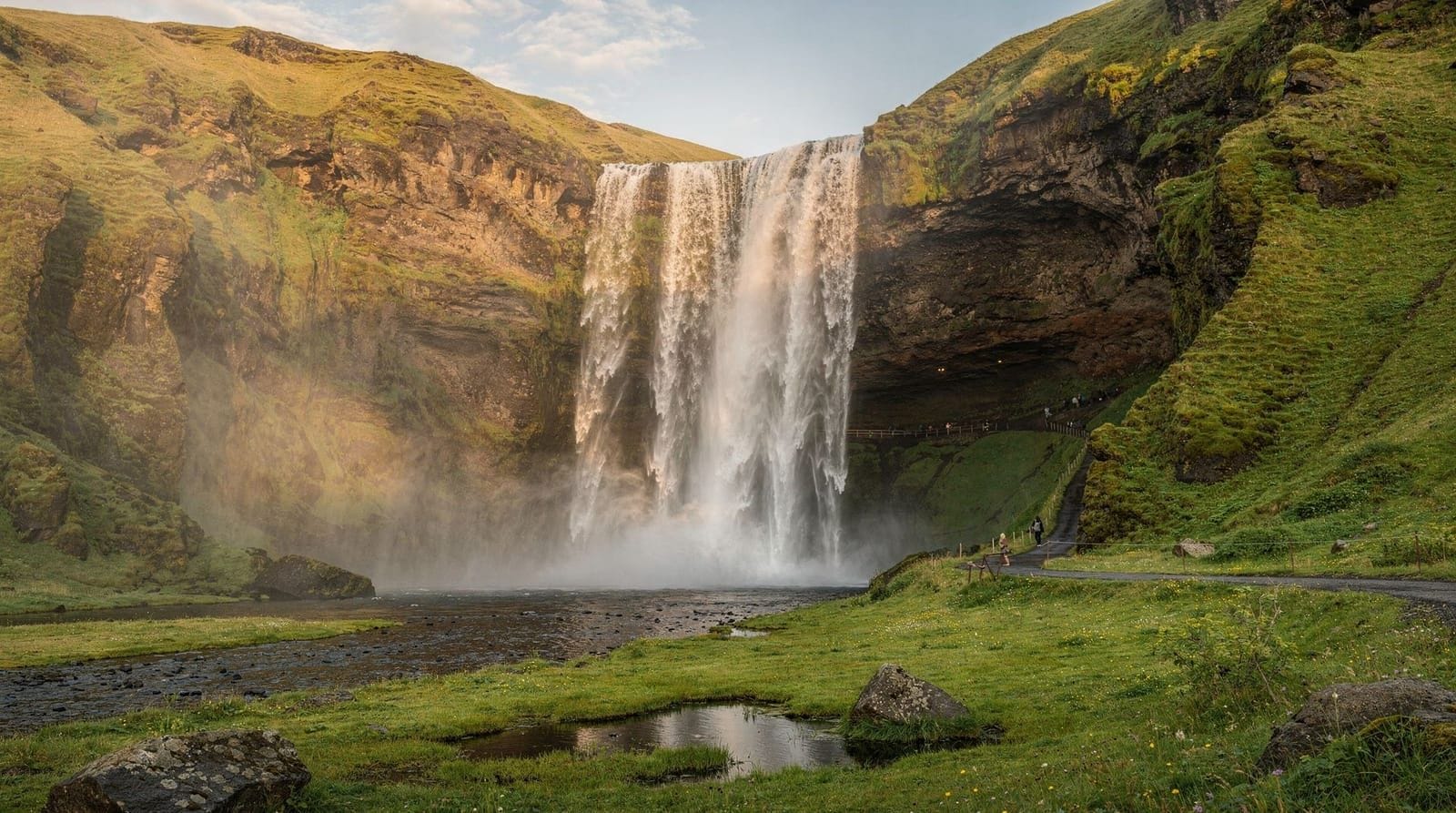
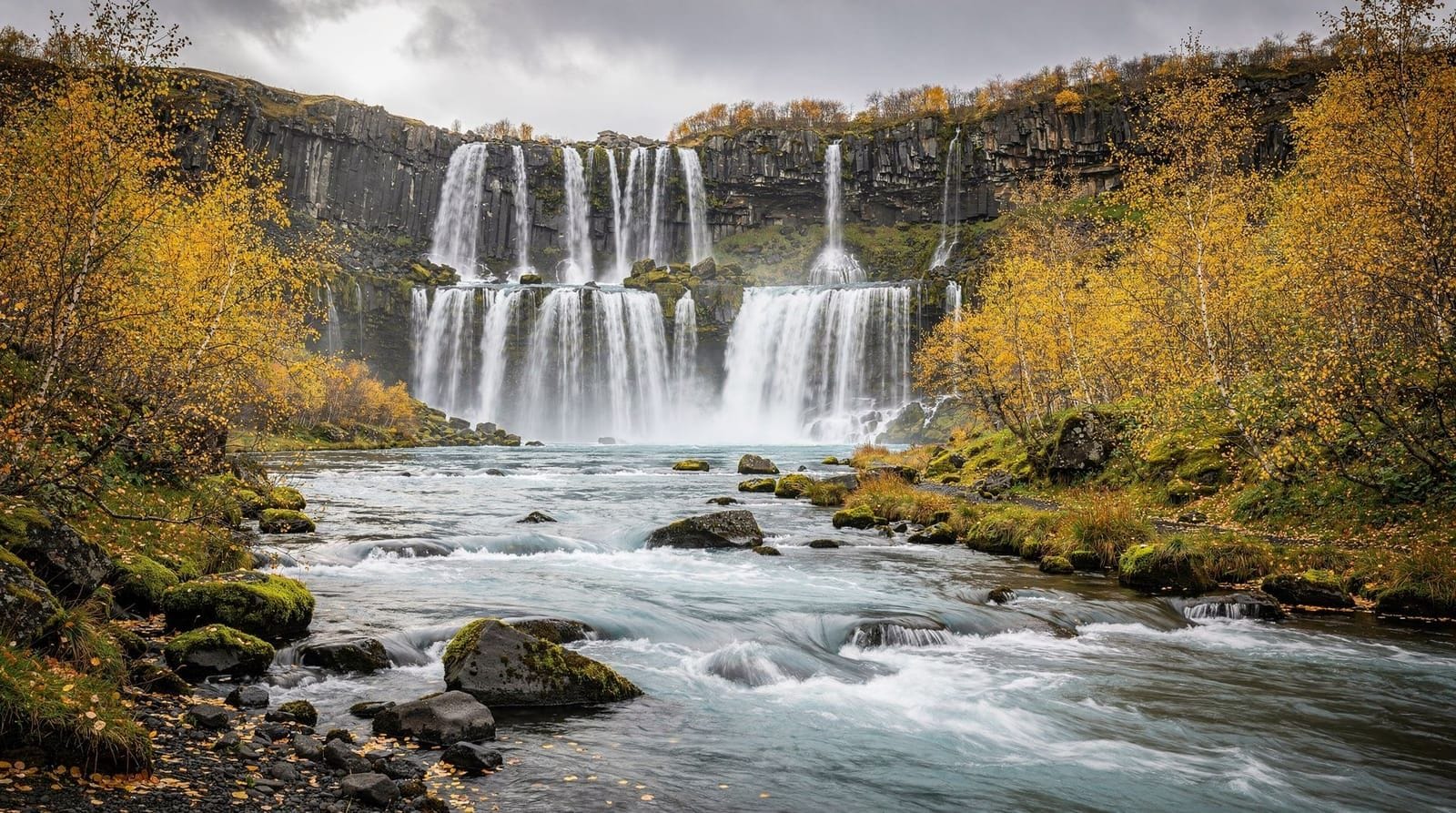
Skógafoss is one of Iceland’s largest and most accessible waterfalls — 60 metres high and 25 metres wide, falling in a single unobstructed plunge into the pool and river below. Unlike Seljalandsfoss 22 km to the west, you cannot walk behind Skógafoss, but you can climb a staircase of 370-plus steps to the top and then continue along the gorge trail into the highlands above.
The waterfall sits on the Skógá river, which drains off the Eyjafjallajökull and Mýrdalsjökull ice caps. The site is free to enter, parking is free, and there are year-round facilities at the base. It is also the starting point for the Fimmvörðuháls trail, one of Iceland’s finest multi-day hikes connecting the South Coast to the volcanic highlands of Þórsmörk.
| Where | South Coast, Route 1, 148 km / ~1h 55min from Reykjavík |
| Cost | Free entry and parking; museum around 2,500 ISK |
| Time needed | 1–3 hours standalone; half-day with the gorge trail |
| Getting there | 25 km east of Seljalandsfoss, on Route 1 |
| Best time | Year-round; mornings for the rainbow, autumn/winter for fewer crowds |
At the base
The first thing visitors notice at Skógafoss is scale. From the car park it looks impressive; from the base of the falls, 50 metres away, the scale becomes clearer — the spray can reach you at distances of 30 metres and beyond in wind, and the sound is substantial. The pool area is accessible right up to the rocks at the base, which are perpetually wet.
On sunny mornings, a primary rainbow — sometimes a double rainbow — forms regularly in the spray. The geometry works best in the morning when the sun is in the south-east and the spray catches the light. This is not a rare occurrence at Skógafoss; it happens on most clear mornings when the sun angle is right.
The base area can get crowded quickly in summer. Most tour buses arrive between 10am and 2pm; arriving before 9am or after 5pm gives a much less congested experience and better light.
The staircase to the top
On the right side of the waterfall (facing the falls), a metal staircase with approximately 370 steps climbs the cliff to the top of the falls. The stairs are well-maintained, with handrails throughout, and the climb takes 10–15 minutes at a steady pace. The view from the top platform — looking back down over the gorge and across the flat South Coast lowlands to the sea — is one of the best panoramic viewpoints on the entire South Coast route.
The effort is worthwhile for almost everyone capable of managing stairs at altitude. The platform at the top is exposed and can be very windy; grip the railings and be careful with children.
Above the platform, a well-marked trail continues up the river gorge. The first section — approximately 2 km along the gorge — passes a series of smaller waterfalls and is accessible for any reasonably fit walker in 45–60 minutes return. The gorge walls are steep and the views back toward the coast are striking.
The Fimmvörðuháls hike
Skógafoss is the southern terminus of the Fimmvörðuháls hiking trail, which climbs into the mountains between Eyjafjallajökull and Mýrdalsjökull before descending into the Þórsmörk (Thorsmork) valley. The full trail is approximately 25 km one-way and is normally hiked over two days with an overnight in a mountain hut.
The trail passes through the lava field created by the 2010 Eyjafjallajökull eruption — one of the few places in Iceland where you can walk through genuinely recent volcanic landscape at this scale. The two new craters from that eruption, Magni and Móði, are visible and approachable on the trail.
For a day hike without multi-day logistics, the first 8–10 km to the snowline above the gorge is achievable and rewarding in good conditions. The terrain becomes more demanding above the gorge; proper hiking boots, waterproof layers, and navigation skills are required above the treeline.
Guided Fimmvörðuháls hikes and Þórsmörk day trips are available from Vík and from Reykjavík. These use super-jeeps to handle the river crossings on the Þórsmörk side that make the route inaccessible by standard vehicle.
The Skógar Folk Museum
Immediately adjacent to the waterfall car park, the Skógar Folk Museum (Skógasafn) is genuinely worth 60–90 minutes of your time. It covers rural Icelandic life from the 18th century to the 20th, with intact turf farmhouses, fishing boats, and period artefacts. Admission is around 2,500 ISK (€16) for adults. This is not a tourist trap — the collection is substantial and thoughtfully presented.
Photography at Skógafoss
The falls face north, which means direct frontal light appears in summer around midday — the opposite of most Icelandic waterfalls where morning or evening works better. In overcast conditions, which are common, the diffuse light eliminates harsh shadows and allows full-spectrum colour in the spray.
The standard wide-angle composition from the base captures the full drop with the gorge walls flanking the falls. A telephoto from the car park (200–400mm) compresses the falls and can isolate the rainbow arc in the spray. The staircase platform offers a composition looking down the gorge that most visitors miss because they photograph it from below; from above, the river snaking away toward the sea has a completely different character.
Long exposures (1/4 to 1 second) smooth the water texture. The base of the falls is too loud to hear your shutter, and the spray makes camera protection important — a rain sleeve or waterproof housing is useful within 30 metres of the base.
Full-day South Coast tour including Skógafoss, Seljalandsfoss, and Reynisfjara black beach — small group from ReykjavíkPractical details
Parking: Free, with a large dedicated car park off Route 1. The car park is clearly signposted and has toilet facilities (basic) adjacent. It fills during peak season; early arrival solves this.
Entry: Free to access both the base and the staircase.
Food: There is a small kiosk near the car park selling coffee, waffles, and snacks. The Skógar Folk Museum has a slightly more substantial café with soup. Neither is a destination meal; bring your own lunch from Reykjavík or from the Krónan in Vík.
Seasonal considerations: The staircase is accessible year-round but can be icy and dangerous in winter. Metal crampons (microspikes) are helpful from November to March. The trail above the falls is closed when snow makes it unsafe — typically November through May above the gorge section.
Accommodation: There is a guesthouse (Hótel Skógafoss) at the site and Skógar Hostel adjacent, both modestly priced (18,000–28,000 ISK / €115–185 for a double in peak season). Staying here gives access to the falls at night and early morning, though Vík has more dining options.
Toilets and facilities: Basic public toilets sit at the main car park; the Skógar Folk Museum café has better facilities and is a reasonable fallback if the car park toilets have a queue during peak arrival times.
The legend of the hidden treasure
Skógafoss has one of Iceland’s better-known pieces of local mythology attached to it. According to the saga, the first settler at Skógar, Þrasi Þórólfsson, buried a chest of gold inside the cave behind the falls. In the 19th century, local boys supposedly found the chest and managed to grab the ring on the lid before it disappeared back into the rock. That ring, they said, became part of the door handle of the Skógar church — and it was a real object until relatively recently.
This story is almost certainly invented, but the detail about the ring handle was taken seriously enough that the Skógar Folk Museum preserves what may be the ring in question. Whether the story is true, the connection between the falls and the idea of something hidden behind the water is a recurring theme in Icelandic landscape folklore — and Skógafoss plays into it effectively given its sheer, opaque curtain that blocks any view of what lies behind.
Eyjafjallajökull and the 2010 eruption connection
The Skógá river draining past Skógafoss comes directly off Eyjafjallajökull, the volcano famous for the April 2010 eruption that grounded European air traffic for weeks. The eruption itself was most visible from the slopes above the falls — the volcanic plume and lava flows were photographed extensively from the hillside above Skógafoss, and the ash cloud that caused the aviation disruption drifted north-east over Scandinavia and the UK.
The eruption sent a jökulhlaup (glacial flood) down the Skógá valley — the river briefly carried ash, ice, and sediment at much higher volumes than normal. Traces of the ashfall are still visible in soil sections near the river valley if you know what you are looking for.
For visitors interested in Iceland’s recent volcanic history, the trail up the gorge above Skógafoss is the most accessible route into the heart of the Eyjafjallajökull landscape. The volcano is not currently active; its next eruption will likely give some months of seismic warning.
Horseback riding near Skógafoss
The flat coastal plain between Skógafoss and Seljalandsfoss is traditional horse-breeding country. Several Icelandic horse farms in the area offer guided rides of 1–2 hours along the coastal plain and river meadows, with views of the glacier-capped mountains inland. These are typically the five-gaited Icelandic horses, known for the smooth “tölt” gait that distinguishes them from continental breeds.
Rides cost approximately 10,000–14,000 ISK (€65–92) per person for a 1.5-hour session. Booking ahead is required; the farms operating in this area are occasionally listed at the Skógar visitor centre.
Combining with the South Coast
Skógafoss sits 22 km east of Seljalandsfoss on Route 1. The two are the logical double-feature of any South Coast day trip: Seljalandsfoss in the morning, Skógafoss 30–40 minutes later, then continue east to Sólheimajökull, Reynisfjara, and Vík.
This sequence covers the core western South Coast sites in a single day from Reykjavík with a return to the city by 9–10pm. Adding the glacial sites — Skaftafell and Jökulsárlón — requires either an early start or an overnight stop in Vík. See the south coast glaciers 4-day itinerary for a more relaxed version.
South Coast volcanoes and waterfalls minibus tour from Reykjavík — premium small-group experienceWhat the Skógar area offers beyond the waterfall
The area around Skógafoss is more developed than most South Coast stops, which is both a positive (facilities exist) and a mild negative (it can feel like a tourist node). Beyond the waterfall and museum:
Skógar Hostel and Guesthouse accommodation: If you are looking to spend the night between Reykjavík and Vík without the higher prices of the Vík hotels, the Skógar area has good mid-range options at 18,000–25,000 ISK (€117–162) for a double in high season.
The gorge walk: As described above, the trail above the falls rewards those who continue beyond the staircase platform. The first 2 km passes three or four additional smaller falls (Skógar tributaries) and the gorge walls reach interesting heights. The further you walk, the fewer people you see.
Walking toward Þórsmörk: Serious hikers beginning the Fimmvörðuháls or Laugavegur multi-day trek start here. The trailhead infrastructure — storage lockers at the hostel, a ranger point, weather briefings — is better here than at most Icelandic trailheads. If you are doing the full Fimmvörðuháls to Þórsmörk route, the Skógar Folk Museum is worth the 90-minute detour before departure.
The coast between Skógafoss and Seljalandsfoss: The strip of Route 1 between the two waterfalls passes through flat farmland with good views of both the mountains inland and the coastal plain. Several small pull-offs exist for photography; one of the better ones is near Skeiðvöllur, a small sports ground, where the mountains north of the road create a particularly clean backdrop.
Skógafoss without a car
Skógafoss is one of the easiest South Coast stops to reach without a rental car, since nearly every South Coast day tour from Reykjavík includes it as a core stop. The standard full-day format covers Seljalandsfoss, Skógafoss, and Reynisfjara in a single loop, typically departing central Reykjavík around 8–8:30am and returning by 8–9pm.
South Coast day tour from Reykjavík — Seljalandsfoss, Skógafoss and Reynisfjara in a single day, no car neededStrætó’s long-distance buses also stop near Skógar on the Route 1 corridor in summer, though schedules are limited and geared toward hikers heading to or from Þórsmörk rather than casual sightseers. For most visitors without a car, a guided day tour or a multi-day South Coast package remains the more practical route to seeing Skógafoss properly rather than relying on public transport timetables.
Skógafoss vs Seljalandsfoss: which to prioritise if short on time
| Skógafoss | Seljalandsfoss | |
|---|---|---|
| Signature feature | 60m single plunge, staircase to the top | Path behind the curtain of water |
| Crowd pattern | Tour buses 10am–2pm | Similarly busy, plus a second wave for Gljúfrabúi next door |
| Best light | Midday (falls face north) | Evening, low sun behind the falls |
| Time needed | 45–75 min including the staircase | 30–45 min, more with Gljúfrabúi |
| Distance from Reykjavík | 148 km / ~1h 55min | 121 km / ~1h 30min |
If forced to choose one, Skógafoss gives more to do (staircase, gorge trail, folk museum) and a more dramatic single waterfall; Seljalandsfoss gives the unique behind-the-curtain perspective. Most South Coast itineraries visit both — they sit only 25 km apart on the same road — so the choice rarely needs making in practice.
Frequently asked questions about Skógafoss
Can you walk behind Skógafoss?
No — unlike Seljalandsfoss, there is no path behind Skógafoss. The falls drop directly against the cliff face with no alcove behind them. You can walk to the base and get very close to the falling water, but not behind the curtain.
How many steps to the top of Skógafoss?
The staircase has approximately 370–400 steps, depending on which section you count. The climb takes 10–15 minutes at a moderate pace. The steps are well-maintained with handrails throughout, though they can be slippery in rain or ice.
Is there a hiking trail above Skógafoss?
Yes — the Fimmvörðuháls trail begins at the top of the staircase and leads 25 km north-east through the mountains to the Þórsmörk valley. The first 8–10 km along the gorge is a popular day hike. The full trail requires two days and an overnight in a mountain hut.
Is Skógafoss free to visit?
Yes. Parking is free, the staircase is free, and the base viewing area is free. The optional Folk Museum next door charges approximately 2,500 ISK (€16) for adults.
What time is best to visit Skógafoss?
Early morning (before 9am) or evening (after 6pm) in summer to avoid tour bus crowds. Mornings are best for the rainbow effect in the spray. The falls are impressive in all weather — overcast and drizzly conditions actually produce better diffuse light for photography than harsh midday sun.
Is the staircase safe in winter?
The staircase is accessible in winter but can be icy. Metal microspikes over hiking boots are strongly recommended between November and March. The trail above the gorge is typically unsafe without mountaineering equipment in winter and should not be attempted without a guide.
How close is Skógafoss to Seljalandsfoss?
About 22 km east on Route 1, a 20–25 minute drive. Most South Coast itineraries visit both on the same day. See the South Coast day trip guide for routing and timing details.
Is there a fee for the Skógar Folk Museum?
Yes — around 2,500 ISK (€16) for adults, separate from the free waterfall and staircase. It is not mandatory to enjoy Skógafoss, but it is genuinely one of the better small museums on the South Coast and worth the 60–90 minutes if you have time.
Top experiences
Bookable activities with verified prices and instant confirmation on GetYourGuide.
Top-rated experiences in Skógafoss — the thundering South Coast waterfall
Best-rated activities across GetYourGuide and Viator.