Jökulsárlón glacier lagoon — Iceland's crown jewel
Everything for Jökulsárlón — boat tours, ice cave timing, Diamond Beach, how to get there from Reykjavík (5h drive), and honest advice on what to skip.
Reykjavik: Jokulsarlon glacial Lagoon with boat tour
Quick facts
- Best time
- Year-round; ice caves Oct–Mar; boat tours May–Oct
- Days needed
- Half-day at minimum; full day combining ice cave + Diamond Beach
- Getting there
- ~5h drive from Reykjavík (375 km east via Route 1)
- Budget per day
- Boat tour 6,500–8,000 ISK / €42–52; ice cave tour 20,000–28,000 ISK / €130–185
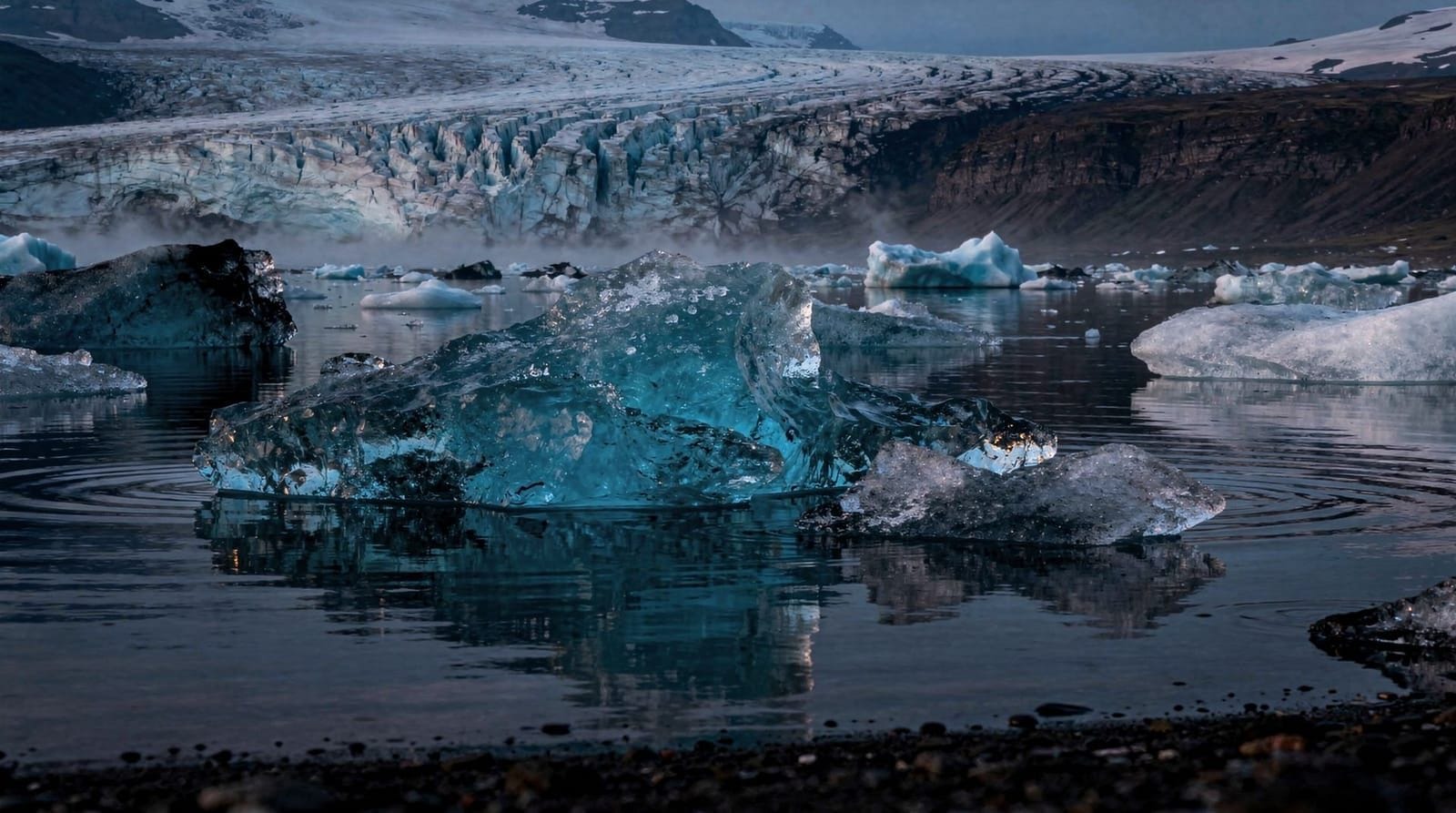
Jökulsárlón is Iceland’s most dramatic glacial landscape and the single most photographed location in the country after the Northern Lights themselves. The lagoon formed as the Breiðamerkurjökull glacier tongue retreated through the 20th century; what was solid ice 100 years ago is now a 25-square-kilometre lake filled with floating icebergs in shades of white, grey-blue, and occasionally nearly transparent aquamarine.
The lagoon sits at the southern edge of Vatnajökull National Park, 375 km from Reykjavík — a 4h 45min to 5-hour drive. This distance is the primary logistical consideration: Jökulsárlón is too far for a comfortable day trip from Reykjavík unless you start very early (5am or earlier) and return very late. Two days is more sensible, with an overnight in Vík or closer to the lagoon itself.
The lagoon
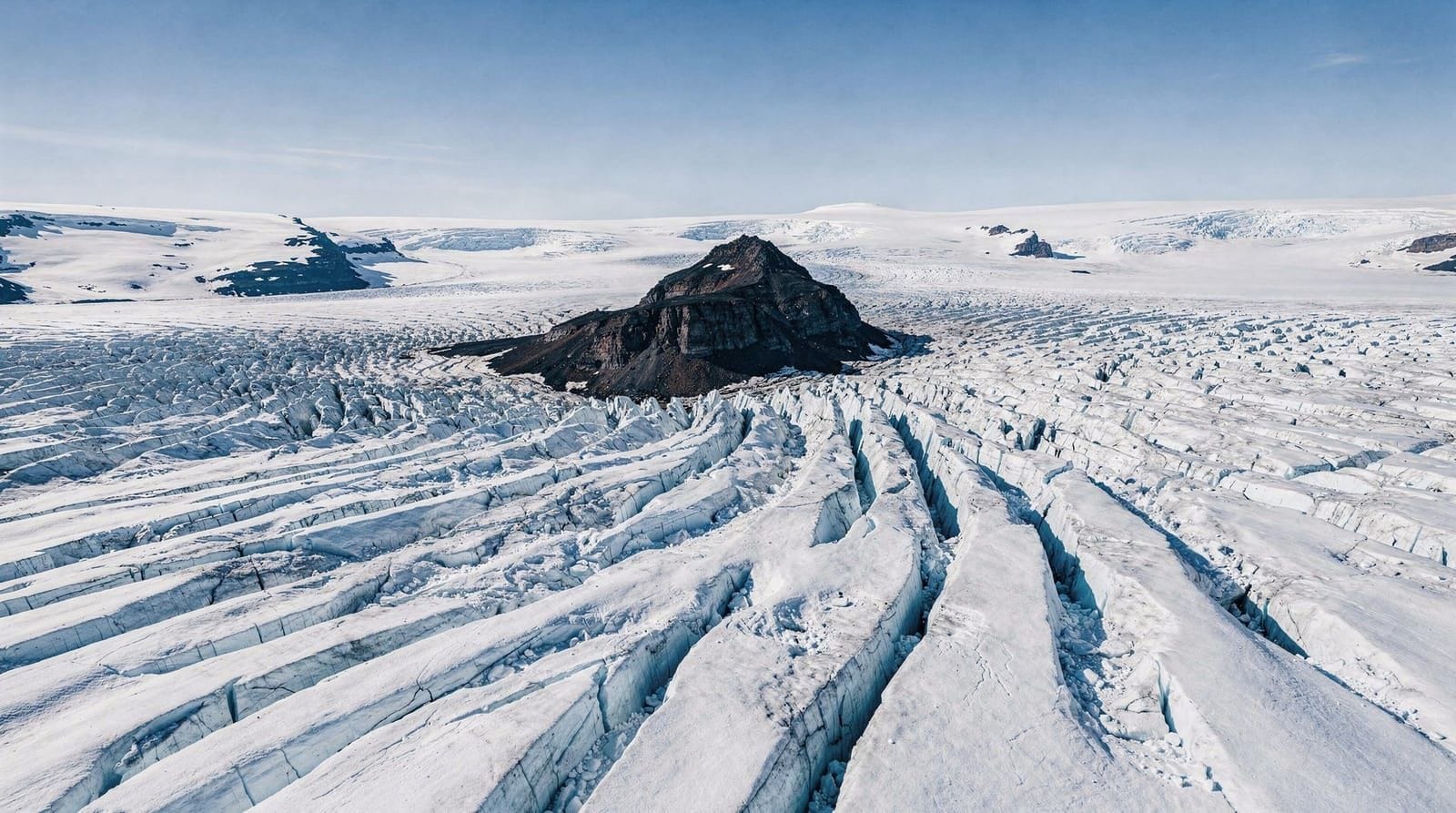
Breiðamerkurjökull, the glacier tongue feeding the lagoon, is part of the Vatnajökull ice cap — Europe’s largest glacier by volume. The icebergs you see in the lagoon calve directly from this glacier; fresh calvings happen throughout the year, sometimes with a thunderous crack audible across the lagoon. The icebergs are predominantly white (air-bubble ice) with streaks of vivid blue where the ice is densest and oldest. Black volcanic ash layers run through many bergs, creating striped patterns.
The lagoon is tidal: it connects to the sea via a short channel, and Atlantic seals often swim up into the lagoon to rest on icebergs or hunt fish in the meltwater. Seeing seals among the icebergs is common from spring through autumn and requires no special tour — they are visible from the shore.
The lagoon’s depth reaches approximately 300 metres in places, and the surface area has roughly quadrupled since 1975 as glacier retreat accelerated. What you are seeing is an actively changing landscape; the lagoon is measurably larger every decade.
Boat tours
The best way to experience the lagoon — as opposed to merely viewing it from the shore — is on one of the amphibious boat tours or Zodiac inflatable tours that operate from the lagoon’s north shore.
Amphibious boat tours are run by Glacier Lagoon (formerly Icelandic Mountain Guides) and depart from the car park several times daily in season (May to October). The boats are large open-topped amphibians that carry 40–50 passengers. Duration is approximately 45–60 minutes. Cost is approximately 6,500–8,000 ISK (€42–52) per adult. The guides narrate the geology and provide small chips of ice to taste. The experience is good but can feel rushed at peak capacity; you circle the accessible part of the lagoon rather than navigating among all the icebergs.
Zodiac boat tours offer a more intimate experience in smaller inflatable boats (8–10 passengers), with the ability to manoeuvre closer to iceberg formations. Costs are higher — around 10,000–14,000 ISK (€65–92) — but the access to smaller channels and less-trafficked areas of the lagoon is worth it for those specifically interested in photography or glaciology.
Both tour types are booked on-site (cash or card) or in advance online. In peak season (July–August), advance booking is strongly advised — the amphibious tours fill by late morning on clear days.
Jökulsárlón glacier lagoon amphibious boat tour — departs from the lagoon car park multiple times dailyThe lagoon is five hours from Reykjavík, which makes the day a driving day unless something is added: a south coast trip combining Jökulsárlón with a glacier hike and a boat puts three distinct things in the same distance.
Ice caves (winter tours)
Between October and April, guided ice cave tours operate from the Jökulsárlón area into the Vatnajökull glacier. These tours drive by super-jeep onto the glacier, then descend into natural ice caves formed within the glacier itself.
The ice inside these caves has the deep cyan-blue colour characteristic of old, dense glacial ice from which all air bubbles have been compressed out. The effect is extraordinary — genuinely unlike any other experience Iceland offers. The caves are dynamic: they form, shift, and close as meltwater flows and the glacier moves, so no two winters offer exactly the same access points.
Tours typically run 3–4 hours from the lagoon car park or from a meeting point in Höfn (the nearest town, 80 km east). Costs range from 20,000 to 28,000 ISK (€130–185) per person. The season is typically October through March, with March often the most reliable for clear blue ice (the caves are most stable later in winter when melt pressure is lower).
Book ice cave tours several weeks in advance in December and January — they are heavily subscribed by visitors combining Jökulsárlón with Northern Lights hunting on the same trip.
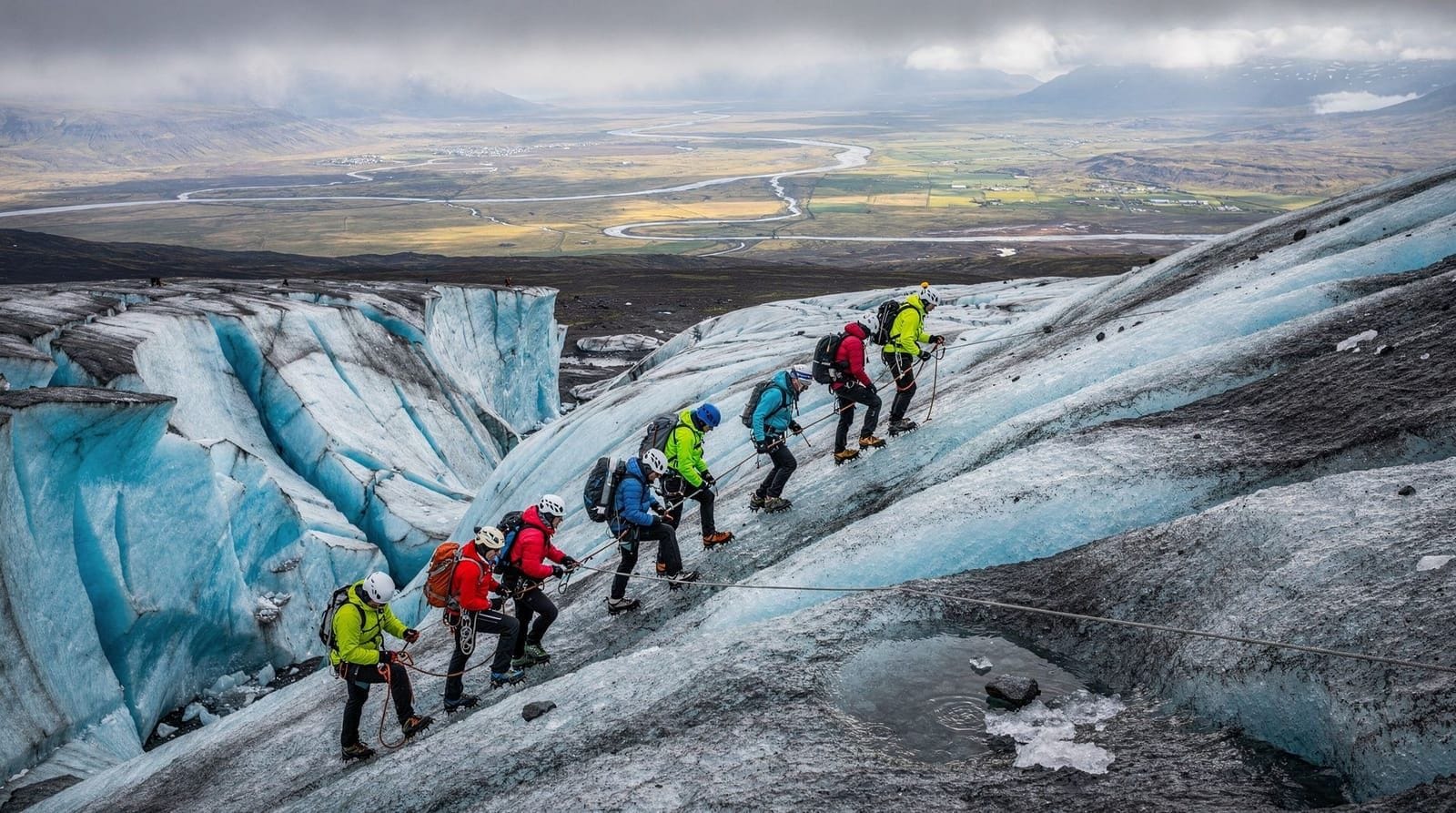
Vatnajökull blue ice cave guided tour — super-jeep access, small group, year’s best cyan-blue iceDiamond Beach
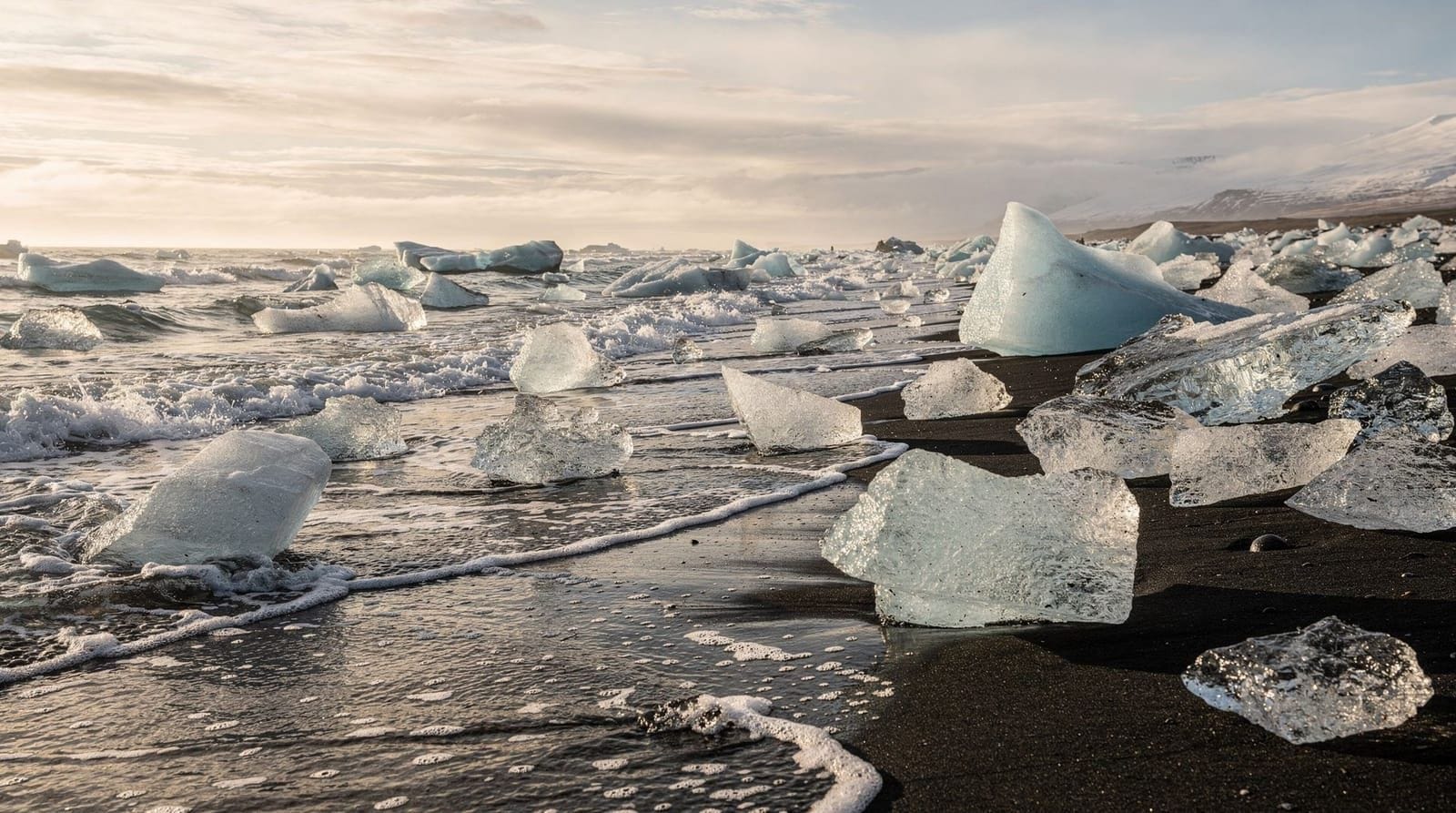
Immediately across Route 1 from the lagoon entrance, Diamond Beach is where icebergs washed back from the lagoon through the tidal channel strand on the black sand shore. The combination — pure white and blue ice on jet-black volcanic sand — creates a natural graphic of unusual beauty.
Diamond Beach is technically a separate destination but is visited in conjunction with the lagoon on every itinerary. Allow at least 30 minutes after the lagoon visit to walk the beach. The ice pieces change with every tide cycle; some visits yield small fragments, others produce bergs the size of refrigerators. Seals occasionally haul out on the larger pieces.
See the Diamond Beach destination page for detailed access notes.
Getting to Jökulsárlón
By car: Route 1 east from Reykjavík, approximately 375 km. The drive passes Seljalandsfoss, Skógafoss, Vík, Skaftafell, and the Fjaðrárgljúfur canyon — all worthwhile stops that add time. A direct drive without stops takes 4h 45min; with the standard South Coast stops, budget 7–8 hours one-way.
Guided tour (multi-day): Jökulsárlón features on 2-day and multi-day South Coast tours from Reykjavík. These tours typically overnight in Vík or in accommodation near Jökulsárlón itself. They are the most practical option if you do not want to drive.
South Coast, Diamond Beach and Jökulsárlón 2-day tour from Reykjavík — includes glacier lagoon boat rideDay trip from Reykjavík: Technically possible if you depart by 4–5am and return by midnight. The light at the lagoon in evening summer is exceptional; this timing is not unreasonable in June or July. In winter, the short daylight window (8am–4pm) makes the arithmetic more difficult.
The science of the lagoon: retreat and future
Breiðamerkurjökull in 1900 reached the sea and extended several kilometres beyond where the lagoon now sits. By the 1930s, retreat had begun and the first small body of meltwater appeared. Today the lagoon is approximately 25 km² and growing at a measurably accelerating rate.
Climate models suggest the lagoon will continue to expand for several more decades as glacier retreat accelerates. The scenario in which Breiðamerkurjökull eventually retreats entirely and the lagoon connects to the sea as a broad fjord is within the range of long-term projections — this would likely happen within one to three centuries at current rates. What is certain is that the lagoon of 2050 will be noticeably larger than the lagoon of today.
This is worth knowing not to alarm you but because it adds genuine context to what you are looking at. The floating icebergs, the calving glacier, the vivid blue ice — these are not static museum pieces. They are a landscape in active transition, and the impermanence adds a layer of significance that a purely geological description misses.
Overnight options at and near Jökulsárlón
For visitors wanting to spend more than an afternoon at the lagoon — or wanting to photograph the Northern Lights reflecting in the ice in winter — overnight accommodation in the area is worth planning.
Fosshotel Glacier Lagoon (approximately 3 km west of the lagoon): The most luxurious option in the immediate area. Modern, comfortable, with a restaurant serving local ingredients. High season doubles: 50,000–70,000 ISK (€325–455). Book months ahead for summer.
Jökulsárlón Guesthouse: Simpler rooms at roughly 25,000–35,000 ISK (€162–230) in high season. Adequate for those whose priority is access rather than comfort.
Smyrlabjörg Guesthouse (~15 km west): Farm guesthouse with basic but comfortable rooms, often more affordable than options closer to the lagoon.
Höfn (80 km east): The nearest proper town with a range of accommodation from guesthouses to the Hótel Edda (summer-only). Höfn is worth the detour for the langoustine — the local fishing harbour produces outstanding langoustine (humar) available in the town’s restaurants for 3,500–5,500 ISK (€23–36) for a soup or 5,000–8,000 ISK (€33–52) for a main.
The Jökulsá á Breiðamerkursandi river
The river connecting the lagoon to the sea is not just a drainage channel — it is an active tidal zone where fresh glacial meltwater mixes with Atlantic salt water. The seal population uses this zone extensively, moving between the open sea (for fishing) and the lagoon (for resting). The bridge on Route 1 over this river channel is one of the best spots for watching seals at close range; they frequently haul out on ice pieces or swim under the bridge in both directions.
The current in the channel can be strong during outgoing tides. The amphibious boat tours carefully manage their exit timing when exploring near the channel mouth. If you are watching from the bridge, allow extra time — seal activity is most concentrated at low tide when the fish are more accessible in the shallower channel.
What’s nearby and the wider Vatnajökull area
The area around Jökulsárlón anchors the eastern South Coast. Within 30 minutes west: Skaftafell with its glacier hikes. Within 10 minutes east: Diamond Beach. Within 80 km east: Höfn, a fishing town with excellent langoustine (humarsúpa — langoustine soup is the local speciality, around 2,500–3,500 ISK / €16–23).
The full Vatnajökull National Park surrounds the entire area; Jökulsárlón is the most accessible entry point. The park’s visitor centre at Skaftafell is better equipped for those wanting to understand the broader landscape.
Photography at Jökulsárlón
The lagoon faces north and is best photographed in the morning when the low sun comes from the east and illuminates the blue faces of icebergs. Sunset (in the north-west in summer) can produce extraordinary amber light on the ice if clouds are present. Overcast conditions actually work well because the diffuse light brings out the internal blue of the ice rather than creating harsh reflections.
From the south shore (the car park side), you are shooting northward toward the glacier — the icebergs are between you and the glacier face, which provides context. From the east bank of the outlet channel, you can shoot back toward the lagoon with the sea and Diamond Beach behind you.
Polarising filters help with reflections on the lagoon surface. A wide-angle lens captures the breadth of the scene; a medium telephoto (100–200mm) isolates individual icebergs. On the boat tours, a zoom lens with image stabilisation (because the boats create vibration) is the most versatile choice.
Boat tour vs ice cave: which to choose
| Amphibious boat | Zodiac boat | Ice cave | |
|---|---|---|---|
| Season | May–October | May–October | October–March |
| Duration | 45–60 min | 45–60 min | 3–4 hours from car park |
| Cost | 6,500–8,000 ISK (€42–52) | 10,000–14,000 ISK (€65–92) | 20,000–28,000 ISK (€130–185) |
| Best for | First-time visitors, families | Photographers, smaller groups | Winter visitors, deep-blue ice |
Practical notes
Car park: Free, large, and clearly marked. There is a paid toilet block at the car park. A small café operates in season with coffee and basic snacks.
Petrol: Fill up at Skaftafell/Kirkjubæjarklaustur before continuing east — the N1 station near the lagoon charges significantly higher prices. Alternatively, fill in Höfn on the way back.
Accommodation near the lagoon: The closest hotel is Fosshotel Glacier Lagoon (~45,000–65,000 ISK / €290–420 per night in high season) — very good but expensive. More affordable options at the Jökulsárlón Guesthouse or in the Kirkjubæjarklaustur area (~20,000–30,000 ISK / €130–195).
Frequently asked questions about Jökulsárlón
How far is Jökulsárlón from Reykjavík?
375 km, a drive of approximately 4h 45min without stops. With the standard South Coast stops (Seljalandsfoss, Skógafoss, Vík, Skaftafell), the journey takes 8–10 hours. Most visitors either stay overnight or join a 2-day guided tour.
Is the boat tour worth it?
For most visitors, yes. The shore view of the lagoon is impressive but the boat tour puts you among the icebergs at water level — a completely different scale experience. The amphibious boats are the most accessible option; Zodiac tours are worth the premium for photographers or smaller groups. Book in advance in summer.
When are the ice caves accessible?
Roughly October to March, with peak stability in January–March. Access depends on glacier conditions each winter — warm spells can close caves briefly. Most operators run tours daily in season weather permitting. Book several weeks ahead in December and January.
Are there seals at Jökulsárlón?
Yes — harbour seals are regularly seen in the lagoon, often resting on ice floes or swimming near shore. They are most active in the morning. No special tour is needed; they can be seen from the main viewing areas on the south shore.
Can I camp near Jökulsárlón?
There is no designated campsite at the lagoon itself. The nearest proper campsite is at Skaftafell (within Vatnajökull National Park, about 60 km west) or in the Kirkjubæjarklaustur area. Wild camping is technically legal on most land in Iceland but discouraged in the national park zone.
Is a 4WD necessary to reach Jökulsárlón?
No. Route 1 to Jökulsárlón is fully paved and accessible to standard 2WD vehicles year-round. Winter driving requires appropriate winter tyres, which all rental cars provide in Iceland’s winter months (typically November–April). A 4WD is only needed if you intend to access the glacier or the ice cave tour pick-up points, which are typically handled by the tour operator’s vehicles.
Can I see the Northern Lights from Jökulsárlón?
Yes — the lagoon is one of the best Northern Lights viewing spots in Iceland due to very low light pollution and the reflective surface of the lagoon. The icebergs reflecting the aurora can create spectacular images. Prime season is September to March; the closer to the equinox the more active the aurora season tends to be.
Top experiences
Bookable activities with verified prices and instant confirmation on GetYourGuide.
Top-rated experiences in Jökulsárlón glacier lagoon — Iceland's crown jewel
Best-rated activities across GetYourGuide and Viator.