F-roads in Iceland: rules, risks, and route planning
Reykjavik: From Reykjavik full day Landmannalaugar super jeep tour
Can I drive F-roads in Iceland with a regular rental car?
No. F-roads legally require a 4x4 (four-wheel drive) vehicle. Driving an F-road in a 2WD car voids your rental insurance entirely. F-roads are also closed from approximately October to mid-June and should only be driven after confirming the opening status on road.is.
Iceland’s F-roads unlock the highland interior — Landmannalaugar’s rhyolite mountains, Þórsmörk’s glacier valley, the Askja caldera — but they are legally and practically unforgiving of underprepared drivers. This guide covers the vehicle requirements, insurance trap, river crossing technique, and the honest question of whether self-driving or a guided super-jeep tour suits your trip better.
| Vehicle required | Genuine 4x4 with high clearance; 2WD is illegal and voids insurance |
| Season | Typically late June to September/October; check road.is, never assume |
| Insurance | Standard rental CDW does NOT cover F-roads — confirm F-road cover in writing |
| Recovery cost if stuck | ISK 500,000–2,000,000+, charged to the renter |
| No-car alternative | Guided super-jeep tours, from around ISK 20,000–40,000/person |
What makes a road an F-road?
Roads prefixed with “F” in Iceland’s road numbering system are highland interior tracks maintained to a different standard than public roads. They are:
- Unpaved (rocks, gravel, earth, lava fields)
- Often without bridges over glacial rivers
- Subject to seasonal closure, typically from October to mid-June
- Only legally accessible by 4x4 vehicles
The “F” stands for fjallvegur (mountain road) in Icelandic. These are not simply gravel roads — they are mountain tracks across Iceland’s interior that see extreme weather, zero services, and no recovery infrastructure beyond what you bring yourself.
The insurance trap
This is the point most travelers miss until it’s too late. Standard rental insurance — including the CDW (Collision Damage Waiver) and any supplemental coverage — does not cover F-roads unless your specific rental contract explicitly includes F-road extension coverage.
If you drive an F-road and your car is damaged:
- Insurance is voided for that incident
- The rental company charges full cost of repairs
- Vehicle recovery from a remote highland location costs ISK 500,000–2,000,000+ (€3,400–13,600) and is charged to the renter
- Police can additionally fine you for driving an inappropriate vehicle on a restricted road
Before booking, ask your rental company specifically: “Does my insurance cover F-roads? Which ones?” Get this in writing. Some companies offer F-road-specific cover for an additional ISK 3,000–7,000/day.
Full insurance breakdown in our car rental insurance guide.
Vehicle requirements
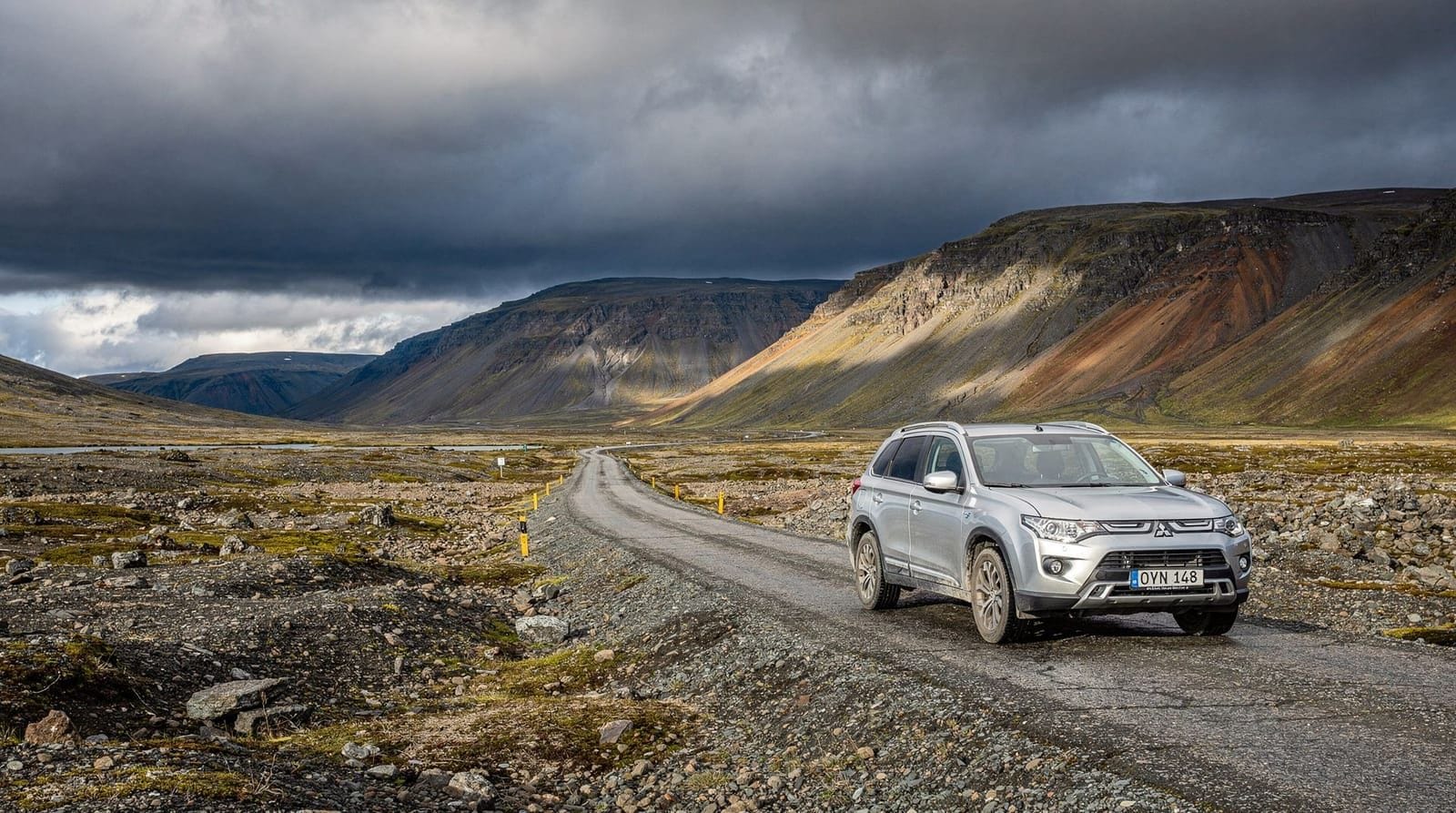
Legal requirement: four-wheel drive (4x4). Not all-wheel drive (AWD) in the marketing sense — genuine high-clearance 4x4 with a proper transfer case. The vehicles commonly used:
- Toyota Land Cruiser (most common in Iceland)
- Toyota Hilux / Tacoma
- Ford Ranger
- Mitsubishi Pajero / L200
- Suzuki Jimny (capable on many F-roads but limited passenger/luggage capacity)
- Purpose-built super jeeps with 38–44-inch tyres (rental only, very expensive)
Most standard SUVs from major rental companies (Duster, RAV4, CR-V) are 4x4 capable but have limited ground clearance. They are technically legal on many F-roads but will bottom out on severe terrain and river beds. Consult your rental company about which F-roads your specific vehicle is cleared for.
Opening dates and current status
F-roads typically open in the following order:
- Late June: Main highland routes (F26, F35 Kaldidalur sometimes earlier)
- Early July: F206 to Landmannalaugar, F210 to Þórsmörk
- Mid-July: F88 to Askja, F910 Sprengisandur if conditions allow
- September–October: Closures begin, reversing in roughly the same order
These dates vary significantly year to year depending on snowpack. 2024 saw some routes not opening until late July. Always verify at vegagerdin.is (the road administration) rather than relying on travel blog dates.
Road.is shows current status with colour coding; any F-road shown as red or purple is closed — do not enter.
Key F-road routes
F35 — Kaldadalur (West Iceland)
Length: ~65 km. Difficulty: Moderate. One of the easier F-roads, no major river crossings, connects Route 1 near Þingvellir to Borgarnes area. Sometimes opens in May. Good for testing F-road driving before the Highland interior.
F206 — Landmannalaugar (South Highlands)
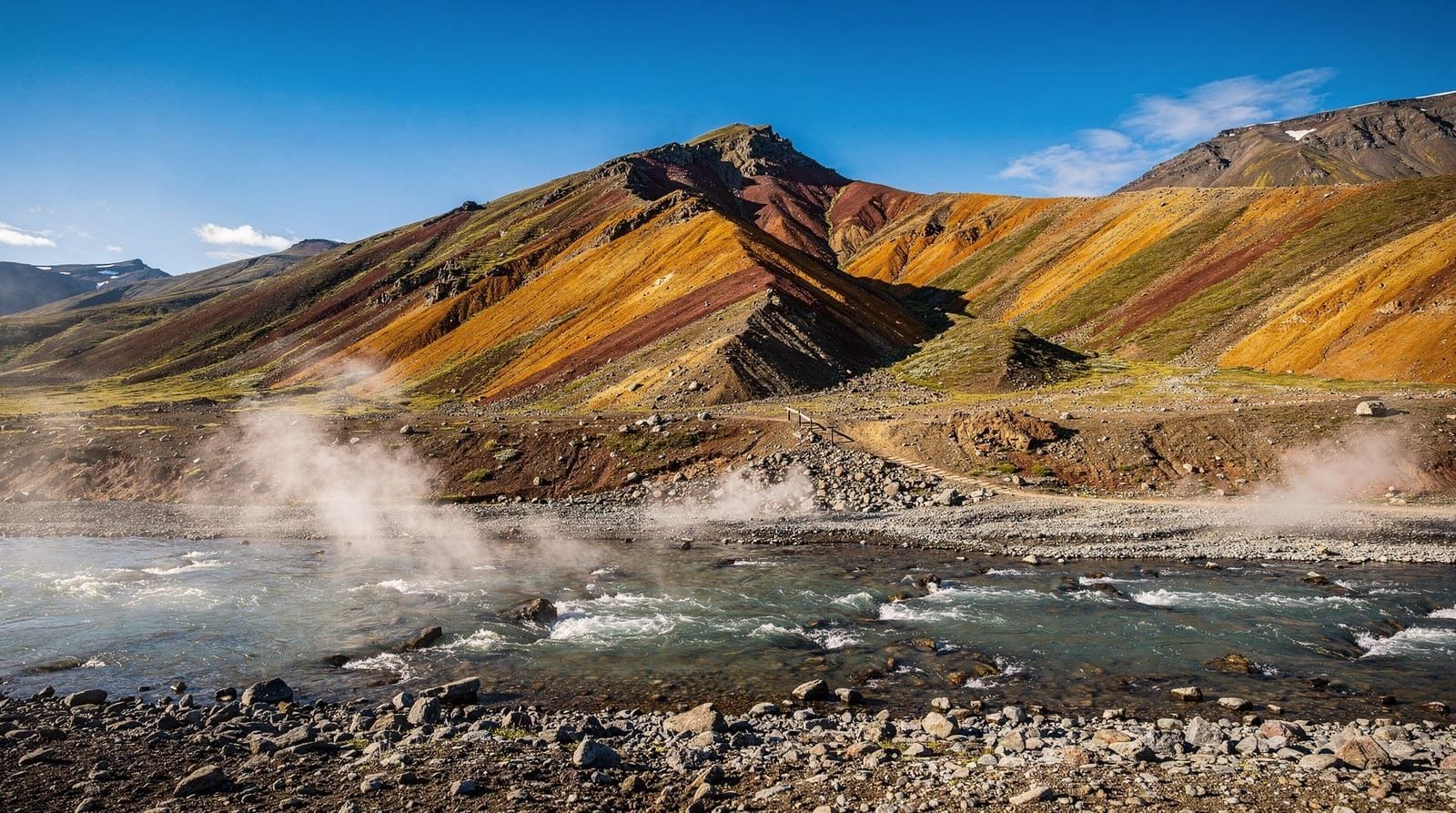
Length: ~50 km from Route 26. Difficulty: Moderate. Multiple river crossings including Jökulgil (typically knee-deep, 20–40 cm). Leads to the Landmannalaugar hiking area — geothermal pools, coloured rhyolite mountains, and the northern end of the Laugavegur Trek. One of the most visited F-roads. Expect queues at river crossings in peak season.
F210 — Þórsmörk (South Iceland)
Length: ~30 km from Route 1. Difficulty: Moderate to hard. River crossings can be thigh-deep depending on glacial melt. Leads to Þórsmörk — one of Iceland’s most spectacular valley systems. The Krossá river crossing near Þórsmörk is frequently the most problematic; super-jeep transfers are available from Básar hut if you are not confident.
F26 — Sprengisandur (Central Highlands)
Length: ~220 km. Difficulty: Hard. The longest highland route crosses the interior desert between Þórsmörk and Akureyri. Multiple significant river crossings, no services, and extreme exposure. Only for experienced F-road drivers with full equipment. Typically open July–August only.
F88 — Askja (Northeast Highlands)
Length: ~60 km from Route 1. Difficulty: Moderate to hard. Leads to Askja caldera and the Viti crater lake. The Lindá river crossing is mandatory and often the deepest crossing on this route. See our Askja guide.
F550 — Kerlingarfjöll (Central Highlands)
Length: ~35 km from Route 35. Difficulty: Moderate. Leads to Kerlingarfjöll mountain resort — geothermal area with hiking and accommodation. The river crossings here have improved since the resort invested in access infrastructure. See combined Askja and Kerlingarfjöll guide.
Signal and navigation on F-roads
Most F-roads run through the highland interior, where mobile signal disappears almost entirely. Do not rely on live navigation apps once you leave the paved network — download offline maps before you set out and carry a physical map (the Mál og Menning Iceland road atlas is the standard choice) as a backup. GPS itself works independently of mobile data, but the base map data for turn-by-turn apps typically needs a live connection unless pre-downloaded.
This is also why a satellite communicator (Garmin inReach or SPOT) is worth the rental cost for any serious F-road route — it works entirely outside the mobile network and lets you send an SOS or check-in message from anywhere.
River crossing technique
River crossings on F-roads are the primary cause of serious damage and insurance claims. Before attempting any river:
-
Walk the crossing first. Exit the vehicle, use a hiking pole or stick, and probe depth and current strength. If water exceeds your knee mid-river, it is likely too deep for most standard 4x4s.
-
Check the depth against your vehicle’s wading capacity. Most mid-size 4x4s have wading depths of 50–60 cm. A full-size Land Cruiser: 70 cm. Super jeeps: 100+ cm.
-
Choose a wide, shallow section. Avoid bends where current concentrates on the outside. Straight sections with braided channels are usually shallower than single-channel bends.
-
Cross at low speed, maintaining steady revs. Do not stop mid-crossing. Drive in low-range 4x4 if available. Keep engine revs up to prevent water entering the exhaust.
-
Cross alone, not in convoy. Vehicles crossing behind disturb the riverbed and can deepen the approach.
-
Cross early in the day. Glacial rivers peak in the afternoon when solar radiation maximises melt. Morning crossings are typically 10–30 cm shallower.
If in doubt: wait for a super-jeep tour or other large vehicle to cross first and watch the depth. Many operators also offer F-road river crossing transfers.
What to bring on F-roads
Minimum equipment for any F-road drive:
- Full tank of fuel plus a 10L jerry can — no petrol stations in the Highlands
- Tyre repair kit and compressor pump
- Tow rope and recovery points (most rental 4x4s have factory points)
- Shovel — for sand, volcanic ash, or getting unstuck
- Physical map (Mál og Menning Iceland road atlas) — GPS fails in some highland areas
- Emergency food and water for 3 days per person
- Warm clothing and sleeping bag even in July — highlands temperature drops to 0°C at night
- First aid kit
- Satellite communicator (Garmin inReach or SPOT) for areas without mobile signal
Planning an F-road trip: practical steps
If you decide to drive F-roads, preparation needs to cover four areas: vehicle, insurance, route, and emergency planning.
Vehicle pre-trip checks:
- Tyre condition and pressure (F-roads are hard on tyres; check pressure cold before departure)
- Spare tyre condition (some campervans and SUVs have undersized spare tyres — check if it will actually work for F-road driving)
- Engine oil level and coolant
- Battery (older rental cars that have been sitting in cold overnight can have marginal battery charge)
Most rental companies do a walk-around check at collection but not a mechanical inspection. If you notice anything unusual, flag it before driving off — not after you’ve broken down in the Highlands.
Route-specific research: Before setting out on any F-road:
- Check road.is for the specific F-road number — not just Route 1 status
- Read the travel notes section for reports of river level changes or track damage
- Search Safetravel.is forums or recent trip reports for the specific route (search “F88 conditions June 2026” type queries)
- Ask your rental company which F-roads your specific vehicle is cleared for and insured on
Timing your departure: Leave early in the morning (07:00–08:00) for two reasons: river crossings are shallowest in the morning before solar radiation increases glacial melt, and if anything goes wrong you have maximum daylight to resolve it.
Convoy planning: Never drive a challenging F-road alone, particularly on first experience. Travel with at least one other vehicle, ideally experienced F-road drivers. This is standard practice among Icelanders and safety-conscious visitors. Shared tow rope, shared spare tyre decisions, and shared river crossing assessment make the difference in serious situations.
Super-jeep tours as the safer alternative
If you want the Highland F-road experience without the vehicle and insurance complexity, super-jeep tours are a legitimate option. Operators in Reykjavik and Akureyri offer F-road day trips to Landmannalaugar, Þórsmörk, Askja, and the Kerlingarfjöll area.
The vehicles — custom-built Land Cruisers and modified trucks with tyres 38–44 inches in diameter — cross rivers that no standard rental 4x4 can safely attempt. The drivers know every route variation, current river levels, and local conditions in real time.
Cost is approximately ISK 20,000–40,000 per person for a day trip. This is substantially more per capita than self-driving, but if you factor in the F-road vehicle rental upgrade and F-road insurance surcharge, the gap narrows. See our super-jeep tours guide.
Full-day Landmannalaugar super-jeep tour from ReykjavíkSelf-drive vs super-jeep: the real cost comparison
| Self-drive 4x4 | Guided super-jeep tour | |
|---|---|---|
| Upfront cost | 4x4 rental + F-road insurance surcharge (ISK 3,000–7,000/day extra) | ISK 20,000–40,000 per person, all-inclusive |
| Skill required | River crossing judgement, navigation, recovery basics | None — driver handles everything |
| Flexibility | Full control of timing and stops | Fixed itinerary and schedule |
| Risk exposure | Damage/recovery costs fall entirely on you if things go wrong | Operator bears vehicle risk |
| Best for | Confident, experienced drivers touring multiple F-roads | First-time highland visitors, solo travellers, tight schedules |
F-roads and highland hiking access
Many of Iceland’s best highland hiking areas are only accessible via F-roads:
Landmannalaugar (F206): The starting point of the Laugavegur Trek and access to the rhyolite mountains of the Central Highlands. Accessible by F-road or seasonal bus from Reykjavik. Camping and hut accommodation at the site.
Þórsmörk (F210): End point of the Laugavegur Trek and start of the Fimmvörðuháls trail to Skógafoss. Extremely dramatic valley system. Accessible by F-road or Strætó/Reykjavik Excursions buses in summer.
Kerlingarfjöll (F550/F35): Highland resort with geothermal hiking and overnight accommodation. More accessible than Askja — a good first F-road destination.
Askja caldera (F88): Remote, dramatic, and genuinely challenging. The Viti explosion crater and Askja lake are like nothing else in Iceland. Requires experience with river crossings. See Askja guide.
F-roads and campervan restrictions
Most campervan rental contracts prohibit F-road driving even if the campervan is a 4x4. The reasons are structural, not just bureaucratic:
- A campervan’s high centre of gravity makes it unstable in river crossings at any significant depth
- Campervan plumbing and water systems can be damaged by suspension impacts on rough F-road terrain
- Recovery of a broken-down campervan in the highlands is extremely expensive and difficult
- Campervan contracts typically specify road types because operators want to avoid high-cost recovery situations
If Highland access is important to your trip, rent a 4x4 car for the highlands segment (one-way rental is possible between Reykjavik and Akureyri for example) and plan campervan travel on Route 1 only.
F-roads and the environment
Iceland’s F-road access has created real conservation challenges. Visitor numbers on Landmannalaugar and Þórsmörk F-roads have increased 300–500% since 2010, and the impact on the surrounding highland ecosystem is visible:
Tyre tracks on vegetation: Iceland’s highland vegetation is exceptionally slow-growing — lichens and mosses that take 200+ years to reach a few centimetres in diameter. A single tyre track off an F-road track can leave visible damage for decades. The rule is absolute: do not drive off the marked track surface, ever.
River bank erosion: High-axle 4x4 traffic at river crossings causes bank erosion that widens and destabilises river channels. This is why vehicles should always use the same established crossing point rather than finding their own approach angle.
Waste management: No facilities exist on most F-roads. Pack out everything. This applies to human waste as well — use the Leave No Trace cathole method (minimum 60 m from any water, 15 cm deep) in highland areas without toilet facilities.
Iceland’s Environment Agency (Umhverfisstofnun) has been considering access restrictions on the most-damaged F-road approaches. Check their website (ust.is) for any access changes before planning highland routes.
Timing F-road visits for lower impact
Early season: The first 2–3 weeks after F-road opening (typically late June/early July) see the lowest traffic. Most visitor arrivals cluster in July–August.
Weekdays vs weekends: Iceland’s F-roads are busiest on Saturday and Sunday when Reykjavik families and weekend hikers combine with international visitors. Mid-week has noticeably lighter traffic at river crossings.
Early morning: Departing from your Ring Road campsite at 06:00–07:00 for a Landmannalaugar or Þórsmörk visit means arriving at river crossings before the peak heat and traffic of afternoon. The dual benefit of shallower rivers and fewer vehicles makes early morning the optimal window.
What to do if you meet another vehicle at a river crossing
F-road river crossings are the most stressful social interactions in Iceland driving. The etiquette:
- The first vehicle to arrive at the crossing has priority to cross
- If two vehicles arrive simultaneously, the lighter (more vulnerable) vehicle crosses first — a standard car should cross before a larger Land Cruiser, which can handle more depth
- Wait on the bank until the crossing vehicle is fully clear — do not enter while another vehicle is mid-crossing
- If a large super-jeep tour is waiting, let them go first and observe the crossing depth and approach
In practice, Icelandic drivers and experienced foreign visitors are usually patient at crossings. Problems arise when impatient drivers enter before the previous vehicle clears.
Frequently asked questions about F-roads
When do F-roads open in 2026?
F-road opening dates for 2026 will be published on vegagerdin.is typically in May–June. Historical average: most main routes open late June to early July. Check road.is for specific current status rather than relying on predicted dates.
Can I drive an F-road in a hired AWD/SUV?
Check your rental contract. Many AWD/SUVs marketed for “active terrain” are not cleared for F-roads by the rental company and are not covered by insurance on F-roads. The vehicle capability matters, but so does the rental contract. Ask specifically.
Are F-roads marked on Google Maps?
Yes, but Google Maps does not indicate opening status or current conditions. Always cross-check on road.is. GPS navigation on F-roads can also be unreliable — maintain a physical map.
Can I hike to Landmannalaugar instead of driving?
Yes. A bus service (Reykjavik Excursions) runs to Landmannalaugar from Reykjavik, typically mid-June to mid-September. This is a valid option if you want to access the hiking without the driving. The Laugavegur Trek can be hiked one-way from Landmannalaugar to Þórsmörk with bus access at both ends.
What happens if I get stuck on an F-road?
Call 112 in Iceland. If you registered a travel plan on safetravel.is, rescuers will know where to look. Vehicle recovery from highland F-roads is expensive and slow — nearest rescue teams may be 2–4 hours away. This is why a satellite communicator is strongly recommended for remote F-road drives.
What is the penalty for driving a 2WD car on an F-road?
No specific criminal fine applies in most cases, though police can issue fines for inappropriate vehicles on restricted roads. The real penalty is financial: any damage to the vehicle is entirely the renter’s responsibility (insurance voided), and vehicle recovery from the Highlands costs ISK 500,000–2,000,000+. The rental company can also charge for the full replacement value of a severely damaged vehicle. These costs are real and documented in rental dispute cases in Iceland.
Are motorcycles allowed on F-roads?
Not legally. F-road restrictions apply to all vehicles — a 4x4 requirement means motorcycles, which are not 4-wheel-drive, are prohibited. Some adventure motorcyclists attempt F-roads anyway but this voids travel insurance for any incident.
Is a guided super-jeep tour a good alternative if I don’t want to self-drive?
Yes, and for many first-time highland visitors it is the better option. Operators use purpose-built vehicles that handle river crossings no standard rental 4x4 can safely attempt, and the driver carries local, current knowledge of conditions. It costs more per person than self-driving but removes the insurance and recovery risk entirely.
Which F-road is the best first experience for a nervous driver?
F35 (Kaldadalur) is the gentlest introduction — no major river crossings and a well-maintained gravel surface connecting Þingvellir to the Borgarnes area. F550 to Kerlingarfjöll is a reasonable second step, with river crossings that have improved thanks to resort investment in access infrastructure.
Top experiences
Best-rated activities across GetYourGuide and Viator.

From Reykjavik: Snaefellsness Peninsula small group day tour
- Viator

Lake Myvatn Day Tour and Godafoss Waterfall for Cruise Ships from Akureyri Port
- Viator

Private Jökulsárlón Glacier Lagoon 2 Day Tour & Glacier Hike
- Viator

From Reykjavik: Katla Ice Cave and South Coast Day Tour
- Viator

Reykjanes Peninsula Private Day Tour - up to 9 passengers
- Viator

Thorsmork Hike Day Tour
- Viator