Driving in Iceland: road rules, hazards, and practical tips
What do I need to know before driving in Iceland?
Drive on the right. Maximum 90 km/h on paved roads, 80 km/h on gravel, 50 km/h in towns. Headlights are mandatory at all times. Seatbelts are compulsory for all seats. F-roads require a 4x4 and are closed October–June. Check road.is every morning before driving.
Iceland’s roads are not technically hard to drive — they’re well-signed and English is universal — but the specific hazards (gravel, single-lane bridges, wind, F-roads) are unlike what most visitors are used to. This guide covers the rules and hazards that actually cause problems, not the generic advice you’ll find everywhere else.
| Speed, paved rural roads | 90 km/h |
| Speed, gravel roads | 80 km/h |
| Headlights | Mandatory at all times, all seasons |
| F-roads | 4x4 legally required, closed Oct–June |
| Check before driving | road.is every morning |
Traffic rules that differ from home
Iceland drives on the right with left-hand drive cars — standard for most visitors from continental Europe and North America. UK and Irish drivers need a day or two to adjust, particularly at junctions and roundabouts.
Speed limits:
- Urban areas: 30–50 km/h (variable, watch signs)
- Paved rural roads: 90 km/h
- Unpaved/gravel roads: 80 km/h
- Residential areas: typically 30 km/h
These are enforced. Fixed speed cameras operate on Route 1, and mobile cameras move frequently. Fines start at ISK 20,000 (€135) for modest speeding and escalate steeply. Rental companies pass all fines directly to renters; there is no way to contest a camera fine as a foreign visitor.
Always on:
- Headlights must be on at all times regardless of daylight, including the midnight sun period
- Seatbelts are compulsory for all passengers including rear seats
- Mobile phone use while driving requires hands-free — this is actively enforced
Right of way at unmarked junctions: Vehicles approaching from the right have priority. This catches drivers used to rule-of-road systems from the left.
Single-lane bridges and passing places
Single-lane bridges (einbreiðar brýr) are common on Route 1, particularly on the South Coast and Eastfjords. The rules:
- Slow down on approach
- The vehicle that arrives first or is closer to the bridge has priority; yield to oncoming traffic if they are already committed
- Do not attempt to pass on the bridge — wait for the other vehicle to clear
- Tour buses require the full width; give them priority
Single-lane mountain roads have passing places (hvíluvegur) marked on the roadside. If you meet an oncoming vehicle, the one nearest a passing place reverses to it.
River crossings and F-roads
What are F-roads?
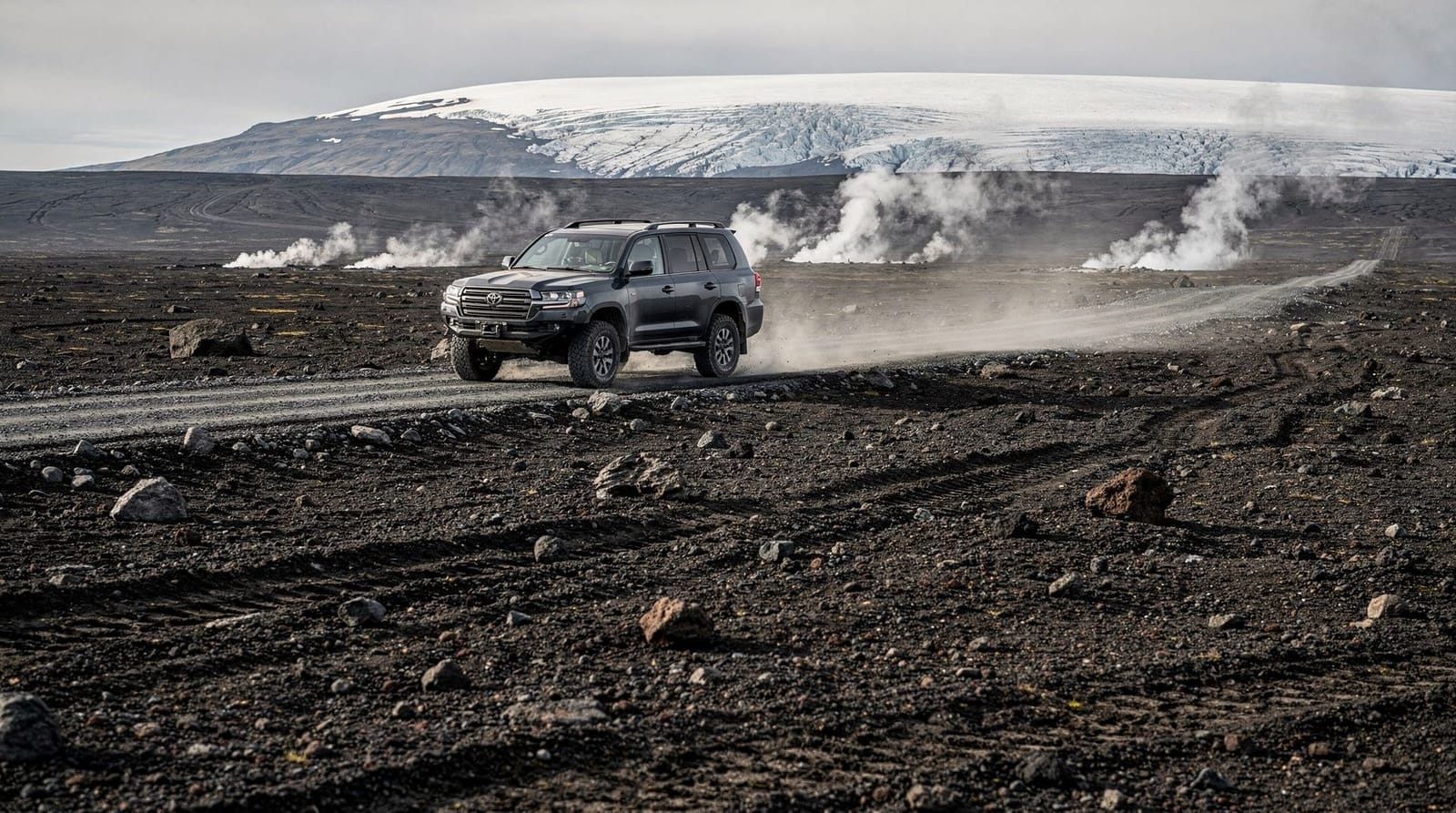
F-roads are highland interior tracks that are only passable from approximately late June to mid-September. They are unpaved, often steep, and may include river crossings (fords). A 4x4 is legally required. Driving a 2WD car on an F-road voids your rental insurance completely and can result in a vehicle recovery bill of ISK 500,000–2,000,000 (€3,400–13,600).
GPS can show F-road routes as navigable when they are physically dangerous or legally closed. Always cross-check with road.is and use the specific F-road opening dates published by Vegagerðin.
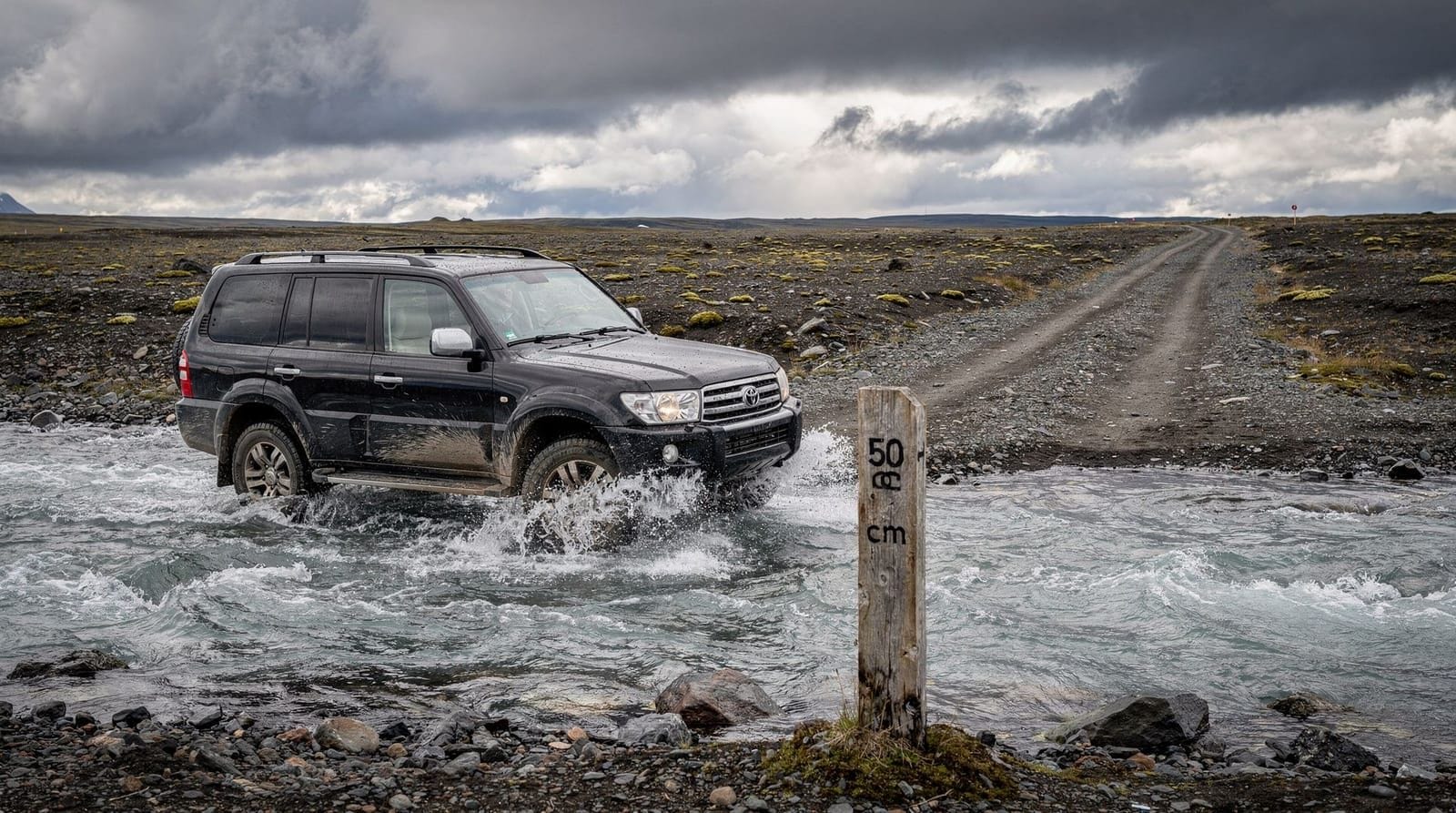
River crossings:
Some F-roads cross glacial rivers with no bridge. Before entering any river:
- Get out and walk the crossing first to check depth and current
- Cross slowly, maintaining steady engine speed — do not stop mid-crossing
- Water must not reach above the car’s recommended wading depth (typically 50–60 cm for a purpose-built 4x4)
- Never attempt a crossing alone; wait for other vehicles if possible
Water damage from river crossings is universally excluded from rental insurance. Details and F-road specifics are in our F-roads guide.
Weather-related hazards
Iceland’s weather changes faster than any forecast predicts. The four main driving hazards:
Wind:
Gusts above 30 m/s (108 km/h) can physically move cars, especially high-sided vehicles like SUVs and campervans. Wind speed alerts appear on road.is with colour coding. The most affected areas are Mýrdalssandur and Skeiðarársandur (South Coast outwash plains) and exposed ridge roads in the Westfjords and highlands. The Icelandic Met Office (vedur.is) gives hourly wind forecasts per location.
Sand and ash:
Sandstorms near Reynisfjara, the black sand plains near Vík, and volcanic ash fallout from Grímsvötn and Katla can reduce visibility to near zero and damage car paintwork and glass within minutes. If a sandstorm is approaching, stop facing the wind (not broadside to it), and park in a sheltered spot. Sand damage is not covered by standard CDW — see our insurance guide.
Ice and snow:
Black ice (hálka) forms without visible warning, particularly on bridges, road dips, and shaded sections. Studded tyres (mandatory on all Iceland rentals from November 1 to April 15) provide grip, not immunity. Drive at 60–70 km/h on potentially icy paved roads. Yellow or orange road condition icons on road.is indicate slippery surface warnings.
Fog:
Highland and Westfjords roads can zero out in fog within minutes. Slow to 40–50 km/h and use dipped headlights. The hazard lights (blikkar) rule: use hazard lights if you have stopped on a road, not as a substitute for slowing down in poor visibility.
One-way tunnels
Iceland has several single-lane (or one-direction) road tunnels with passing places:
- Hvalfjörður Tunnel: 5.7 km toll tunnel under the fjord north of Reykjavik (ISK 1,500–2,400 toll depending on vehicle type, paid by card at the toll booth)
- Fáskrúðsfjörður / Reyðarfjörður tunnels (East Iceland): Free, with passing bays inside
- Siglufjörður tunnel: Free two-lane but important for northern loop
Passing protocol inside tunnels: pull into a passing bay if oncoming traffic approaches; the bay closest to the oncoming vehicle yields.
Parking and protected areas
Parking in Iceland carries real restrictions. Do not park:
- On vegetation, moss, or lichen — these grow at 1–2 mm per year and take centuries to recover
- Beside black sand beaches without using designated lots (erosion issue, also fine-able)
- At “closed” barriers at natural sites — these are for access management, not photo ops
- On road edges where you block passing places
The 2024–2026 Reykjanes volcanic events added exclusion zones around Grindavík and Svartsengi — these are enforced by police and cannot be entered without permits.
What to do if you get stuck or break down
- Call 112 for genuine emergencies (medical, vehicle off road in remote area)
- Call your rental company for mechanical breakdown — they have roadside assistance numbers on the rental agreement
- Register your travel plan at safetravel.is before remote driving — rescuers check this
- Stay with your vehicle — it is far more visible from search aircraft than a person on foot
Pull onto gravel verges, not grass, if you need to stop. Turn on hazard lights if you are stopped on or near the carriageway.
Getting from Keflavik Airport
Most self-drive trips start with picking up a car at Keflavik Airport or in central Reykjavik. The airport is 50 km from Reykjavik city centre via Route 41 and Route 1. The drive is straightforward (no tolls, well-signed). Full logistics in our Keflavik Airport transfer guide.
The Reykjanes Peninsula and eruption zones
Since 2021, the Reykjanes Peninsula has had recurring volcanic eruptions in the Fagradalsfjall and Sundhnúkagígar systems. The area around Grindavík has been repeatedly evacuated and is subject to ongoing access restrictions.
Current situation (2026): Check safetravel.is and the Almannavarnir (Civil Protection) website for current exclusion zones before driving to the Reykjanes Peninsula. The Blue Lagoon and Keflavik area remain open, but some coastal roads and Grindavík access may be restricted. Exclusion zones can expand within hours when eruption activity increases.
Do not attempt to drive to active eruption viewing areas without checking current permitted zones. Roads in exclusion areas are blocked and fines apply.
What Icelanders actually drive and why it matters
Understanding local driving culture helps you interpret Icelandic driver behaviour on the road.
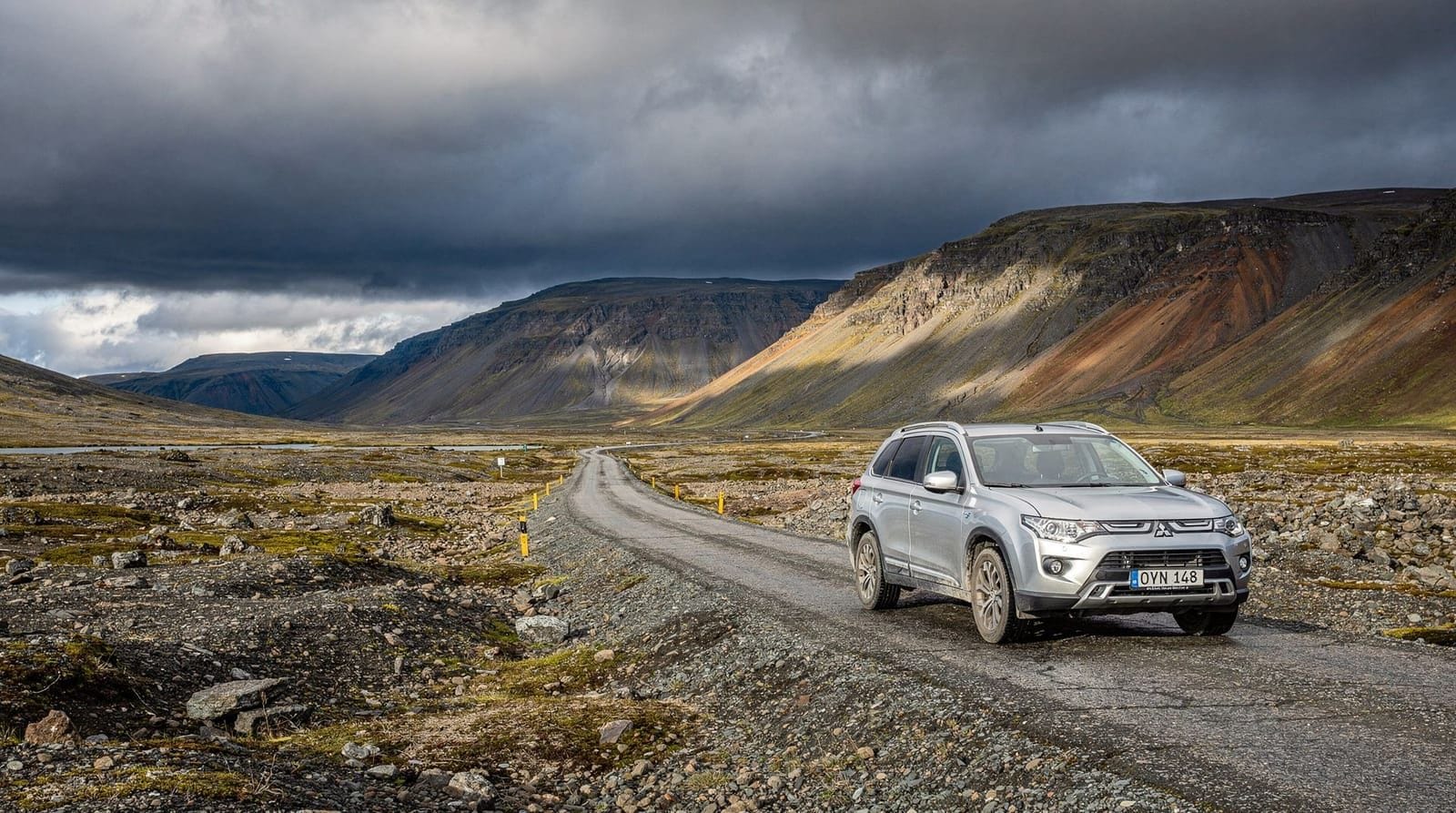
Icelanders drive large vehicles — Toyota Land Cruisers, Toyota Hiluxes, and large SUVs are common even for daily urban driving. This is not status posturing: Iceland’s weather demands high-clearance, robust vehicles, and the F-road network (used by locals for recreation) requires 4x4. The cultural result is that Icelandic drivers expect other vehicles to give way and maintain speed on Ring Road; they are less accustomed to slow-moving tourist rental cars making unexpected stops.
This creates one of the main friction points: tourists stopping on the Ring Road carriageway (not in pull-offs) to photograph something. Icelandic drivers approach at 90 km/h and don’t expect a stopped vehicle. Use only designated pull-offs.
Road markings and signs you’ll encounter
Route numbers: Yellow signs with road numbers. Route 1 is the Ring Road. Routes 2–99 are main regional roads. Routes 100–999 are secondary roads. Routes F001 onwards are F-roads. Route numbers starting with F are a legal 4x4 requirement.
Single lane bridge (einbreiðar brú): Black and white lozenge-pattern sign. Means the bridge ahead has one lane — see the bridge passing rules earlier in this guide.
Blind summit (blint hæðarhorn): Triangle with a hill crest. Reduce speed before the crest; you cannot see oncoming traffic.
Soft shoulder (mjúkur vegkandur): Triangle with a vehicle falling off a road edge. Common near volcanic ash and sand areas. Do not pull onto the shoulder here — it may be unstable.
Open gate (hlið): Some farming areas have livestock gates across the road. Open them, drive through, close them. Leaving gates open is a serious countryside offence in Iceland.
Restricted area (aðgangur bannaður): Red circular sign — do not enter. In volcanic exclusion zones this is enforced.
Driving with children in Iceland
Iceland is generally child-friendly for road trips, but specific safety points:
Car seats: Iceland law requires child seats as per EU standards (ECE R44 or R129, by weight/height groupings). Rental companies provide car seats at ISK 2,000–4,000 extra per rental — book these in advance as they are limited. Bring your own from home if travel with an infant.
Reynisfjara beach: The sneaker waves here are documented fatalities. Children near the water’s edge at Reynisfjara are at genuine risk. Keep children at least 30 m from the water; the waves are non-predictable and fast.
Driving rest stops: Service stations with toilets are approximately every 60–100 km on the Ring Road. Longest gap between service facilities: East Fjords (~140 km). For families with young children, plan stops at identified petrol stations rather than hoping to find a roadside option.
Weather and children: Iceland’s wind can knock over a small child. At exposed viewpoints (Dyrhólaey cliffs, Dettifoss rim, mountain roads), hold children’s hands — this is not overcautious.
Driving apps beyond Road.is
The essential combination for Iceland driving:
Road.is: Current road conditions and closures. Used by every Iceland driver.
Vedur.is app: Icelandic Meteorological Office app. Wind speed and gusts per location are the most critical weather data for driving decisions. Wind speed forecasts update hourly.
112 Iceland: Emergency app from ICE-SAR and Almannavarnir. Submit your travel plan, trigger SOS with GPS. Install before leaving Reykjavik.
Safetravel.is: Travel plan registration system. Takes 3 minutes; register every day’s planned route before setting out.
Google Maps offline: Download Iceland offline map at home before relying on it for navigation. In-car mobile data fails in remote areas.
Driving etiquette: the unwritten rules
Iceland doesn’t have the road rage culture of some countries, but there are courtesies that matter:
Thanking with lights: Icelanders flash headlights briefly (one quick dip) to acknowledge a give-way. If someone waits for you at a single-lane bridge, flash your lights as you pass. This is standard courtesy.
Campsite and car park parking: In campsite parking areas, the convention is to face into the campsite (front of car towards the site, not the road). At viewpoint car parks, don’t double-park across other cars even if the lot is full. Walk the extra 200 m from the overflow area.
Passing on dual-carriageway: The Reykjavik–Borgarnes section of Route 1 has dual lanes. The right lane is the driving lane; the left is for overtaking. Driving slowly in the left lane is unusual in Iceland.
Hazard light misuse: Do not use hazard lights while driving in rain or fog as a “warning” — this is not the Icelandic convention and confuses following drivers who may not be aware you have slowed or stopped. Hazards are for stopped vehicles only.
Fuel economics: which cards save money
Petrol is Iceland’s largest per-day self-drive expense after the car rental itself. Small savings compound over 10+ days:
Orkan app: Download the Orkan app (available internationally). Gives 5–8% discount at all Orkan stations on the Ring Road. Registration requires a phone number and card; international cards accepted.
N1 loyalty card: The N1 card gives marginal savings (2–3%) at N1 stations and is most useful for Icelandic residents. International visitors benefit less.
Self-service vs staffed: Self-service pumps (unmanned) are consistently 5–10 ISK/litre cheaper than staffed pumps. Most major stations have self-service lanes that operate 24 hours.
Reykjavik prices vs ring road: Reykjavik city petrol prices are typically 5–15 ISK/litre lower than rural Ring Road stations (East Fjords and highland approaches). A full tank before leaving Reykjavik is always worth it.
Diesel vs petrol: Most 4x4 rental cars run on diesel (gas oil). Diesel is approximately 10–20 ISK/litre cheaper than petrol in Iceland. Verify your vehicle fuel type at collection — putting petrol in a diesel engine requires an expensive fuel drain.
Frequently asked questions about driving in Iceland
Do I need an International Driving Permit for Iceland?
EU/EEA, US, Canadian, Australian, New Zealand, and UK licences are accepted directly. Most other nationalities need an IDP alongside their national licence. Check with your rental company before booking — their terms override general guidance.
Can I drive to Iceland from mainland Europe?
No — Iceland is an island. Ferries run from Denmark and the Faroe Islands (Smyril Line) to Seyðisfjörður in East Iceland. You can bring a personal vehicle on this ferry, which is how Icelanders import cars.
Are petrol stations open 24 hours?
Many stations have self-service pumps accessible 24 hours with a card. Staffed stations typically close at 22:00–23:00. Card payment requires a PIN — see the fuel section of our Iceland self-drive guide.
What happens if I drive on a closed road?
Police can fine you. If your car is damaged, rental insurance is voided. Rescue teams have started billing drivers for rescues from preventable situations since 2022 — expect charges of ISK 100,000–500,000+ (€680–3,400) for emergency extractions from closed roads.
How do I read the road.is colour coding?
Green = passable. Yellow = drive with caution. Orange = difficult, experience required. Red = impassable/closed. Purple = closed, do not enter. Check every road segment you plan to drive, not just the overall route status.
Can I use a dashcam in Iceland?
Yes. No legal restriction. Dashcam footage has helped renters successfully dispute damage claims, so it is worth installing one before collection.
What happens if I drive through a red light or ignore a road sign in Iceland?
Traffic cameras and police patrols monitor Route 1 and major roads. Fines are issued to the registered vehicle. Rental companies pass fines to renters within 30–90 days of the violation notice. Ignoring road closure signs can result in fines and voided insurance for any subsequent damage. Iceland’s traffic laws are equivalent to other Nordic countries in seriousness.
Can I cross into Greenland or the Faroe Islands by road from Iceland?
No. Iceland is an island. There are no road connections to any other country. International travel from Iceland requires a flight or the Smyril Line ferry to the Faroe Islands and Denmark (Seyðisfjörður departure, twice weekly in summer). The Smyril Line ferry allows vehicle transport — this is how some travelers do Iceland as part of a drive-through Scandinavia road trip.
Are there petrol cards or discount schemes?
The Orkan app gives 5–8% discount at Orkan pumps. N1 has a loyalty card with marginal savings. Neither requires Icelandic residency — download the app on arrival. Most are only for Icelandic payment cards but some accept international Mastercard.
Top experiences
Best-rated activities across GetYourGuide and Viator.

From Reykjavik: Snaefellsness Peninsula small group day tour
- Viator

Lake Myvatn Day Tour and Godafoss Waterfall for Cruise Ships from Akureyri Port
- Viator

Private Jökulsárlón Glacier Lagoon 2 Day Tour & Glacier Hike
- Viator

From Reykjavik: Katla Ice Cave and South Coast Day Tour
- Viator

Reykjanes Peninsula Private Day Tour - up to 9 passengers
- Viator

Thorsmork Hike Day Tour
- Viator