Geysir and Haukadalur — Iceland's original geothermal field
Geysir and Haukadalur geothermal field: Strokkur erupts every 5–10 min, mud pools, hot springs. Entry is free. Driving from Reykjavík and what to expect.
Reykjavik: Golden Circle Gullfoss Geysir Thingvellir full day
Quick facts
- Best time to visit
- Year-round; early morning before tour coaches arrive; winter steam is more dramatic
- Days needed
- 1 to 2 hours as part of a Golden Circle day
- Getting there
- 115 km east of Reykjavík via Route 35; about 1.5 hours by car
- Budget per day
- ISK 0 entry / EUR 0; parking ISK 800 / EUR 5; café food ISK 1,800–3,500 / EUR 12–23
The word “geyser” comes from this place
Geysir, in the Haukadalur valley of South Iceland, is the original geyser — the source of the English word. The eruptions of the Great Geysir were documented in Icelandic sagas and described by European travellers from the 13th century onwards. When scientists needed a name for this type of hydrothermal feature, they borrowed directly from the Icelandic place name (from the Old Norse “geysa,” to gush).
| Where | Haukadalur valley, 115km east of Reykjavík on Rte 35 |
| Cost | free entry; around ISK 800/€5 parking; café food ISK 1,800–3,500 |
| Time needed | 30–90 minutes for the geothermal trail and 3–5 Strokkur eruptions |
| Getting there | self-drive Rte 35, or as part of a Golden Circle guided tour |
| Best time | year-round; early morning before tour coaches arrive |
The Great Geysir itself is largely dormant now. It last erupted reliably in the early 2000s, when earthquake activity temporarily reopened its conduit, and can occasionally be triggered artificially by adding soap (a practice now banned). But Strokkur, 50 metres to the southwest, erupts reliably every 4–10 minutes, shooting a column of boiling water 20–40 metres into the air. The asymmetry between Geysir’s historical fame and Strokkur’s actual performance is worth understanding before you arrive.
What Haukadalur is
The Haukadalur geothermal field sits above a shallow magma intrusion that heats groundwater to boiling. The field includes approximately 30 named springs and a handful of mud pots. Groundwater percolates down through the bedrock, heats, and either emerges as steady hot springs or builds pressure in a confined conduit until it releases explosively — the geyser mechanism.
The geothermal features visible at the site include:
- Strokkur — the reliably erupting geyser. A blue bubble of near-boiling water swells in the mouth of the vent before each eruption; photographing the bubble at maximum size, just before it breaks, is more striking than the eruption column itself.
- Blesi — a pair of pools side by side, one clear and one opaque milky blue. The colour difference results from silica concentration: the opaque pool has more dissolved silica in suspension.
- Konungshver — “King’s Spring,” a larger hot pool adjacent to the Great Geysir, named after King Frederick VIII of Denmark who visited in 1907.
- Fata — a cauldron of blue-green boiling water, surrounded by silica sinter deposits.
- Mud pots — several smaller pools where hydrogen sulphide gas causes acidic conditions that dissolve the surrounding rock into grey-white mud.
The entire trail covering all features is roughly 800 metres of walking. There are no fences around most of the geothermal features. The “do not step off the path” warnings are serious: the white silica crust adjacent to pools looks like solid ground and sometimes is not. A tourist suffered severe burns near a hot pool at Haukadalur in 2016 by stepping on thin crust over superheated water.
Entry and facilities
Entry to the geothermal trail is free. Parking costs ISK 800 (EUR 5). The Geysir Hotel and Visitor Centre complex adjacent to the car park includes:
- A café and restaurant (soup of the day ISK 2,500 / EUR 16; burger ISK 3,800 / EUR 25; open-face sandwich ISK 2,200 / EUR 14)
- A gift shop (the usual Icelandic wool, books, and Viking-themed items at tourist prices)
- Toilets and facilities
The café food is adequate and typically crowded from 10:00 to 14:00. There is a petrol station at the Geysir Hotel if you need fuel before continuing east to Gullfoss or west toward the Secret Lagoon.
Strokkur eruption photography
Strokkur erupts frequently enough that you can take multiple shots. The photographic sequence: the vent is quiet, then the water level in the mouth rises, then a translucent blue dome of water swells upward (this takes about 3 seconds), then it breaks and the column launches upward. The dome-swelling phase is the most photogenic still image; the full column is the most dramatic video sequence.
Stand on the east side of the vent for backlit steam against the sky in morning light. Prevailing wind is typically from the southwest — standing downwind places you in the steam, which is unpleasant; observe the steam direction before positioning yourself.
Double eruptions (two consecutive eruptions in rapid succession) occur roughly every 30 minutes or so and are considerably more dramatic than single eruptions. Worth waiting for if you have time.
What Geysir (the original) looks like now
The Great Geysir’s vent is clearly visible — a large pool of pale blue boiling water, about 20 metres across, with a central depression. It does not erupt. Occasionally the water level fluctuates, and there is subtle bubbling, but nothing resembling the historical eruptions documented at 70–80 metres. The dormancy began in the 1950s and has been near-complete since (with the exception of the 2000–2003 earthquake-triggered activity period).
This is a common disappointment for visitors who arrive expecting to see the “famous” Geysir erupt. Strokkur is genuinely impressive and erupts constantly; the original Geysir is historically important but visually a hot pool. The distinction is rarely communicated clearly in tour marketing.
Gullfoss is 9 km away
Gullfoss waterfall is a 9-kilometre drive east along Route 35. Most visitors continue directly from Geysir to Gullfoss, spending 30–45 minutes at each, before returning west. The road between them is paved and well-maintained year-round.
Golden Circle full day — Gullfoss, Geysir, Þingvellir — the standard guided circuit covering all three main sites. ISK 13,000–15,000 (EUR 85–99) from Reykjavík with transport. This tour structure spends about 45 minutes at Geysir, which is sufficient for the geothermal walk and 2–3 Strokkur eruption cycles.
Golden Circle small group with 7 stops including Kerið and Friðheimar — smaller bus, more stops, more flexibility at each site. ISK 18,000–22,000 (EUR 118–145). Allows more time at Geysir if you want to wait for the double eruption or do a more thorough walk of the field.
Nearby — the Secret Lagoon at Flúðir
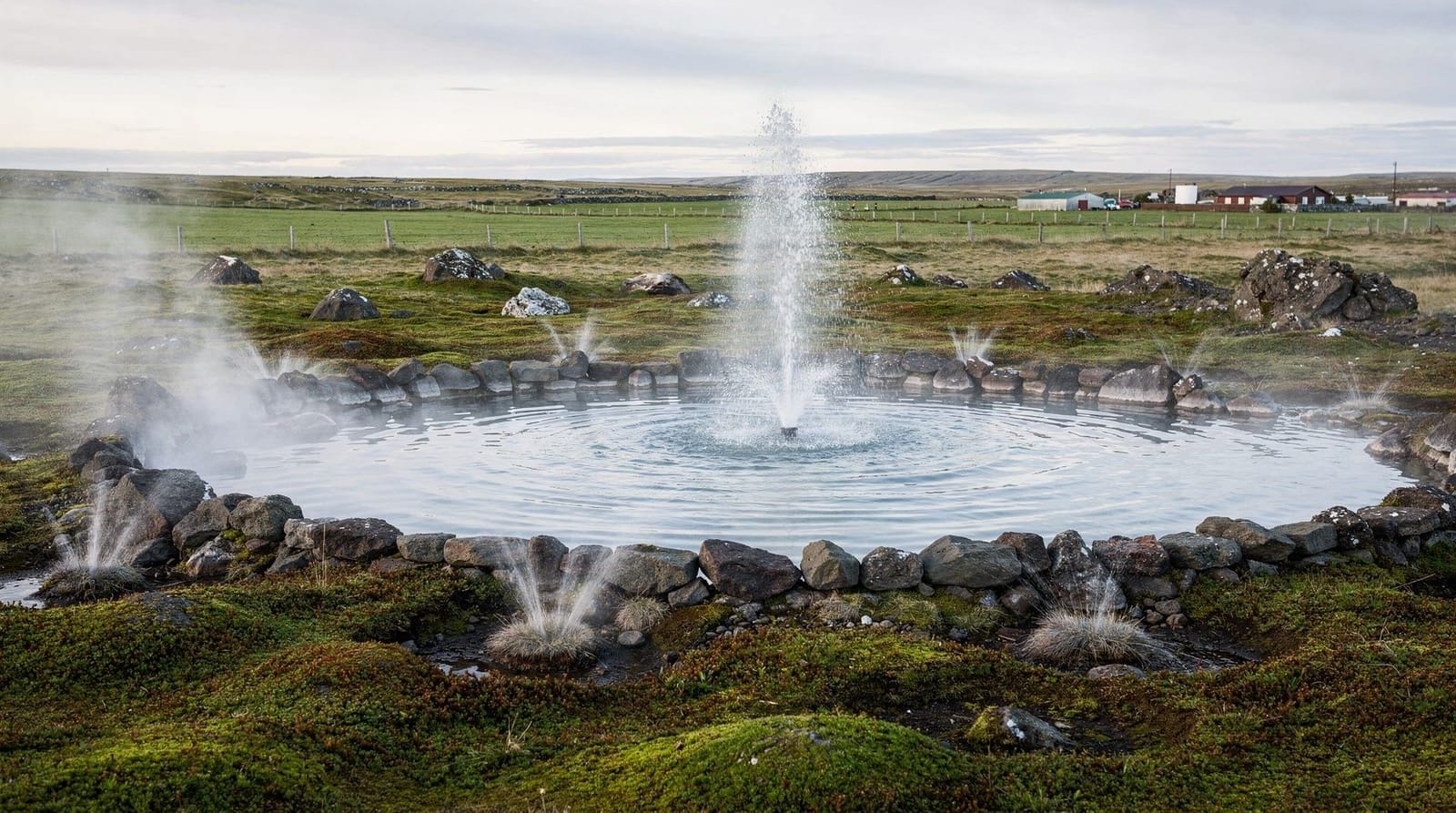
Flúðir is 15 km west of Geysir on Route 35/30. The Secret Lagoon (Gamla Laugin) is Iceland’s oldest swimming pool, fed by geothermal water at 38–40°C, set in a garden with small natural hot springs bubbling up adjacent to the pool. Admission is ISK 3,500 (EUR 23). This is a more authentic, less commercial geothermal bathing experience than the Blue Lagoon and works well as a Golden Circle add-on.
The science of geysers
A geyser requires a specific combination of geological conditions that are rare enough to make the Haukadalur field internationally significant even in its current partially-dormant state. The requirements: a water source, a confined underground plumbing system that allows water to be superheated without immediately escaping, and a constriction in the conduit that allows pressure to build before release.
In Strokkur’s case, groundwater percolates down through the basalt and is heated by a shallow magma intrusion. The conduit is a roughly cylindrical tube — perhaps 3 metres in diameter at the surface, narrowing at depth — that fills with water and heat until the pressure builds to the point where the water flashes to steam. The eruption is not the water boiling: it is a rapid phase transition from superheated liquid to steam when the pressure drops slightly, driving the water column upward.
The mechanism was first described scientifically by Robert Bunsen (of Bunsen burner fame), who visited Iceland in 1846 and published a detailed analysis of the Great Geysir’s eruption mechanics. Iceland was a significant site in the development of volcanology and geothermal science precisely because of Haukadalur and similar fields.
History of the Great Geysir
European scholars first described the Great Geysir’s eruptions in the 13th century in Icelandic annals. By the 18th century it was sufficiently famous that it appeared in scientific literature across Europe. In its most active periods, the eruptions reached 80 metres or more, making it one of the world’s largest geysers.
The 1845 eruption sequence that Bunsen observed reached 54 metres. By the early 20th century the eruptions had become erratic, and soap was occasionally added to the pool to trigger performances for tourist groups (the addition of surfactant reduces surface tension and initiates the eruption mechanism artificially). This practice was eventually banned to prevent damage to the conduit chemistry.
The geyser’s dormancy deepened through the mid-20th century. A significant earthquake in 2000 temporarily reactivated it — the seismic shock apparently reopened or unblocked portions of the conduit, and eruptions resumed for 2–3 years before the geyser quieted again. This episode confirmed that the underground plumbing system remains intact; the dormancy is a matter of conduit blockage rather than loss of heat source.
The geothermal system and Langjökull
The heat source for Haukadalur is ultimately connected to the same magmatic system that drives all of South Iceland’s geothermal activity. The water in the geothermal springs originates partly from Langjökull glacier meltwater percolating down through the porous basalt, heated by contact with rock influenced by the underlying magma, and emerging at the surface through fractured zones.
The same glacial meltwater that feeds Geysir’s underground system eventually drains into the Hvítá river — the same river that flows over Gullfoss waterfall 9 km east. The hydrological and geothermal systems in this part of South Iceland are interconnected in ways that were not well understood until the 20th century.
Winter at Haukadalur
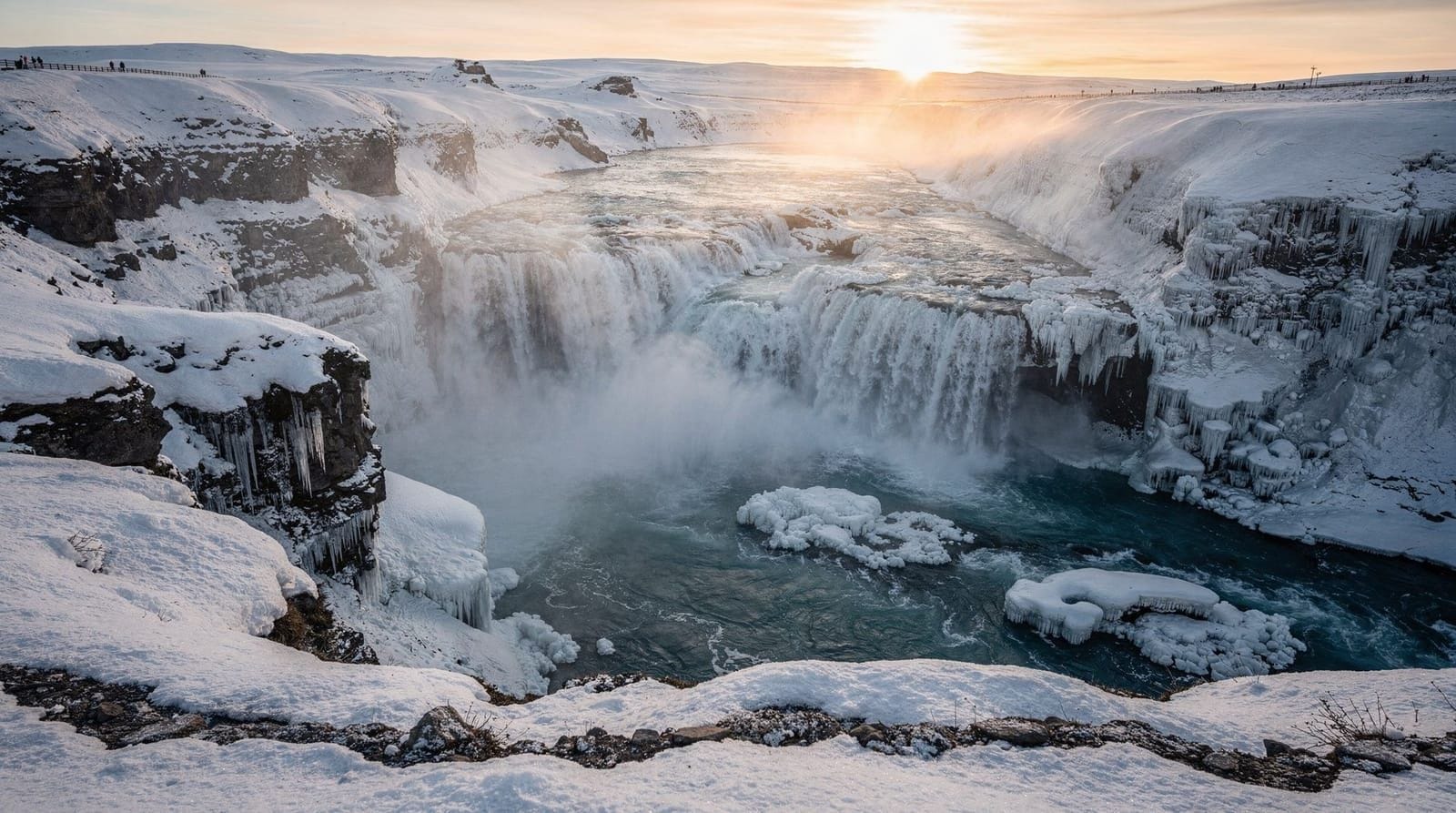
Winter visits to Geysir are less crowded and visually more dramatic. The steam from the hot springs and Strokkur eruptions is more visible in cold air, creating dense white clouds against dark skies. Morning light (low-angle in winter) catches the steam beautifully. The car park is plowed; the trail to the features can be icy — microspikes are useful.
The main risk in winter is that the Geysir Hotel’s café operates reduced hours (often closed by 16:00–17:00), so check before relying on it for a meal.
The wider Geysir area — Brúarfoss and other walks
Beyond the main geothermal trail, the Haukadalur area has some lesser-known natural features worth combining with a Geysir visit.
Brúarfoss, approximately 6 km northwest of Geysir via a combination of dirt roads and a 30-minute walk, is a small waterfall where the Brúará river plunges through a basalt channel. The water is a vivid turquoise — similar to Fjaðrárgljúfur — due to the pale volcanic substrate. It receives far fewer visitors than the main Geysir area and is worth the detour for those who want a quieter experience. Accessible in a 2WD via the rough track; the walk to the falls from the nearest parking takes about 20–30 minutes.
Haukadalur itself — the “Hawk Valley” — extends north of the geothermal area into farming country. The valley has been inhabited since the Saga Age; a church and the ruins of a medieval farm are visible near the visitor centre. The Saga of Ari the Wise (Íslendingabók) is linked to this area — Ari was born at Haukadalur farm in approximately 1067 CE.
Refrigerator bread and the Geysir area cafés
A minor but genuinely Icelandic food note: some cafés in the Geysir area serve geothermal bread (hverabrauð) — the dark rye bread cooked in the ground using residual geothermal heat from shallow vents. The bread is dense, slightly sweet (from the long slow cook), and earthy. It is specifically associated with geothermal areas and is worth trying at least once. Available at the Geysir Hotel café and at the Friðheimar tomato farm.
The Friðheimar farm café, 25 km southwest of Geysir on Route 35, serves the most celebrated tomato soup in Iceland (ISK 2,900 / EUR 19 for soup and bread). Reservations are required for lunch; it is frequently booked out 2–3 weeks ahead in peak summer. The greenhouse setting is novel: you eat among thousands of tomato plants, and the warmth and humidity contrast with the cold outside. Worth planning for if you have a reservation.
Practical logistics for a self-drive visit
Geysir sits on Route 35, a well-maintained paved road that connects easily to the rest of the Golden Circle loop. If you’re self-driving rather than joining a coach, a few extra details are worth knowing before you set off:
Fuel: the Geysir Hotel complex has a petrol station, useful if you’re continuing east to Gullfoss or beyond rather than looping back through Selfoss. Top up here rather than assuming the next station is close — rural South Iceland stations are more spread out than they appear on a map.
EV charging: fast chargers are available at the Geysir Hotel car park, a practical stop if you’re driving an electric rental on the Golden Circle loop and want to top up while walking the geothermal trail.
Timing against Þingvellir: most self-drivers do Þingvellir first, then Geysir, then Gullfoss, following the standard clockwise Golden Circle direction. Reversing this order — Gullfoss first, then Geysir, then Þingvellir — puts you at Geysir in the early afternoon rather than late morning, which is usually worse for crowds, so the standard order is generally the better choice specifically for avoiding the Geysir crush.
Accessibility: the main geothermal trail is flat gravel and manageable for visitors with limited mobility, though the ground near some pools is uneven. The café and toilets at the visitor centre are wheelchair accessible.
Timing your visit against the crowds
Geysir is one of the three Golden Circle stops and gets the coach-tour crush that comes with that status. Timing matters more here than at Þingvellir, because the geothermal field is small enough that a single arriving coach visibly changes the atmosphere at Strokkur.
| Arrival time | What to expect |
|---|---|
| Before 09:00 | Quiet, uninterrupted views of the vent, easy photography |
| 10:30–14:00 | Peak coach traffic; crowded viewing area around Strokkur |
| After 16:00 | Crowds thinning, good evening light in summer |
The golden-circle-self-drive guide has more detail on sequencing the full loop to dodge the worst of the midday congestion, and the best-time-to-visit-iceland guide covers how Geysir’s crowd patterns shift across the seasons.
Frequently asked questions about Geysir and Haukadalur
Does the Great Geysir still erupt?
Rarely. The Great Geysir was historically the most famous geyser in Europe, erupting to 70–80 metres, but it has been dormant since the 1950s (with a brief reactivation from 2000–2003 following earthquake activity). Strokkur, 50 metres away, erupts reliably every 4–10 minutes and is the main attraction today.
How high does Strokkur erupt?
Typically 20–35 metres, occasionally up to 40 metres. The height varies between eruptions. Strokkur erupts every 4–10 minutes — enough that you will see multiple cycles during a 30-minute visit.
Is it safe to stand near Strokkur?
The designated viewing areas are safe. The water in the eruption column is near boiling (around 85–90°C at the surface). Standing directly downwind puts you in the steam; it is not dangerous at viewing distances but is unpleasant. The silica crust adjacent to the pools is not safe to walk on — stay on marked paths.
How long should I spend at Geysir?
30–60 minutes is sufficient to walk the full geothermal trail and see 3–5 Strokkur eruptions. If you want to photograph the double eruption or watch more eruption cycles, 90 minutes is comfortable. Tour buses typically allocate 45–60 minutes.
Is there a charge to enter Geysir?
No admission charge for the geothermal trail. Parking costs ISK 800 (EUR 5) per car. The facilities (café, toilets, gift shop) are separate costs.
Can I see Geysir and Gullfoss together in one stop?
They are separate sites 9 km apart. Most visitors spend 45–60 minutes at Geysir then drive to Gullfoss, spending another 30–45 minutes there. The combination is the natural pairing in the Golden Circle route.
What’s the biggest disappointment for first-time visitors to Geysir?
Expecting the Great Geysir itself to erupt. It’s been largely dormant since the 1950s, and tour marketing doesn’t always make that clear. Strokkur, 50 metres away, is the geyser that actually performs — reliably, every 4–10 minutes — so the visual spectacle is real, it’s just not coming from the geyser with the famous name.
Can I visit Geysir without joining a Golden Circle tour?
Yes. Self-driving to Geysir on Route 35 takes about 1.5 hours from Reykjavík, and entry to the geothermal trail is free regardless of how you arrive. Many independent travellers combine a Geysir stop with Gullfoss and the Secret Lagoon without ever booking an organised tour.
Top experiences
Bookable activities with verified prices and instant confirmation on GetYourGuide.
Top-rated experiences in Geysir and Haukadalur — Iceland's original geothermal field
Best-rated activities across GetYourGuide and Viator.