Golden Circle self-drive guide: routes, timing, and what to skip
Reykjavik: From Reykjavik Golden Circle full day guided trip
How long does the Golden Circle self-drive take?
The core Golden Circle — Þingvellir, Geysir, Gullfoss — covers approximately 300 km from Reykjavik. With reasonable time at each site, allow 7–9 hours. Adding Kerið crater adds 1 hour and ~60 km. Adding the Secret Lagoon adds 30 minutes to Geysir and another 1–2 hours. Full day trip from Reykjavik.
What the Golden Circle actually is
The Golden Circle is a loose term for the tourist loop covering three main sites east of Reykjavik: Þingvellir National Park, the Geysir Geothermal Area (containing Strokkur geyser), and Gullfoss waterfall. The classic route covers ~230 km from Reykjavik; add Kerið crater and you reach ~290 km.
It is Iceland’s most visited day-trip route — both from the city and as a standalone tour. In July–August, the parking lots at Geysir and Gullfoss are at capacity by 10:00. Self-driving the Golden Circle is straightforward, but getting there early is the difference between a pleasant visit and a crowded shuffle.
| Distance | ~230 km core loop, ~290 km with Kerið |
| Time needed | 7–9 hours including stops |
| Road surface | Fully paved, no 4x4 required |
| Parking fees | Þingvellir 500 ISK, Geysir 700 ISK, Gullfoss free, Kerið 400 ISK |
| Best departure | 07:30–08:30 from Reykjavik |
The classic route
Reykjavik → Þingvellir (50 km, ~45 minutes via Route 36)
Take Route 1 east from Reykjavik, then Route 36 north into the valley. Þingvellir National Park sits in a rift valley where the North American and Eurasian tectonic plates are pulling apart at approximately 2 cm per year. The park also served as Iceland’s original parliament site (Alþingi) from 930 AD.
What to see: The Almannagjá gorge walk (1.5–2 km, flat, along the rift fissure), the Öxará river and waterfalls, Þingvellir church. Allow 1.5–2 hours minimum for the gorge walk. The park requires a 500 ISK (€3.40) parking fee in summer — use the Hakid or Leirar car parks, not the overflow areas.
Snorkelling Silfra: Silfra fissure inside Þingvellir is the world’s only place to snorkel between two tectonic plates in glacially filtered freshwater with near-10-metre visibility. Requires advance booking. More in our Silfra snorkelling guide.
Þingvellir → Geysir (75 km, ~1 hour via Route 365 or Route 36/37)
Route 365 is the direct option — some gravel near Laugarvatn. Route 36/37 through Laugarvatn village is paved. The Laugarvatn Fontana geothermal spa is a legitimate stop if you want a warm-water break between major sites.
What to see at Geysir: The Geysir Geothermal Area contains both Geysir (the original, rarely active now) and Strokkur (erupts every 4–8 minutes to 15–20 m height). Arrive before 10:00 or after 16:00 to avoid the worst crowds. The whole area is a 30-minute walk with multiple smaller hot springs, mud pools, and steaming vents. No entry fee, but parking costs ISK 700 (€4.75). Allow 1–1.5 hours.
Adjacent stop: Friðheimar tomato farm is 3 km from Geysir — a glass greenhouse restaurant serving tomato soup and horseradish in a geothermal-heated growing environment. Lunch reservation required; ISK 3,500–5,500 (€24–37) per person. Worth booking for a unique Iceland lunch experience. Full day is better if you are adding this.
Geysir → Gullfoss (10 km, ~15 minutes via Route 35)
The shortest drive of the day. Gullfoss (“Golden Falls”) is a two-tiered 32 m waterfall that generates a permanent mist cloud visible from the car park. The falls drop into a narrow canyon and the viewpoint is accessible on two walkways — lower (close, wet) and upper (wide view, less spray). In winter, ice formations modify the falls significantly.
Crowds: Gullfoss receives approximately 600,000 visitors per year. Peak crowd time is 11:00–14:00. Arrive before 09:30 or after 16:00 for manageable numbers. The car park fills on peak summer days — overflow parking is available 200 m down the road. Allow 1–1.5 hours.
Gullfoss → Kerið Crater → Reykjavik (100 km via Route 35/36/1)
Kerið crater is a 6,500-year-old explosion crater with a vivid turquoise lake 10 m below the rim. It is small (15 minutes to walk the rim, 10 minutes to descend to the water) but visually striking. Entry fee ISK 400 (€2.70). Located at Selfoss turnoff on Route 35.
Total return to Reykjavik from Kerið via Route 35 to Route 1: approximately 75 km, 1 hour.
Alternate route: counterclockwise Golden Circle
Most visitors drive clockwise (Þingvellir → Geysir → Gullfoss → back). The counterclockwise alternative (Kerið → Gullfoss → Geysir → Þingvellir) means arriving at Þingvellir last with afternoon and evening light — often better for photography. It also means hitting Gullfoss and Geysir in the morning when they are more crowded, so the trade-off depends on your priorities.
Adding the Secret Lagoon
The Secret Lagoon (Gamla Laugin) in Flúðir is 35 km off the main Golden Circle route via Route 30. It is a natural geothermal pool at approximately 38–40°C — a working swimming pool since 1891, not a luxury spa. Entry ISK 3,200–3,900 (€22–27) per adult. The pool is small enough that advance booking is advisable in summer.
Adding the Secret Lagoon to a Golden Circle day adds approximately 1–1.5 hours driving and 1–2 hours at the pool. This makes for a 10–11 hour full day from Reykjavik.
Alternatively, the Blue Lagoon is accessible on a return from the Golden Circle via Reykjanes rather than Route 1 — this adds ~50 km but creates a Þingvellir/Geysir/Gullfoss/Blue Lagoon mega-day that many visitors find exhausting. The Blue Lagoon guide has timing details.
Self-drive vs guided tour
If you prefer not to drive, guided Golden Circle tours depart Reykjavik daily from multiple operators:
Full-day guided Golden Circle tour from ReykjavikThe trade-off: guided tours stop at Geysir for 45 minutes and Gullfoss for 30 minutes. Self-driving allows 2+ hours at each. If you want to walk the full Almannagjá gorge at Þingvellir and properly explore each site, self-driving is better.
Practical self-drive details
Fuel: Petrol stations at Laugarvatn and Selfoss on the Golden Circle loop. If coming from Reykjavik with a full tank, you won’t need to refuel for the basic loop.
Parking fees: Þingvellir ISK 500, Geysir ISK 700, Gullfoss free (as of 2026). Kerið ISK 400. Have ISK cash or a card that works at outdoor kiosks.
Road surface: The standard Golden Circle route (Route 36, 365, 37, 35) is entirely paved. No 4x4 required.
Connectivity: Good mobile coverage throughout the Golden Circle loop. Road.is conditions are rarely a concern here except in severe winter weather.
What makes the Golden Circle visually distinctive
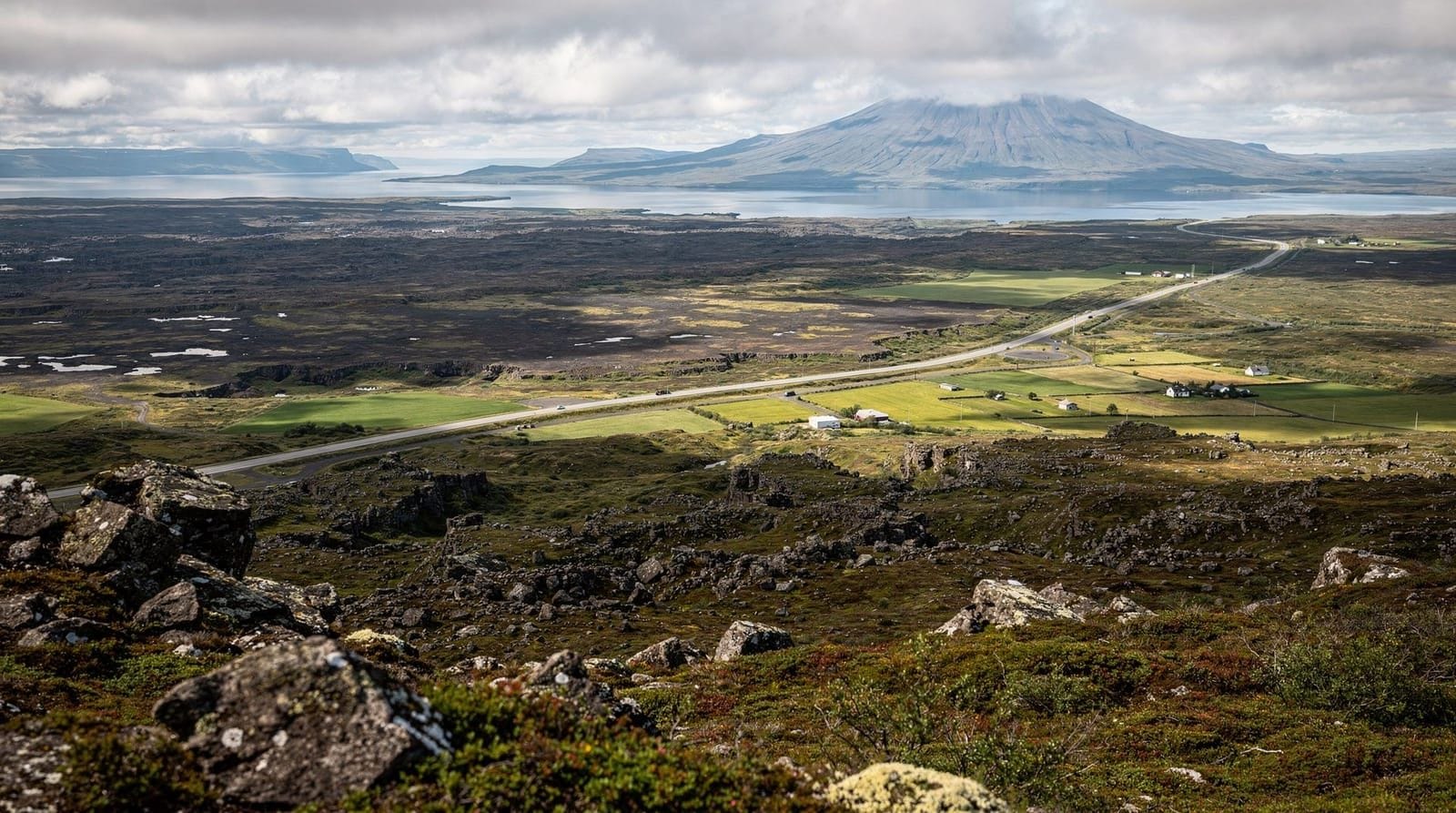
The Golden Circle sits in the volcanic zone connecting Reykjavik to the Eastern Highlands. Unlike the dramatic coastal scenery of the South Coast, the landscapes here are primarily geological — flat lava plains, steam rising from fissures, and geothermal areas where the ground smells of sulphur and the earth bubbles.
Þingvellir’s light: The rift valley faces roughly north, and the afternoon sun can create beautiful angled light across the Almannagjá gorge. Golden hour at Þingvellir in summer (22:00–23:00) with the gorge walls catching light is often better than midday. If you go counterclockwise on the Golden Circle — finishing at Þingvellir rather than starting there — the late-day timing works in your favour.
Strokkur’s behaviour: The geyser erupts every 4–8 minutes, but the eruptions vary significantly in height. Small eruptions reach 10–12 m; large ones 20–25 m. Occasionally a “double bubble” occurs where two chambers release simultaneously, creating a larger plume. The waiting game at Strokkur is genuinely engaging — experienced visitors circle the spring from different angles to catch different eruption views. The north side of the spring gives the best backlit eruption shot in the afternoon.
Gullfoss in different light: The waterfall’s orientation means it photographs best in morning light (east-facing lower falls) or under overcast conditions that prevent harsh shadows in the mist-filled canyon. In afternoon summer sun, the spray can create lens flare issues. The upper viewpoint gives width perspective; the lower platform gives proximity and spray experience.
Side trips from the Golden Circle
Laugarvatn Fontana
10 km off Route 35 near Laugarvatn village. A small geothermal spa on the lake shore — significantly quieter than Blue Lagoon and Sky Lagoon. ISK 4,200–5,200 (€29–35) entry including hot pools and sauna. Also offers a traditional Icelandic lava bread baking demonstration where rye bread is baked underground in volcanic heat. Well-reviewed by visitors seeking a less commercial spa experience.
Bruarfoss waterfall
A 3 km round-trip hike from the road near Geysir delivers an intensely blue waterfall (the water flows from Þingvellir’s glacially filtered groundwater) — the most vivid blue of any Iceland waterfall. Not signposted on most routes. The trailhead is near Efri-Reykir on Route 37. Allow 1 hour from car to falls and back. Unmarked on many tourist maps but increasingly well-known.
Kerið crater
Already included in the main route (optional add-on), but worth the detail: Kerið is a 6,500-year-old scoria cone explosion crater. The vivid red, orange, and ochre rocks around the crater rim contrast with the aquamarine lake at the bottom. The crater was formed by a shield volcano collapsing rather than a traditional explosive eruption. Walk the rim (15 minutes) and descend to the waterline (another 10 minutes, steep gravel path).
Planning for groups: logistics on the Golden Circle
Self-drive groups (3+ vehicles): Coordinating parking at busy Golden Circle sites in peak season is easier if groups carpool into fewer vehicles. The Geysir car park charges per vehicle (not per person), and parking options near Gullfoss are limited.
Large groups on guided tours: Groups of 8+ are typically better served on large coach tours rather than multiple small rental cars. The coach approach allows one parking space and one payment rather than logistics for multiple vehicles.
Photography groups: Sunrise at Þingvellir (05:30–06:30 in midsummer) is when the gorge is unoccupied. For photography, consider splitting the Golden Circle over two early mornings rather than one full day.
Winter Golden Circle: specific considerations
All three main sites are accessible in winter. The specific differences:
Gullfoss in winter (December–March): Ice formations modify the waterfall significantly. In cold winters (January–February), portions of the upper falls freeze into blue ice formations that partially dam the flow before shattering. This is visually extraordinary but depends on temperatures sustained below -10°C for at least a week.
Þingvellir under snow: The rift valley fills with snow, transforming the gorge walk. The Öxará river may partially freeze. The landscape becomes quieter and more austere. Parking is maintained but the upper Leirar car park may not be fully ploughed.
Geysir winter timing: Strokkur erupts regardless of season. The steam cloud in cold air is dramatically larger than in summer. The area stays accessible but can be icy on the paths around the hot springs. Wool socks and waterproof boots essential.
The Silfra snorkelling add-on
Silfra fissure in Þingvellir National Park is a genuinely unique world attraction — the only place on earth to snorkel between two tectonic plates in glacially filtered freshwater. Visibility reaches 80–100 m, making it one of the clearest snorkelling sites anywhere.
How it connects to the Golden Circle: Since Þingvellir is the first stop on the Golden Circle, starting with a Silfra snorkel tour (typically 08:00–11:00) and then continuing the Golden Circle loop works logistically. You exit Silfra as the tour bus crowds arrive at Þingvellir. Full details in our Silfra snorkelling guide.
Temperature reality: Silfra water is 2–4°C year-round. Dry suits are provided by all operators; you will be warm inside the suit. Your face, which is exposed, will be cold — experienced operators provide hoods. First-timers are always surprised by the face immersion temperature.
Booking requirements: Silfra operators (Dive.is, Arctic Adventures, and others) require prior snorkelling or diving ability and a medical declaration. Advance booking essential in summer — popular operators sell out 2–4 weeks ahead.
What the Golden Circle misses
Being honest about what the Golden Circle doesn’t offer helps set realistic expectations:
No glacier experience: The Golden Circle doesn’t come close to Iceland’s glaciers. For glacier proximity, you need the South Coast (Solheimajokull) or Jökulsárlón/Vatnajökull area.
Limited coastal scenery: The Golden Circle is inland volcanic landscape. No dramatic sea stacks, black sand beaches, or coastal cliffs.
No puffins: Puffins are coastal birds. The Golden Circle has none.
Wildlife viewing: Very limited compared to the South Coast, Snæfellsnes, or Húsavík. Some birdwatching at Þingvellir (golden plover, Arctic tern nesting).
If your priority is diverse landscape variety in a single day, the South Coast delivers more range. The Golden Circle delivers depth in geological and historical significance. See the full Golden Circle vs South Coast comparison.
Food stops along the self-drive route, ranked
Beyond Friðheimar (covered above) and the site cafés, a few additional food options along the Golden Circle route are worth knowing about for a self-drive day:
Efstidalur II farm (near Laugarvatn, on Route 37): a working dairy farm with a restaurant serving burgers made from their own cattle and ice cream made on-site from their own milk. Genuinely good quality, mid-range prices, and a small viewing window into the milking parlour. A worthwhile detour of about 10 minutes off the main Route 36/37 corridor between Þingvellir and Geysir.
Skjól Sundlaug snack bar (Laugarvatn village): basic but adequate — sandwiches, coffee, hot dogs. Useful if you’re stopping at Laugarvatn Fontana anyway and want a cheaper option than the spa’s own café.
Selfoss bakeries and supermarkets (on the return leg): if you skipped lunch at Friðheimar or the Geysir café, Selfoss has a Bónus supermarket and several bakeries offering considerably cheaper food than any Golden Circle site café — worth the short detour if budget matters more than convenience.
EV and hybrid rental considerations
Iceland’s rental fleet increasingly includes EVs and hybrids, and the Golden Circle is one of the easier routes in the country to complete on electric power alone. The full core loop with Kerið is around 290 km — comfortably within the range of most modern EVs, with charging points at Þingvellir visitor centre, Laugarvatn, near the Geysir Hotel, and in Selfoss on the return leg.
Practical notes for EV self-drivers: charging speeds at these Golden Circle points are generally moderate (not ultra-rapid), so plan a 20–30 minute charging stop into your Geysir or Selfoss break rather than treating charging as a separate errand. Check plugshare.com before departure for real-time charger availability, since summer weekends see higher demand from other EV renters doing the same route.
Combining the Golden Circle with a Reykjanes detour
A less common but workable variation: instead of returning directly to Reykjavík from Kerið, continue south to the Reykjanes Peninsula and approach the city via the Blue Lagoon and the peninsula’s volcanic landscape. This adds roughly 1.5–2 hours to the day compared to the direct Route 1 return, but converts a Golden-Circle-only day into a broader geological tour covering both the continental rift at Þingvellir and the still-active Reykjanes volcanic system.
This variation suits travellers who won’t otherwise have a dedicated Reykjanes or Blue Lagoon day, but it makes for a genuinely long day (11–13 hours from a 07:30 departure) and is not recommended if you’re also trying to fit in Kerið, the Secret Lagoon, and Friðheimar in the same 24 hours.
Practical timing table for the Golden Circle
| Departure from Reykjavik | Þingvellir arrival | Geysir arrival | Gullfoss arrival | Return to Reykjavik |
|---|---|---|---|---|
| 07:30 | 08:15 | 10:00 | 11:00 | 17:00 (with Kerið) |
| 09:00 | 09:45 | 11:30 | 12:30 | 18:30 (with Kerið) |
| 10:00 | 10:45 | 12:30 | 13:30 | 19:30 (with Kerið) |
| After 10:00 | All sites crowded all day |
This table assumes approximately 2 hours at Þingvellir, 1 hour at Geysir, 1 hour at Gullfoss, and 30 minutes at Kerið, with drive time between sites. The 07:30 departure gives you the morning at Þingvellir before coach arrivals at 10:00.
Frequently asked questions about Golden Circle self-driving
Do I need to book parking in advance for the Golden Circle?
No. Parking is pay-on-arrival at all three main sites. In peak summer the car parks fill, but there is always overflow parking nearby. Arriving before 10:00 avoids the worst crowds.
Can I do the Golden Circle in half a day?
A rushed version, covering only Geysir and Gullfoss (skipping Þingvellir) takes 5–6 hours. Including Þingvellir properly: 7–9 hours. Trying to do the full Golden Circle plus Secret Lagoon in half a day is not realistic.
Which Golden Circle site is most worth lingering at?
Þingvellir, for most independent travelers. It is the largest area, the least crowded if you arrive early, and has the most walking available. Geysir and Gullfoss are spectacular but compact. Most guided tours spend disproportionately little time at Þingvellir.
Is the Golden Circle accessible in winter?
Yes. All Golden Circle roads are maintained year-round. Winter adds ice risk — check road.is. Gullfoss in winter with ice formations is arguably more beautiful than in summer. Geysir erupts regardless of season. Þingvellir is extraordinary in snow.
Should I combine Golden Circle and South Coast?
Only if you are not interested in stopping for long at either. Both are full-day itineraries separately. Our Golden Circle vs South Coast guide compares them properly.
Are there electric vehicle (EV) charging points on the Golden Circle?
Yes. Charging points exist at Þingvellir National Park visitor centre, at Laugarvatn village, near the Geysir Hotel, and in Selfoss (return route). Iceland has been expanding EV infrastructure rapidly. The Golden Circle is now manageable in an EV with 200+ km range from Reykjavik. Check plugshare.com for current charger locations before departure.
What is the best time to leave Reykjavik for the Golden Circle?
07:30–08:30. This gets you to Þingvellir before the tour bus surge at 10:00, and allows proper time at each site without racing. If you leave at 10:00, expect crowded conditions at all three sites.
Is the Golden Circle good for a first-time Iceland visitor?
Yes — it is specifically the most recommended first day-trip for first-timers. The sites are all within 2 hours of Reykjavik, the roads are well-signed and paved, there are service facilities at every major stop, and the landscapes cover three distinct types (historical/geological, geothermal, waterfall). It gives a varied introduction to Iceland’s character in a single manageable day.
Can I do the Golden Circle in an EV rental?
Yes. The core loop (~230–290 km with Kerið) is within range of most modern EVs, with charging points at Þingvellir, Laugarvatn, Geysir, and Selfoss. Build a 20–30 minute charging stop into your day and check plugshare.com before departure.
Should I add the Reykjanes Peninsula and Blue Lagoon to the same day?
Only if you have no other day free for it — this variation adds 1.5–2 hours and creates an 11–13 hour day. Most visitors get a better experience treating the Blue Lagoon and Reykjanes as a separate outing.
Top experiences
Bookable activities with verified prices and instant confirmation on GetYourGuide.
Top experiences
Best-rated activities across GetYourGuide and Viator.

From Reykjavik: Snaefellsness Peninsula small group day tour
- Viator

Lake Myvatn Day Tour and Godafoss Waterfall for Cruise Ships from Akureyri Port
- Viator

Private Jökulsárlón Glacier Lagoon 2 Day Tour & Glacier Hike
- Viator

From Reykjavik: Katla Ice Cave and South Coast Day Tour
- Viator

Reykjanes Peninsula Private Day Tour - up to 9 passengers
- Viator

Thorsmork Hike Day Tour
- Viator