Secret Lagoon at Flúðir — Iceland's oldest geothermal pool
Secret Lagoon (Gamla Laugin) in Flúðir: Iceland's oldest swimming pool at 38–40°C, geothermal springs, and no prebooking required. ISK 3,500 admission.
Reykjavik: Iceland Secret Lagoon admission ticket
Quick facts
- Best time to visit
- Year-round; winter evenings for aurora potential above the steam
- Days needed
- 1 to 2 hours for the soak
- Getting there
- 100 km east of Reykjavík via Route 1 and Route 35/30; about 1.25 hours by car
- Budget per day
- ISK 3,500 admission / EUR 23; towel rental ISK 700 / EUR 5
Iceland’s oldest swimming pool in a working village
The Secret Lagoon (Gamla Laugin — “Old Pool” in Icelandic) is a naturally heated outdoor pool in the village of Flúðir, 100 km east of Reykjavík. It was originally constructed in 1891, making it Iceland’s oldest documented swimming pool. It fell out of use in the mid-20th century, was restored and reopened in 2014, and has since become one of the most popular geothermal bathing spots in South Iceland — partly because it offers a genuine alternative to the heavily commercialised Blue Lagoon.
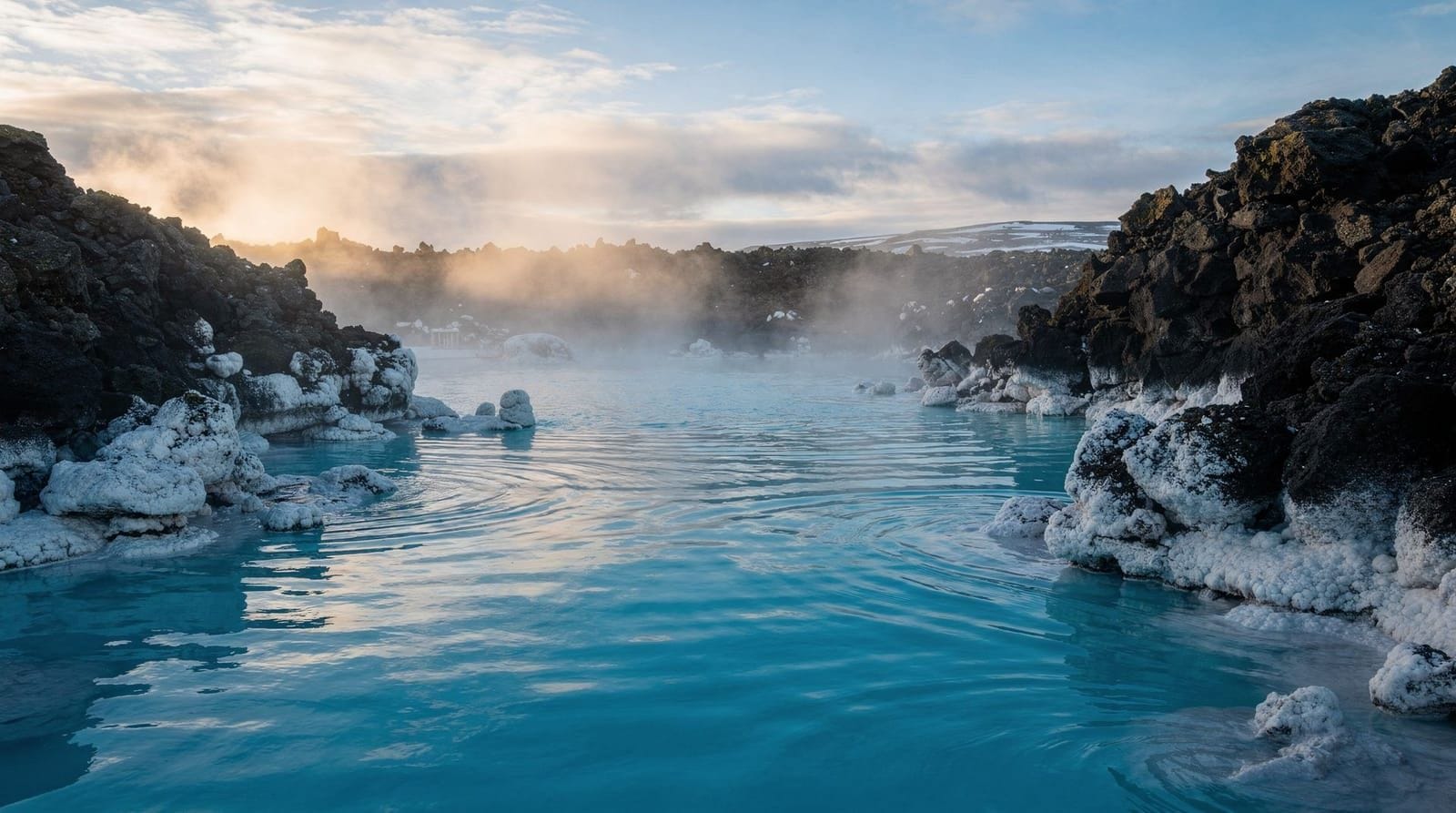
The pool is fed by several geothermal hot springs that bubble up through the floor and surrounding ground. The water temperature is maintained at 38–40°C year-round. The setting is a walled garden with the pool, a changing room, showers, and the surrounding natural hot springs visible around the pool edge — some reaching near-boiling and clearly marked.
Unlike the Blue Lagoon, no prebooking is required for most of the year (capacity can be reached on summer weekends, so afternoon visits are preferable). There is no fancy in-water bar, no silica mud mask ritual, and no Instagram-optimised LED lighting. There is a warm outdoor pool, clean facilities, and natural hot springs in the garden.
| Facilities | Changing rooms, showers, lockers, small shop; no food service on site |
| Mobile signal | Reliable in Flúðir village and at the pool |
| Parking | Free lot directly at the pool entrance |
| Wheelchair access | Flat path from changing rooms to pool; entry via steps — not fully accessible |
| Families | Straightforward for children of any age comfortable in a standard pool depth |
Secret Lagoon admission ticket — ISK 3,500 (EUR 23) for adults; ISK 1,750 (EUR 12) for children under 14. Towel rental ISK 700 (EUR 5); locker rental ISK 500 (EUR 3). Facilities include changing rooms and showers. Open daily from 10:00; closing times vary seasonally (18:00–20:00 in winter, 22:00 in peak summer).
The pool and its springs
The pool itself is approximately 38 by 11 metres, about 1.5 metres deep throughout. The geothermal water enters from multiple inlets, maintaining the temperature without artificial heating systems. The pool floor is natural pebble and sediment over a geothermal substrate.
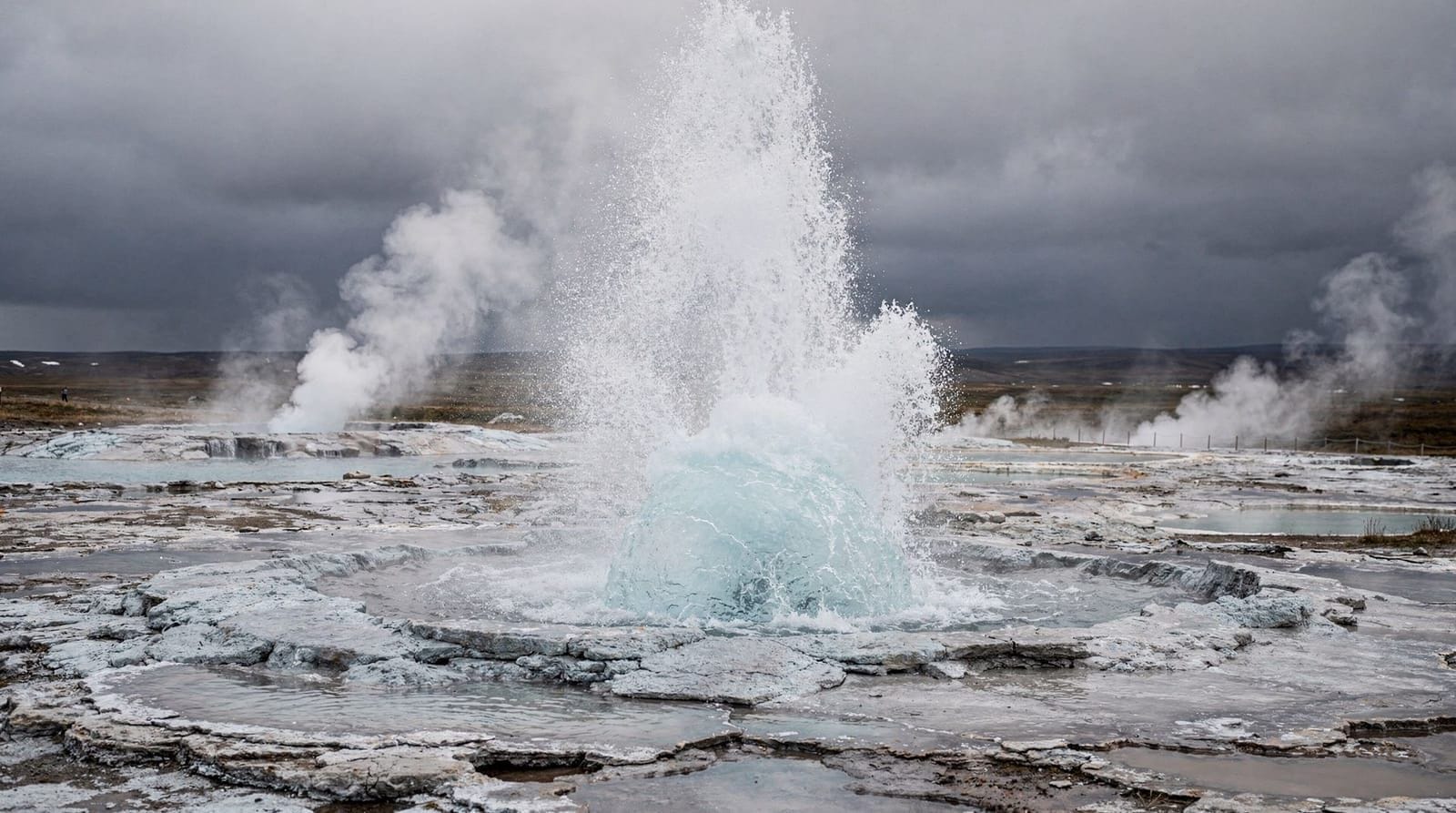
Around the edges of the pool garden, several natural hot springs and geysir-type vents are visible. One small geyser — locally called “little Strokkur” — erupts to a height of about a metre every few minutes, producing a satisfying burst of steam. The hot springs in the garden are between 80 and 100°C and are clearly marked and fenced.
The water in the pool has a slight mineral odour (hydrogen sulphide — the characteristic “rotten egg” smell of geothermal water) that is mild at the Secret Lagoon compared to some other pools. It dissipates immediately after showering.
Comparing the Secret Lagoon to the Blue Lagoon
This comparison comes up frequently, so it deserves a direct answer:
Blue Lagoon: Created as a byproduct of the Svartsengi geothermal power plant in the 1970s; not a natural lagoon. Price starts at ISK 12,000 (EUR 79) for basic entry and rises to ISK 20,000+ (EUR 130+) for premium packages. Prebooking required months in advance in peak season. Capacity: over 1,000 visitors per day. The water is milky-blue from silica suspension, genuinely unusual in appearance. The silica mud mask is included and genuinely good for skin. But it is a theme park around a geothermal pool, not a natural hot spring experience.
Secret Lagoon: A natural pool in a genuine village. ISK 3,500 (EUR 23). No prebooking required. Maximum capacity around 100–150 at a time. Clear water (not milky). No in-water services. Quieter, more human-scale, and a third of the price.
Neither is objectively better — they are different experiences. If you want the dramatic appearance, the silica treatment, and the polished hospitality infrastructure, the Blue Lagoon is the better choice. If you want a warm outdoor soak that feels more connected to actual Icelandic life, the Secret Lagoon is the better choice and significantly cheaper.
The Sky Lagoon near Reykjavík offers a third option: more commercial than the Secret Lagoon but more original than the Blue Lagoon, with a cliff-edge ocean view.
Flúðir village
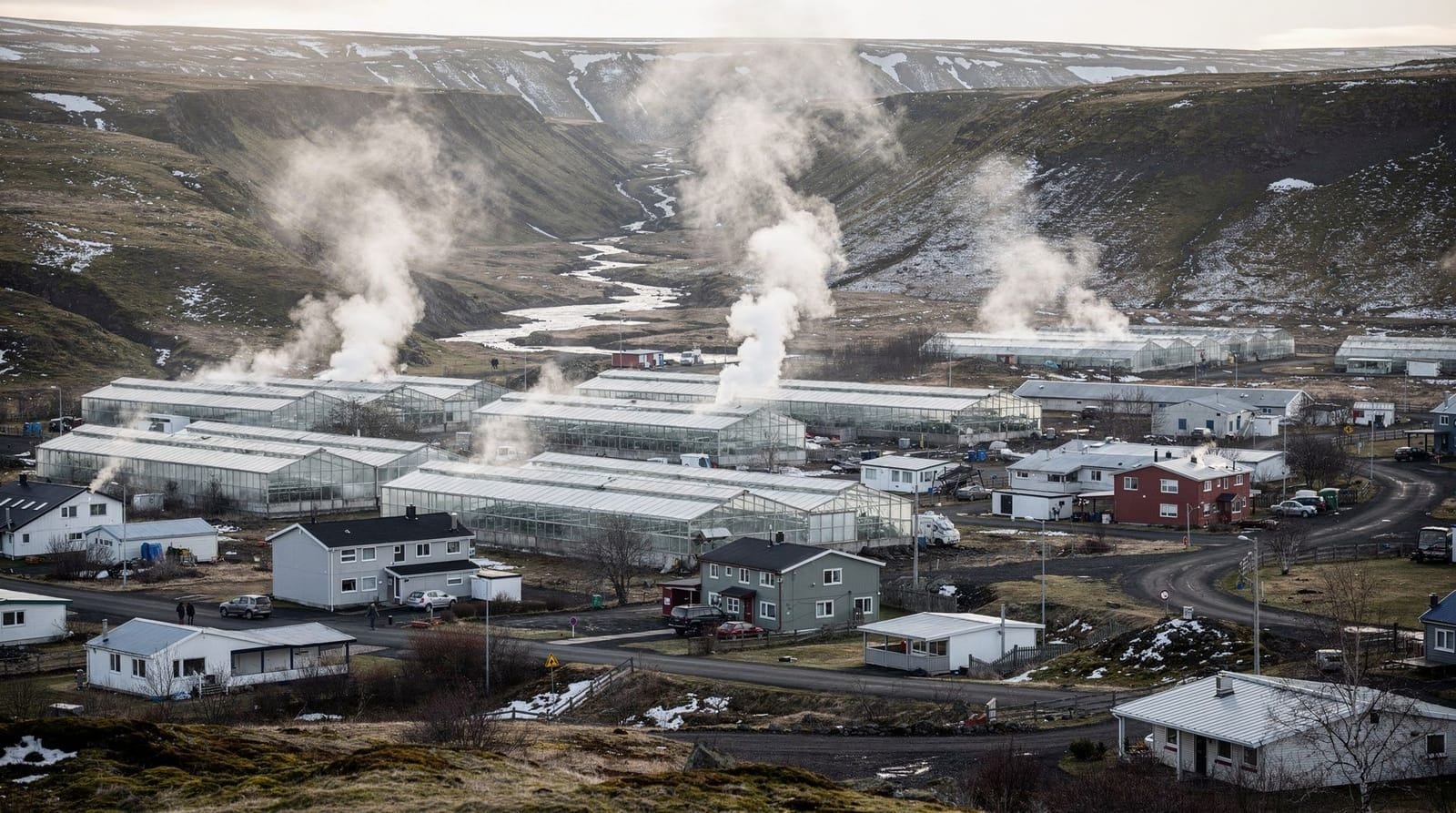
Flúðir (population ~400) is a small agricultural village in the Árnessýsla area of South Iceland, known primarily for mushroom cultivation. The village has a petrol station, a small supermarket (Krónan), a couple of cafés, and the swimming pool. The surrounding area is flat farmland and wetland.
This is not a tourist village in the usual sense — it functions as an agricultural community with a geothermal pool. The absence of tourist infrastructure beyond the pool itself is part of the appeal for visitors who find Reykjavík’s tourist areas overwhelming.
Getting there and combining with the Golden Circle
Flúðir is 15 km west of Geysir via Routes 35 and 30. It is not directly on the standard Golden Circle route, but adds about 30 minutes of detour to any Golden Circle day trip. The natural sequence:
- Þingvellir (Route 36 from Reykjavík)
- Geysir and Gullfoss (Routes 365 and 35 east)
- Return via Route 35 south, then Route 30 west to Flúðir for the Secret Lagoon
- Continue south to Selfoss and Ring Road 1 back to Reykjavík
This loop adds about 30–35 minutes of additional driving versus the direct return. Total driving on a Golden Circle + Secret Lagoon day: approximately 280 km.
Golden Circle and Secret Lagoon day tour from Reykjavík — the most popular combined format, covering Þingvellir, Geysir, Gullfoss, and the Secret Lagoon soak. ISK 17,000–21,000 (EUR 110–138). Transport from Reykjavík included; Secret Lagoon admission included in most versions (check before booking).
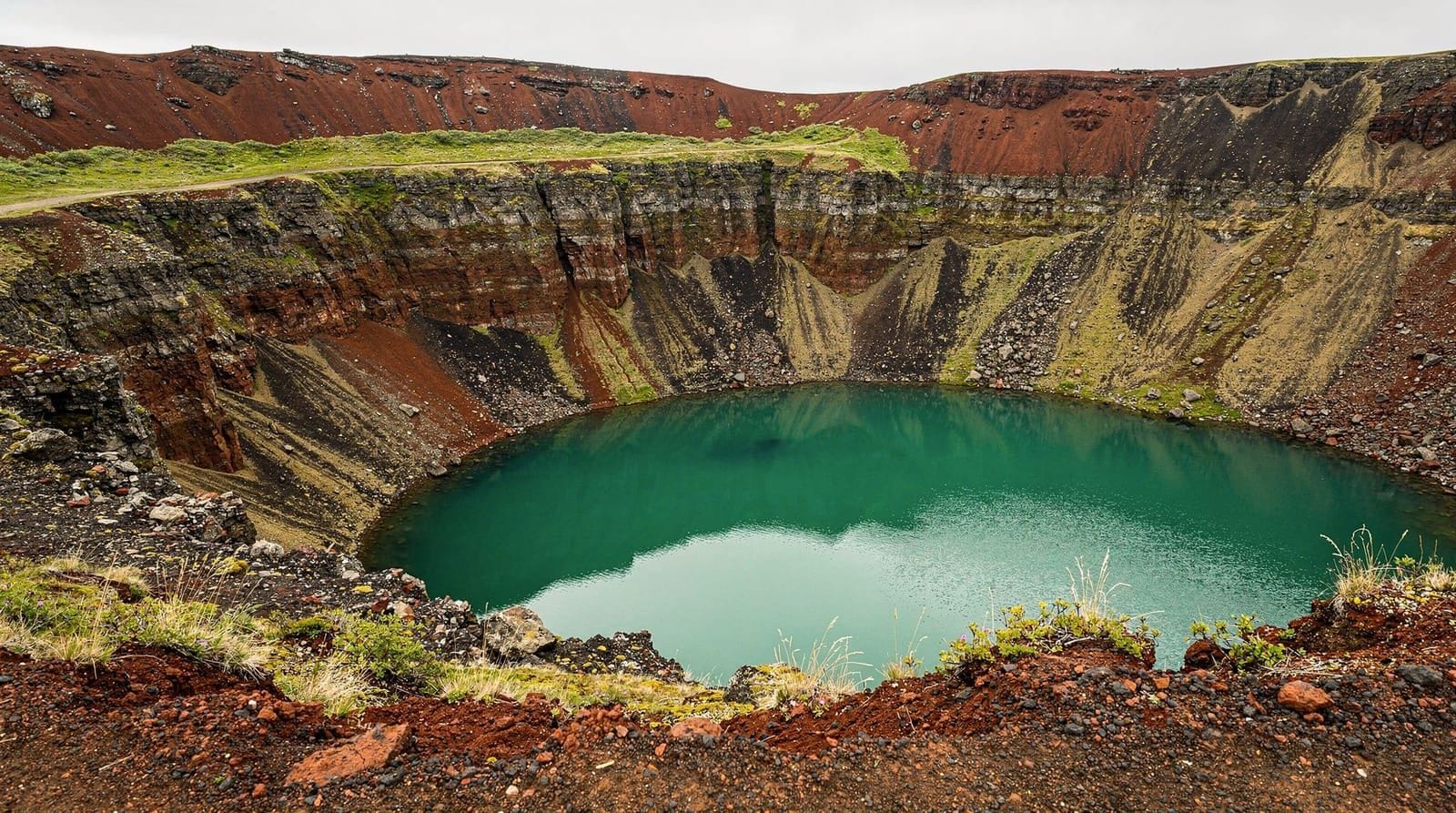
Golden Circle, Kerið, and Secret Lagoon from Reykjavík — extends the circuit to include Kerið crater. ISK 19,000–23,000 (EUR 125–150). A long but comprehensive day covering all the southern Golden Circle highlights.
Winter at the Secret Lagoon
Winter visits (October–March) are particularly atmospheric. The contrast between the warm water (40°C) and the cold air (often -5 to -10°C) creates a dense steam layer over the pool. On clear nights, the northern lights are visible from the pool — lying in warm water watching aurora activity overhead is the kind of experience that justifies the visit to Iceland in winter in the first place.
The pool is open year-round, including during snowfall. The path between the changing room and the pool is heated to prevent ice. The natural hot springs around the pool produce steam that is especially visible in cold air.
The history of Gamla Laugin
The original pool construction in 1891 was part of a broader Icelandic movement to formalise the use of geothermal water for communal bathing — a practice that had existed informally for centuries but began to take organised form in the late 19th century. The pool was used by the local community until the mid-20th century when local interest waned and newer pool facilities in larger towns drew visitors away.
The restoration project that led to the 2014 reopening was motivated partly by the growing tourism market and partly by local interest in preserving what had become a semi-derelict historical site. The restoration maintained the basic pool structure and the garden of natural hot springs while adding modern changing facilities, showers, and an access control system.
The result is a site that feels genuinely old — the pool walls, the surrounding springs, and the rural garden setting have an authenticity that purpose-built geothermal attractions cannot replicate. The small geyser-like vent in the garden has been active since before the pool was built.
Flúðir as a mushroom capital
Flúðir’s agricultural identity is tied to mushroom cultivation as much as to geothermal greenhouses. The combination of geothermal heat, reliable moisture from the lowland terrain, and the entrepreneurial use of heated growing conditions has made the area a significant supplier of button mushrooms to Icelandic supermarkets. Iceland imports most of its food, but Flúðir mushrooms are a domestic product.
The local Farmers’ Market (Bændamarkaðurinn) in Selfoss — held weekly in summer — includes produce from the Flúðir area and is worth visiting if you are interested in Icelandic domestic agriculture and local food. Selfoss is 40 km south of Flúðir on Route 1.
The wider geothermal context
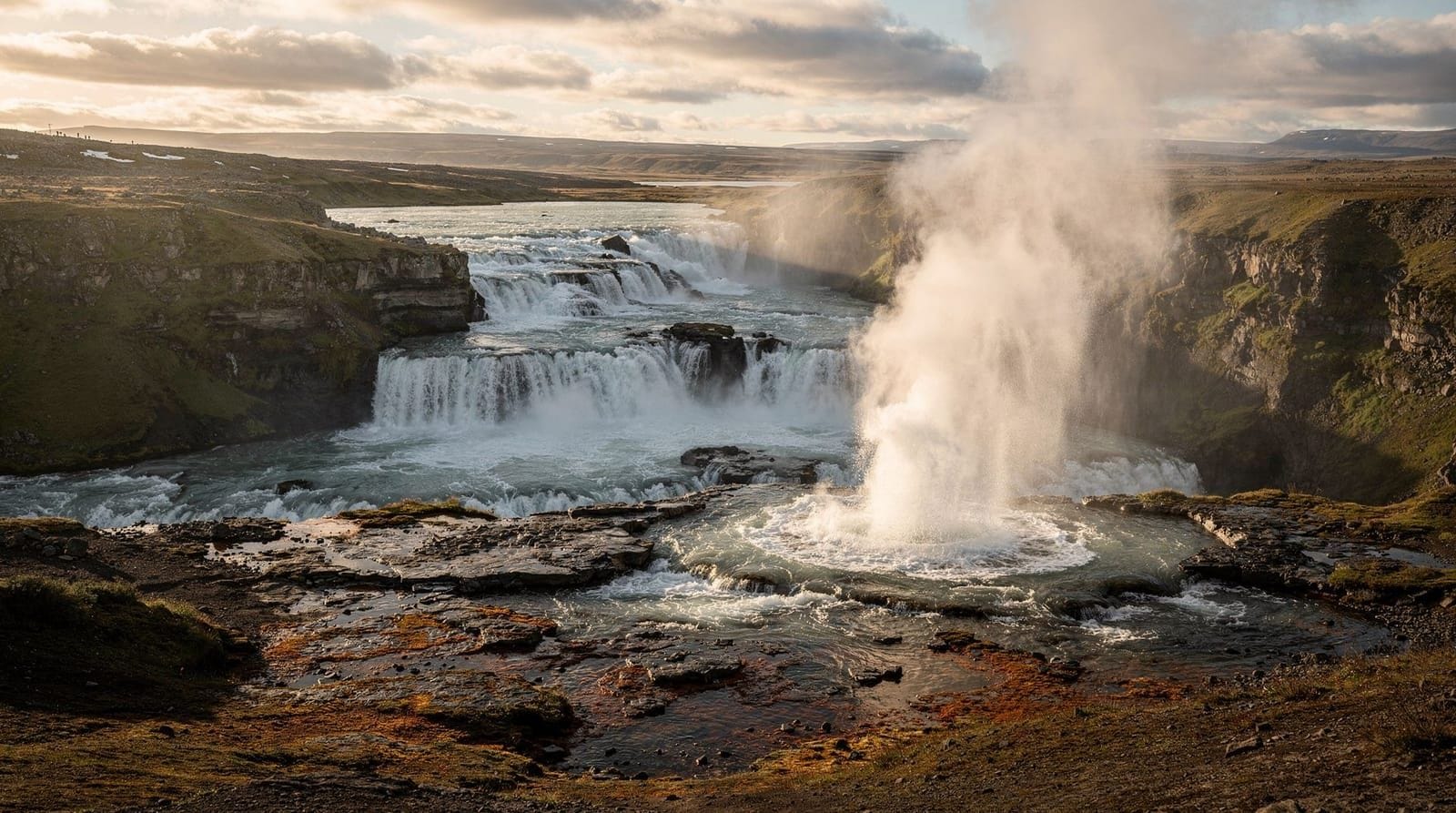
Flúðir and the Secret Lagoon sit within the South Iceland lowlands — a geologically active zone where the Western Volcanic Zone meets the South Iceland Lowland. The geothermal activity here is milder than at Geysir or Hveragerði, but the subsurface heat gradient is sufficient to keep the spring water at bathing temperatures year-round without any mechanical heating.
The geothermal spring that feeds the Secret Lagoon has been measured at approximately 70–80°C at the source. The mixing of this water with cooler groundwater and the pooling effect maintains the bathing temperature at 38–40°C in the pool itself. The flow rate from the springs is sufficient to keep the pool water fresh — it turns over completely several times per day, maintaining water quality without heavy chemical treatment.
What to eat in Flúðir
Flúðir’s food options are limited but adequate:
Café Rauðiháls: A small café in the village serving coffee, cakes, and light meals. ISK 500–1,800 (EUR 3–12). Open daytime hours in season.
The Secret Lagoon reception: Sells snacks, water, and chocolate. No hot food at the pool itself.
Selfoss (40 km south): The nearest town with restaurant options. Ram restaurant and Café Kaffi Krús are the main options for a proper meal. ISK 3,000–5,500 (EUR 20–36) for mains.
If you are continuing to Reykjavík from Flúðir, Selfoss has a Bónus and Nettó supermarket for picnic supplies.
Practical information
Opening hours: Daily. Summer (June–August) 10:00–22:00; shoulder season (April–May, September–October) 10:00–20:00; winter (November–March) 11:00–20:00. Hours may vary on public holidays.
Facilities: Changing rooms (separate male/female), showers, lockers, a small reception and shop. No café or food service at the pool itself.
Accessibility: The path from changing rooms to pool is flat. The pool entry is via steps at one end. Not fully wheelchair accessible; contact in advance if needed.
What to bring: Swimwear (required), towel (or rent ISK 700 / EUR 5), and flip-flops or sandals for the changing room area. No silica mud masks; no face mask treatment.
Capacity: Maximum around 100–150 visitors. On summer Saturday afternoons, the pool can reach capacity briefly (queue or return later). On weekday mornings and winter evenings, it is often quiet.
A practical note on the “secret” framing
The name “Secret Lagoon” is now entirely ironic. The pool receives tens of thousands of visitors per year and appears prominently in all Iceland travel guides, tour operator listings, and social media. The marketing origin of the name — evoking something off-the-beaten-path — dates from the 2014 reopening, when it genuinely was less well-known.
This is worth flagging because visitor expectations sometimes diverge from reality. The pool is not isolated, remote, or uncrowded on summer weekends. On a quiet weekday morning in May or October, you might have it nearly to yourself. On a Saturday afternoon in July, there will be 60–80 people in and around the pool. Neither extreme is unusual.
The advantage over the Blue Lagoon remains meaningful: walk-in access most of the time, no prebooking required, a fraction of the price, and a smaller human scale. But “secret” it is not.
Geothermal bathing culture in Iceland
Iceland has the highest density of natural hot springs per capita of any country, and bathing in geothermal water is genuinely embedded in everyday life. The municipal swimming pools (sundlaugar) in virtually every Icelandic town include at least one outdoor geothermal hot pot (heitur pottur) — heated to 38–44°C — where locals gather year-round for informal social contact.
The hot pot culture is different from spa culture: it is casual, social, and unadorned. Icelanders sit in hot pots year-round, in all weather. The experience at the Secret Lagoon is closer to this hot pot tradition than the Blue Lagoon’s spa experience. You are in warm water outside; you might be in snow or rain at the same time; this is considered normal and pleasant rather than difficult.
The Reykjavík municipal pools (Laugardalslaug, Vesturbæjarlaug) charge ISK 1,200 (EUR 8) admission and give a more authentic Icelandic bathing experience than any tourist-facing lagoon. Worth knowing if you are in Reykjavík and curious about how locals actually use geothermal water.
Fitting the Secret Lagoon into a Golden Circle day
Because Flúðir sits just off the main Golden Circle loop, the Secret Lagoon works best as the final stop of the day rather than a separate trip. A typical sequence — Þingvellir, Geysir, Gullfoss, then south via Route 35 to Flúðir — ends the day with a soak instead of a straight drive back to Reykjavík. This adds roughly 30–35 minutes of driving versus skipping Flúðir entirely, a small cost for what many visitors rate as the highlight of the day.
For visitors on the golden-circle-one-day itinerary, swapping in a Secret Lagoon stop instead of a highway rest break is a straightforward substitution that most self-drivers can make without restructuring the whole day. Guided tours that include the lagoon build this stop into the schedule already; confirm admission is included before booking, since some Golden Circle tours only stop at Flúðir without covering entry.
Frequently asked questions about the Secret Lagoon
Do I need to prebook the Secret Lagoon?
No prebooking is required for most of the year. On summer weekends (Friday–Sunday, July–August) the pool can reach capacity from about 14:00–17:00; weekday mornings and winter visits are generally walk-in with no wait. The website shows current availability but most visitors walk in without issues.
Can I visit the Secret Lagoon without a car?
It’s difficult without either a rental car or a tour. Flúðir has no direct public bus service well-suited to a day trip from Reykjavík, and the village itself, while pleasant, has limited walking-distance sights beyond the pool. The practical options are self-driving as part of a Golden Circle day or booking one of the combined Golden Circle and Secret Lagoon tours, which handle the transport entirely.
Is the Secret Lagoon as good as the Blue Lagoon?
It depends what you are looking for. The Secret Lagoon is smaller, less commercial, and considerably cheaper. It lacks the dramatic milky-blue water appearance and the silica treatment. The Blue Lagoon is a more polished product in a striking setting; the Secret Lagoon is a more authentic local experience. They serve different expectations.
Can I see the northern lights from the Secret Lagoon?
Yes, on clear nights from October to March. The pool is outdoors and unlit beyond the immediate pool area, so sky visibility is good. Aurora activity is weather and solar dependent — check vedur.is for the aurora forecast. Soaking in the pool while watching aurora overhead is a genuine highlight if conditions cooperate.
Is the water at the Secret Lagoon safe to be in?
Yes. The pool water is regularly monitored. The main geothermal springs in the surrounding garden are extremely hot (80–100°C) and clearly marked; stay clear of these. The pool water itself is maintained at 38–40°C, which is a safe bathing temperature.
How far is the Secret Lagoon from Reykjavík?
Approximately 100 km via Ring Road 1 east and Route 35; about 1 hour 15 minutes driving. It is more distant than the Golden Circle sites and requires a short detour from the direct return route, but is easily combined with a Golden Circle day.
Should I choose the Secret Lagoon or Sky Lagoon if I only have time for one?
It depends on your route. If you’re doing the Golden Circle, the Secret Lagoon fits naturally into that day with minimal added driving. If you’re staying closer to Reykjavík without a Golden Circle day, Sky Lagoon is more convenient — 20 minutes from the city centre — and offers a more polished spa experience (ocean view, multi-step ritual) at a higher price. Neither is a wrong choice; the decision mostly comes down to which fits your itinerary’s driving pattern.
Does the Secret Lagoon get busy, and when is it quietest?
Yes, on summer weekend afternoons — capacity of 100–150 can be reached between roughly 2pm and 5pm in July and August. Weekday mornings, and any time in shoulder season or winter, are typically quiet with no wait. If a calm, uncrowded soak matters more than timing around a Golden Circle day, aim for a weekday visit.
Top experiences
Bookable activities with verified prices and instant confirmation on GetYourGuide.
Top-rated experiences in Secret Lagoon at Flúðir — Iceland's oldest geothermal pool
Best-rated activities across GetYourGuide and Viator.