Golden Circle day trip from Reykjavík — complete practical guide
Reykjavik: From Reykjavik Golden Circle full day guided trip
How long does the Golden Circle day trip take from Reykjavík?
The standard Golden Circle loop (Þingvellir, Geysir, Gullfoss) takes 7–9 hours including driving. Adding Kerið crater adds 1 hour; adding the Secret Lagoon adds 2 hours. The total driving distance is 280–300 km. Depart Reykjavík by 08:00 to avoid peak crowds at midday.
The Golden Circle is Iceland’s most visited day route, and the crowds that implies should not dissuade you — the three main stops are genuinely impressive and can all be experienced well with the right timing. Þingvellir, the geyser field at Geysir-Haukadalur, and Gullfoss each represent something Iceland does unlike anywhere else.
The challenge is not the route itself but the timing. In July, Geysir has 4,000–5,000 visitors before 14:00. Arriving at 09:00 instead of 11:00 transforms the experience.
| Where | Þingvellir, Geysir, Gullfoss — 280–300 km loop from Reykjavík |
| Cost | Free sites + parking fees (~2,000–3,000 ISK total) + fuel/tour cost |
| Time needed | 7–9 hours core loop; 9–11 hours with add-ons |
| Best time | Depart Reykjavík by 08:00 |
| Getting there | Self-drive (all paved) or guided tour, no 4WD required in summer |
The three essential stops
Þingvellir National Park
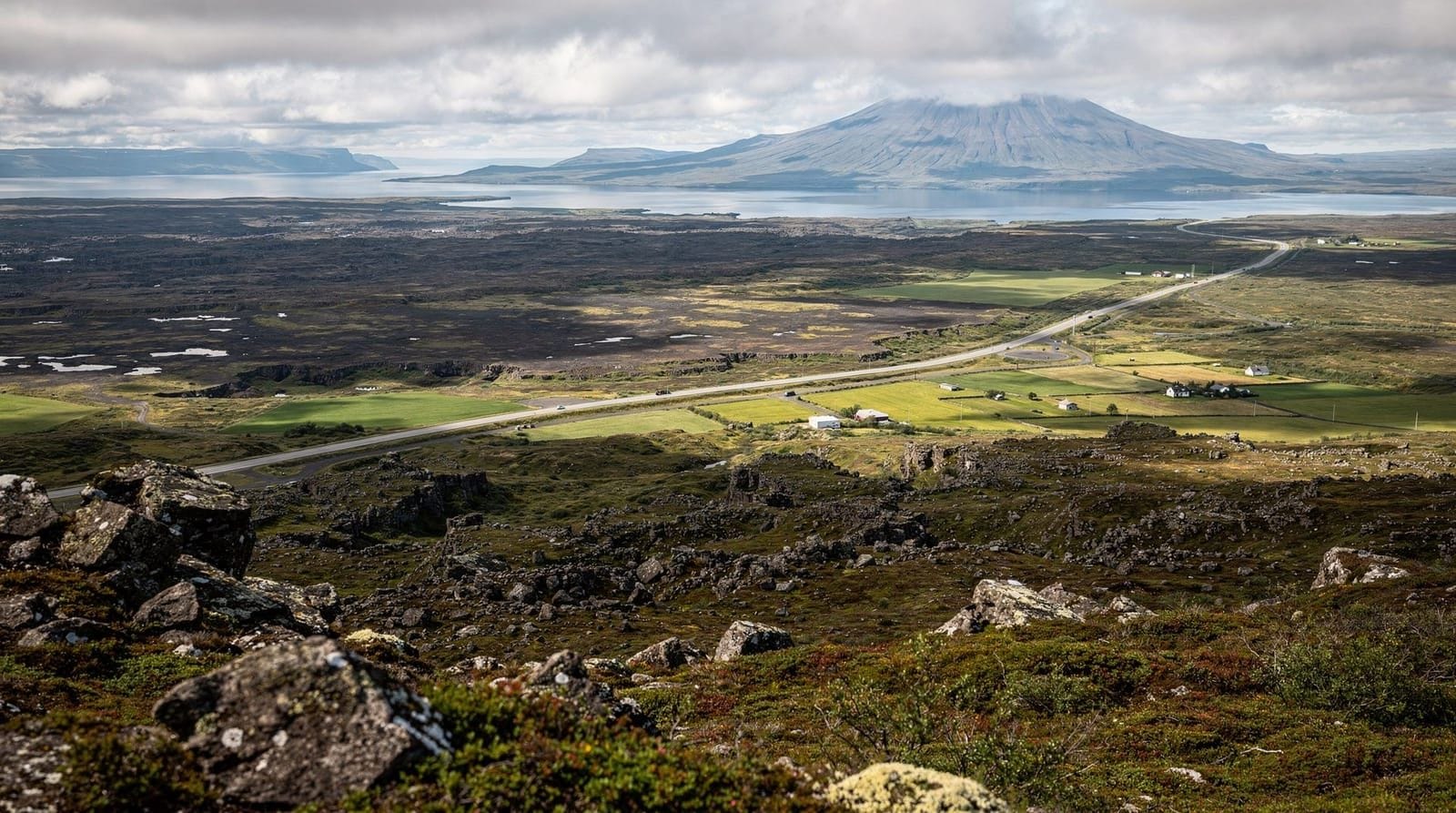
Þingvellir sits on the boundary between the Eurasian and North American tectonic plates. Walk the Almannagjá gorge and you are walking through a rift that has been opening at 2 cm per year for millennia. The geometry is visible: you are physically between two continents.
The Alþingi (Icelandic parliament) met here from 930 to 1798 AD — making this the site of the world’s oldest surviving parliament. The Law Rock (Lögberg) is marked; the dramatic acoustics of the Almannagjá gorge allowed the lawspeaker’s voice to carry without amplification.
The lake, Þingvallavatn, is Iceland’s largest and holds the clearest freshwater in Europe — used for snorkelling and scuba diving by advanced divers (Silfra rift, within the National Park, is world-famous for visibility). For day-trippers without a wetsuit, the viewpoint from Hakið above the park gives the best overview.
Allow: 1.5–2 hours minimum. The National Park Service centre near the car park has excellent context on the geology and history. Car park: 750 ISK (€5).
Geysir geothermal area
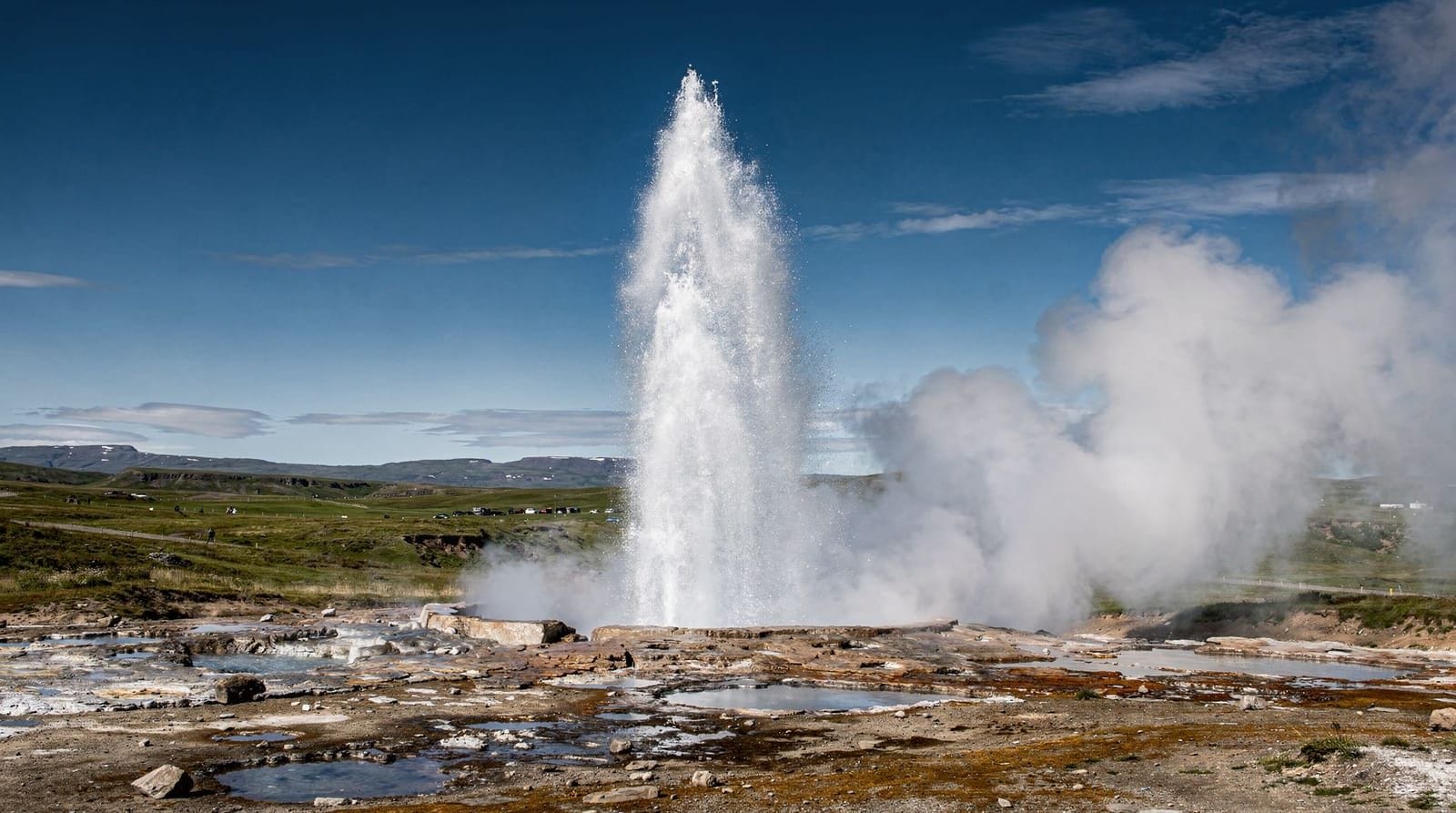
The word “geyser” comes from this specific place — Geysir (from Old Norse geysa, to gush) is the original. The main Geysir spring is now largely dormant, but the neighbouring Strokkur erupts every 4–8 minutes to 20–30 m, producing a reliably crowd-pleasing spectacle.
Approach: the eruption is entirely predictable in frequency but not to the second. Wait within 50 m of the spring; when the dome of water begins to build (a few seconds before the eruption), the crowd instinctively pulls out phones. The actual eruption lasts 1–3 seconds.
The surrounding geothermal field has several boiling pools, steam vents, and a mud pot. The paths are clearly marked; stay on them — the area is active and the ground crust is thin.
There is a large gift shop, café, and restaurant at the Geysir hotel. Food is acceptable but overpriced — if you are adding Friðheimar for lunch, skip the Geysir café.
Allow: 45 minutes to 1 hour.
Gullfoss
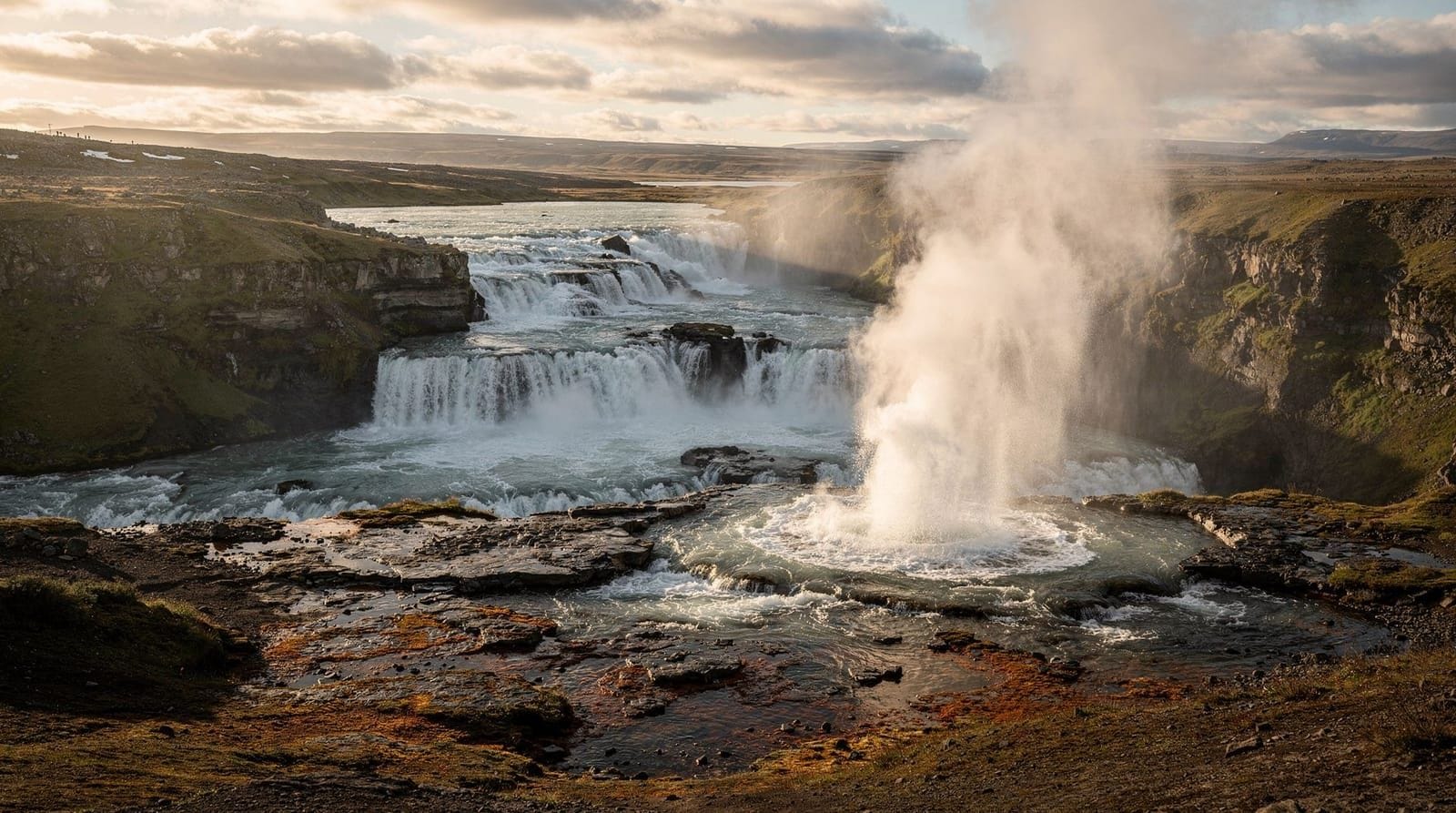
Gullfoss (“Golden Falls”) is a two-tiered waterfall on the Hvítá glacial river, dropping a combined 32 m into a narrow gorge. The upper viewpoint gives a panoramic view; a lower path descends close to the first drop and spray.
In high water (spring melt, May–June), the power of Gullfoss is formidable. In winter, ice formations around the falls are beautiful. In summer, rainbows appear regularly in the mist.
The café and visitor centre at Gullfoss serve adequate soup and coffee. There is a small heritage exhibit about Sigríður Tómasdóttir, who campaigned successfully in the 1920s to prevent the falls being harnessed for electricity generation.
Allow: 45 minutes to 1 hour.
Guided tours versus self-driving
Self-driving the Golden Circle is straightforward. All routes are paved; there are no ferry crossings, river fords, or complex navigation decisions. A standard rental car (including compact 2WDs) is appropriate year-round except in severe winter conditions.
The advantage of self-driving: arrive at each stop before or after guided tour buses; pause as long as you want; add spontaneous stops.
The advantage of a guided tour: expert commentary at each stop, no driving fatigue on return, and cheaper than rental car + fuel for solo travellers.
Golden Circle full-day guided tour — Þingvellir, Geysir, Gullfoss, expert English guide, hotel pickup from ReykjavíkFor small groups (2–4 people): rental car typically beats the guided tour on value. For solo travellers or couples who want context: guided tours are good value.
Best add-ons to extend the Golden Circle
Kerið volcanic crater (+45 min)
Kerið is a 3,000-year-old explosion crater lake with vivid russet-red walls and a turquoise lake at the bottom. A path circles the full rim (about 20 minutes) with views across the crater. Adult admission 900 ISK (€6). Located 15 km south of the main Golden Circle loop on Route 35, making it an easy addition when driving back toward Reykjavík.
Secret Lagoon, Flúðir (+2 hours)
The Secret Lagoon at Flúðir is a natural geothermal pool that has operated since 1891 — Iceland’s oldest swimming pool. The temperature is around 38–40°C year-round. Entry is 3,500 ISK (€23) for adults (includes swim cap). Unlike the Blue Lagoon, there is no elaborate infrastructure — changing rooms, a snack bar, and the pool. Situated 20 km from Gullfoss.
Friðheimar tomato greenhouse (+1.5 hours)
Friðheimar is a geothermally heated greenhouse farm that grows tomatoes year-round near Reykholt on the Golden Circle route. The farm restaurant serves an all-tomato menu (tomato soup, tomato-based pasta, tomato Bloody Mary) and is excellent — comfortably the best lunch option on the Golden Circle. Reservations recommended in peak season.
Snorkelling or diving Silfra (+3 hours)
The Silfra rift in Þingvellir National Park offers snorkelling and scuba diving in glacial meltwater filtered through lava for 30–100 years. Visibility is 80–100 m — among the best freshwater visibility on Earth. The water is 2–4°C; dry suits are provided. This turns the Golden Circle into a full adventure day. See snorkelling at Silfra.
Timing advice
Peak July/August crowds at Geysir: 10:00–15:00 is when 80% of guided tours arrive. If you are self-driving, arrive at Geysir by 08:30–09:00 or wait until 16:00+.
Þingvellir before 09:00 gives you the gorge almost to yourself. Many people drive through mid-morning and leave by 10:00, but arriving at 08:00 for the first light is genuinely special.
Gullfoss in evening light (after 18:00 in summer, from June to August when daylight is nearly 24 hours) gives warm golden light on the falls and dramatically reduced crowds.
Getting to the Golden Circle without a car
Bus transfers: the Strætó bus company runs a service from the BSÍ bus terminal in Reykjavík to Þingvellir, Geysir, and Gullfoss (the Excursion Passport). However, bus times are fixed and waiting between stops is time-consuming. Guided tours are more efficient if you don’t have a rental car.
Premium Golden Circle minibus tour — Þingvellir, Geysir, Gullfoss, Kerið, Friðheimar lunch, small group (max 19), with hotel pickupThe Golden Circle in winter
Winter Golden Circle conditions:
- Roads open and passable year-round (check vedur.is daily)
- Gullfoss partially frozen in January–February with ice formations
- Geysir steam more dramatic in cold air
- Þingvellir under snow is exceptionally beautiful
- Crowds reduced by 70–80% compared to summer
A 4WD is strongly recommended from November to March. Departure time should be adjusted to daylight hours: depart at 09:00 in December (sunrise around 11:15), allowing all stops in the 4-hour daylight window.
Itinerary timing
A standard Golden Circle day from Reykjavík:
- 08:00: Depart Reykjavík
- 09:00–10:30: Þingvellir
- 11:00–11:45: Geysir
- 12:00–13:00: Gullfoss (lunch at café or packed)
- 13:30–15:00: Kerið and/or Secret Lagoon
- 16:30–17:00: Return to Reykjavík
Add Friðheimar lunch: swap the Gullfoss café stop and add 1 hour to the midday section.
Frequently asked questions about the Golden Circle day trip
How early should I book a Golden Circle tour?
For peak summer (July–August): book 2–4 days ahead for standard tours. Small group tours (max 8–16 people) fill faster — book a week ahead. For private tours, 1–2 weeks ahead.
Is the Golden Circle suitable for children?
Yes, it is one of the more family-friendly day trip routes in Iceland. The Geysir eruption is reliable and thrilling for children. Þingvellir has walking at all difficulty levels. Gullfoss viewing platform is accessible (some steps). The driving between stops is manageable for most children.
Can I do the Golden Circle and the South Coast in consecutive days?
Yes, and this is a very common two-day itinerary from Reykjavík. The Golden Circle is clockwise/north-east from Reykjavík; the South Coast is due east along the Ring Road. Different directions, no overlap.
Where do I park at Geysir?
The Geysir Hotel operates the car park, which costs around 800 ISK (€5) in peak season. Arrive before 09:00 to park right at the site; after 10:00, the overflow car park is used. The walk from overflow to the geyser area is about 400 m.
Is it worth doing the Golden Circle in half a day?
Only if you accept a compromise: pick two of the three main sites and do them properly rather than rushing all three. Geysir and Gullfoss pair well as a focused half-day; save Þingvellir for a day with more time.
How much does a self-drive Golden Circle day actually cost?
For two people including fuel, parking, Kerið, and a Friðheimar lunch, expect roughly 14,000–17,000 ISK total — considerably less per person than a guided tour with the same stops.
Practical food options on the Golden Circle
The Golden Circle has adequate but not exceptional food options. Planning ahead avoids disappointing midday stops.
Friðheimar tomato greenhouse (near Reykholt, between Geysir and Gullfoss): the standout food option on the route. An all-tomato menu in a working greenhouse heated by geothermal energy. Tomato soup (1,800 ISK / €12) is genuinely good; the tomato-based pasta dishes are filling. The novelty of dining surrounded by tomato plants in mid-Iceland is genuine. Reservation required in peak season (book online).
Geysir Hotel café: adequate lunch options at tourist prices — soup, sandwiches, buffet items. Use it if timing forces it, but Friðheimar is a better choice if you plan ahead.
Gullfoss café: similar to Geysir — functional, overpriced. A good coffee-and-cake stop.
Skálholt cathedral (15 km south of Route 35, en route back from Gullfoss): a significant historical site — the bishopric of Iceland from 1056 to 1785. The modern cathedral rebuilt in 1963 is architecturally interesting, and the exhibition covers Iceland’s religious history. The small café serves good coffee and traditional Icelandic pastries. A worthwhile 20-minute detour on the return leg.
The Golden Circle beyond the standard circuit
The three anchor stops define most visits, but the area has more depth:
Bruarfoss waterfall: a small but vivid turquoise waterfall on the Bruará river, 8 km from the main Route 35 near Laugarvatn. Reached by a 30-minute walk from the roadside car park. The intensely blue-green water colour is unusual — fed by springs that maintain a consistent mineral temperature.
Laugarvatn Fontana: a geothermal bath and spa on the shores of Lake Laugarvatn. Entry around 4,500 ISK (€29). The geothermal steam rooms built over hot springs and the outdoor pools make this a mid-circuit relaxation option. The bakery next door bakes rye bread in the geothermal ground — one of Iceland’s more unusual culinary experiences.
Haukadalur forest: the valley around the Geysir area was partially planted with Icelandic birch and introduced conifers as part of a reforestation programme. A 30-minute walking trail through the forest above the geothermal field is quiet and pleasant — a contrast to the crowded geyser area below.
Understanding Þingvellir in depth
Þingvellir deserves more than a 45-minute walk-through. The site layers geology, political history, and natural history in a way that rewards closer attention.
The main gorge (Almannagjá) is a 7.7 km rift valley formed where the Eurasian and North American plates pull apart. The rifting has opened by about 70 m in total over the past 10,000 years and continues at 2 cm per year. Walking through the gorge, the scale of the geological forces involved becomes physical rather than abstract.
The parliamentary site (Lögberg, the Law Rock) is marked with an Icelandic flag. The Alþingi met here for more than 800 years without interruption — settlers from across Iceland would ride for days to attend. Laws were announced orally from the rock; the acoustics of the gorge allow a voice to carry 100–200 m without amplification.
The lake, Þingvallavatn, is Iceland’s largest at 84 km². It is fed by the lava-filtered groundwater of the surrounding highlands, giving exceptional clarity. The snorkelling and scuba diving in the Silfra rift — a fissure between the tectonic plates filled with this filtered water — achieves 80–100 m visibility, among the best freshwater visibility on Earth. Full Silfra snorkelling details in a separate guide.
For the Golden Circle itinerary, an early start at Þingvellir (08:00 or earlier) is the most rewarding approach. The gorge at dawn, before the tour buses arrive, is one of Iceland’s quieter moments.
Budget breakdown for a self-drive Golden Circle day
Being specific about costs helps with trip budgeting. For a self-driving couple in a rental car:
| Item | Approximate cost |
|---|---|
| Fuel (Reykjavík round trip, ~300 km) | 4,000–5,000 ISK |
| Þingvellir parking | 750 ISK |
| Geysir parking | 700–800 ISK |
| Gullfoss parking | Free |
| Kerið admission | 900 ISK per adult |
| Lunch at Friðheimar | 3,500–5,500 ISK per person |
| Total (2 people, with Kerið + Friðheimar lunch) | ~14,000–17,000 ISK for the car and both people |
This compares to 20,000–36,000 ISK per person for a guided full-day tour with the same stops — meaning a couple self-driving with lunch included spends roughly what one person pays for a guided tour. The trade-off is your own driving time and no expert narration; see the self-drive vs guided comparison above for which matters more to you.
What a rushed Golden Circle actually looks like
Some visitors, usually those combining the Golden Circle with an arrival or departure day, try to compress the loop into 4–5 hours. This is possible but changes the experience substantially: Þingvellir becomes a 20-minute photo stop rather than a proper gorge walk, Geysir becomes “wait for one eruption and leave,” and Gullfoss is a five-minute upper-viewpoint glance with no time for the lower platform.
If your schedule genuinely only allows a half-day, it is better to choose two of the three sites and do them properly than to rush all three. Geysir and Gullfoss are 10 minutes apart and pair well as a half-day pair; Þingvellir stands better as a separate, unhurried visit if you have another day free.
Top experiences
Bookable activities with verified prices and instant confirmation on GetYourGuide.
Top experiences
Best-rated activities across GetYourGuide and Viator.

From Reykjavik: Snaefellsness Peninsula small group day tour
- Viator

Lake Myvatn Day Tour and Godafoss Waterfall for Cruise Ships from Akureyri Port
- Viator

Private Jökulsárlón Glacier Lagoon 2 Day Tour & Glacier Hike
- Viator

From Reykjavik: Katla Ice Cave and South Coast Day Tour
- Viator

Reykjanes Peninsula Private Day Tour - up to 9 passengers
- Viator

Thorsmork Hike Day Tour
- Viator