Goðafoss travel guide
Goðafoss, the Waterfall of the Gods, is 50 km from Akureyri on the Ring Road. Best viewpoints, visiting tips, and how to combine it with Mývatn.
Akureyri: Port Godafoss waterfall classic tour
Duration: 2.5-3 hours
Quick facts
- Best time
- Year-round; most water Jun–Jul; ice formations Dec–Feb
- Days needed
- 1–2 hours
- Getting there
- 50 km east of Akureyri via Ring Road, ~45 min drive
- Budget per day
- Free entry; budget for fuel and food
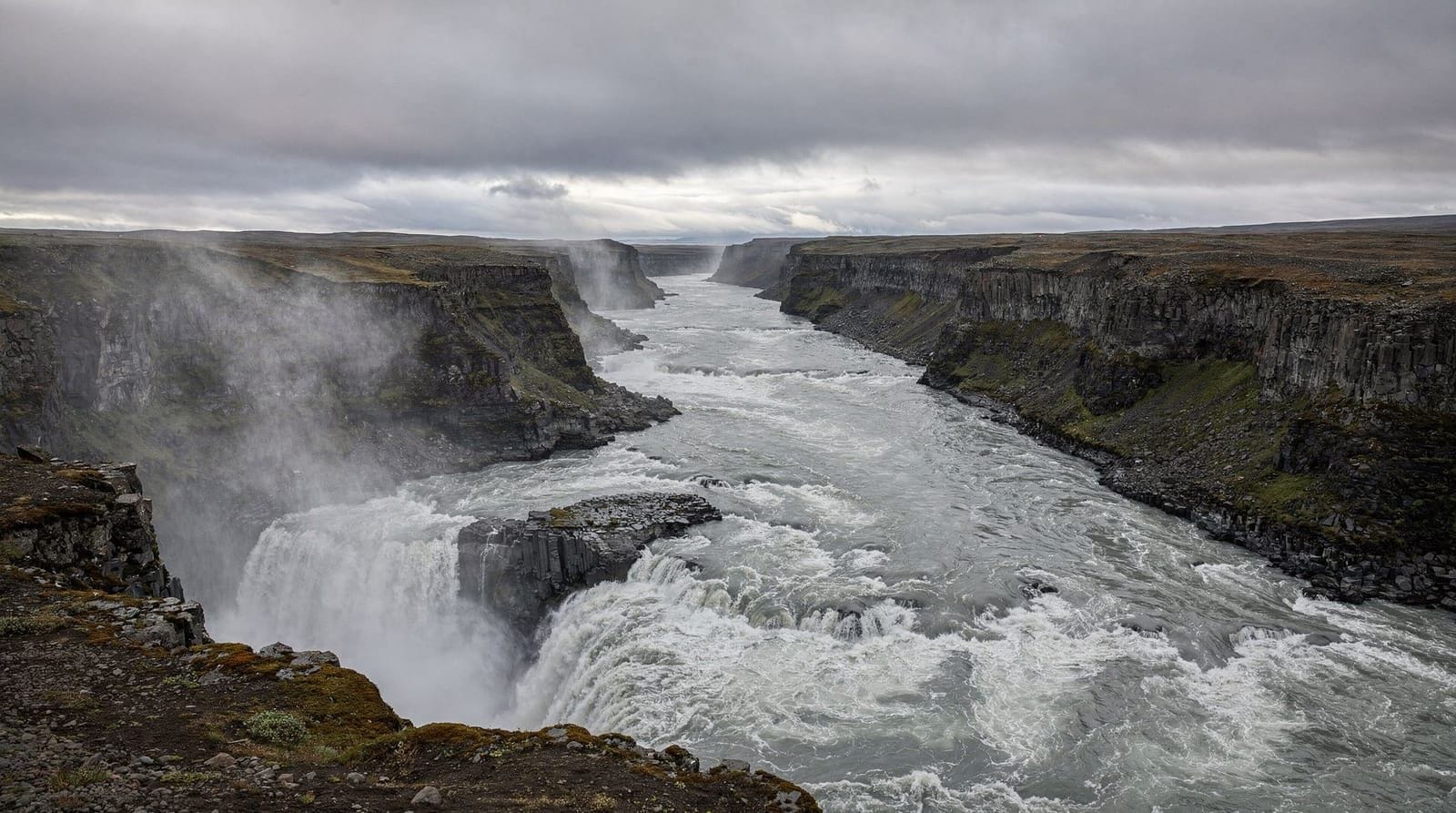
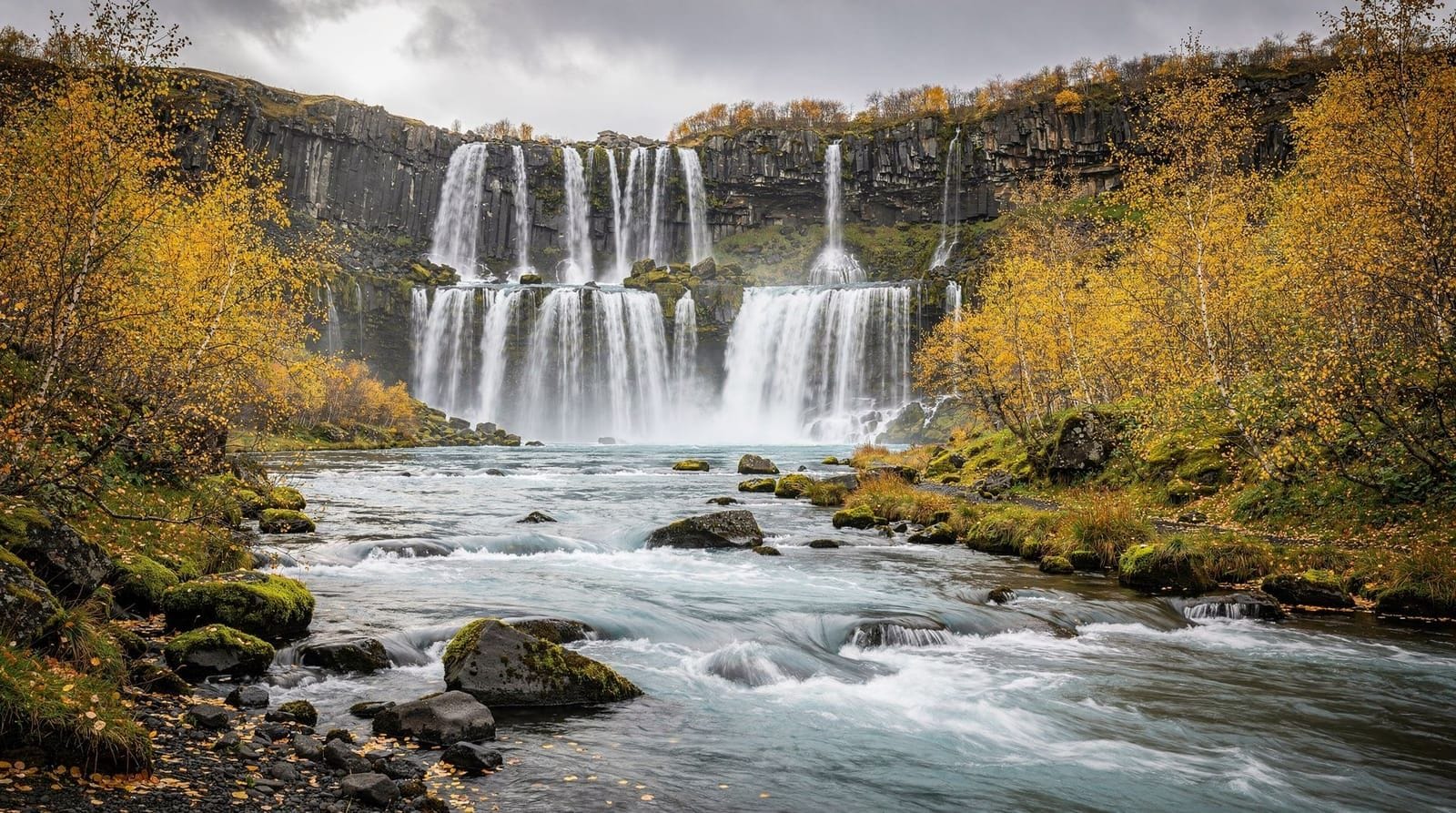
Goðafoss — the “Waterfall of the Gods” — sits beside the Ring Road 50 km east of Akureyri, where the Skjálfandafljót river drops 12 metres over a basalt horseshoe some 30 metres wide. It is not Iceland’s tallest or most powerful waterfall, but it may be the most complete: the crescent shape, the black basalt columns on both banks, the volume of water, and the ease of access combine to make it one of the most photographed waterfalls in the country.
| Where | Ring Road, 50km east of Akureyri |
| Cost | free entry and parking |
| Time needed | 30–45 minutes for both viewpoints |
| Getting there | self-drive Ring Road, or as part of an Akureyri day tour |
| Best time | June–July for maximum flow; Dec–Feb for ice formations |
Every driver on the Ring Road through North Iceland passes within a kilometre of Goðafoss. The car park is signed; the walk to the best viewpoints takes 5–10 minutes. Entry is free. If you are driving between Akureyri and Lake Mývatn, stopping here adds 30–45 minutes to your journey and is unambiguously worthwhile.
The historical significance
The name is not decorative. In the year 1000 AD, a man named Þorgeir Ljósvetningagoði — the law-speaker of Iceland’s parliament, the Alþingi — was tasked with resolving a deepening conflict between the country’s Christians and pagans. After a night of deliberation wrapped in furs, he declared that Iceland would adopt Christianity as the official religion. On his return north, he is said to have thrown his carved wooden statues of the Norse gods into the falls now bearing their name.
The story is recorded in Njáls saga and regarded by historians as broadly accurate. Whether the statues literally landed in these falls or in another part of the river is debated, but the location has been accepted as Goðafoss since the 12th century.
What to see and where to stand
East bank
The car park serves the east bank. A path leads to the main viewpoint above the falls on the eastern side — this is where most photographs are taken. From here you can see the full horseshoe shape and the main drop. The basalt columns on the far bank are clear. Getting lower, to the base of the eastern bank, involves a short scramble on wet rock; the spray is significant in high flow.
West bank
A separate car park (signed from the Ring Road slightly west of the main car park) accesses the west bank. The path along the west bank gives a different angle — looking upstream at the falls’ approach, and then level with the crest. In summer, walking the full arc from east car park to west car park takes about 30 minutes; crossing between the two requires using the Ring Road bridge, not possible on foot in the middle.
The small cascade
Just downstream from the main falls, a smaller cascade is visible from the east bank. This is photogenic in winter when ice formations build up around it.
Photography notes
The east bank viewpoint is east-facing, which means afternoon and evening light (north Iceland summers give golden light until midnight) is better than morning. The falls run roughly east-west; for sunrise-direction shots, the west bank gives more options. A polarising filter helps cut glare from the spray.
Ice in winter (typically December through February) transforms the falls completely — the edges freeze but the centre runs free, creating half-iced formations that photograph well. Winter driving adds complexity; the Ring Road is ploughed, but ice can make the car park approach slippery.
Combining Goðafoss with other sights
Goðafoss is almost never a standalone destination — it is a natural component of either an Akureyri day trip or a Diamond Circle drive.
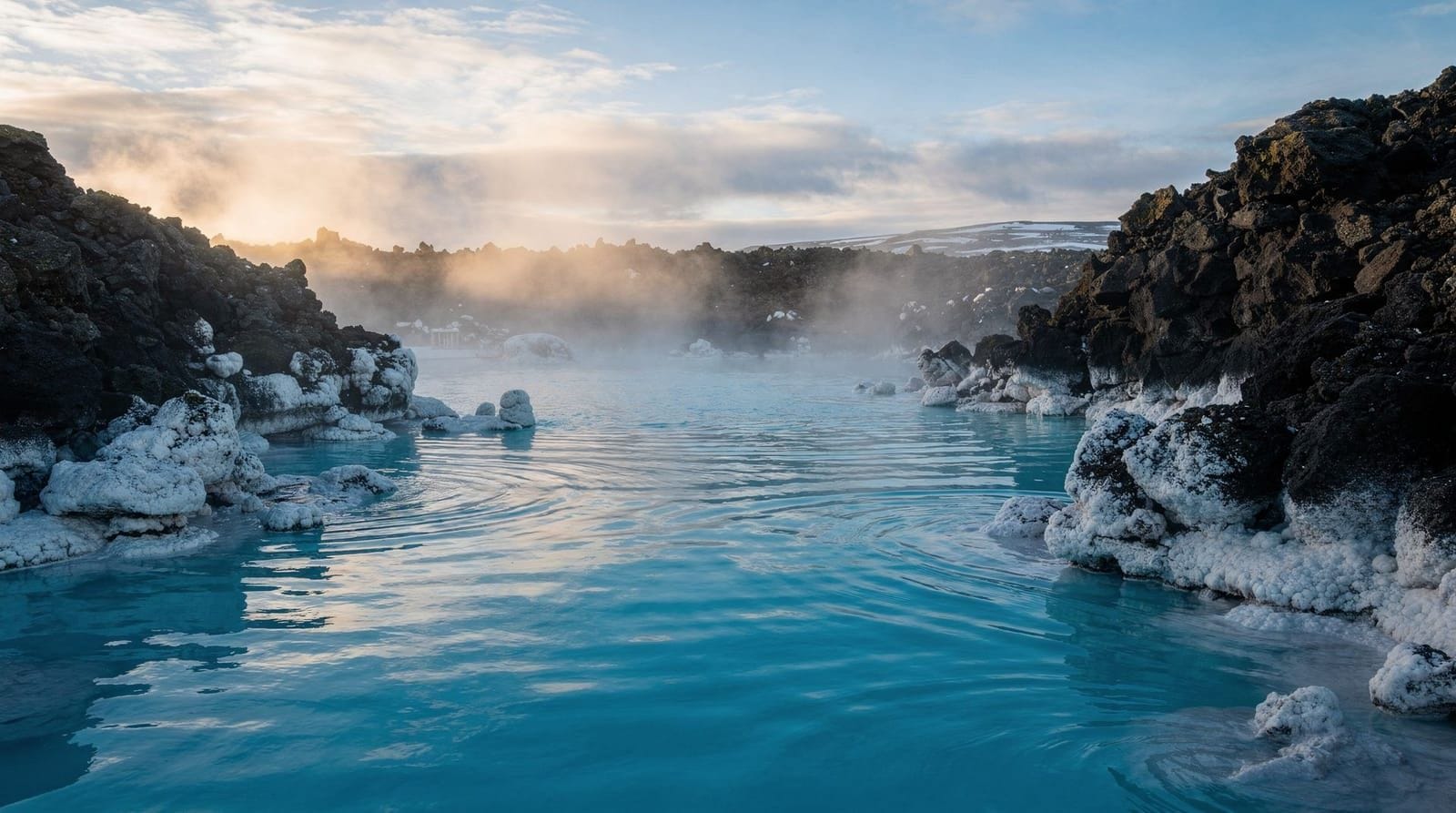
Goðafoss + Mývatn Nature Baths: From Goðafoss, continue east 50 km (40 minutes) to Lake Mývatn and the Nature Baths. This is the most popular combination and takes about 4–5 hours total from Akureyri and back.
Goðafoss + Dettifoss: Dettifoss is 70 km east of Goðafoss via the Ring Road and Route 862/864. Combining both in a single day from Akureyri makes a full 8–9 hour day.
Goðafoss + Forest Lagoon: The Forest Lagoon near Akureyri can be combined with a Goðafoss stop — have the falls in the morning, the lagoon in the afternoon.
Akureyri port: Goðafoss waterfall and Forest Lagoon combined tour.
Tours departing from Akureyri also combine Goðafoss with Mývatn or the full Diamond Circle:
Day trip from Akureyri: Goðafoss waterfall and Mývatn Nature Baths.
Cruise calls at Akureyri leave a narrow window and the falls are forty minutes east: a Goðafoss tour from Akureyri port collects at the quay and returns to it, which is the only version that fits a shore day.
Practical information
Entry fee: None. The car parks on both sides are free.
Opening hours: The falls themselves are accessible 24 hours. The toilets and café near the east car park operate daytime hours in summer.
Facilities: A small service building near the east car park has toilets and a basic café/kiosk. The café is seasonal (May–October approx). Bring food if visiting in shoulder seasons.
Crowds: Goðafoss is busy in July and August. Arrive before 9am or after 6pm to have the main viewpoint to yourself. It is a standard stop on Ring Road bus tours; coaches arrive throughout the day.
Safety: The viewing platforms are fenced in key areas but the river above the falls is not. Keep back from the waterfall edge, especially with children. The rocks near the spray are slippery year-round.
River and geology
The Skjálfandafljót is the third longest river in Iceland at 186 km, rising in the Highlands and flowing north to the sea near Húsavík. The horseshoe shape of Goðafoss results from glacial erosion in the post-Ice Age period and ongoing erosion by the current — the falls are slowly retreating upstream. The basalt columns flanking the falls formed when lava cooled slowly in a regular pattern, contracting into hexagonal pillars.
Getting there
From Akureyri: Take the Ring Road east. Goðafoss is signed on the right (east bank) approximately 50 km from Akureyri. The drive takes around 45 minutes.
From Mývatn: Take the Ring Road west for 50 km; approximately 45 minutes.
From Reykjavík: Following the Ring Road all the way is 6+ hours. Most visitors fly or drive to Akureyri and treat Goðafoss as a day trip.
There is no public bus that stops at Goðafoss itself, though Strætó route buses pass nearby; confirm current stop locations at straeto.is.
Fuel and services near Goðafoss
There is no petrol station at Goðafoss itself. If you’re self-driving, fuel up in Akureyri before heading east, or at the small station near Mývatn if approaching from that direction. Mobile signal is generally reliable along this stretch of the Ring Road, unlike some of Iceland’s more remote highland routes, but it’s still worth having offline maps loaded for the drive in shoulder-season weather when road conditions can change quickly.
EV charging: fast chargers are available in both Akureyri and at Mývatn, but not at Goðafoss directly — plan a charging stop at one end of the drive rather than assuming you can top up at the falls.
Cruise ship visitors and Akureyri port calls
Goðafoss is a common inclusion on Akureyri cruise-port shore excursions, since it’s close enough to fit within a typical port call window while still delivering a genuine North Iceland landscape experience. A half-day tour combining Goðafoss with either the Forest Lagoon or a short Mývatn stop is achievable within most cruise schedules; check your ship’s departure time carefully, since the round trip from the port plus time at each stop can run 4–5 hours.
Akureyri port: Goðafoss waterfall, Santa Claus House and Forest Lagoon tour.
Basing yourself for a Goðafoss visit
Most visitors reach Goðafoss from one of two bases, and the choice affects how you structure the rest of the day:
| Base | Distance to Goðafoss | Natural pairing |
|---|---|---|
| Akureyri | 50 km, ~45 min | Forest Lagoon, Mývatn Nature Baths, or the full Diamond Circle |
| Húsavík | 90 km, ~1 hr 15 min | Whale watching in the morning, Goðafoss on the way to or from Mývatn |
| Mývatn | 50 km, ~45 min | Combine with the Mývatn geothermal area sights on the same day |
If you’re doing the Diamond Circle as a loop rather than an out-and-back, Goðafoss works naturally as either the first or last stop of the day depending on which direction you drive the circuit.
Frequently asked questions about Goðafoss
Why is Goðafoss called the Waterfall of the Gods?
The name refers to the year 1000 AD event when the law-speaker Þorgeir Ljósvetningagoði, after deciding that Iceland would officially convert to Christianity, reportedly threw his pagan wooden idols into the falls. Goðafoss in Icelandic literally means “waterfall of the gods” (goð = gods, foss = waterfall).
Is Goðafoss better than Dettifoss?
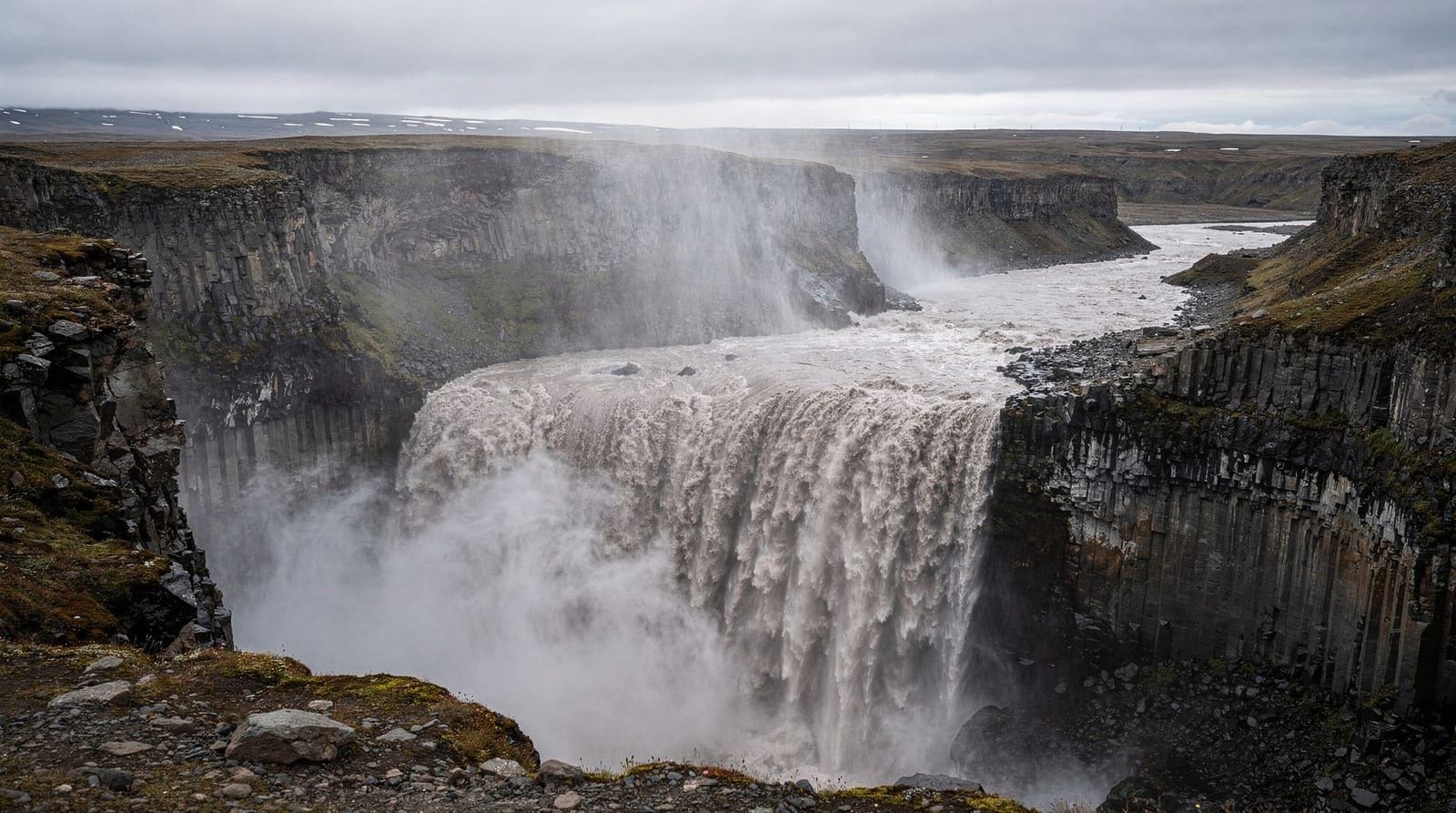
They are different in almost every way. Goðafoss is wide (30m), horseshoe-shaped, aesthetically refined, easily accessible, and free. Dettifoss is Iceland’s most powerful waterfall — 100m wide, 44m tall, with a roar and spray that overwhelm the senses. Goðafoss is the more photogenic and peaceful; Dettifoss is the more physically impressive. Both are worth seeing if you are in North Iceland; if forced to choose one, Dettifoss has the greater raw impact.
How close is Goðafoss to the Ring Road?
The east car park is directly adjacent to the Ring Road — the falls are visible from the road on a clear day. From pulling in to standing at the main viewpoint is about 5 minutes on foot.
Can you swim at Goðafoss?
No. The water is glacier-fed and extremely cold (3–7°C), and the current above and below the falls is dangerous. Swimming is not permitted near the falls.
What is the best time of year to photograph Goðafoss?
Summer (June–August) offers the most water flow from snowmelt and long daylight for extended shooting hours. Winter (December–February) offers dramatic ice formations and the potential for northern lights over the falls. Spring (April–May) has high flow from snowmelt but unpredictable weather. The falls look good in all seasons; the choice depends on whether you prioritise volume, ice, or light quality.
Is there anything to do near Goðafoss besides the waterfall?
The immediate area is limited to the falls and a small service building. The nearest meaningful alternative is Akureyri (50 km west) or Lake Mývatn (50 km east). Some visitors combine Goðafoss with the Laufás farmstead museum (19 km west), an 18th-century turf farmhouse that is open in summer.
Goðafoss in context: Iceland’s major waterfalls
Iceland has over 10,000 waterfalls — a function of glaciers, high precipitation, and a geology that creates constant vertical drops. In terms of visitor impact, Goðafoss ranks alongside Skógafoss and Seljalandsfoss on the south coast for ease of access and visual quality. The key differences from its southern rivals:
- Goðafoss is free (Seljalandsfoss has a parking fee)
- Goðafoss is in North Iceland, naturally integrating into a Diamond Circle day
- Goðafoss has a horseshoe shape unique among Iceland’s major waterfalls
- Skógafoss and Seljalandsfoss have higher vertical drops (62m and 60m vs 12m)
For travellers doing the full Ring Road, the south coast waterfalls and Goðafoss serve as natural bookends to the island’s waterfall experience.
The Skjálfandafljót upstream
The Skjálfandafljót river above Goðafoss winds through agricultural land before entering a canyon section near the falls. The highlands where it originates (the Sprengisandur plateau in the interior) are accessible only by F-road. In summer, the volume peaks in late June and July due to snowmelt. The water is heavily glacially silted — the grey-brown colour at the falls comes from suspended rock flour ground off by glaciers upstream.
Below Goðafoss, the river continues through a gorge before meeting the sea near Húsavík. The canyon section downstream contains Aldeyjarfoss, another waterfall about 50 km south on Route F26 (F-road, 4WD required). Aldeyjarfoss is ringed by basalt columns in an almost complete cylinder around its pool — one of Iceland’s most dramatic and least-visited waterfall settings.
Laufás heritage site
Laufás, 19 km west of Goðafoss and just off Route 1, is a preserved turf farmstead dating from the 18th century. Several turf buildings survive with original interiors — the kind of domestic archaeology that puts the Icelandic rural experience into context. Run by the Akureyri Museum; entry around 1,500 ISK (€10). Open May through September. The farmstead is genuinely worth 45 minutes if history interests you; it is usually quiet.
Visiting with children
Goðafoss is a good stop with children. The paths are short and clearly marked, the viewpoints have barriers in the most exposed places, and the visual impact is immediate. The spray is exciting rather than overwhelming. There is a basic café with hot drinks and snacks in summer. No special equipment required. The main caution is wet rocks near the falls edge — ordinary trainers are slippery; grip-sole shoes are recommended even for short walks.
Goðafoss in winter
The Ring Road stays open past Goðafoss year-round. In winter (December–February), the edges of the falls freeze progressively, creating ice formations while the central flow continues. Northern lights are theoretically possible from the falls’ viewpoint on clear nights — the area has minimal artificial light pollution. However, winter road conditions between Akureyri and Mývatn can include ice and reduced visibility; check road.is and allow extra travel time. A guided northern lights tour from Akureyri that includes a falls stop is the safer winter option.
Practical guide to the Ring Road waterfall corridor
Goðafoss sits within a broader “waterfall corridor” that stretches from Ísafjörður in the Westfjords to Skógafoss on the south coast. On the North Iceland section of the Ring Road east of Akureyri, the sequence is:
- Goðafoss (Ring Road, 50 km east of Akureyri) — free, 30–45 min
- Geitafoss (small falls near Mývatn, not widely visited) — 5 min detour
- Dettifoss (Route 862 north, 140 km from Akureyri) — 1–2 hours
- Selfoss (1 km upstream from Dettifoss, on foot) — 45 min add-on
- Hafragilsfoss (2 km downstream from Dettifoss, on foot) — 45 min add-on
For travellers focused on waterfalls specifically, the Iceland waterfalls guide compares all major falls across the country by height, flow, accessibility, and crowds.
Tour options including Goðafoss
Guided tours from Akureyri that include Goðafoss range from dedicated waterfall tours to longer Diamond Circle or Mývatn day trips. The Goðafoss-and-Forest-Lagoon combination is popular for cruise passengers — a 4-hour tour that fits a port call with time remaining for the city.
Akureyri port: Goðafoss waterfall and geothermal baths — 4-hour guided tour.
Combining Dettifoss and Goðafoss in a single day is manageable from Akureyri; the drive between the two is under an hour along the Ring Road and Route 862.
Goðafoss for the Iceland first-timer
If this is your first visit to Iceland and you are doing the Ring Road or a North Iceland loop, here is honest context on how Goðafoss compares to expectations:
Visitors coming from the south coast who have already seen Skógafoss (62m tall, thunderous), Seljalandsfoss (walk-behind cave, dramatic), and Dyrhólaey may find Goðafoss underwhelming on pure scale. It is wider but shorter than those falls, and the approach from the Ring Road feels less remote.
The honest recommendation: go anyway, especially if the Diamond Circle is on your itinerary. The historical context is real, the shape is genuinely different from anything on the south coast, and the combination of Ring Road location plus free entry makes it an easy stop. Spend 30 minutes and move on rather than making it the centrepiece of a day.
If waterfall photography is your primary goal, Dettifoss is the North Iceland waterfall worth the extra driving time.
Goðafoss accessibility
Goðafoss is one of Iceland’s most accessible waterfalls for visitors with limited mobility:
- The east bank car park is directly beside the Ring Road
- The path to the main viewpoint is approximately 200 metres on firm gravel
- The viewpoint itself has a low stone barrier
- No significant elevation change between car park and viewpoint
- Toilets at the east car park (in summer) are in a separate structure but accessible
The west bank car park has a similar setup. The rim trails between the two banks require more walking and some uneven ground.
For detailed accessibility information across Iceland’s main sites, the Icelandic Tourist Board maintains a database at ferdalag.is. Goðafoss is one of the sites rated accessible for wheelchair users with assistance.
Weather and safety summary for Goðafoss
The falls are safe and accessible for most visitors with basic precautions:
- Stay on marked paths — the viewpoints are defined and safe; off-path rock near the spray is slippery
- Waterproof jacket recommended in all seasons
- The falls are 24-hour accessible — no entry gates, no closing time
- Photography at night (summer midnight sun, winter northern lights) is possible and the area has no barriers after hours
- Winter visit: confirm Ring Road conditions at road.is; the car park approach road can be icy
For the best time to visit Iceland guide which covers seasonal conditions for specific sites including Goðafoss, see that planning resource.
Should I visit Goðafoss on the way to or from Mývatn?
Either works equally well logistically, since the drive is the same distance in both directions. Visiting on the way there means you’re fresh for the falls; visiting on the way back means you’ve already seen Mývatn’s geothermal sights and can treat Goðafoss as a scenic wind-down stop before returning to Akureyri.
Is Goðafoss included in most Diamond Circle tours?
Yes, nearly all Diamond Circle itineraries from Akureyri or Húsavík include a Goðafoss stop, either at the start or end of the loop, since it sits directly on the Ring Road route between the two towns and the rest of the circuit’s sights.
Top experiences
Bookable activities with verified prices and instant confirmation on GetYourGuide.
Top-rated experiences in Goðafoss travel guide
Best-rated activities across GetYourGuide and Viator.

Whale Watching from Downtown Akureyri
- Viator

Big Whales & Puffins RIB boat tour from Húsavík
- Viator

East Glacial River – Grade 4 Rafting with Drysuits, North Iceland
- Viator

Top-Rated Family Rafting – Drysuits & Geothermal Hot Cocoa
- Viator

Original Big Whale Safari & Puffins Speedboat Tour from Húsavík
- Viator

Lake Myvatn Day Tour and Godafoss Waterfall for Cruise Ships from Akureyri Port
- Viator