Kirkjufell
Kirkjufell is Iceland's most photographed mountain — a sharp pyramid above Grundarfjörður. Guide to visiting, timing, and the Kirkjufellsfoss viewpoint.
Reykjavik: Snaefellsnes peninsula and Kirkjufell day trip
Quick facts
- Best time
- Year-round; northern lights in autumn/winter; midnight sun in June/July
- Days needed
- 2–3 hours at the site; base yourself at Grundarfjörður for early/late light
- Getting there
- 2 hours from Reykjavík via Rte 1 and Rte 54 to Grundarfjörður (158 km)
- Budget per day
- Free entry; budget 1,500–2,500 ISK / €10–€17 for coffee and a snack in Grundarfjörður
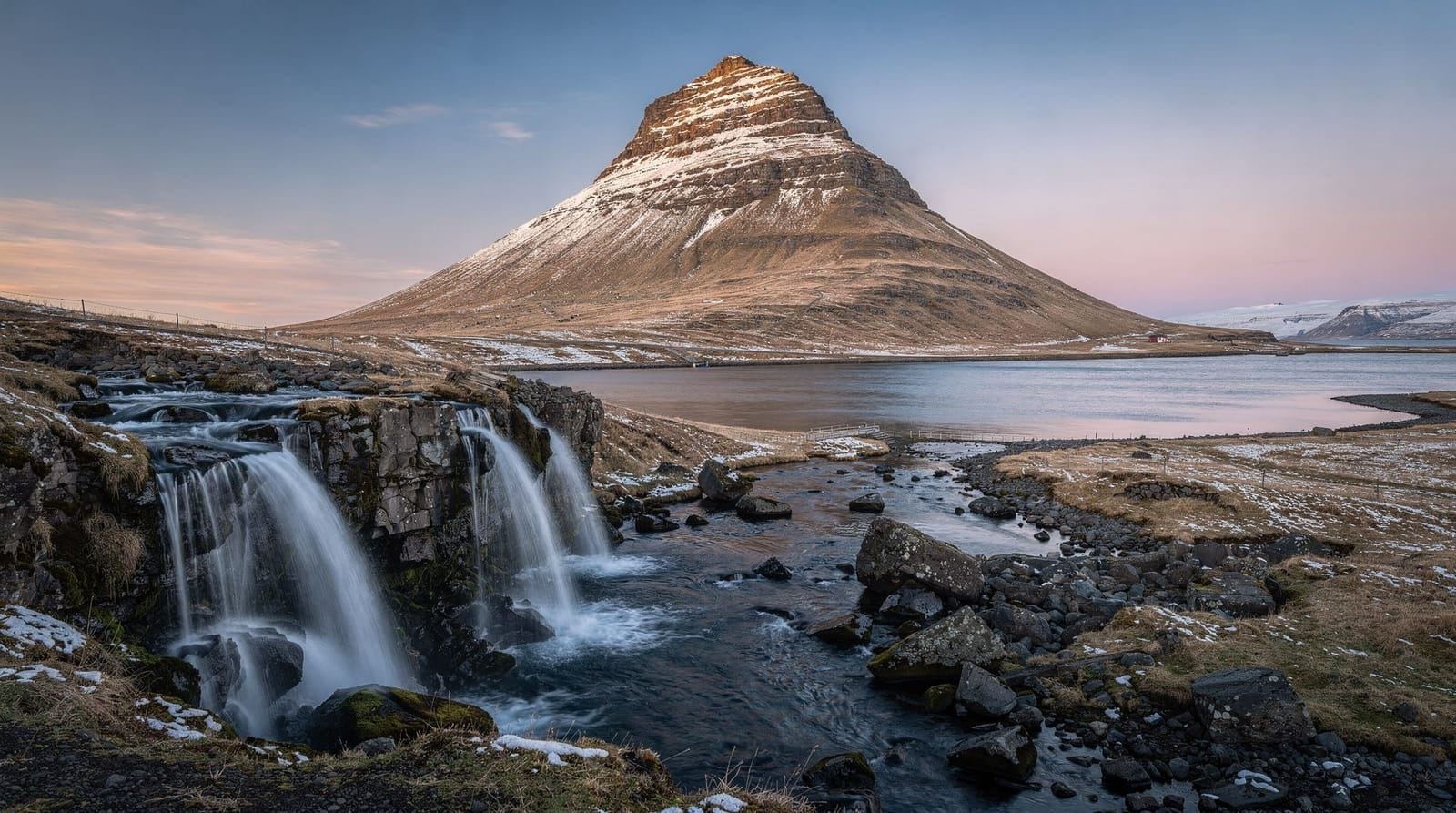
Kirkjufell — “Church Mountain” — is a 463-metre volcanic peak that rises above the north coast of the Snæfellsnes peninsula near the town of Grundarfjörður. It is Iceland’s most photographed mountain, appearing on postcards, Instagram feeds, and travel magazine covers with a frequency that raises expectations dangerously. The question visitors ask most often is whether it lives up to those expectations. The honest answer is yes — the mountain’s symmetry is more striking in person than in most photographs, and the foreground waterfall (Kirkjufellsfoss) provides a composition that requires very little skill to capture well.
The mountain also appeared as the “Arrowhead Mountain” location in Game of Thrones (Season 7), which added another layer of recognition. If that context matters to you, it is the correct location.
The viewpoint and what you actually see
The standard photograph — mountain reflected in the braided stream channels, waterfall in the lower foreground — is taken from a small elevated platform on the east side of Route 54 just before Grundarfjörður. The platform is clearly signed and has a small car park (free). The viewpoint is about 100 metres from the road.
The mountain itself is a table-top tuya (volcanic mountain formed by eruption beneath a glacier) with steep basalt flanks that give it the distinctive pyramid appearance from the south and east. The north and west flanks are less dramatic. The waterfall (Kirkjufellsfoss) is a short cascade through a braided stream about 200 metres east of the mountain base — it is not particularly large, but it frames the mountain effectively.
Timing and crowds
Summer peak (July–August): the car park fills by 9 a.m. on weekends and by 10 a.m. on weekdays. Tour buses arrive between 10 a.m. and 2 p.m. The platform can have 50–80 people at once during this period. Solutions: arrive before 8 a.m. (the light is usually better anyway), or arrive after 6 p.m. when day-tour buses have left.
Autumn and winter: significantly quieter. The mountain sees northern lights season from September through March, and catching the aurora above Kirkjufell is achievable with clear skies and a good forecast on veður.is. The aurora-forecast-explained guide covers this in detail. Dress for cold — Grundarfjörður can be wind-exposed and temperatures drop below freezing from October.
June: midnight sun means the mountain is lit from unusual angles late at night. The 11 p.m. light in late June is a warm amber that makes for unusual photographs. This is when long-exposure work on the waterfall is most interesting.
Small-group Snæfellsnes and Kirkjufell tour from ReykjavíkHiking Kirkjufell
The mountain can be climbed via a route on the west ridge, but this is a serious scramble — not a hiking trail. The lower slopes involve steep grass and loose rock; the upper section requires some handwork. It is not a technical climb, but it is not suitable for casual walkers. No formal trail exists, and there are no safety features. Multiple emergency call-outs from this mountain occur each season.
If you want to walk in the area: the easy walk along the stream toward Kirkjufellsfoss is straightforward and brings you close to the waterfall base. The surrounding Grundarfjörður area has marked walking trails above the town that give elevated views of the mountain from a different angle.
Photography notes
Morning: east-facing light hits the waterfall first; the mountain itself is front-lit from the east in the morning. On a clear summer morning this is typically the better option.
Golden hour (evening): summer evenings give warm sidelight on the west flank. In late June, the sun barely sets — low-angle light persists for hours.
Northern lights: the mountain’s silhouette with aurora overhead has become one of Iceland’s most recognised images. You need a clear sky, minimum KP 2 forecast, and a new moon or at least a low moon. Check the Icelandic Met Office aurora forecast at vedur.is. The dark area south of the road (away from Grundarfjörður’s lights) gives cleaner sky.
Composition: the standard three-part composition (foreground stream, Kirkjufellsfoss, mountain) works at f/8–f/11 with the foreground in focus. Long exposures of the waterfall (1–4 seconds) smooth the water while keeping mountain detail. Neutral-density filters are useful in summer due to the brightness.
Grundarfjörður practicalities
The town has around 900 residents and has all the basics: Samkaup-Strax supermarket, N1 petrol station, a small guesthouse cluster, and one or two restaurants. The Bjargarsteinn Mathús restaurant serves local fish; meals run 3,500–5,500 ISK (€24–€37). There is a small camping area near the town (around 2,000 ISK per person per night).
The nearest accommodation directly facing Kirkjufell is the Kirkjufell Guesthouse on the road into town — rooms run 20,000–28,000 ISK in summer. Booking well in advance (March or earlier) is necessary for peak July dates.
Snæfellsnes and Kirkjufell combined day tourCombining Kirkjufell with the peninsula
Kirkjufell is 30 km from Stykkishólmur (20 minutes) and 70 km from Arnarstapi (1 hour). A logical day itinerary does Kirkjufell early, continues west to the glacier area and the Arnarstapi–Hellnar walk, and returns via Búðir. This is the snaefellsnes-2-days first day in compressed form.
If you are on a single day from Reykjavík, Kirkjufell plus the Arnarstapi–Hellnar walk plus a glacier viewpoint is achievable in about 10–11 hours total. Skipping the glacier entirely and spending more time on the north coast (Kirkjufell, Stykkishólmur harbour, Vatnshellir cave) is an equally valid approach.
Kirkjufell across the seasons
| Season | Crowds | Light/conditions | Best for |
|---|---|---|---|
| Spring (Apr–May) | Low–moderate | Snow cap lingers; waterfall runs high with snowmelt | Quiet photography, powerful waterfall |
| Midnight sun (mid-Jun–early Jul) | High by day, empty after 10pm | Warm low-angle light near midnight | Late-night long exposures |
| Summer (Jul–Aug) | Very high 9am–5pm | Best average weather | Early-morning or evening visits only |
| Autumn (Sep–Oct) | Moderate, dropping | Aurora season begins; dark by mid-Sept | Mountain silhouette with aurora |
| Winter (Dec–Mar) | Low | Snow cover, short daylight, best aurora odds | Northern lights photography |
For a fuller seasonal comparison across the whole country, see the best time to visit Iceland guide and, if aurora is the priority, the best time to see northern lights guide.
Spring (April–May)
The mountain is quieter in April and May than in summer, and snow may linger on the summit and upper slopes, adding a white cap to the pyramid shape. The stream feeding Kirkjufellsfoss runs higher with snowmelt — the waterfall is more powerful in May than in August. Early morning light arrives before 5 a.m. in late May. The northern lights season is ending but can still produce displays on clear April nights.
Midnight sun (mid-June to mid-July)
From around June 10 to July 5, the sun does not drop below the horizon. This creates an unusual photographic window: low-angle warm light at 11 p.m. to 1 a.m. that is rarely available for landscape photography elsewhere. The reflection channels in the stream braids catch this light differently from daytime photographs. Long-exposure work on the waterfall is viable at near-midnight. The car park is often empty after 10 p.m. even in peak season.
Autumn (September–October)
The aurora season begins. By mid-September, nights are dark enough for aurora photography — Grundarfjörður has minimal light pollution to the south and west, and the mountain’s silhouette against a green aurora is one of Iceland’s iconic images. October is windy and cold but has the best combination of quiet conditions and northern lights potential.
Winter (December–March)
Snow typically covers Grundarfjörður valley from November onward. The mountain may be partially or fully snow-covered, giving a different character. Winter twilight (2–4 hours of low light in December) creates unusual blue-hour conditions throughout the day. The Kirkjufell Guesthouse and a few other Grundarfjörður accommodations stay open year-round; advance booking is easier but still recommended for January aurora-chasing trips.
Kirkjufell vs other Iceland mountain viewpoints
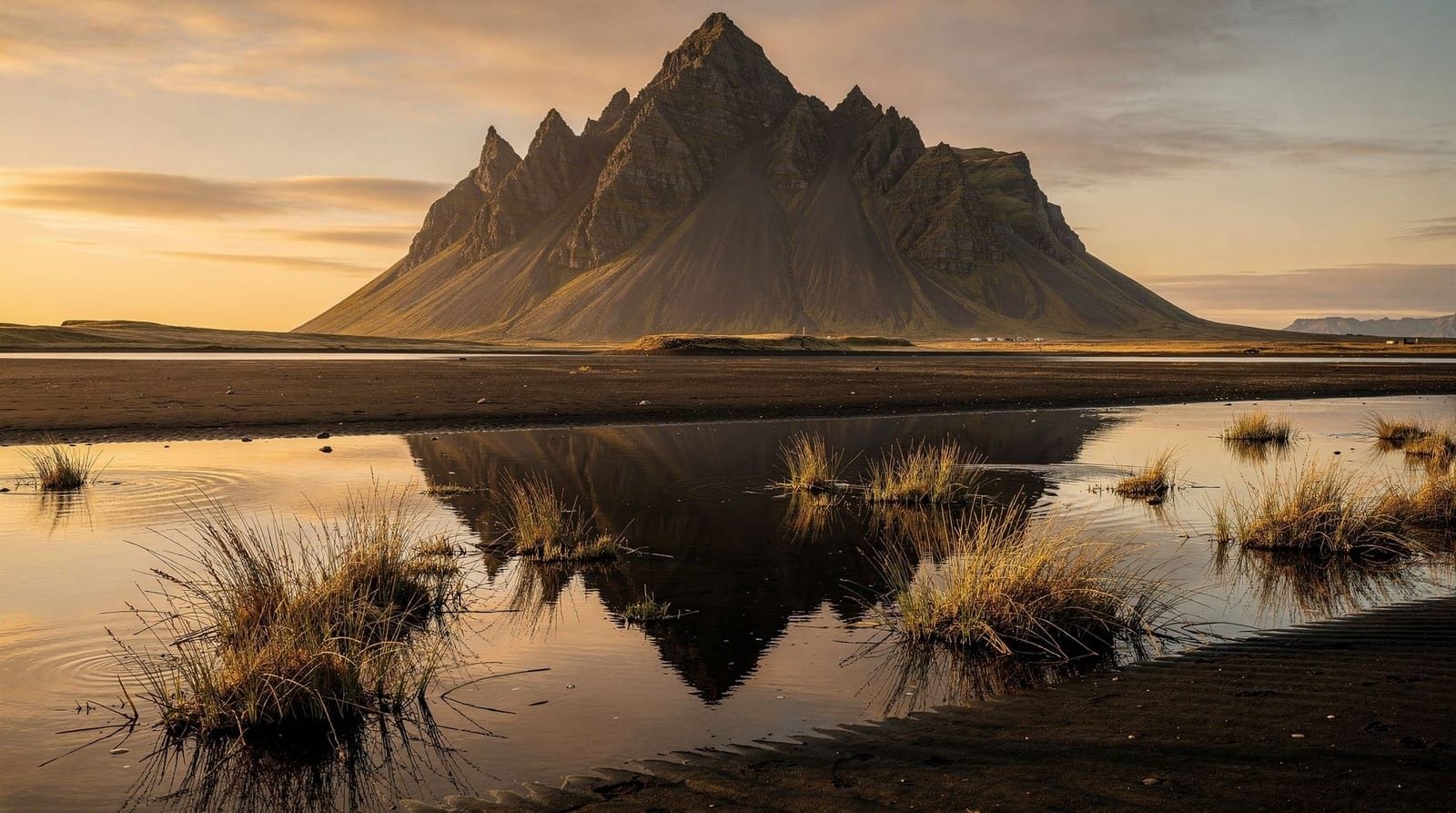
Iceland has several photogenic singular mountains: Vestrahorn near Höfn, Herðubreið in the highlands, and Hrútfjallstindar in the north. Kirkjufell’s advantage is the combination of an accessible car park within 100 metres of the viewpoint, the waterfall framing element, and the dual-season appeal (summer composition with midnight sun; winter composition with aurora). Vestrahorn requires a 1,000 ISK access fee and the approach road is gravel; it is less accessible but more dramatic in mountain scale. Herðubreið is highlands-only — no 4x4, no visit. For a visitor on a standard Iceland itinerary wanting a quality mountain photograph without specialist access, Kirkjufell has no serious competition.
Detailed photography guidance
Equipment and settings
For the standard three-element composition (waterfall foreground, stream channels, mountain):
- Wide-angle lens (16–24mm): needed to include waterfall and mountain together from the standard platform. At 24mm on a full-frame sensor you can fit both comfortably with some sky.
- Long exposure: 2–8 seconds at f/11 smooths the waterfall. Use a tripod — the platform is stable. ISO 100–200 to minimise noise in the sky.
- Polarising filter: reduces glare on the stream channels in midday light, deepens the sky colour. Most useful in summer.
- ND filter (6-stop): allows longer exposures in bright summer light for more complete waterfall smoothing.
Northern lights photography at Kirkjufell
Set up on the east side of the road (across from the standard platform), facing north or northwest to get the mountain in the foreground. Use ISO 800–1600, f/2.8–f/4, exposures of 8–20 seconds depending on aurora brightness. The darker the moon, the cleaner the image — check the lunar calendar alongside the aurora forecast. The stream channels add foreground interest even in aurora photographs.
The most effective time is 11 p.m. to 2 a.m. in September and October. A KP index of 3 or higher produces visible aurora in this location; KP 2 is borderline.
Avoiding the crowd in photographs
If you are at the standard platform during peak hours, move slightly left or right of the main crowd to find a clean foreground. A slightly lower angle (crouching on the platform) changes the perspective. The east side of the stream further away from the car park gives a longer, shallower composition with the mountain further back — less classic but less photographed.
Arriving by guided tour vs self-driving
Guided day tours from Reykjavík to Snæfellsnes include Kirkjufell as one of several stops, typically spending 25–35 minutes at the viewpoint. This is enough time for photographs and a brief walk to the waterfall, but does not allow for the kind of extended session needed to capture changing light or multiple compositions. Tours run by reputable operators include small-group (8–12 person minibus) options that allow more flexibility than large coach tours.
Self-driving gives complete time control — you can arrive at 7 a.m. before any buses, spend 2 hours, and leave before the crowds arrive. The cost comparison (car rental plus fuel vs guided tour at 15,000–20,000 ISK per person) favours self-driving in a group of 2 or more for this specific location.
Getting the most from a half-day visit
The minimum worthwhile visit is 90 minutes: park, walk to the platform, photograph, walk the stream path toward the waterfall base, return. A full half-day (3–4 hours) allows: platform photography in the morning, a walk to the Kirkjufellsfoss base, coffee in Grundarfjörður, and a return to the platform in different light. If you are staying overnight at the Kirkjufell Guesthouse or the Grundarfjörður campsite, a pre-dawn visit to the platform (4–5 a.m. in summer) is almost always worth the alarm — the site is typically empty and the light is unusual.
Frequently asked questions about Kirkjufell
Is Kirkjufell the same mountain as in Game of Thrones?
Yes. Kirkjufell appeared as the “Arrowhead Mountain” in Game of Thrones Season 7 (Beyond the Wall). The mountain’s shape and surroundings match the filmed sequences. This is the actual location.
Can you hike to the top of Kirkjufell?
Technically yes, but it is a steep scramble on loose ground rather than a hiking trail and is not recommended without experience. Emergency rescues from this mountain are reported every season. The view from the standard viewpoint is the practical option for most visitors.
How crowded is Kirkjufell in summer?
Very crowded between 9 a.m. and 5 p.m. in July and August, with tour buses contributing to the congestion. Arrive before 8 a.m. or after 6 p.m. for a manageable experience. Autumn (September–October) is significantly quieter and has the benefit of northern lights season beginning.
What is the best time of day to photograph Kirkjufell?
For standard landscape photography: early morning (east-facing light on the waterfall) or evening light in summer. For northern lights: any time between September and April when KP 2+ forecast and clear skies align — Grundarfjörður has low enough light pollution for good aurora viewing. The kirkjufell-photography guide covers compositions in depth.
Is the Kirkjufell viewpoint free?
Yes. The viewpoint car park is free, the path to the waterfall is free, and there is no fee to walk in the area. Commercial guided tours from Reykjavík typically stop here as part of a longer Snæfellsnes itinerary.
How far is Kirkjufell from Reykjavík?
Approximately 158 km, or about 2 hours driving via Route 1 and Route 54. The route is straightforward on paved road the entire way. No 4x4 required, though winter conditions call for care — see the driving in Iceland guide for winter road advice.
Top experiences
Bookable activities with verified prices and instant confirmation on GetYourGuide.
Top-rated experiences in Kirkjufell
Best-rated activities across GetYourGuide and Viator.