Aurora forecast explained — how to read Kp, cloud, and solar wind data
Reykjavik: Small group Northern Lights tour
How do I read an aurora forecast for Iceland?
Check two things: the Kp index (3-day forecast at spaceweatherlive.com or the NOAA website) and the cloud cover forecast (vedur.is for Iceland-specific cloud maps). You need Kp 2+ in Iceland and a clear or partly clear sky. The 1–3 hour short-range Kp forecast is the most actionable; 3-day forecasts are directional only.
What causes the aurora
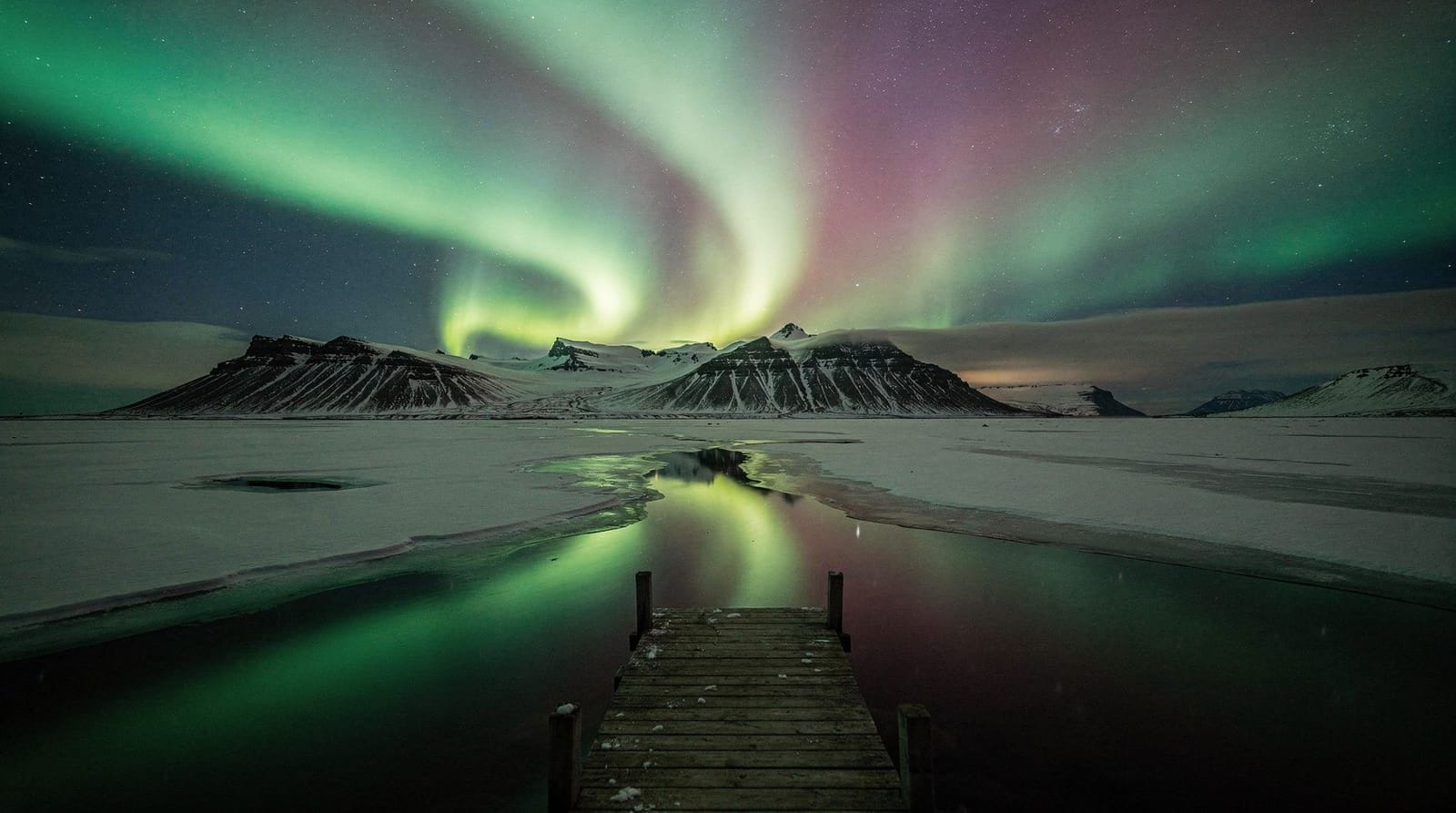
The northern lights are caused by charged particles from the sun — primarily electrons and protons — colliding with atmospheric gases at altitudes of 90–300 km. These collisions excite oxygen and nitrogen molecules, which release the excess energy as visible light. Green is the most common colour (oxygen at 90–150 km), red appears at higher altitudes (oxygen above 200 km), and blue/purple comes from nitrogen.
The intensity and visibility of this display depends on how much solar energy is being directed at Earth’s polar regions at any moment. This is what the Kp index tries to measure.
| Best tools | vedur.is (Iceland cloud + aurora), SpaceWeatherLive (Kp, Bz, solar wind) |
| Minimum for a display | Kp 2+ and clear or partly clear sky |
| Best check times | 3 days out for planning, 18:00–19:00 same day to confirm |
| Season | Late August to mid-April, dark skies required |
| If self-driving fails | A guided tour uses the same data plus local scouting — see best time to see northern lights |
The Kp index: what it actually measures
The Kp (planetary K-index) is a global scale from 0 to 9 measuring geomagnetic disturbance. It is derived from magnetometers at 13 ground stations worldwide and updated every 3 hours. It does not measure aurora brightness directly — it measures the disturbance to Earth’s magnetic field caused by incoming solar wind.
The scale is logarithmic: Kp 4 is roughly twice the activity of Kp 3. A Kp 9 “extreme” event is rare (a few times per decade) and produces aurora visible at the equator.
For Iceland specifically:
- Kp 1–2: Faint arc visible at dark sites on the horizon. Easy to miss without dark-adapted eyes.
- Kp 3–4: Clear display visible to the naked eye, often covering a significant portion of the sky. Strong enough for good photographs.
- Kp 5–6: Active display with movement, multiple colours, visible from light-polluted areas.
- Kp 7+: Major storm. Whole-sky display with intense movement. These are relatively rare — a few nights per year even at solar maximum.
Where to find the Kp forecast
NOAA Space Weather Prediction Center (swpc.noaa.gov)
The source of truth for Kp forecasts. NOAA publishes:
- 3-day Kp forecast: updated 4 times per day. Shows predicted Kp in 3-hour blocks. Useful for planning which evenings to prioritise.
- Real-time Kp: the current measured Kp value, updated every 3 hours.
- 1-minute magnetometer data: the most sensitive indicator. A rising magnetometer trace often precedes visible aurora by 5–20 minutes.
SpaceWeatherLive
SpaceWeatherLive.com aggregates NOAA data into a more user-friendly format. The app sends push notifications when Kp exceeds your chosen threshold. The real-time dashboard shows current Kp, solar wind speed, solar wind density, and the Bz value. For most visitors to Iceland, this app covers everything needed.
Icelandic Met Office — vedur.is
The Met Office publishes a dedicated aurora forecast at en.vedur.is/weather/forecasts/aurora-forecast. This combines the Kp forecast with local cloud cover predictions specific to Iceland. The colour-coded map shows which parts of Iceland have cloud-free skies at what times during the next 24 hours. This is the single most useful tool for deciding where to drive on a given night.
The cloud forecast page also shows a 48-hour animated cloud map. Learn to use this before your trip.
How to interpret the cloud forecast
The vedur.is cloud map uses a percentage scale. Values under 30% over your target area mean a reasonable clear-sky window. Values above 70% mean mostly cloudy. The 48-hour animation shows how cloud systems move — watching this animation at 18:00 on a viewing night shows whether the region you plan to visit will clear before midnight.
Iceland’s cloud systems typically move from southwest to northeast. Clear windows often arrive from the north or northwest. This is why aurora hunters in Reykjavík sometimes drive north toward Akranes or northwest toward the Snæfellsnes Peninsula — not because those places are inherently better, but because clear sky often arrives from that direction.
Solar wind data: the real-time layer
Once you decide to go out for the evening, monitoring real-time solar wind data becomes relevant.
Solar wind speed
Measured at the DSCOVR satellite (L1 point), solar wind speed of 400–600 km/s is average. Speeds above 600 km/s often produce enhanced aurora activity. Values above 800 km/s during a coronal mass ejection can trigger major storms.
The Bz component: the most critical number
Bz is the north-south orientation of the interplanetary magnetic field. When Bz is negative (southward), it connects efficiently with Earth’s northward-facing magnetic field at the poles, allowing solar particles to flow into the atmosphere and trigger aurora.
Bz around 0: neutral, minimal effect. Bz -5 to -10 nT: moderate coupling, enhances ongoing aurora activity. Bz below -10 nT: strong coupling, often triggers significant displays even at moderate Kp.
Watch for sustained negative Bz (more than 30–60 minutes below -5 nT). Brief dips to -8 and recovery to 0 produce weak effects. Sustained -10 for two hours is when things get interesting.
The 27-day pattern and why it matters
The sun rotates every 27 days from Earth’s perspective. Coronal holes (persistent open magnetic regions) that produce fast solar wind streams often recur roughly every 27 days. If Iceland had a good aurora night on October 15th, the same coronal hole may produce enhanced activity again around November 11th — not guaranteed, but worth tracking.
Several apps and websites (SpaceWeatherLive, SolarHam) track coronal hole positions and flag recurring stream periods.
Practical forecast workflow for Iceland visitors
Three days before: Check NOAA’s 3-day Kp forecast. Flag the evenings with predicted Kp 3+. Note this is directional planning only.
Day of viewing: At noon, check vedur.is for Iceland cloud cover for the coming 24 hours. Identify which regions look clear. Cross-reference with Kp forecast for the same evening.
Evening (18:00–19:00): Refresh the cloud map. Check current solar wind conditions on SpaceWeatherLive. If Kp forecast is 2+ and at least one region of Iceland appears to have clear skies, plan to go out.
Departure (21:00): Check real-time Bz. If it has been negative for more than 30 minutes, activity is likely elevated. Enable push notifications for Kp alerts. Head to your chosen dark-sky location.
In the field: Stay on the vedur.is cloud map. If clouds close in from the southwest, decide whether to wait or relocate. The real-time short-range Kp is updated every few minutes on SpaceWeatherLive — watch for rising values.
Common misconceptions about forecasts
Misconception: “Kp 7 forecast means I will definitely see aurora.” Reality: Kp 7 means strong geomagnetic disturbance is forecast. Cloud cover will still block the view. And Kp forecasts at 3 days out are imprecise — actual values on the night often differ.
Misconception: “A tour operator checks the forecast, so I don’t need to.” Reality: Operators monitor conditions, but understanding the forecast yourself lets you evaluate whether rescheduling makes sense and helps you self-drive on the best nights.
Misconception: “The aurora is visible whenever the Kp app sends an alert.” Reality: Many apps alert on Kp 2 or 3, which is only visible in very dark, cloud-free conditions. Filter your alerts to Kp 4+ to reduce false urgency.
Reading the solar wind dashboard
When you are in Iceland planning an aurora night, the NOAA or SpaceWeatherLive real-time dashboard shows several values simultaneously. Understanding what each means — and which to prioritise — avoids information overload and helps you make fast go/no-go decisions.
Solar wind speed (km/s): Average is 400–500 km/s. Values above 600 km/s indicate enhanced solar wind output, typically from a coronal hole. Above 700 km/s, aurora activity tends to be elevated. The speed value alone is not decisive — fast wind with a northward (positive) Bz does nothing, while moderate-speed wind with a strongly negative Bz can trigger significant displays.
Solar wind density (p/cm3): The number of protons per cubic centimetre in the solar wind. Average is 5–10 p/cm3. Values above 20 p/cm3 indicate a dense wind that, combined with negative Bz, can produce enhanced aurora. Very high density values (50+ p/cm3) often accompany CME (coronal mass ejection) impacts.
IMF Bz (nT): The critical value. Northward (positive) = quiet. Southward (negative) = active. Track the trend over 30–60 minutes rather than a single reading. A Bz that has been -8 nT for 45 minutes has had time to couple with the magnetosphere and produce aurora. A brief dip to -8 and immediate return to 0 has minimal effect.
Estimated Kp (current): Derived from the magnetometer network readings. This is a 3-hour average measured to the nearest whole number. The “estimated Kp” on SpaceWeatherLive updates more frequently using real-time magnetometer data from selected stations — this is more responsive than the official NOAA 3-hour Kp update.
1-minute X-ray flux: Measured by NOAA’s GOES satellites. A spike in X-ray flux (shown in the background of SpaceWeatherLive) indicates a solar flare. If the flare is directed at Earth, a CME may follow 1–3 days later. This is relevant for the 3-day planning window but not for same-night decisions.
The practical real-time decision comes down to three checks: Is Bz sustained below -5 nT? Is Kp (estimated) above 2? Is the cloud forecast clear over your target area? All three positive: go out. Any one of the first two is zero: wait.
The 27-day recurrence pattern
One of the most useful — and most underused — aurora planning tools is the sun’s rotation period. Viewed from Earth, the sun rotates approximately once every 27 days. Coronal holes, which are open magnetic regions on the sun’s surface that emit persistent streams of fast solar wind, rotate with the sun. This means a coronal hole that produced a solar wind event on a given date is likely to face Earth again approximately 27 days later.
This 27-day recurrence is not a guarantee. Coronal holes evolve — they grow, shrink, and sometimes disappear between rotations. But in practice, during Solar Cycle 25’s current active period, many coronal holes have persisted through multiple rotations. Checking historical solar wind data from 27 days ago is a legitimate planning tool: if October 15th produced elevated Kp activity driven by a coronal hole stream, mark November 11th as a candidate aurora night for your trip.
SpaceWeatherLive maintains a solar wind archive with hourly data going back years. The SolarHam website (solarham.net) tracks coronal hole positions and publishes a recurring event calendar. Neither tool is a firm forecast — but both add a probabilistic layer to planning beyond the raw 3-day NOAA forecast.
For a winter trip planned 2–3 months ahead, examine the aurora data from 27, 54, and 81 days before your travel window. If those periods show regular elevated activity, the same coronal hole rotation cycle may produce activity during your visit. This is a tool for setting realistic expectations, not booking certainty.
The 27-day pattern also helps explain why aurora activity sometimes clusters: a persistent active coronal hole region produces elevated activity every 27 days for several consecutive rotations, then fades. From a visitor’s perspective, arriving in one of these “active windows” significantly improves odds beyond the baseline.
Setting up alerts without drowning in notifications
Most aurora apps let you set a Kp threshold for push notifications — getting this wrong is a common source of frustration. Setting the threshold too low (Kp 1–2) means constant alerts for activity that’s rarely visible from anywhere but the darkest sites; setting it too high (Kp 6+) means missing the moderate Kp 3–4 nights that produce Iceland’s most common good displays.
A practical threshold: Kp 3 for a general alert, with a habit of checking the Bz component manually whenever an alert fires — a Kp 3 forecast with a strongly negative Bz is worth acting on; a Kp 3 with neutral Bz may fizzle. Combine this with a daily manual check of the vedur.is cloud forecast at around 18:00 rather than relying purely on automated alerts, since no current app cross-references Iceland-specific cloud cover with solar activity in a single notification.
Time zone note: NOAA forecasts and most apps default to UTC. Iceland’s time zone is UTC+0 year-round (no daylight saving), which simplifies this compared to most of Europe, but double-check the display setting on unfamiliar apps before relying on the times shown.
Battery and connectivity: checking forecasts repeatedly through a cold night drains phone batteries faster than usual, and rural dark-sky locations often have weak or no signal. Download the vedur.is cloud map and NOAA oval image before leaving your accommodation so you have a recent snapshot even if you lose signal once you’re actually out chasing clear sky.
Understanding substorms
A substorm is a sudden intensification of auroral activity, typically lasting 15–60 minutes, that occurs against a background of ongoing moderate geomagnetic activity. Substorms are a fundamental feature of how aurora works — and understanding them helps set expectations during an evening of viewing.
The auroral substorm cycle proceeds in three phases:
Growth phase (20–60 minutes): energy from the solar wind accumulates in Earth’s magnetotail. The aurora is quiet or weakly active during this phase. The Kp index may be elevated but the display is subdued. This is the “waiting” phase that frustrates visitors who see a good forecast but only a faint glow.
Expansion phase (5–15 minutes): the magnetotail releases stored energy suddenly. The aurora explodes in brightness and motion — this is the dancing curtain, the rapidly moving arcs, the whole-sky pulsing display that photographs produce. Kp may spike by 1–2 units within minutes.
Recovery phase (30–60 minutes): activity diminishes but remains visible. The display fades to a diffuse glow or quiet arc before the next substorm cycle begins.
For practical viewing, this means that patience during a quiet period is often rewarded. An evening where the aurora sits as a faint arc on the horizon for 40 minutes may suddenly erupt into a full substorm display. Tours that return passengers after 2 hours of “nothing much” sometimes miss the substorm expansion phase that begins at hour three.
The most actionable forecast signal for substorm prediction is the Bz component. A sustained negative Bz (below -8 nT for 30+ minutes) typically precedes a substorm expansion. Monitoring real-time Bz on SpaceWeatherLive and expecting a burst of activity after a sustained negative dip is the closest thing to short-range substorm prediction available to recreational aurora hunters.
How to interpret the aurora oval map
The aurora oval map shows the predicted extent and intensity of the auroral band across the polar region. It is one of the most informative tools available — and one of the most commonly misread.
What the oval represents: The oval is a ring around the geomagnetic pole (not the geographic pole) where auroral activity is most concentrated. The oval’s position and width change with Kp level. At Kp 1, the oval sits tight around the pole — covering Svalbard and the far north of Norway. At Kp 3–4, the oval expands to cover Iceland, northern Norway, and northern Canada. At Kp 7+, the oval extends as far as Scotland, southern Germany, and the northern United States.
The viewing zone: Critically, the best aurora viewing is not directly under the oval but slightly equatorward of it. If you are directly under the centre of the oval, you are looking up at the underside of the auroral curtain — which can appear as a diffuse overhead glow. The most dramatic views (curtains, arcs, rays) are seen from just south of the oval’s southern edge, looking north. For Iceland, which sits on or just equatorward of the oval during Kp 2–4, this geometry is naturally favourable.
The colour scale: NOAA’s oval map uses a colour scale from blue (minimum activity) to green, yellow, orange, and red (maximum). The colour represents the strength of electron precipitation at that location, not the predicted Kp. A green patch over Iceland on the oval map suggests moderate electron precipitation — this typically corresponds to Kp 3–4 but the oval colour and the Kp index are derived differently.
Using the oval in real time: During an active night, the NOAA Aurora Forecast page (swpc.noaa.gov/products/aurora-30-min) updates the oval estimate every 30 minutes based on satellite data. Watching the oval move or intensify over Iceland in real time is more informative than waiting for the next 3-hour Kp update. When the oval’s southern boundary is at or below Iceland’s latitude on the map, conditions are active.
The oval map combined with the vedur.is cloud forecast gives you the two variables that matter most: is there activity over Iceland, and can you see through the sky to observe it.
Apps and tools compared
| Tool | Best for | Limitation |
|---|---|---|
| vedur.is | Iceland-specific cloud + aurora forecast | Kp-only, no Bz/solar wind detail |
| SpaceWeatherLive | Real-time Kp, Bz, solar wind, push alerts | Cloud cover not Iceland-specific — cross-check with vedur.is |
| NOAA SWPC | Source-of-truth Kp and 30-minute oval | Less user-friendly interface than SpaceWeatherLive |
| My Aurora Forecast (app) | Simple alerts for casual trip planning | Less granular than the dashboards above |
No single tool covers everything — the practical workflow described above (NOAA/SpaceWeatherLive for activity, vedur.is for cloud) is the combination experienced aurora hunters actually use.
Self-driving vs a guided tour: what the forecast changes
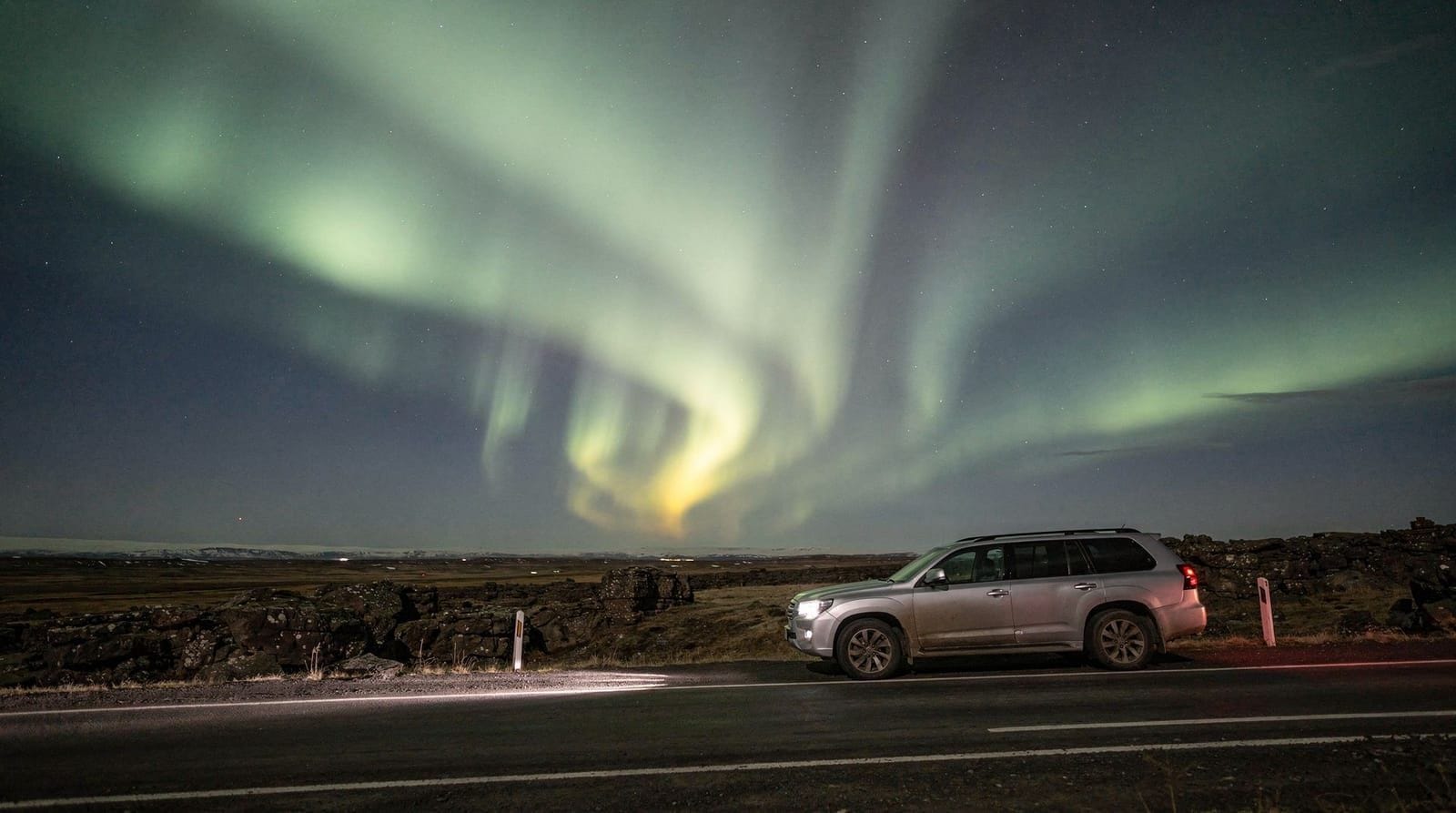
Reading the forecast yourself is most valuable if you’re self-drive aurora hunting — you decide where to go, when to leave, and when to give up on a cloudy region and reposition. If you’d rather not drive Iceland’s dark rural roads at night, a guided minibus or small-group tour uses the same data plus local knowledge of which car parks and viewpoints are currently clear.
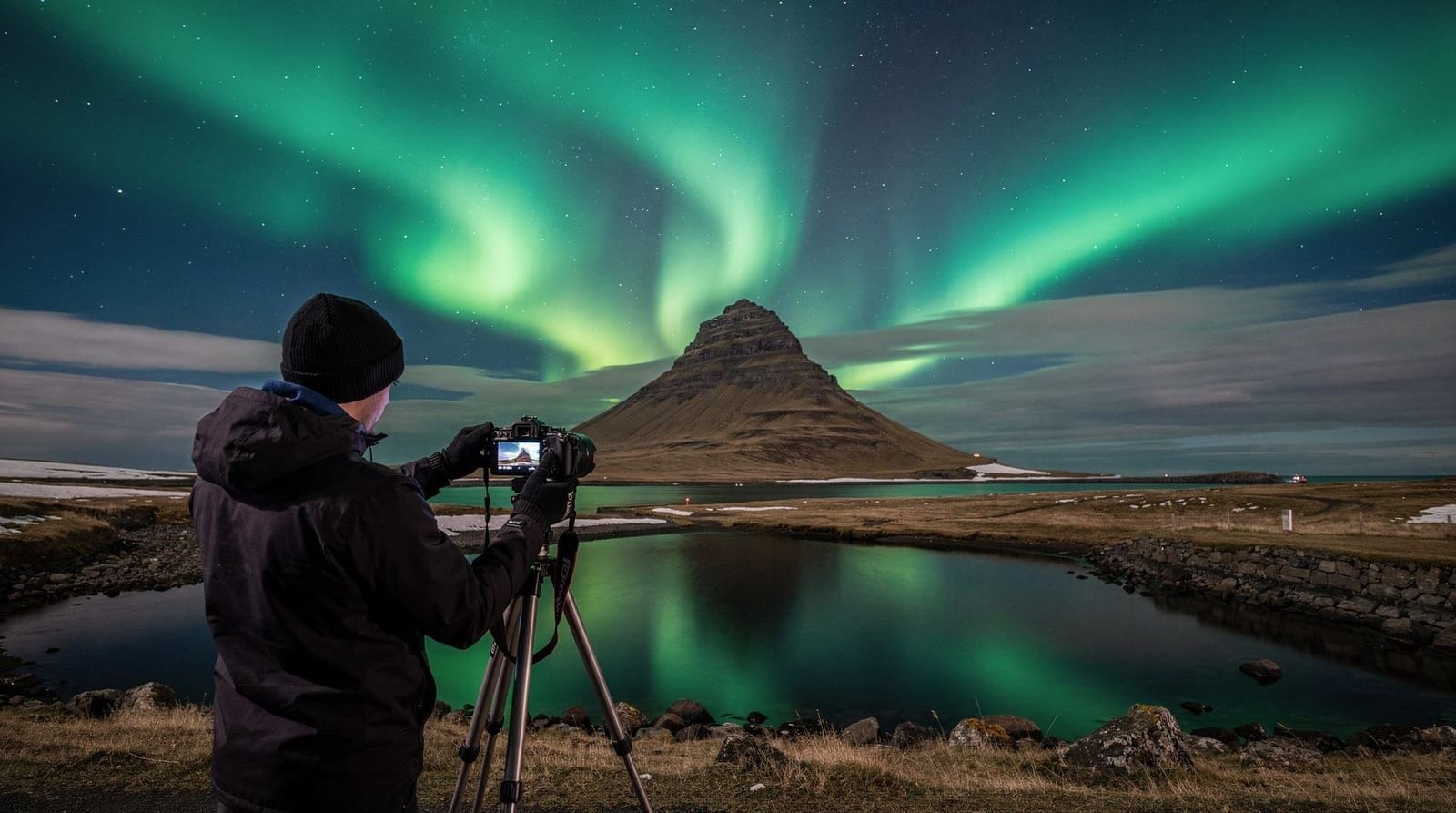
Reykjavík small-group northern lights tour — guides monitor the same forecast data and reposition to clear skyEither way, where to see northern lights covers the specific dark-sky locations worth driving to once your forecast check gives you the green light, and northern lights photography covers camera settings for when a display actually appears.
Frequently asked questions about aurora forecasts
Is there an aurora forecast specifically for Iceland?
Yes. vedur.is (Icelandic Met Office) publishes a combined aurora and cloud cover forecast specific to Iceland, updated daily. This is the most relevant single source for planning viewing nights in Iceland.
How accurate is the 3-day Kp forecast?
Directionally useful but not reliable enough for firm plans. The 3-day forecast is based on the current state of the sun and known solar wind streams. Unexpected solar flares can dramatically change the outlook. Use it for initial planning, then confirm with 24-hour and same-night data.
What does “substorm” mean in aurora forecasts?
A substorm is a sudden intensification of aurora activity, often lasting 15–60 minutes. Substorms can occur even at moderate overall Kp levels and produce brief but intense displays. They are not reliably predictable more than 30–60 minutes ahead.
Can the aurora be seen in the south of Iceland?
The aurora oval covers the entire country during moderate Kp levels. South Iceland — including the South Coast and Vík — is as well-positioned as Reykjavík, with the advantage of lower light pollution.
Top experiences
Best-rated activities across GetYourGuide and Viator.

Private 2-Day Glacier Lagoon, Ice Cave and Northern Lights
- Viator

Reykjavik Private Northern Lights Tour with Pro Photographer
- Viator

Private Aurora Hunt in Iceland with Professional Photos
- Viator

Northern Lights Classic MiniBus Tour from Akureyri
- Viator

Northern Lights Jeep Tour - Icelandic Guide | Photos | Cocoa
- Viator
Akureyri: From Akureyri Northern Lights tour
- GetYourGuide