Best time to see the northern lights in Iceland
Reykjavik: Northern Lights lifetime guarantee
When is the best time to see the northern lights in Iceland?
The best months are September through March, when Iceland has enough darkness for aurora visibility. Peak season is October–February, with long nights (up to 20 hours of darkness in December) and historically higher auroral activity. You need darkness, a clear sky, and a Kp index of at least 2–3 in Iceland.
Chasing the aurora in Iceland means planning around darkness first and everything else second. This guide breaks down exactly which months work, why, and how to stack the odds in your favour.
| Season | Late August to mid-April |
| Peak months | October–February |
| Cost | Free from a dark spot; guided bus tours around 12,000–15,000 ISK |
| Booking | 1–2 weeks ahead in peak season; sooner over Christmas/New Year |
| You also need | Clear sky + Kp 2–3 or higher on the night |
Why darkness is the only thing you can actually control
Aurora borealis does not follow a timetable. Solar wind, cloud cover, and the random geometry of Earth’s magnetic field all interact in ways that no forecast can pin down more than 3–4 days out. The one variable in your control is choosing a time of year when Iceland has enough darkness to actually see the lights — even when they appear.
Iceland sits between 63° and 66° N latitude. At midsummer, it never gets dark enough for aurora viewing. From late May through mid-July, twilight persists through midnight and the sky never drops below astronomical twilight. No aurora forecast, however impressive, will override this physical fact.
The flip side: during the winter months you get long, dark windows every single evening. Even if the first two nights are cloudy, night three might clear. That statistical buffer is what serious aurora hunters rely on.
Month-by-month breakdown
September and October
Darkness returns in earnest by mid-September. Sunset is around 20:00 and proper darkness begins around 21:30–22:00. By October, it is dark by 20:00.
September and October are arguably the sweet spot. Cloud cover is lower than mid-winter, temperatures are still manageable for standing outdoors (0°C to 10°C), and the autumn equinox around September 22 is statistically associated with geomagnetic disturbances — a real but modestly sized effect on aurora frequency.
Expect 6–9 hours of usable darkness per night by October. Tour operators run nightly excursions from Reykjavík from early September.
November and December
November is a transition month: more darkness than October, but cloud cover starts climbing. December is the darkest month, with only 4–5 hours of daylight near the solstice. On the upside, every clear night is a long viewing opportunity. On the downside, Iceland’s sub-arctic maritime weather produces overcast skies frequently in both months.
Prices for flights and accommodation rise sharply in December around the Christmas and New Year period. See Iceland in winter for practical advice on travelling during this period.
January and February
January is the stormiest month in Iceland on average. Blizzards, high winds, and low pressure systems sweep through regularly. When it clears, auroras are spectacular — but plan for disrupted travel. Car hire companies impose strict F-road bans and some highland routes are impassable.
February is statistically one of the better aurora months in Iceland. Darkness is still 14–16 hours, storm frequency starts to drop slightly, and the aurora oval is still positioned well overhead. Many regular aurora hunters rate February as their preferred month precisely because it balances darkness with marginally more predictable weather than January.
March
March is the other equinox month and frequently produces strong geomagnetic activity. Darkness is around 12 hours by the equinox, dropping steadily toward the short nights of summer. The major practical advantage: roads are more accessible, self-drive is more feasible, and highland passes start reopening in late March.
March suits self-drivers who want to escape city light pollution without the full brutality of a January blizzard. For self-drive aurora hunting, it is often the most practical month.
April to August
Twilight returns and aurora hunting becomes impractical. April still has 2–3 usable dark hours after midnight, but the window closes rapidly. May through mid-August: no aurora viewing. If you are visiting in summer, redirect your energy toward the midnight sun.
Solar cycle and why 2025–2027 is a good era
The aurora depends on solar activity, which follows an 11-year cycle. Solar Cycle 25 reached its predicted maximum in late 2024–2025, making the current period one of the most geomagnetically active in over a decade. The increased solar wind output means more frequent and more intense aurora displays compared with the 2018–2021 minimum. Displays that would have required Kp 6 to be visible in Reykjavík may now appear at Kp 4.
This elevated activity will persist — with some decline — through 2026 and into 2027. If you have been postponing an aurora trip, the next two years are genuinely among the best in the 11-year cycle.
What conditions you actually need on any given night
Getting the season right is necessary but not sufficient. On the night itself you need all three:
Darkness — at least astronomical twilight (sun 18° below horizon). This is guaranteed from late September to mid-March in Iceland.
Clear sky — even 20% cloud cover can block a display. The Icelandic Met Office (vedur.is) publishes cloud cover forecasts and a dedicated aurora forecast. Check both every day from around noon.
Solar activity — Kp index 2 or above in Iceland. SpaceWeatherLive.com aggregates NOAA data and sends push alerts. The 27-day forecast is not reliable; the 3-day is reasonably useful; the 1-hour short-range is the one to act on.
Tour vs. self-drive — how it affects your season choice
If you are booked on a guided bus tour from Reykjavík, the operator monitors forecasts and takes you to wherever clouds are thinnest that night. This flexibility partially compensates for bad luck with weather. See the comparison in northern lights tours: bus vs. boat for detail.
Self-drivers have the advantage of chasing clear skies across a larger radius — sometimes 100–200 km from Reykjavík into South Iceland or toward North Iceland. This is most feasible in the shoulder months (September, October, March) when roads are generally passable.
Northern Lights tour with lifetime guarantee — if you don’t see the lights, you can come backChoosing your itinerary around aurora season
The northern lights winter 5-day itinerary is designed specifically around October–March travel, combining Reykjavík with the South Coast and positioning you in areas of lower cloud cover on clear-sky nights.
If you are planning the ring road, doing it in October or late February gives you both scenic driving and aurora possibilities at night, without the extreme winter driving risks of December and January.
Accommodation and light pollution
Where you sleep matters for self-directed viewing. Central Reykjavík produces substantial sky glow. Budget accommodation options near Vik or Jökulsárlón — both popular stops on the South Coast — put you under genuinely dark skies. Several farm stays and guesthouses in South Iceland market themselves specifically as aurora-viewing properties, with south-facing windows and outdoor hot tubs for cold-night watching.
For dedicated aurora hotels, see best northern lights hotels.
Realistic expectations: probability by month
The table below uses approximate cloud-free night frequency and aurora activity data. These are planning estimates, not guarantees.
| Month | Darkness (hours) | Typical cloud-free nights/week | Aurora probability per clear night |
|---|---|---|---|
| September | 8–12 | 3–4 | Moderate (Kp activity variable) |
| October | 12–15 | 2–3 | Moderate–High |
| November | 15–18 | 2–3 | High |
| December | 18–20 | 1–2 | High (when clear) |
| January | 17–19 | 1–2 | Very High (when clear) |
| February | 14–17 | 2–3 | High |
| March | 10–14 | 2–4 | Moderate–High (equinox boost) |
Booking tours in advance vs. on arrival
In peak season (December–February), popular tours sell out. The lifetime guarantee tours book weeks ahead because demand from hopeful travellers is high. Book your first-choice tour before you arrive, then re-evaluate conditions each night.
If you arrive without a booking, same-day availability exists on most tour platforms — but the premium small-group tours go first. Base-level bus tours with 40–50 passengers rarely sell out.
Understanding Iceland’s weather windows
The most persistently underrated element in aurora planning is Iceland’s weather — specifically, the difference between the seasonal cloud cover patterns that affect different regions and months. The aurora forecast is irrelevant if you cannot see through the sky.
Iceland’s weather is driven primarily by the jet stream and Atlantic low-pressure systems. These systems sweep in from the south and southwest, bringing cloud and precipitation to the south coast and Reykjavík first. The north and east of Iceland are in a partial rain shadow created by the central highland plateau and often have clear skies when the southwest is overcast.
For Aurora hunters based in Reykjavík, the practical implication is directional: on nights when the vedur.is cloud map shows cloud over the south and west, the drive toward North Iceland or East Iceland is the correct decision. A 3-hour drive north on a clear night beats a 30-minute drive south into the cloud bank.
The months with the most stable, cold, clear weather in Iceland are typically February and late March — when high-pressure systems from the north push cold arctic air south over the country, producing crystal-clear skies for several days at a time. These “high-pressure windows” are the most productive aurora periods because they combine good solar activity probability with the clearest possible skies.
Planning around the solar cycle
Solar Cycle 25 is at its peak, and the current window through 2026–2027 is genuinely one of the best for aurora viewing in over a decade. Understanding the cycle helps you make confident trip decisions rather than relying on vague “best months” advice.
The sun’s activity rises and falls over an approximately 11-year cycle. At solar maximum, the number of sunspots, solar flares, and coronal mass ejections (CMEs) increases significantly. CMEs are the eruptions that send dense clouds of magnetised plasma toward Earth — when these clouds interact with Earth’s magnetic field, they produce the strongest aurora events.
At solar minimum, aurora displays still occur, but they are driven primarily by recurring coronal hole streams rather than CMEs. These streams are weaker and more predictable but produce Kp 3–5 events regularly throughout the winter. At solar maximum, CME-driven events push Kp to 6, 7, or even 8+ — the kind of events that produce full-sky colour displays visible across northern Europe.
Practical planning implication: during solar maximum years, the floor for aurora activity is higher. Even a “quiet” aurora night in 2025 or 2026 may produce better displays than a typical night during the 2018–2020 solar minimum period. If you have been wondering whether this year is a good year to visit — yes, it is.
The solar cycle cannot be collapsed into month-by-month forecasts, but you can track it through NOAA’s Solar Cycle Progression chart (published at swpc.noaa.gov). If the current sunspot number is above 100, the cycle is still near its peak. If it has declined to below 50, you are in the early downslope.
The role of moonlight in aurora planning
Moonlight is the variable that most aurora hunters underestimate. During a full moon, the sky brightness increases dramatically — enough to wash out Kp 2 and Kp 3 aurora displays completely. During a new moon with no moonrise, the sky is maximally dark and even a Kp 2 smear on the horizon is visible to dark-adapted eyes.
The relationship is not binary. A half moon rising after midnight affects only the second half of the viewing window. A waxing crescent that sets before 22:00 leaves the prime viewing hours (22:00–02:00) unaffected. Checking the lunar calendar alongside aurora forecasts pays dividends.
For planning purposes:
- New moon ± 3 days: ideal conditions for viewing faint aurora
- Quarter moon: acceptable, only affects viewing in the direction of the moon
- Full moon ± 3 days: only strong aurora (Kp 5+) will overpower the moonlight
Free lunar calendar tools are built into both the SpaceWeatherLive app and the vedur.is aurora forecast page. Set your travel dates around new moons in your target month for the statistically best dark-sky conditions. In a typical aurora season, planning around two new-moon windows per month doubles your effective viewing time compared to ignoring the lunar cycle.
A counterintuitive note: on Kp 5+ nights, the moon’s effect is minimal. The aurora is bright enough to outshine a quarter moon. If solar activity is very high during your visit, the lunar phase becomes less important. The lunar calendar matters most on marginal nights — which are, statistically, the majority of aurora nights.
Booking strategy by month
The commercial landscape of aurora tours in Iceland varies significantly across the season, and understanding it helps you avoid overpaying and maximise flexibility.
September: Low competition, high availability. Tour operators have just reopened their winter rosters and are eager for bookings. Same-day availability is common. Prices are at their seasonal low for both tours and accommodation. The downside: shorter dark windows mean tours return earlier, and some operators run their programme with thinner staffing.
October: The sweet spot for bookings. Enough demand to justify full programme operation — all the major operators are running nightly. Prices are still reasonable. Lifetime guarantee tours have full fleet availability. Booking 1–2 weeks ahead is sufficient for most tour types. Early October school holidays in some European countries can create brief demand spikes — check your dates.
November and early December: Demand starts rising but is not yet Christmas-level. Premium small-group tours are worth booking 2–3 weeks ahead. The “shoulder winter” period before Christmas often has better value on accommodation than December.
December and January: Peak pricing and lowest availability. Christmas week (December 23 – January 2) sees flights and hotels at their most expensive. Popular lifetime guarantee tours may sell out weeks ahead. If you are visiting in December, book everything before October. Late January — after the holiday premium drops — often offers the same dark skies and lower prices.
February: A genuinely underrated booking window. The holiday premium has passed, flights are cheaper than January, but the aurora season is still fully operational. This is when many experienced aurora hunters visit. Book tours 1 week ahead; accommodation 2–4 weeks ahead for rural properties.
March: Prices drop compared to February. Late March has the added benefit of safer self-driving conditions as road surfaces improve. Tour operators run through March with full schedules; some begin winding down in April. Book accommodation in popular aurora hotels (South Coast, Snæfellsnes) 3–4 weeks ahead.
The northern lights winter 5-day itinerary is structured around October and February as the optimal months for balancing all these factors.
Photographing the aurora on your own timeline
Timing your trip around the aurora is only half the planning — capturing it well requires a bit of separate preparation. A tripod is close to mandatory: handheld shots at the shutter speeds aurora photography needs (typically 2–10 seconds) will blur. A wide-angle lens (14–24mm equivalent) captures more sky and works better in low light than a standard zoom. Manual focus set to infinity (checked in daylight beforehand, since autofocus usually fails in the dark) avoids the common mistake of a beautifully composed but out-of-focus frame.
Camera settings that work as a starting point: ISO 1600–3200, aperture as wide as your lens allows (f/2.8 or wider ideally), shutter speed 4–8 seconds for a fast-moving display and up to 15–20 seconds for a faint, slow one. Review your first few frames and adjust — a display that looks faint to the naked eye often shows vivid green and purple on the camera sensor. For more detail on adapting these settings to Iceland’s specific winter conditions, see the Iceland photography guide.
Self-drive vs guided tour: which suits your season window
Both routes work, but the trade-offs shift depending on when you’re travelling.
| Approach | Best months | Main advantage | Main limitation |
|---|---|---|---|
| Guided bus tour | Any aurora month | Operator monitors forecasts and relocates to clearer sky | Group pace, fixed pickup/return times |
| Self-drive | September, October, March | Full flexibility to chase clear patches over a wide radius | Requires confidence driving unfamiliar roads at night, sometimes in snow |
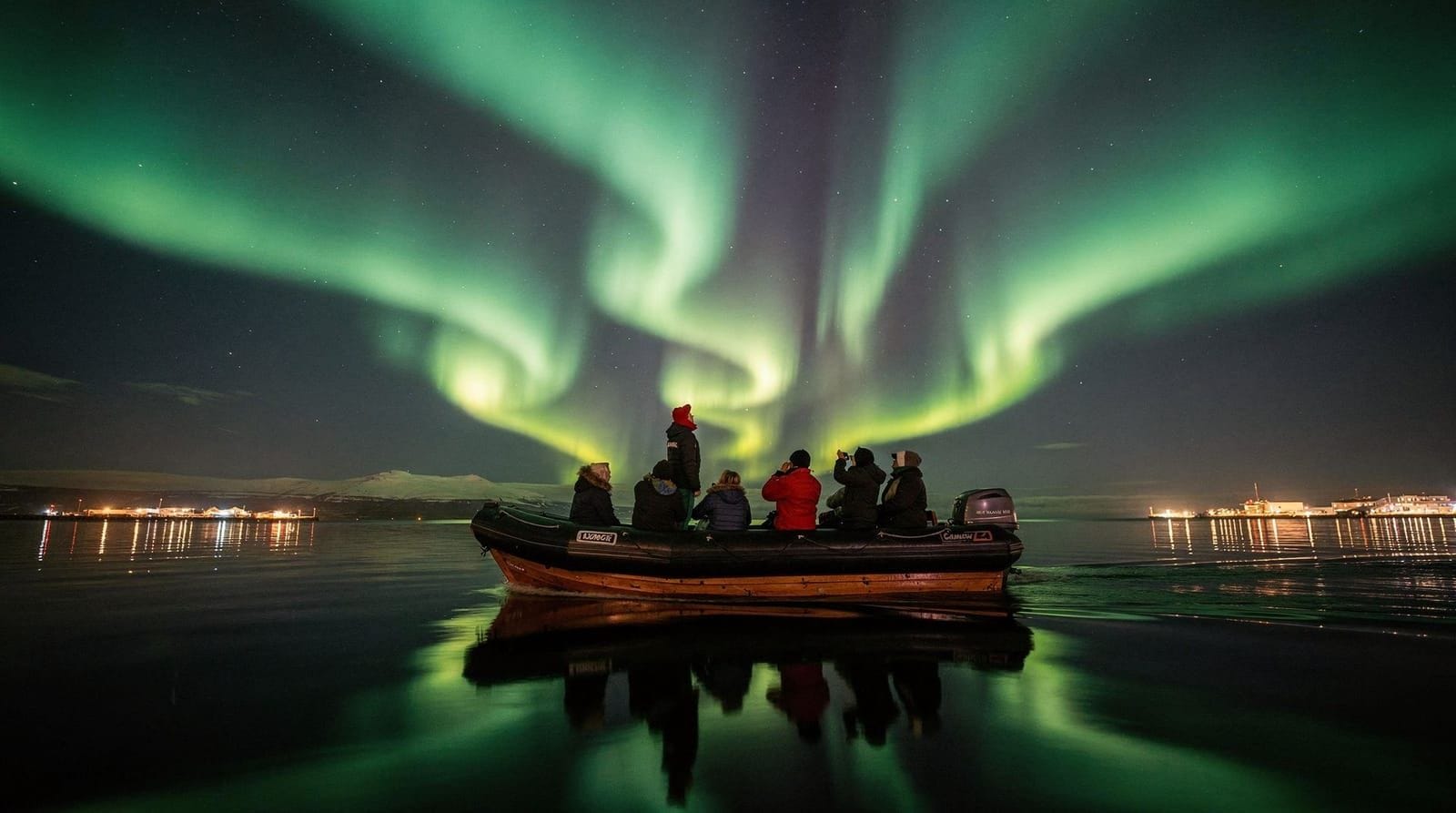
| Boat tour (Faxaflói Bay) | October–March | Escapes land-based light pollution entirely | Weather-dependent, can be cold and exposed |
If you’re unsure which format fits your trip, northern lights tours: bus vs. boat breaks down the tour-format decision in more depth, and self-drive aurora hunting covers the specific driving and safety considerations for going it alone.
Where to actually stand once you’re in season
Timing gets you into the right months; location on the night still matters enormously. City light pollution in central Reykjavík genuinely washes out weaker displays — even a short drive to Grótta lighthouse or Öskjuhlíð hill on the city’s edge improves contrast noticeably. For a proper dark-sky base, the South Iceland coast around Vík or the Jökulsárlón area has minimal ambient light and open horizons in every direction. North Iceland around Akureyri is worth prioritising specifically in months when the southwest forecast looks cloudy, since it often sits in a rain shadow from the same Atlantic systems. For a guided perspective on picking a specific viewing spot rather than a whole region, where to see northern lights has site-by-site detail.
Frequently asked questions about when to see the northern lights
What is the absolute worst month to try for northern lights in Iceland?
June and July. Iceland does not reach astronomical darkness at all during these months — the sky stays in permanent twilight and aurora is invisible regardless of solar activity.
Can you see northern lights in a snowstorm?
No. Snow and thick cloud block the view completely. Snowstorms in Iceland can also make driving hazardous or impossible. Always check road conditions at road.is before heading out in winter.
Is it worth booking a northern lights tour if the forecast is bad?
If you are staying multiple nights, a bad forecast on night one does not mean the rest of your trip is ruined. Operators with lifetime guarantees will rebook you at no cost if the lights do not appear. If you have only one night in Iceland, a bad forecast significantly reduces your odds — but tours still run because conditions can change within the night.
Do auroras happen every night in Iceland in winter?
No. The aurora oval passes over Iceland frequently, but visible displays require both solar wind and a cloud-free sky. In a typical winter week, you might have 2–3 genuinely good aurora nights out of 7.
What time of night are northern lights most likely?
Peak geomagnetic activity often occurs around magnetic midnight — approximately 22:00–02:00 local time in Iceland. Tours typically run 21:00–01:00. The lights can appear at any hour of darkness, so longer dark periods (December, January) give more chances per night.
Do I need to drive somewhere remote, or can I see them from Reykjavík?
You can sometimes see strong displays (Kp 4+) from within Reykjavík, but city light pollution suppresses fainter shows. A short 10–15 minute drive to the city’s edge (Grótta, Öskjuhlíð) or joining a bus tour that drives out toward darker sky improves your odds considerably without requiring a multi-hour trip.
Top experiences
Bookable activities with verified prices and instant confirmation on GetYourGuide.
Top experiences
Best-rated activities across GetYourGuide and Viator.

Private 2-Day Glacier Lagoon, Ice Cave and Northern Lights
- Viator

Reykjavik Private Northern Lights Tour with Pro Photographer
- Viator

Private Aurora Hunt in Iceland with Professional Photos
- Viator

Northern Lights Classic MiniBus Tour from Akureyri
- Viator

Northern Lights Jeep Tour - Icelandic Guide | Photos | Cocoa
- Viator
Akureyri: From Akureyri Northern Lights tour
- GetYourGuide