Northern lights from Reykjavík — practical guide
Reykjavik: Northern Lights lifetime guarantee
Can you see the northern lights from Reykjavík?
Yes, but only during strong geomagnetic events (Kp 4+) right in the city centre. Most nights require driving 15–45 minutes to darker locations. Guided tours depart nightly from Reykjavík's BSÍ bus terminal from late August through April and handle the logistics of finding clear skies.
How Reykjavík fits into aurora travel
Reykjavík is not a northern lights destination in itself — it is a departure point. The city’s population of 130,000 generates too much light pollution for casual aurora viewing from the city centre. However, every major aurora tour operator in Iceland is based in Reykjavík, and the city is within 45 minutes of genuinely dark skies in multiple directions.
| Where | Reykjavík city centre plus 15–45 min drive to dark-sky spots (Grótta, Þingvellir) |
| Cost | Bus tour around 8,000–11,000 ISK; small-group around 12,000–20,000 ISK |
| Season | Late August–April, best statistically September–March |
| Time needed | 3–4 hours per tour night; budget 3–5 nights for a real chance |
| Booking | Advance booking recommended; look for free-reschedule or lifetime-guarantee policies |
For most visitors to Iceland, the northern lights experience starts and ends in Reykjavík: book a tour, get picked up from your hotel or from BSÍ bus terminal, and be driven to wherever conditions are best that evening.
Tour options departing from Reykjavík
Large-bus tours (30–50 passengers)
The most affordable option. Operators including Reykjavík Excursions and Gray Line run converted coaches or large minibuses that seat 30–50 people. Guides provide commentary and may assist with basic camera settings. Flexibility is limited — the bus stops at pre-planned lay-bys.
Cost: 8,000–10,500 ISK per adult (€55–€75). Includes hot cocoa and sometimes a photograph taken by the guide.
Small-group minibus tours (8–16 passengers)
More flexible routing and a more personal experience. These tours can pull over more easily and adjust their route based on real-time cloud movement. Guides on smaller tours often have more photography experience and spend more time helping passengers.
Cost: 12,000–18,000 ISK per adult (€85–€125). Some include professional photographs.
Premium Northern Lights minibus from Reykjavík — small group, 4 hours, hot drinks includedBoat tours
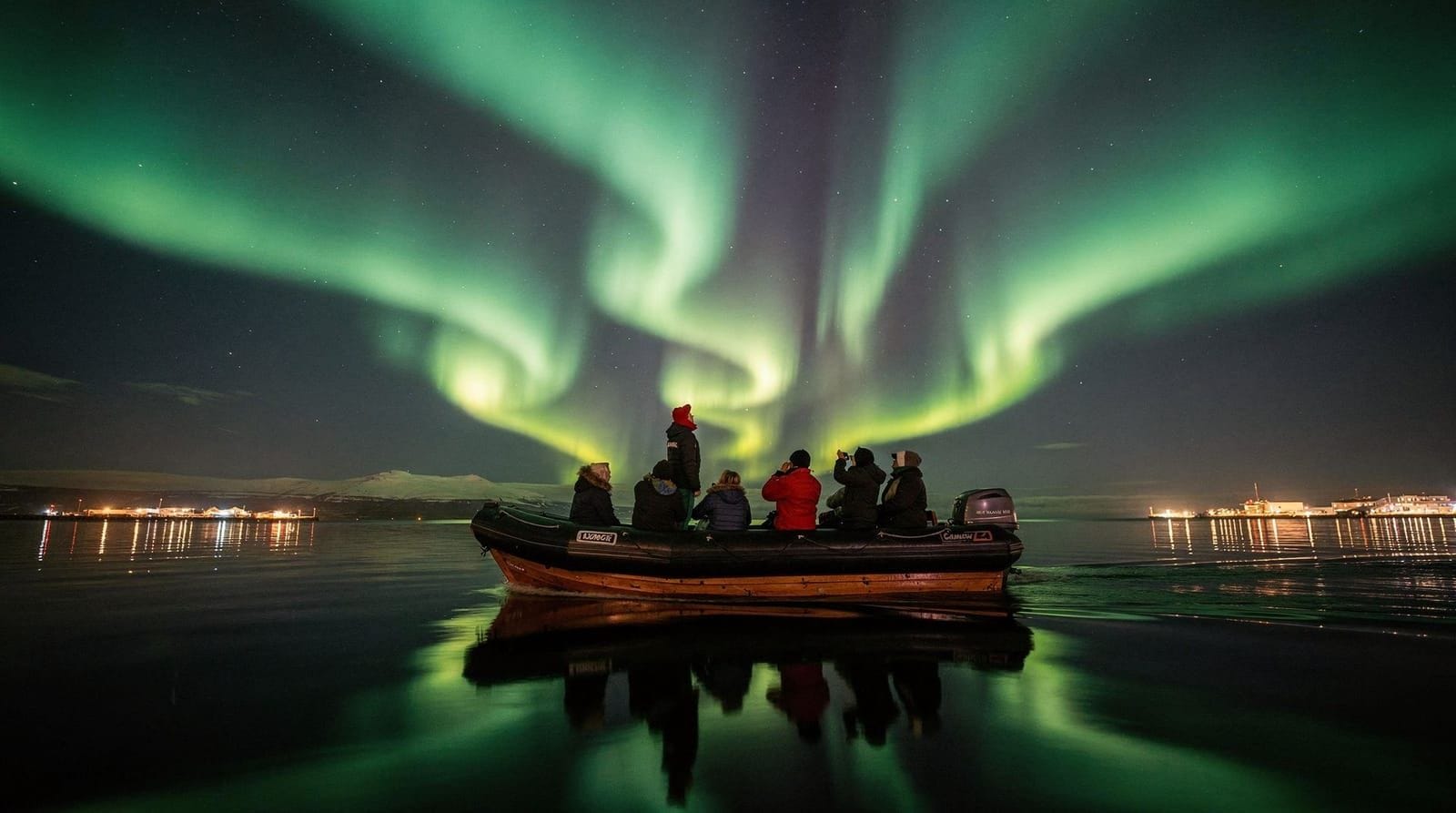
Two to three Reykjavík operators run aurora boat tours from the Old Harbour. The boat heads into Faxaflói bay, eliminating city light pollution entirely. Sea spray and motion sickness are considerations; this format suits travellers who specifically want a unique experience or exceptional photographs.
Northern Lights guided boat tour from Reykjavík Old Harbour — with photosLifetime guarantee tours
Several operators offer a rebook-free-of-charge policy if the aurora does not appear. The Reykjavík Sightseeing lifetime guarantee tour, for example, allows you to join any future departure with the same ticket. This policy is particularly useful if you are visiting Iceland multiple times or have flexibility in your schedule.
Northern Lights tour with lifetime guarantee — rebook as many times as neededJeep and super-jeep private tours
Private 4WD or super-jeep tours cost 60,000–120,000 ISK for 2–4 people but offer maximum flexibility: the driver-guide chases clear skies across the entire Reykjavík radius, can go off-road where conditions allow, and adjusts completely to your photography needs. Worth considering if you are seriously into aurora photography and have a group to split the cost.
Going independently from Reykjavík
If you have a rental car, independent aurora hunting from Reykjavík is straightforward. The core principle: drive away from light pollution in the direction with the clearest sky forecast.
Grótta lighthouse (Seltjarnarnes)
The most popular spot for Reykjavík residents. Take Ægissíða road west to the Seltjarnarnes headland and park at the lighthouse access road. The lighthouse is surrounded on three sides by water, and the city’s light pollution is mostly behind you to the east. At Kp 3+, auroras are visible here without any other travel. Accessible on foot from the bus terminus at Seltjarnarnes (bus 11 from Hlemmur).
Öskjuhlíð hill (The Pearl/Perlan)
The elevated ground around the Perlan museum (Öskjuhlíð) is 10 minutes from central Reykjavík. The hill rises above some of the surrounding light pollution. Not a dark-sky site, but useful during strong events when you want to check conditions before deciding whether to drive further.
Mosfellsbær outskirts (20 minutes)
Route 1 northeast toward Mosfellsbær leads quickly to the foothills of Esja mountain. The small town of Mosfellsbær (population 10,000) causes minimal sky glow. Turnoffs toward Nesjavellir and Þingvellir both enter dark terrain quickly after the town.
Þingvellir National Park (45 minutes)
For self-drive aurora hunting, Þingvellir is the most reliable destination within an hour of Reykjavík. The park closes the main visitor centre but the parking areas stay accessible. The wide Þingvallavatn lake lies below, unlit. At Kp 2+ and clear skies, this is a very productive location.
What actually happens on tour nights
Forecasting and cancellation
Tour operators monitor the Icelandic Met Office (vedur.is) forecast throughout the day. By 19:00–20:00, most operators decide whether conditions are viable. If cloud cover is forecast at 100% over the entire southwest, they message participants to reschedule. Partial cloud is not a cancellation trigger — guides will try to find clear pockets.
The tour itself
Tours typically leave central Reykjavík between 21:00 and 22:00 and head in the direction with the best forecast. Most spend 1–3 hours at various dark spots, often moving between locations if the first site clouds over. A strong night means standing in a field watching green curtains ripple for 30–60 minutes while guides shout camera settings at each other.
On a marginal night, tours may return passengers after 3 hours with only a faint shimmer on the horizon to show for it. This is not a failure on the operator’s part — it is what aurora hunting looks like. The guarantee policies exist precisely for this reason.
Photography on tours
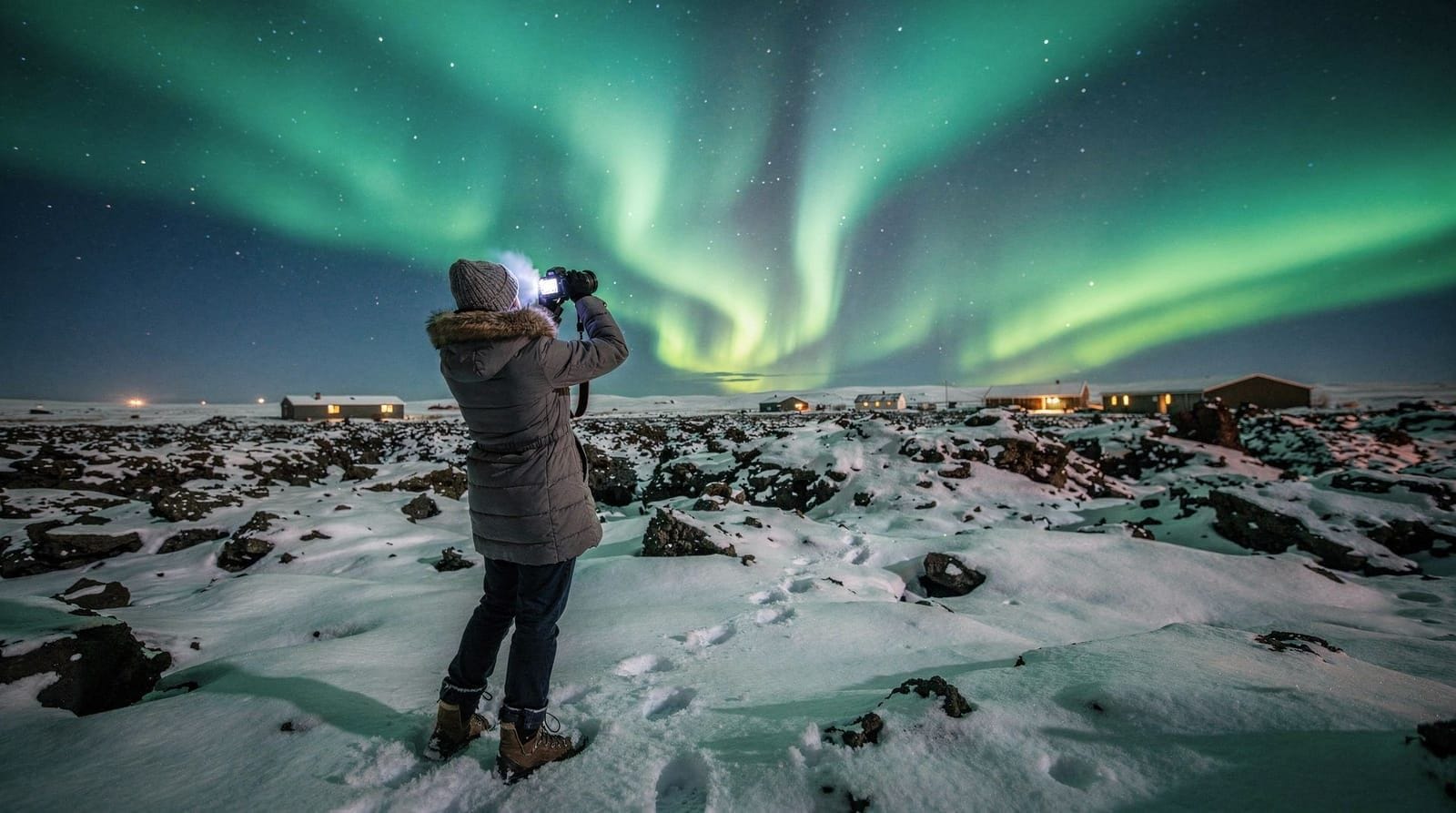
Most guides on small-group tours will give brief advice on long-exposure settings. For serious photographers, see northern lights photography for a full guide on equipment and technique. The key settings: ISO 1600–3200, aperture f/2.8 or wider, shutter 10–25 seconds. A tripod is not optional.
Reykjavík as a multi-night base for aurora hunting
The optimal strategy from Reykjavík is:
- Book your preferred tour type in advance (lifetime guarantee if you are nervous about odds).
- Check vedur.is at noon and 18:00 each day.
- On evenings with Kp 2+ and partial or clearing skies, join the tour or self-drive to Grótta/Þingvellir.
- On fully overcast evenings, take a rest night — Reykjavík’s restaurants and bars are genuinely good.
- The best time to see northern lights guide has probability tables by month to help calibrate expectations.
If you plan to base yourself in Reykjavík for the northern lights winter itinerary, five nights gives you 3–4 realistic aurora-hunting windows even in a week of mixed weather.
Calibrating your expectations before the first night
The gap between the aurora photographs you see online and what you actually observe on a typical aurora night in Iceland is significant. Understanding this gap before your first night prevents the discouragement that colours some visitors’ entire experience.
Photographs of the northern lights are taken at ISO 1600–3200 with 10–20 second exposures, collecting light over time and boosting the colour of the aurora beyond what your eye perceives in real time. A Kp 3 aurora that looks like a pale greenish band to the naked eye will look like a dramatic curtain in a 15-second exposure photograph. This is not a failing of your eyes — it is how cameras work.
On a Kp 3 night, expect: a clearly green arc or band visible on the northern horizon, possibly with some vertical rays. Active but not fast movement. Visible to the naked eye but less saturated than photographs. A camera will capture this as dramatic; your eye will register it as “real and interesting but quieter than expected.”
On a Kp 5+ night, expect: curtains covering a significant portion of the northern sky, possible red or pink at the top of the display, noticeable movement and shape changes over minutes. Clearly impressive to the naked eye. These nights are less common — perhaps 3–5 per week during active solar periods.
On a Kp 1–2 night: a faint greenish haze near the horizon. Your camera will capture it; your eye may not register it as aurora at all without experience. Not every alert night delivers a visual display — this is a normal part of aurora hunting.
Combining northern lights with the Blue Lagoon
One popular evening combination: soak at Sky Lagoon (8 km from central Reykjavík) until dusk, then drive to Grótta or join a late-departure aurora tour. Sky Lagoon itself stays open until 23:00 and sits in a coastal location with limited light pollution to its west. During strong events, aurora displays are visible from the lagoon.
Alternatively, some operators run combined Blue Lagoon and northern lights evenings — an afternoon Blue Lagoon soak followed by an evening aurora tour. This requires careful timing as the Blue Lagoon is 50 minutes from Reykjavík and the logistics only work smoothly if you have a car or book a combined transfer.
The Reykjavík aurora tour ecosystem
Reykjavík is home to more aurora tour operators per capita than any other city in the world. This concentration of providers has produced a competitive market with a wide range of options — but also makes choosing between operators confusing.
Understanding the three tiers helps:
Mass-market operators (Reykjavík Excursions, Gray Line Iceland, Sterna Travel): These companies run large-vehicle tours with 30–50 passengers. They are professionally managed with reliable departure schedules, well-maintained vehicles, and standardised cancellation policies. The trade-off is the group size — with 40 passengers, individual photography assistance is limited and stops are determined by the group’s pace, not yours. Prices are 8,500–11,000 ISK per adult (€59–€77).
Mid-tier operators (Arctic Adventures, Troll Expeditions, Hidden Iceland): These companies typically run smaller buses (16–24 passengers) or minibuses (8–16 passengers). The smaller format allows more flexible routing and more individual attention. Many have professional photographers as guides on some departures. Prices are 12,000–20,000 ISK per adult (€84–€140).
Premium and specialist operators (Northern Lights Center, Lava Tours, various private guides): Private tour providers who run entirely custom experiences — your departure time, your route, your schedule. Also specialist aurora photography tours with professional photographers aboard. Prices range from 50,000 ISK for a shared “semi-private” experience to 120,000+ ISK for a fully private night out.
Booking directly with the operator rather than through a third-party platform has advantages: better communication about conditions, easier rescheduling, and access to the lifetime guarantee if the operator offers one. Some operators explicitly restrict lifetime guarantee eligibility to direct bookings.
A less obvious factor when comparing operators within the same tier is pickup logistics. Hotels in the 101 Reykjavík postcode (city centre) are typically the first or second stop, meaning less time spent on the bus before reaching a dark-sky spot. Guesthouses further out — in Kópavogur or Hafnarfjörður, for instance — may add 20–30 minutes of pickup driving before the tour proper even begins, which matters on a night with a narrow weather window. If your hotel sits outside central Reykjavík, ask about pickup order when booking, or consider making your own way to BSÍ terminal, which is usually the first departure point regardless of route.
What a strong aurora looks like from the city
Most aurora photographs from Iceland show dramatic curtains of green light over remote wilderness. The visual reality from Reykjavík during a strong event is different — and worth understanding before you decide whether to book a tour or watch from the city on a given night.
During a Kp 4 event from central Reykjavík, aurora appears as a diffuse green glow on the northern horizon, competing with streetlights. It is clearly visible, clearly green, and unmistakably not city light — but it lacks the crisp movement and colour saturation of a rural viewing experience. From Grótta lighthouse or the harbour waterfront, the same Kp 4 event looks considerably better: a clear arc or band running east-west across the northern sky, sometimes with vertical rays.
A Kp 5 event from central Reykjavík is genuinely impressive. The city’s glow fades into irrelevance as the aurora brightens and fills more of the sky. The arc develops into dancing bands, and faint red or pink appears at the top. From the Sólfar sculpture on the waterfront — facing north with the bay in front of you — Kp 5+ events produce photographs that rival anything taken from darker rural spots.
A Kp 6+ event from Reykjavík looks the same as from a field in South Iceland. At this level the aurora is filling a large portion of the sky and competing with city light is no longer a factor. The practical advice: on nights forecast at Kp 3 or below, it is worth driving 20–30 minutes to Grótta at minimum or Þingvellir if conditions warrant. On nights forecast at Kp 5+, you can watch productively from anywhere in the city with a clear northern view.
The Kp index updates every 3 hours from NOAA and every few minutes from SpaceWeatherLive’s real-time data. Decide whether to stay in the city or drive based on the current reading at 21:00–22:00, not the previous day’s forecast.
Photography logistics for Reykjavík-based aurora hunters
Shooting aurora from Reykjavík requires a slightly different approach than rural shooting, because the ambient light changes the exposure dynamics.
Shorter exposures: Reykjavík’s street light produces a sky glow that registers as orange or yellow in your RAW files. A 25-second exposure at ISO 3200 near the city will produce a heavily orange-tinted sky. Use shorter exposures (8–12 seconds) and correct the white balance in post-processing to isolate the aurora’s green.
Watch for the moon and light direction: From Grótta, the city light dome is to the east (behind you when facing north). You can shoot west and north with relatively dark skies, but shooting east toward the city produces images flooded with orange city glow.
Foreground subjects in Reykjavík: The Sólfar sculpture, the Old Harbour cranes, or Hallgrímskirkja church can all serve as foreground subjects for aurora compositions. These options only work during Kp 5+ events when aurora fills enough sky to appear above a building or structure.
The Grótta lighthouse: At Grótta, the lighthouse itself (a red-striped structure) can be used as a foreground subject. Expose for the aurora first (ISO 1600–3200, f/2.8, 10–15 seconds), then evaluate whether the lighthouse is properly illuminated or needs a light painting supplement. The lighthouse is not lit artificially at night — it emits only its navigational light signal.
For a full treatment of aurora photography technique, the northern lights photography guide covers equipment, settings, and composition in detail.
Multi-night strategy from a single Reykjavík hotel
Staying in Reykjavík for 4–5 nights with aurora as the primary goal is a practical and popular approach. The city offers restaurants, museums, and nightlife for cloudy evenings, and the tour departure infrastructure means you can book and cancel with flexibility.
A structured approach for a 5-night Reykjavík-based aurora trip:
Night 1: Book a guided bus or minibus tour regardless of conditions. This is your orientation night — learn the forecast process by observing what the guide does, understand the road directions, and calibrate your expectations. Even on a moderate night, this is useful groundwork.
Night 2: Check vedur.is at 16:00. If Kp forecast is 3+ and any region within 60 km shows clearing, drive independently to Þingvellir or Grótta. If conditions are poor, rest.
Nights 3–4: These are your best nights statistically — you have learned the forecast and you have two more chances. On a good-forecast night, drive further (to the Reykjanes Peninsula or toward Selfoss) for darker skies. On marginal nights, walk to Grótta.
Night 5: Reserve a backup tour booking for this night. If your previous nights were all overcast, this is when a lifetime guarantee tour’s value becomes clear — go with an operator who will drive wherever conditions are best.
The key psychological insight: treat bad-weather evenings as rest evenings, not failures. Iceland’s weather window is wide enough that 5 nights reliably includes 2–3 viable aurora opportunities during the main season. See the probability table in best time to see northern lights for month-by-month expectations.
Some Reykjavík hotels have small rooftop terraces or roof access — ask at reception before your first night. During Kp 5+ events, a hotel rooftop with a clear northern view can provide a legitimate aurora sighting without leaving the building.
Frequently asked questions about northern lights from Reykjavík
What is the Kp threshold to see auroras from central Reykjavík?
Kp 4 is generally the minimum for seeing auroras from the city centre. The harbour front and Sólfar sun voyager sculpture on the waterfront face north and give a reasonable view during strong events.
Are hotel rooms near Grótta available for aurora hunting?
Several guesthouses in the Seltjarnarnes and Laugardalur areas of Reykjavík are within walking distance or a 5-minute drive of dark-sky spots. There is no specific “aurora hotel” district in Reykjavík — proximity to Grótta is the main location advantage.
Do cruise ship passengers in Reykjavík have aurora tour options?
Yes. Most operators offer same-day booking for cruise passengers with guaranteed hotel/harbour pickup. Check the arrival and departure times carefully — tours run from 21:00, so overnight port calls are required.
How many nights in Reykjavík give a realistic chance of seeing the aurora?
There is no guaranteed number, but 3–5 nights is the honest planning baseline for the main season (September–March), based on how often the region gets at least one clear-enough evening with Kp 2+ activity. A single night can absolutely deliver a strong display, but it can equally deliver total cloud cover; if the northern lights are a primary reason for your trip rather than a hoped-for bonus, build in enough nights that one or two washouts don’t end your chances entirely.
Is aurora hunting from Reykjavík family-friendly?
Tours generally accept children ages 4+. The main concern is late-night timing and standing in cold temperatures. Small-group tours allow families more flexibility to return to the bus and warm up. For a family trip, see Iceland with kids for broader advice.
Should I book a tour or drive myself from Reykjavík?
It depends on whether you have a rental car and how comfortable you are driving unlit roads at night. A tour removes the forecasting work entirely — the guide reads vedur.is and the Kp index for you and drives to whatever spot looks best that evening, which matters most on your first night or two before you have learned the rhythm of Icelandic weather. Self-driving to Grótta or Þingvellir costs nothing beyond fuel and lets you leave the moment you see a promising Kp reading, without waiting for a scheduled departure. See do you need a tour for northern lights for a fuller comparison, including insurance and road-condition considerations for driving in Iceland after dark.
Rebooking and refund policies worth knowing before you pay
Cancellation and rescheduling terms vary more between operators than the tour experience itself, and they matter more than almost any other factor if your trip is short. Three patterns are common in the Reykjavík market:
- Weather cancellation by the operator: if the company cancels because forecast cloud cover is total, you are typically rebooked free or refunded in full — this is standard and not something to worry about.
- “No aurora seen” guarantees: some operators (the lifetime-guarantee product is the clearest example) let you rejoin any future departure at no extra cost if the tour ran but no aurora appeared. Read the fine print on how many rebookings are allowed and whether there’s an expiry date.
- Passenger-initiated cancellation: if you cancel because you personally decide the forecast looks poor, most operators do not refund — only the operator’s own weather call triggers a refund. Booking a flexible-date ticket, where available, avoids this trap on a short trip with only one or two aurora-hunting nights available.
Top experiences
Bookable activities with verified prices and instant confirmation on GetYourGuide.
Top experiences
Best-rated activities across GetYourGuide and Viator.

Private 2-Day Glacier Lagoon, Ice Cave and Northern Lights
- Viator

Reykjavik Private Northern Lights Tour with Pro Photographer
- Viator

Private Aurora Hunt in Iceland with Professional Photos
- Viator

Northern Lights Classic MiniBus Tour from Akureyri
- Viator

Northern Lights Jeep Tour - Icelandic Guide | Photos | Cocoa
- Viator
Akureyri: From Akureyri Northern Lights tour
- GetYourGuide