Do you need a tour to see the northern lights in Iceland?
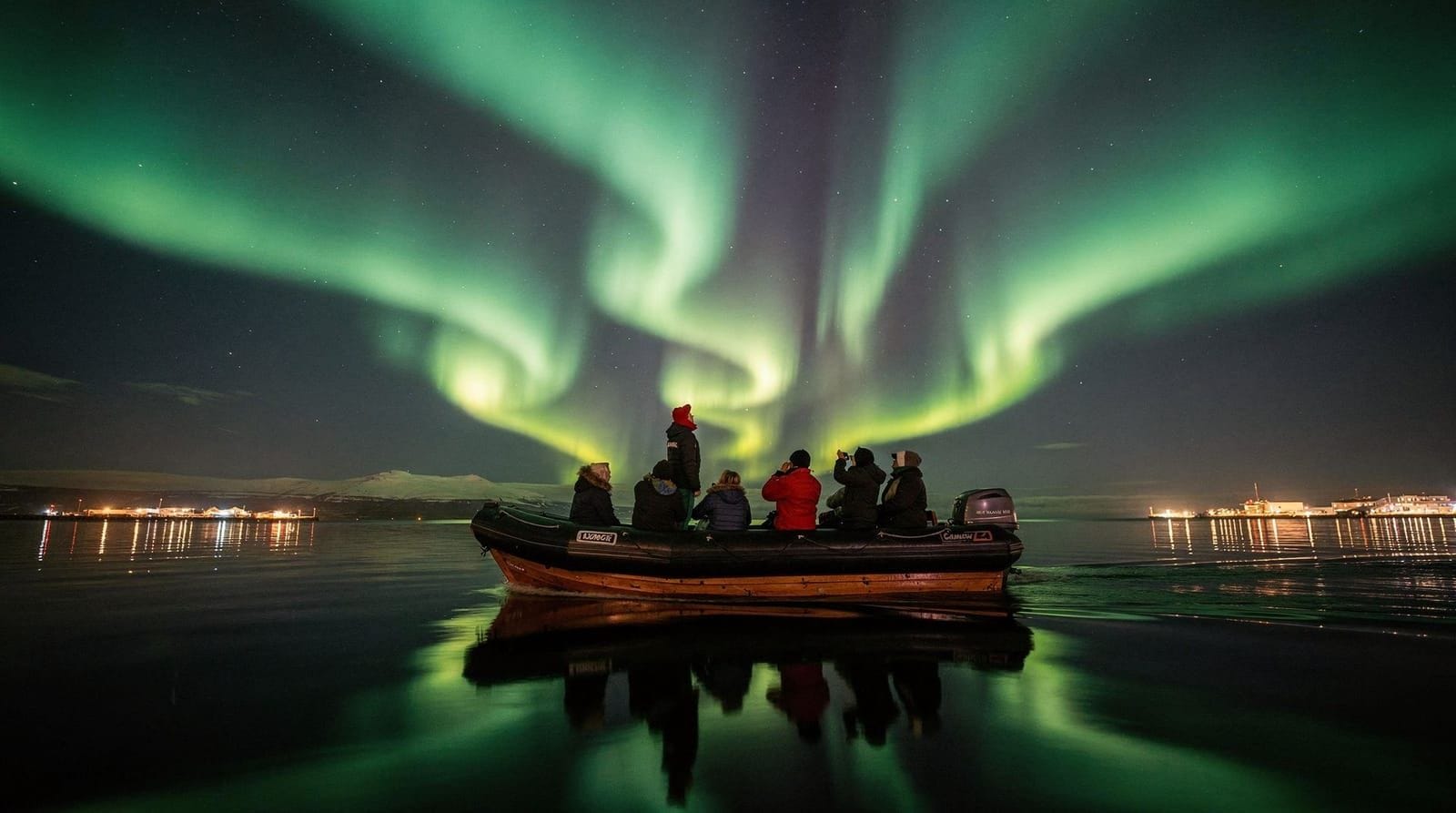
Reykjavik: Aurora borealis Northern Lights tour
Do you need a guided tour to see the northern lights in Iceland?
No. The northern lights are a natural atmospheric phenomenon visible to anyone in a dark location under a clear sky with sufficient solar activity. You do not need a guide. However, guided tours provide real advantages: they monitor forecasts in real time, drive to wherever conditions are best, and save you the setup time. Independent viewing is practical if you have a rental car and understand the basic forecast.
The honest answer upfront
Tours do not create aurora or improve your luck with weather. The aurora appears or it does not, based on conditions that no operator controls. What tours genuinely offer is knowledge, logistics, and the cloud-chasing mobility that a passenger without a car cannot replicate.
If you have a rental car and spend one hour learning how to read the aurora forecast before your trip, you can independently match the core service a bus tour provides. Whether that hour of learning and the ongoing forecast-checking is worth saving 8,000–15,000 ISK per night is a personal calculation.
| Cost per tour night | around 8,000–15,000 ISK/person |
| Cost, self-drive (per night, shared) | often lower over 3+ nights |
| No car? | Tour is essentially required |
| 3+ nights, comfortable driving? | Self-drive usually wins |
| Best hybrid | Tour night 1, self-drive after |
The case for booking a tour
No car? Tours are essential
Without a rental car, guided tours are the only way to reach dark-sky locations outside Reykjavík. Walking from central Reykjavík to Grótta lighthouse (5 km) is possible but cold and dark. No regular bus service operates late at night to rural locations. If you are in Iceland without a car, book a tour.
Short stay (1–2 nights): the stakes are high
With only one or two opportunities, having a guide who monitors forecasts all day and makes routing decisions in real time is more valuable than on a week-long trip. The guide’s judgment of which direction to drive can make the difference between seeing aurora and returning empty-handed.
First-time visitors to winter driving in Iceland
Iceland’s winter roads are manageable for experienced drivers — but unfamiliar drivers in rental cars on dark, narrow, icy roads at midnight are a safety concern. For a first winter visit, doing at least the first aurora night as a guided tour lets you observe the landscape and get comfortable before self-driving on subsequent nights.
The lifetime guarantee option
If you are anxious about potentially paying for a trip to Iceland and not seeing aurora, a tour with a lifetime guarantee addresses that concern directly. The guarantee means your investment is not lost if clouds persist throughout your visit.
Aurora borealis northern lights tour from Reykjavík — one of the oldest-running operatorsThe case against booking a tour (self-drive advantages)
You can leave when conditions are right
Tour buses depart at 21:30 regardless of conditions. If the clearest sky window is from 23:00 to 02:00, the tour departs an hour before conditions are optimal and returns passengers home as conditions peak. A self-driver can leave at 22:30, stay until 03:00, and capture the full display.
You can stay longer at productive locations
Bus tours stop for 20–30 minutes at each location before moving on. During a strong display, you might want to stay 90 minutes at the same spot for an evolving show. Tour schedules do not accommodate this.
You can choose your foreground
For northern lights photography, composition is everything. Tours stop at pre-planned pull-offs. Self-drivers can choose any location within their driving range — Kirkjufell for the classic mountain foreground, Jökulsárlón for the glacier lagoon, or Seljalandsfoss for the waterfall. Composition quality is higher with full location freedom.
You can react to the real-time forecast
A clear-sky window at 01:00 is invisible to tour passengers who returned at midnight. A self-driver can go back out, or extend the evening if the sky clears unexpectedly.
Cost over multiple nights
A guided tour at 10,000 ISK per night × 5 nights = 50,000 ISK (€350). A rental car for 5 days costs roughly 30,000–50,000 ISK for a basic 4WD (shared cost if there are 2 passengers). Self-driving on 3–4 of those nights — after learning the forecast process — replaces multiple tour costs. Over a week in Iceland, self-driving is almost always more cost-effective than nightly tours.
A hybrid approach
The most pragmatic strategy for a 4–7 night aurora-focused trip:
Night 1: Book a guided tour. Learn the forecast process by watching what the guide does. Understand the cloud-chasing routing. Get your first aurora experience with local knowledge support.
Nights 2–6: Self-drive based on what you learned. Use vedur.is and SpaceWeatherLive. Drive to the clearest-sky region as conditions develop. Extend stays at productive locations.
This approach costs one tour fee and gives you 4–5 independent nights with full flexibility.
When guides add genuine value beyond logistics
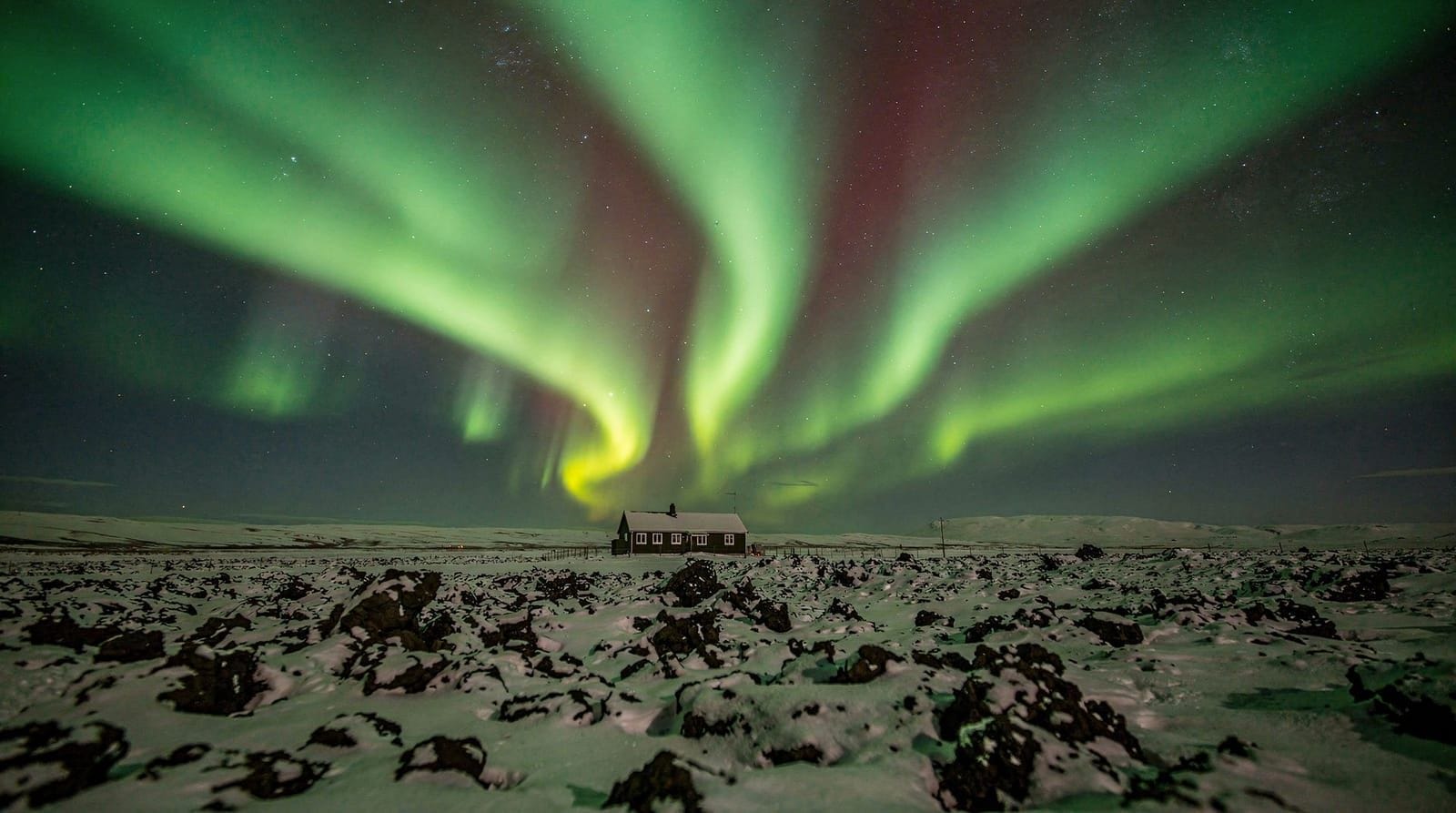
On nights when aurora activity is high — Kp 5+ with a full display covering the sky — there is no logistical advantage to having a guide. The lights are visible everywhere, you can find your own dark field, and no expertise is needed.
Where guides earn their fee is on marginal nights: Kp 2–3, partially cloudy, with a narrow clear-sky window in one direction. An experienced operator who has driven Iceland’s roads for 10 years can identify which 40 km radius has the highest probability of clearing skies faster than a first-time visitor learning to read the vedur.is map.
If your visit includes several marginal nights (which is typical in Iceland in winter), a guide’s local knowledge delivers real value. If you happen to arrive during a Kp 6 geomagnetic storm on a clear week, you could have found aurora standing in your hotel carpark.
Northern Lights tour with free photos and hot cocoa — includes rebook if no aurora appearsBuilding aurora hunting into a broader Iceland itinerary
For travellers visiting Iceland primarily for other reasons — hiking, whale watching, the Ring Road — aurora hunting can be integrated into the trip without dedicated effort or expense, provided you understand a few basic logistics.
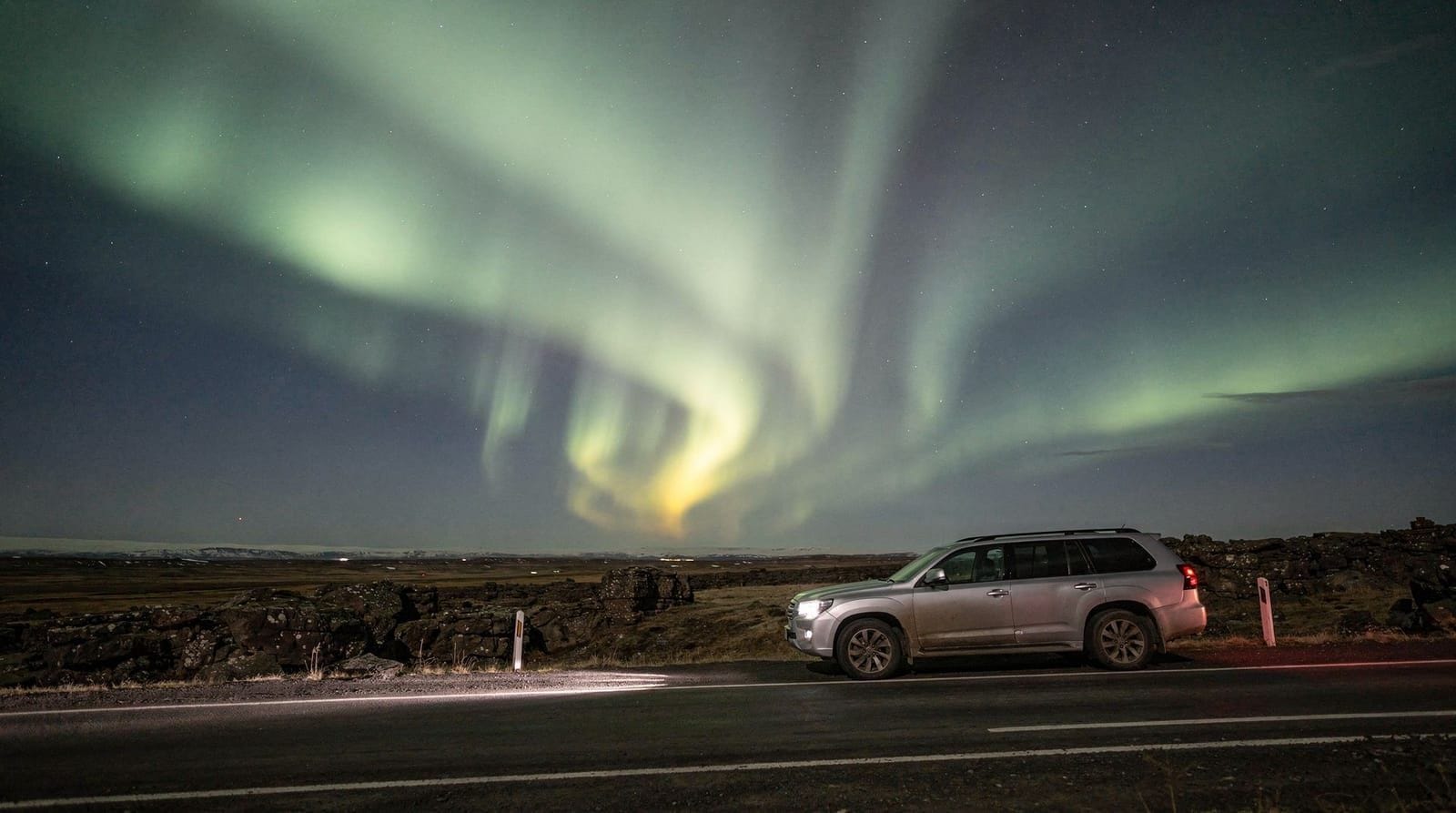
The core principle: any night during the aurora season when you are in a dark location with a clear sky is a potential aurora night. A South Coast 3-day itinerary sleeping near Vík puts you in prime aurora territory every night. A Ring Road 7-day route passes through dark-sky areas nightly. You do not need to plan a separate “aurora excursion” — the aurora comes to you if you are already in position.
The practical additions that turn a standard itinerary into an aurora-ready one:
Install vedur.is before arrival: Check it each morning for the 24-hour forecast. A 2-minute daily check tells you whether the coming evening has any aurora potential.
Ask your accommodation about aurora alarm: At any rural guesthouse, ask at check-in whether they offer an aurora wake-up. Many do, and the service is not always advertised.
Keep your camera accessible: If you are already carrying a camera for daytime photography, keeping a spare battery charged and the tripod accessible in the car allows immediate aurora photography when conditions appear unexpectedly.
Do not chase from a city: If your itinerary has you in Reykjavík on a potentially good aurora night, consider driving 30–45 minutes rather than watching from the city. For non-dedicated aurora trips, Þingvellir or Grótta lighthouse represents an appropriate investment of effort without rebuilding the whole itinerary around aurora.
This integrated approach covers perhaps 60–70% of what a dedicated aurora trip provides, at essentially zero additional cost beyond an occasional short detour.
What to expect if you go independently
The self-drive aurora hunting guide covers the full workflow. In summary:
- Check vedur.is at 18:00 for cloud forecast
- Identify which direction from Reykjavík is clearest
- Check SpaceWeatherLive for current Kp
- Drive to the clearest-sky dark-sky location in that direction
- Set up, dark-adapt your eyes for 15 minutes, watch and wait
The main psychological challenge: self-driven aurora hunting involves more uncertainty and more active monitoring than handing the logistics to a guide. Some travellers find this engaging; others find it stressful. Know which type you are before deciding.
Summary: who should book a tour
Book a tour if you:
- Do not have a rental car
- Are visiting for only 1–2 nights
- Are uncomfortable driving winter roads in Iceland at night
- Want zero decision-making — just show up and watch
- Are anxious about your aurora odds and want a lifetime guarantee option
Go independently if you:
- Have a rental car
- Are staying 3+ nights
- Are comfortable with winter driving
- Want to stay longer at good locations
- Are focused on photography with full location control
Learning to forecast independently
The practical skill that makes self-directed aurora hunting work is reading the vedur.is cloud forecast competently. This is not difficult — the interface is straightforward — but there is a learning curve in interpreting what you see. Understanding the forecast process before arrival eliminates the main gap between guided and independent aurora hunting.
The cloud forecast on vedur.is works as follows. The forecast map shows cloud cover as a percentage at a given time: 0% is completely clear, 100% is solid overcast. The map updates every few hours and the animation advances in 3-hour steps over a 48-hour window. To use it effectively:
First, change the time slider to show the forecast for 22:00–01:00 — the core aurora viewing window. Then watch the animation. Are the clear areas (blue or pale yellow on the map) in your target direction growing or shrinking over the forecast period? Cloud systems in Iceland typically move southwest to northeast. A clear zone approaching from the northwest will often clear the Reykjavík region by midnight if the animation shows it advancing.
The second step: cross-reference the cloud forecast region with the direction from Reykjavík. If the map shows the clearest conditions to the east — which means the Þingvellir direction or toward the South Coast — that is where you drive. If it shows clearest to the north (Borgarfjörður, Akranes direction), that is your route.
The third step: at 20:00–21:00, check SpaceWeatherLive for current Kp and Bz values. If Kp is above 2 and Bz has been negative for the past hour, conditions are active. If both the cloud forecast and the activity look positive, commit to the drive.
Practice this process for 2–3 evenings before your trip using historical data. vedur.is archives cloud forecast animations — you can replay an evening from last October and compare what the forecast showed against what aurora hunters reported that night. After two practice sessions, the forecast interface becomes intuitive.
The aurora forecast explained guide covers the technical details of Kp, Bz, and the 27-day recurrence pattern in full.
The first night strategy
The first night of any Iceland aurora trip carries disproportionate psychological weight. Arriving after a long flight, excited about aurora, and immediately heading out on a cold night — this is when most visitors make decisions based on enthusiasm rather than conditions.
A structured first-night approach significantly improves overall trip outcomes:
Book a guided tour for your first night regardless of your skill level. Even experienced aurora hunters benefit from a first-night tour. The guide’s cloud-chasing route tells you something real about the current weather patterns. The locations the guide visits become reference points for your own subsequent drives. And if conditions are poor, you hear firsthand how the guide thinks about rescheduling — useful context for your own decisions on later nights.
Set realistic expectations for the first night. Statistically, any given night in Iceland during aurora season has roughly a 30–50% chance of producing a meaningful display, depending on month. The first night is not inherently special. If it is cloudy or activity is Kp 1, this is not a failure — it is a representative sample of what aurora hunting looks like.
Do not exhaust yourself. Arriving on a long-haul flight and staying out until 02:00 on night one often results in fatigue that affects nights two and three. On first nights with poor conditions, accept the situation, return at midnight, and sleep well. The statistical payoff comes across multiple nights, not the first one.
Use the first night to calibrate your clothing. The single most common complaint from first-night aurora tours is being colder than expected. If you return cold, upgrade your clothing the next day — add a layer, buy better gloves at a Reykjavík outdoor store (Cintamani and 66°North both have excellent winter layers at around 10,000–25,000 ISK for key pieces).
A well-managed first night sets up the rest of the trip productively. A first night where you freeze, miss a poor display, and return disappointed can shade the entire trip.
When tour expertise genuinely outperforms self-drive
The case for self-driving aurora hunting is strong and generally correct for 3+ night trips with rental cars. But there are specific situations where a guided tour’s expertise provides genuinely better outcomes than independent efforts.
Marginal cloud conditions with moving systems. When the cloud map shows a narrow clear window crossing the Reykjavík region, the speed of cloud movement and its precise track is difficult to interpret for someone who does not know Iceland’s micro-climates. An experienced guide who has driven the same roads for 8 winters knows which valleys clear first, which hilltops have their own cloud shadow, and how long a clearing typically persists. This local knowledge is non-replicable from a map.
The first storm break. Iceland’s weather patterns are repetitive: a multi-day low-pressure system produces solid overcast, followed by a clearing as the system passes. The precise timing of when the sky clears after a storm is highly variable. Guides with weather experience read the transition more accurately. Self-drivers can use the vedur.is animation to approximate this, but the guide’s pattern recognition is faster and more accurate.
Nights with Kp 1–2 and narrow dark-sky windows. A guide who knows exactly which north-facing hillside 30 km from Reykjavík is in a micro-climate shadow can put you in front of a Kp 2 display that would be invisible from any of the standard pull-offs. Self-drivers following the vedur.is map may choose a nominally clear location that has localised haze from maritime air, while the guide drives to an elevated viewpoint that is above the haze layer.
Travellers with very limited drive radius. Some visitors in Iceland do not want to drive more than 30–40 km from Reykjavík at night. Within this radius, a bus tour and a self-driver have essentially the same location options. The guide’s advantage — knowing which of those nearby spots is most likely clear right now — is most valuable at close range.
The bottom line: tours are worth their cost on the most difficult aurora nights, not the easy ones. On a Kp 6 night with clear skies over the Reykjavík region, any self-driver will see the lights. On a Kp 3 night with 30% partial cloud and shifting winds, a good guide earns their fee.
Frequently asked questions about aurora tours and independence
Can I see the northern lights without leaving Reykjavík at all?
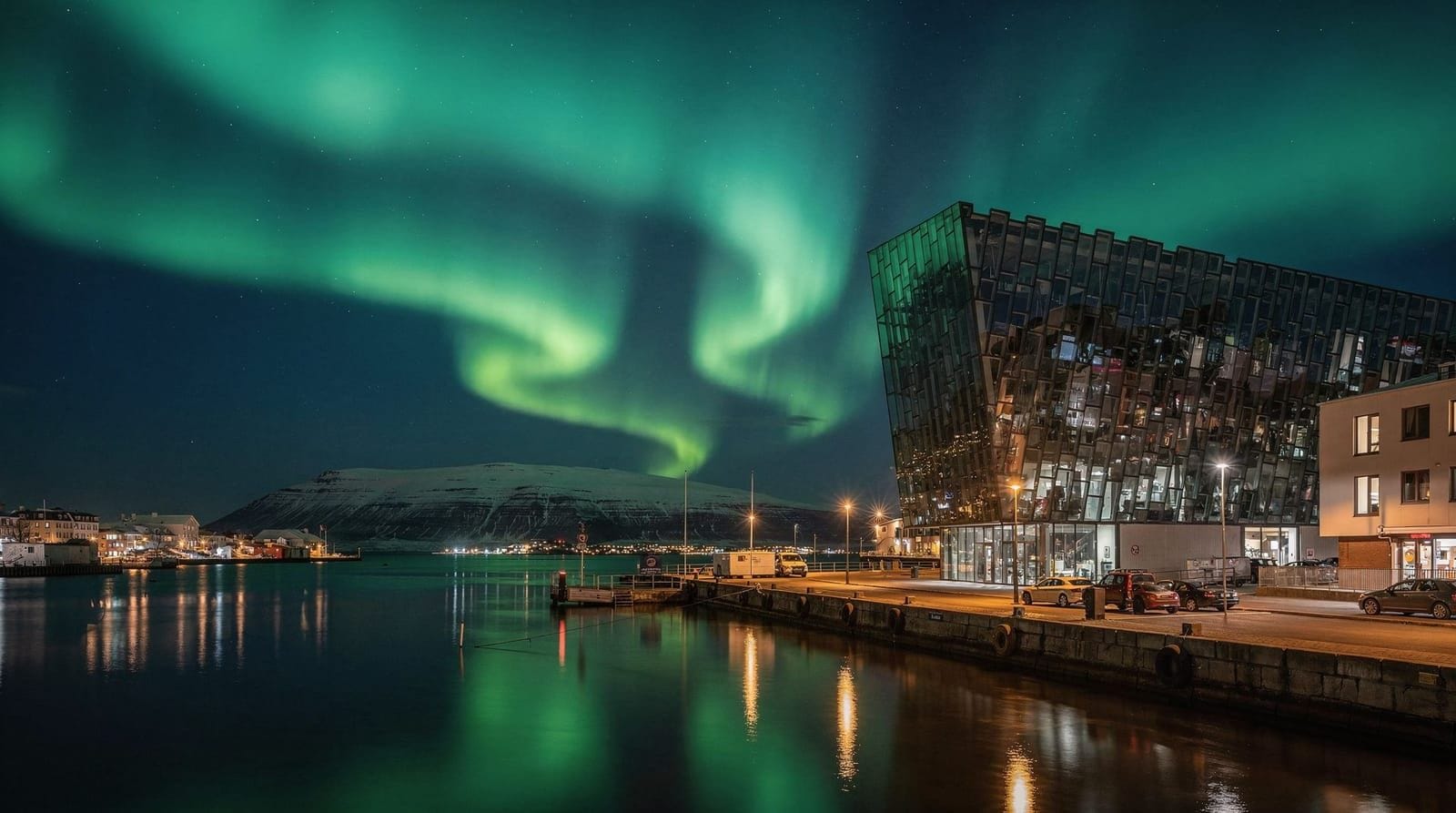
During strong events (Kp 5+), yes — from the harbour waterfront or Grótta lighthouse. These events occur multiple times per winter during solar maximum periods like 2025–2026. For the majority of aurora nights, driving 20–40 km is necessary.
Are there northern lights apps that replace a guide?
No app replaces local knowledge of which roads are icy, which pull-offs have safe parking, or which direction historically clears first in Reykjavík. But apps like SpaceWeatherLive and vedur.is cover the actual science of aurora forecasting completely. The gap is practical local knowledge, not astronomical data.
Do tour prices include hotel pickup?
Most Reykjavík bus tours pick up from a central point (BSÍ bus terminal or main hotels). Confirm at booking. Small-group minibus tours are more likely to offer direct hotel pickup. Private tours typically include any pickup location you specify.
Is it worth doing a northern lights tour if I have already seen aurora elsewhere?
That depends on whether you want the social/guided experience or are primarily focused on quality aurora viewing. If you have seen aurora in Norway or Finland and want maximum photographic control in Iceland’s distinctive landscape, self-driving gives you more. If you prefer a structured evening with local storytelling and no logistics, a guided tour adds value regardless of prior experience.
Top experiences
Bookable activities with verified prices and instant confirmation on GetYourGuide.
Top experiences
Best-rated activities across GetYourGuide and Viator.

Private 2-Day Glacier Lagoon, Ice Cave and Northern Lights
- Viator

Reykjavik Private Northern Lights Tour with Pro Photographer
- Viator

Private Aurora Hunt in Iceland with Professional Photos
- Viator

Northern Lights Classic MiniBus Tour from Akureyri
- Viator

Northern Lights Jeep Tour - Icelandic Guide | Photos | Cocoa
- Viator
Akureyri: From Akureyri Northern Lights tour
- GetYourGuide