Kirkjufell photography guide — Iceland's most iconic mountain shot
Reykjavik: Snaefellsnes national park tour from Reykjavik
Where exactly do you stand to photograph Kirkjufell with the waterfall?
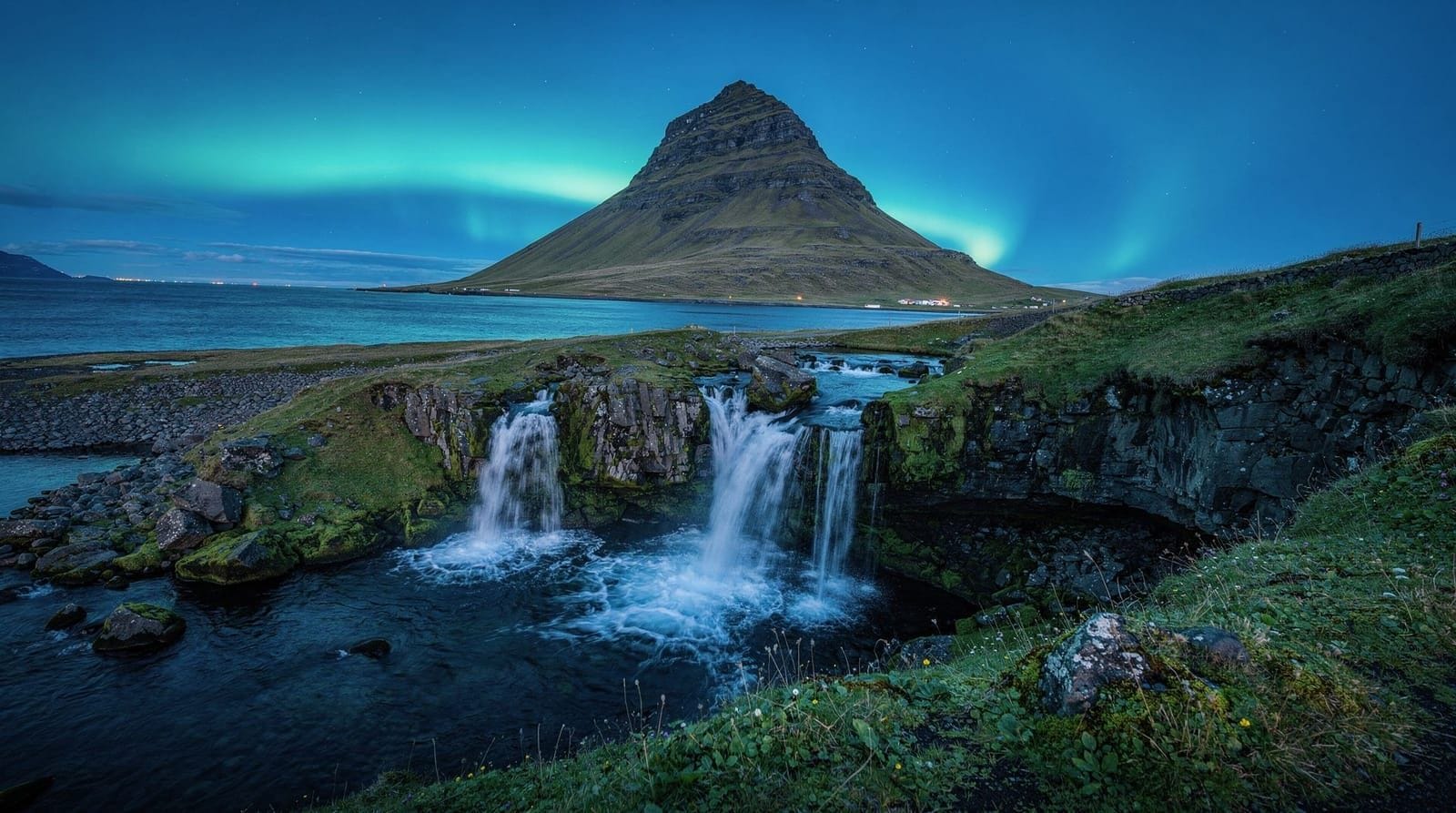
The classic shot is from the lower bank of Kirkjufellsfoss, approximately 30–50 m from the falls, with Kirkjufell mountain framed behind the waterfall. The falls are 5 minutes from the Route 54 car park near Grundarfjörður. Best light is sunrise (from the northeast) or overcast. Exact GPS position is 64.9260° N, 23.3066° W.
| Where | Route 54, near Grundarfjörður, Snæfellsnes Peninsula |
| Cost | Free — small car park, no entrance fee |
| Time needed | 20–45 min for the classic shot; longer for sunrise/blue hour |
| Getting there | 2 hours from Reykjavík by car |
| Best time | Sunrise (northeast light) or overcast; avoid midday clear-sky sun |
Kirkjufell (463 m) is a distinctive arrowhead-shaped mountain on the north coast of the Snæfellsnes Peninsula, near the town of Grundarfjörður. The mountain is photographically famous because of one specific composition: Kirkjufellsfoss waterfall in the foreground, Kirkjufell rising behind it, usually under dramatic sky conditions.
This composition has appeared in Iceland tourism campaigns, fantasy TV productions, and thousands of travel Instagram accounts. Getting there requires a 2-hour drive from Reykjavík, 5 minutes’ walk from the road, and good timing. Getting the photograph everyone else has is easy. Getting something original requires more thought.
The classic composition — exactly where to stand
The main photography position is the south bank of Kirkjufellsfoss, where the falls and mountain align. From the small car park on Route 54 (approximately 3 km east of Grundarfjörður, signposted), walk 5 minutes to the falls.
Exact position: Stand on the bank south of the falls, approximately 30–50 m from the waterfall. Use a wide-angle to standard lens (16–35 mm). The waterfall occupies the lower third of the frame; Kirkjufell fills the upper two-thirds. The mountain appears framed by the sky above the falls.
This is the “canonical” shot and will be recognizable to anyone who has seen Iceland photography. Thousands of photographers have stood in this exact spot. The question is whether this matters to you.
GPS coordinates for the optimal shooting position: approximately 64.9260° N, 23.3066° W. The path leads directly there.
Variations on the classic
North bank viewpoint
Cross the small bridge upstream of the falls to the north bank. From here, the mountain is to your left and the falls to your right — a landscape orientation with more sky. Less commonly photographed. Useful when the south bank is crowded.
Higher south bank position
Walk about 100 m south and slightly uphill from the main viewpoint to look down onto the falls from an elevated position. The mountain drops into the background more; the falls become the primary subject. Different but less iconic.
Long exposure at dusk/night
The combination of silky-water falls and Kirkjufell under the northern lights or deep blue dusk sky is one of the most popular variations. For northern lights: October–March, dark skies, clear forecast. For long-exposure dusk: any season.
Approaching the mountain directly
Kirkjufell itself is a hiking target — the trail to the summit (463 m, 2–3 hours return, exposed ridge, some scrambling required) offers views back toward the Snæfellsnes coast and Grundarfjörður bay. Not everyone knows this is possible. The mountain from the south bank appears difficult but is approachable from the west side with route-finding. See the hiking in Iceland guide for general advice.
Light and timing
The mountain faces roughly northeast, meaning:
Best light for the classic shot: Sunrise light comes from the northeast and illuminates the mountain face directly. In summer, sunrise is at 3–4 am — inconvenient but crowd-free. The golden hour before sunrise (astronomical twilight starts even earlier) produces warm light on the peak before direct sun appears.
Worst time: Midday on clear days. Direct overhead sun flattens the mountain’s texture and creates harsh shadows in the falls.
Good alternative: Overcast conditions. The even diffuse light removes shadows and allows long exposures of the waterfall without blown highlights. Many of the most striking Kirkjufell photographs are taken under grey skies.
Northern lights position: The falls to the south of the mountain mean the mountain is your foreground (or middle ground) with the northern lights above. The wide composition frames both. Exposure for northern lights: ISO 1600–3200, f/2.8, 5–15 seconds depending on activity level. See the northern lights photography guide.
Crowds
Kirkjufell is busy from approximately 9 am to 5 pm in peak season (June–August). At those times, the south bank viewpoint has a constant rotation of photographers and tourists. Several large tour buses stop here daily.
Strategies:
- Arrive before 8 am
- Visit after 7 pm in summer (still full daylight)
- Come in shoulder season (May, September) — significantly fewer visitors
- Winter visits in snow or frost create a completely different scene with far fewer people
The TV series connection
Kirkjufell appeared as “Arrowhead Mountain” in multiple seasons of Game of Thrones, filmed in Iceland in 2014–2015. This significantly increased international recognition of the mountain and is responsible for much of the tourism surge it has seen since. If you are a fan of the series, the scenes filmed here are in the areas north of the Wall — the mountain itself was used as a landmark in the narrative.
The film location adds nothing to the physical experience of being there, but knowing the connection explains why visitors occasionally do dramatic poses on the north bank.
Practical details
Location: Route 54, approximately 65 km from Snæfellsbær (the main town on the peninsula), 2 hours from Reykjavík.
Parking: Small car park (15–20 spaces) on Route 54. In peak season this fills before 9 am. Overflow parking on the road verge. No parking fee.
Facilities: None at the falls. Grundarfjörður (3 km west) has a petrol station, supermarket, and café. The Kirkjufell destination page has the full town services list.
Nearest accommodation: Grundarfjörður has guesthouses and a campsite. Staying locally allows sunrise visits without a long pre-dawn drive.
What else is on Snæfellsnes
Kirkjufell is the most photographed site on the peninsula but not the only one worth seeing. The Snæfellsnes day trip guide covers the full circuit:
- Snæfellsjökull glacier and National Park
- Djúpalónssandur (pebble beach with shipwreck)
- Arnarstapi and Hellnar villages (dramatic coastal cliffs)
- Rauðfeldsgjá gorge
- Ytri-Tunga seal beach
A guided Snæfellsnes day tour from Reykjavík covers Kirkjufell, the glacier, and the coastal sites in a well-paced day. The guide’s knowledge of the peninsula’s folklore (Jules Verne’s Journey to the Centre of the Earth entrance point, Snæfell’s association with Celtic spirituality) adds context to what would otherwise be scenery-only.
Camera equipment recommendations
For Kirkjufell specifically:
Wide-angle lens (16–24 mm): Captures the falls and mountain in the same frame. The standard choice for the classic shot. A moderate wide angle (24 mm) is less distorted than an extreme wide (16 mm).
Tripod: Essential for any low-light or long-exposure work. The viewing area is flat and stable enough for most tripod setups.
Polarising filter: Useful for the falls to reduce glare and deepen the colour of the water. Remove it for low-light/northern lights work.
Remote shutter release: Standard for sharp long exposures.
Lens cloth: Falls spray reaches the front lens element even from the main viewpoint in wind. Have a cloth accessible, not buried in your bag.
For broader Snæfellsnes photography advice, see the Iceland photography guide and the best photo spots in Iceland.
Frequently asked questions about Kirkjufell photography
What time is sunrise at Kirkjufell?
In June, astronomical twilight begins around 1:30–2 am and sunrise around 3 am. In September, sunrise is around 6:30–7 am. For winter months (December–January), sunrise is around 11:30 am. The PhotoPills app gives exact times for any location and date.
Can you photograph Kirkjufell in winter?
Yes, and winter offers some advantages — snow on the mountain, ice on the falls, low-angle light all day, fewer visitors, and possible northern lights above the peak. The access road is plowed. Wear crampons or good winter boots for the path to the falls (which can be icy).
Is there a drone ban at Kirkjufell?
There is no specific ban at Kirkjufell itself. However, the Snæfellsnes area has general drone regulations that apply across Iceland — no flying near populated areas, no flying in national park airspace without permission, and no flying that disturbs wildlife. See the drone rules Iceland guide before flying.
Is Kirkjufellsfoss waterfall impressive on its own?
Honestly, no. It is 7 m high and unremarkable without the mountain context. The appeal is entirely compositional. Visitors who arrive expecting a dramatic waterfall are sometimes surprised. The draw is the mountain behind it.
How crowded is Kirkjufell in September?
Significantly less crowded than July–August but not empty. Autumn weekdays are the quietest; autumn weekends can still see 50–100 visitors during the main hours. Pre-dawn arrival in September (sunrise around 6:30 am) typically gives 5–20 minute solo access to the viewpoint.
The mountain’s name and its pronunciation
Kirkjufell translates literally as “Church Mountain” — the shape of the peak, seen from certain angles, resembles a church steeple. The pronunciation is approximately “keer-kyoo-fedl” — the “ll” in Icelandic is a lateral fricative, not a simple “l.”
Kirkjufellsfoss is “keer-kyoo-fedls-foss.” Icelandic pronunciation is consistently challenging for English speakers, but the local effort is appreciated. At tourist-heavy sites like Kirkjufell, staff are accustomed to all manner of approximations.
Getting original Kirkjufell photographs
The “standard” Kirkjufell photograph has been taken hundreds of thousands of times. Getting something genuinely different requires either a different condition or a different position.
Different conditions:
- Fog or low cloud partially obscuring the summit creates mystery that the clear-sky version lacks
- Storm incoming: dark brooding sky behind the mountain with sunlit foreground
- Heavy frost: the mountain covered in hoarfrost, with a blue winter morning sky
- Northern lights: the full aurora display over the mountain is among Iceland’s most reproduced images, but it requires being there when the aurora is active (forecast-dependent, September–March)
Different positions:
- From the water: some photographers hire a kayak from Grundarfjörður and photograph the mountain from the fjord, which gives an angle not reproducible from land
- From higher ground: walk south from the falls and climb the moraine above for an elevated perspective looking north toward the mountain across the entire bay
- From the beach north of town: looking back south, the mountain rises above the town’s fishing harbour — an entirely different composition that shows the relationship between the mountain and the community
Different timing:
- The 24 hours before and after summer solstice (around June 21) give the flattest light trajectory and the most extended golden hour — effectively 24 hours of usable light with the sun circling the northern horizon
- An hour before sunrise in September: deep blue sky with the first light touching the summit while the falls are still in shadow
Kirkjufell as a hiking destination (not just a viewpoint)
Most visitors treat Kirkjufell as a photography stop of 20–45 minutes. The mountain is also a genuine hiking objective that almost nobody does.
The ascent route begins on the southwest flank, following a ridge that becomes progressively narrower toward the summit. The last 200 m involves exposed scrambling on sloped rock. No technical equipment is needed for competent scramble-hikers, but this is not a casual walk — the exposure on the final ridge is significant and in wet conditions the rock is slippery.
Total ascent: approximately 463 m. Duration: 2–3 hours return for fit walkers. The summit view over Snæfellsnes and Grundarfjörður bay is outstanding.
Important: Do not attempt the summit in wet, icy, or windy conditions. The narrow ridge section is dangerous without dry stable footing. This mountain has seen mountain rescue callouts. If conditions are not ideal, photograph from below and save the summit for another visit.
The Snæfellsnes full-day context
Kirkjufell is most logically visited as part of a Snæfellsnes Peninsula day or overnight trip. From Reykjavík (160 km to Grundarfjörður), the drive to Kirkjufell takes approximately 2 hours via the Hvalfjörður tunnel (saves 30 minutes vs the northern route around the fjord).
A sensible Snæfellsnes circuit from Reykjavík:
- Kirkjufell (morning, 1.5–2 hours)
- Ólafsvík and Melsvík area (30 minutes)
- Snæfellsjökull glacier and National Park (3 hours)
- Djúpalónssandur pebble beach (1 hour)
- Arnarstapi to Hellnar coastal walk (1.5 hours)
- Return via southern route through Borgarnes
Total: approximately 12 hours including driving. See the Snæfellsnes day trip guide for the full circuit.
Common photography mistakes at Kirkjufell
These are the errors that produce the photographs that look like everyone else’s:
Using the same front-and-centre composition: The falls-in-front-mountain-behind shot has been taken millions of times. Spend 10 minutes exploring the viewpoint before setting up your tripod. The bank to the north of the falls, the elevated position to the south, and the slightly wider angle that includes Grundarfjörður bay all give different compositions.
Shooting in midday light: Kirkjufell’s peak-hour shots (10 am–3 pm) produce flat light and full crowds. The mountain’s texture disappears in overhead light. The same mountain at 5 am under a rising sun or 10 pm under the midnight sun is a completely different subject.
Forgetting the reflection: When the Kirkjufellsá stream is calm (low-wind conditions), the pool below the falls reflects both the falls and the mountain. This doubles the visual impact and produces one of the less-commonly seen Kirkjufell compositions. Requires calm weather and a moment of patience.
Over-processing: The instinct with Iceland photography is to push saturation and contrast. Kirkjufell’s natural palette — the green-brown mountain, grey basalt, white water, and variable sky — works better with restrained editing. Trust the scene’s natural contrast rather than manufacturing additional drama.
Gear specifically for Kirkjufell
In addition to standard wide-angle and tripod:
Graduated ND filter: In bright conditions, the sky above Kirkjufell is often dramatically brighter than the falls and foreground. A 2–3 stop graduated ND filter balances this without HDR blending. The hard-edge grad works because the mountain has a relatively flat horizontal profile.
Remote shutter release: Essential. Any camera vibration is visible in long-exposure waterfall shots, and the smooth road bridge near the falls can vibrate slightly from passing vehicles.
Spare batteries: Cold temperatures (5–10°C in summer, -5 to -15°C in winter) drain batteries 30–40% faster than room temperature. Two fully charged batteries for any pre-dawn shoot.
Head torch: Even in summer, pre-dawn navigation to the viewpoint (3 am in June) benefits from a head torch for the path from the car park.
Accommodation strategy for Kirkjufell photography
The best Kirkjufell photographs require pre-dawn or midnight-sun visits. This means staying locally in Grundarfjörður or nearby rather than making the 2-hour drive from Reykjavík at 2 am.
Grundarfjörður options:
- Grundarfjörður Campsite: directly in town, approximately 2,000 ISK (~€13) per person per night
- Guesthouse options in town and nearby: 15,000–25,000 ISK (~€100–165) per room
- Kirkjufell Hostel: budget option closer to the mountain
Staying one or two nights allows multiple golden-hour/blue-hour/northern-lights attempts without time pressure. The Snæfellsnes 2-days itinerary structures this properly with accommodation recommendations.
The simple rule: if Kirkjufell photography is a priority, don’t day-trip it. Stay overnight and approach the subject with the time it deserves.
Editing Kirkjufell photographs
Post-processing choices matter more at Kirkjufell than at many Iceland locations, precisely because the composition is so widely recognised — over-processed versions stand out as generic rather than distinctive. Start with white balance: the falls’ water and any snow in frame are the most reliable neutral reference points; use them to correct any colour cast rather than relying on auto white balance, which can shift warm or cool depending on sky conditions. For the mountain itself, moderate contrast and a restrained approach to saturation preserve the natural green-brown-grey palette that makes the scene recognisable rather than pushing it toward an artificial teal-and-orange look common in over-edited landscape work. If shooting a long exposure of the falls, check for noise in the darker foreground rocks and apply targeted noise reduction rather than a blanket adjustment that could soften the water’s texture.
Seasonal shooting conditions at a glance
| Season | Light | Crowds | Conditions | Best for |
|---|---|---|---|---|
| Summer (Jun–Aug) | 24-hour daylight, low-angle midnight sun | Highest | Green surroundings, ice-free path | Midnight sun shots, long golden hours |
| Autumn (Sep–Oct) | Shorter days, good golden hour | Moderate | Cooling temps, occasional frost | Balance of light and lower crowds |
| Winter (Nov–Feb) | Late sunrise (~11:30am), low sun all day | Lowest | Snow, ice on path — crampons useful | Snow-covered mountain, aurora above peak |
| Spring (Mar–May) | Lengthening days | Rising | Variable, meltwater in falls | Transitional light, fewer crowds than summer |
Drone photography considerations
A drone opens compositions that are impossible from the ground — an elevated view showing the full relationship between Kirkjufell, Kirkjufellsfoss, and Grundarfjörður bay. If you’re flying, check current regulations before your trip: Iceland requires drone registration for any drone over 250g, and specific restrictions apply near the Snæfellsjökull National Park boundary and around any populated areas. Fly early morning when the area is quiet to avoid disturbing other photographers on the ground, keep well clear of nesting birds in the cliff areas nearby, and never fly directly over people at the viewpoint. See the drone rules Iceland guide for the full legal picture before you fly.
Top experiences
Bookable activities with verified prices and instant confirmation on GetYourGuide.
Top experiences
Best-rated activities across GetYourGuide and Viator.

Ice Cave by Katla Volcano Super Jeep Tour from Vik
- Viator

Puffin and Volcano Tour with Ebbi
- Viator

Dynjandi Waterfall & Farm Visit Tour from Isafjordur Port
- Viator

3,5-Hour Sightseeing Tour To Dynjandi Waterfall
- Viator

Volcano ATV Tour
- Viator

Lake Myvatn Day Tour and Godafoss Waterfall for Cruise Ships from Akureyri Port
- Viator