Drone rules in Iceland — regulations, permits, and no-fly zones
Can I fly a drone in Iceland?
Yes, with restrictions. Iceland follows EU drone regulations (EASA framework) since joining the European Economic Area. Most recreational drones fall under the Open Category requiring only basic safety rules (below 120m altitude, away from airports and people). National parks, nature reserves, and areas near Keflavík airport require specific permits or are restricted entirely.
Iceland is one of the most rewarding places on earth to fly a drone — and one of the easiest places to get it wrong. The rules are stricter than most visitors expect, national park permits take weeks rather than days, and the wind alone destroys more drones here than any regulator does. This guide covers the legal framework, the specific no-fly zones, and the practical checklist that separates a legal, safe flight from an expensive mistake.
| Legal framework | EASA Open Category (EU rules), enforced by Samgöngustofa |
| Hard no-fly zones | Þingvellir, Keflavík 5.5km radius, nature reserves in nesting season |
| Permit-needed zones | Vatnajökull and Snæfellsjökull national parks (apply weeks ahead) |
| Typical fine | From around 100,000 ISK, higher near airports |
| Insurance | Around €15–25/day from providers like Coverdrone if not already covered |
Iceland’s drone regulation framework
Iceland is part of the European Economic Area (EEA) but not the EU. In practice, Iceland has adopted the EU’s EASA drone regulations for recreational and commercial use, meaning the same framework that applies in Germany, France, or Norway applies in Iceland — with some Iceland-specific additions for national parks and nature reserves.
The EU drone framework (Commission Implementing Regulation 2019/947) divides drone operations into three categories:
Open Category: low-risk operations, no authorisation required but specific rules must be followed. Specific Category: higher-risk operations, require operational authorisation from the national authority (in Iceland: Samgöngustofa, the Transport Authority). Certified Category: highest-risk operations, not relevant for recreational use.
Most tourists flying drones fall entirely within the Open Category.
Open Category rules that apply in Iceland
For a drone below 250g (such as DJI Mini 3 or Mini 4 Pro) in the A1 subcategory:
- Maximum altitude: 120 metres AGL
- Can fly over uninvolved people (but not intentionally over crowds)
- Must not fly in restricted zones or near airports without authorisation
- Operator must keep visual line of sight at all times
- No flights at night without specific authorisation
For drones 250g–900g in the A1 subcategory with Class C1 marking (most consumer drones):
- Same altitude limits
- Must not fly over uninvolved people
- Operator registration required in home country
For drones 250g–4kg in the A2 subcategory:
- Must maintain at least 30m horizontal distance from uninvolved people (50m in automatic mode)
- Operator competency certificate required
The practical takeaway: a DJI Mini 3 (249g) has the most permissive rules. A DJI Air 3 or Mavic 3 (above 249g) has stricter people-proximity requirements.
Restricted and prohibited areas
Keflavík International Airport
A 5.5 km radius around Keflavík Airport (BIKF) is a restricted zone. Within this zone, no drone flight is permitted without ATM authorisation from ISAVIA. The restricted area covers parts of the Reykjanes Peninsula lava fields that are otherwise good photography terrain — check your location specifically before flying.
Reykjavík domestic airport (BIRK) has a separate restriction zone covering most of central Reykjavík. This zone effectively prohibits drone flying above Reykjavík city centre without authorisation.
Þingvellir National Park
Þingvellir is a UNESCO World Heritage Site and Iceland’s most visited national park. Drone flights are prohibited without explicit written permission from Þjóðgarðurinn Þingvellir (the Þingvellir park authority). Permit applications must be submitted well in advance — this is not a same-day approval process.
Vatnajökull National Park
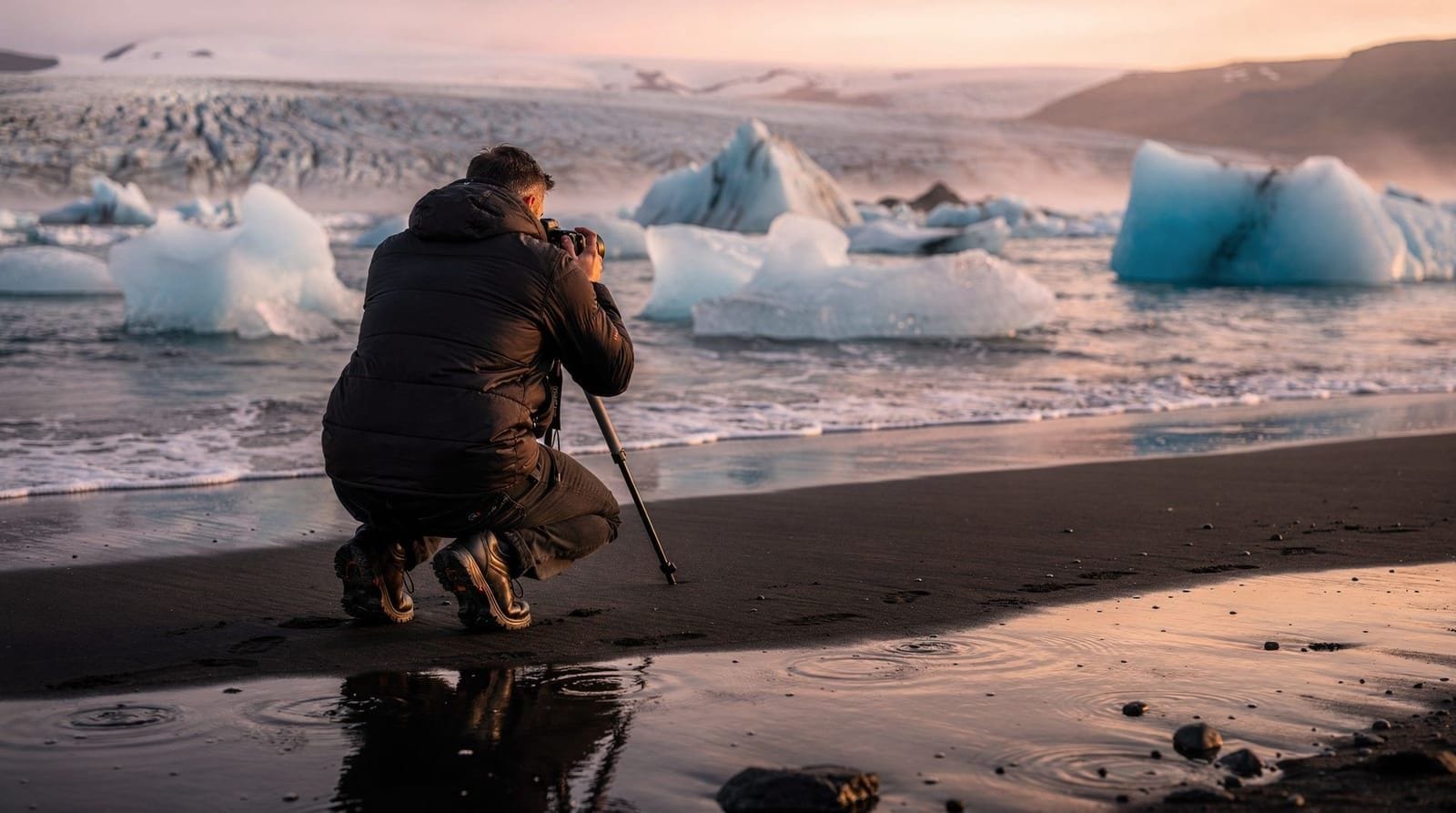
Vatnajökull National Park covers a significant portion of Southeast Iceland including Skaftafell, Jökulsárlón, and the interior glaciers. Drone flights require advance permission from Vatnajökull National Park. The park authority evaluates requests and approves only those with clear purpose and minimal ecological impact.
In practice: drone flights for recreational photography at Jökulsárlón are routinely requested and sometimes approved, but the process takes weeks, not minutes.
Snæfellsjökull National Park
Snæfellsjökull National Park at the tip of the Snæfellsnes Peninsula requires permits for drone flights. The glacier and coastal areas around Arnarstapi are within park boundaries.
Nature reserves and bird protection areas
Iceland’s Environment Agency (Umhverfisstofnun) designates nature reserves and bird protection areas where drone flights disturb wildlife and are prohibited during nesting season. Key locations:
- Látrabjarg bird cliffs (puffin, razorbill, gannet nesting): drone flights prohibited during the nesting season (May–August), when the cliffs are the very reason most photographers visit.
- Westman Islands: significant puffin and seabird nesting areas, restricted.
- Dyrholaey promontory: the entire headland closes to all access during puffin nesting, and drone flights near breeding seabirds are illegal.
Areas near search and rescue operations
Iceland’s emergency services regularly conduct helicopter operations, especially in winter mountain and coastal areas. Any active search and rescue operation creates an immediate temporary flight restriction. Monitor local news and the ISAVIA NOTAM system during your trip.
Flying in Iceland’s wind: a technical assessment
Iceland’s wind is the most significant operational challenge for drone photographers, separate from regulations. Consumer drones have rated wind resistance limits (typically 10–12 m/s, or about 36–43 km/h) that are exceeded regularly in Iceland’s coastal and highland areas.
Wind data from vedur.is shows average wind speeds at coastal monitoring stations. These averages do not show gusts — and Iceland’s gusts can be 2–3 times the average wind speed. A station showing 8 m/s average wind may be producing 18–20 m/s gusts, well beyond the operational envelope of a DJI Mini 3.
Practical wind assessment before flight:
- If you can see trees or tall grass bending and whipping continuously, surface wind is likely 10+ m/s.
- If standing without holding onto anything requires active effort, surface wind exceeds safe drone operating conditions.
- At altitude (60–120 m), wind speed is typically higher than at ground level — often by 30–50%. Plan for your drone’s operating altitude, not the surface conditions.
Iceland’s safest regions for drone photography from a wind perspective are sheltered valley interiors (such as Þingvellir in calm high-pressure conditions), the lee side of mountains, and the sheltered southern fjords on calm days. The entirely exposed Reykjanes Peninsula coastline, the Snaefellsnes Peninsula coast, and any highland terrain are among Iceland’s most challenging drone environments.
If you arrive at a location and the wind exceeds your drone’s rated limit, the correct decision is not to fly. A drone crash in Iceland due to operator error in known wind conditions creates property and liability exposure that no photograph justifies.
The geothermal risk factor
Flying a drone over active geothermal areas poses specific risks beyond legality. Thermal columns above geysers and fumaroles create unpredictable updrafts that can immediately destabilise small drones. The Geysir-Haukadalur area and Fagradalsfjall Volcano zone present real safety risks to drone operation regardless of legal permissions.
Do not fly over active geysers or fumaroles. The thermal column is invisible, and the sudden updraft is not recoverable.
Practical checklist before flying
-
Registration: Confirm your drone is registered in your home country (required for 250g+). Carry proof of registration.
-
Check geofencing in your flight app: DJI GO, DJI Fly, and AirMap all show restricted zones. Cross-reference with the physical location on the ISAVIA map.
-
National park check: If your planned flight is anywhere near a national park or nature reserve boundary, check directly with the park authority. Boundaries are not always obvious from road level.
-
Airport proximity: Use AirMap or DJI’s built-in system to verify distance from Keflavík and Reykjavík airports.
-
Weather: Iceland’s wind speed regularly exceeds the operational limits of most consumer drones (10–12 m/s). Check the vedur.is wind forecast for your specific location. Flying in wind gusts above your drone’s rated limit risks loss of control.
-
Insurance: EU regulations recommend (and some countries require) third-party liability insurance for drone operations. Check your travel insurance policy — most standard policies do not cover drone liability. Specialist drone insurance is available from providers including Coverdrone.
Where drone photography works well in Iceland
Locations outside restricted zones that offer strong aerial photography potential:
Fjaðrárgljúfur canyon: The winding river canyon in Fjaðrárgljúfur (east of Kirkjubæjarklaustur on Route 1) is outside national park boundaries and allows drone photography. The canyon’s serpentine form is one of the most distinctive aerial perspectives in Iceland.
Keri crater lake: Kerið crater is a private attraction with an entrance fee. The symmetrical crater lake photographs extremely well from above. The private ownership means drone flying may be possible with specific approval from the site management.
Coastal areas outside nature reserves: Large sections of the South Coast and Reykjanes Peninsula coastline outside designated reserves are open for drone photography with standard Open Category compliance.
Farm areas away from settlements: Much of Iceland’s agricultural land is not subject to specific restrictions. Open landscapes with Icelandic horses or sheep from above can be compelling, provided you maintain required distances from people and animals.
Penalties for non-compliance
Samgöngustofa (Iceland’s Transport Authority) enforces drone regulations with fines. Flying in restricted zones without authorisation can result in fines starting at 100,000 ISK (€700) and potentially confiscation of equipment. Flying near airports without clearance is a criminal offence in Iceland, not a minor infraction.
The Icelandic media regularly reports on tourists flying drones over Þingvellir and other protected areas — these cases typically result in fines and significant negative publicity.
Practical pre-flight checklist
The gap between knowing the regulations and executing a legal, safe drone flight in Iceland is narrowed by a systematic pre-flight process. The following checklist reflects the actual sequence an experienced drone operator follows before any Iceland flight.
48 hours before the flight:
- Check the vedur.is wind forecast for your planned location. Iceland’s coastal winds regularly exceed the operational limit of consumer drones (typically 10–12 m/s or 36–43 km/h). Do not plan a flight session in an area forecast for winds above your drone’s rated limit.
- Verify your drone’s registration is current and you have a digital or printed copy.
- Confirm your insurance coverage. Check your travel insurance policy specifically for drone liability — most standard policies exclude it entirely. If coverage is absent, short-term drone insurance from providers such as Coverdrone costs approximately €15–€25 per day and is available to purchase online up to the day before.
Day of flight:
- Load the location into AirMap or DJI’s geo-awareness system. If either flags a restricted zone, do not override and fly anyway. The DJI geo-fence system can be unlocked for specific zones, but unlocking does not make the flight legal — it just disables the hardware prevention.
- Check the ISAVIA NOTAM system (isavia.is) for temporary flight restrictions (TFRs) in your area. TFRs are issued for search and rescue operations, VIP movement, air shows, and firefighting activities. A TFR issued after you planned your flight is still legally binding.
- Check weather at takeoff time specifically — wind conditions change hourly in Iceland. The forecasted conditions at 09:00 may not reflect actual conditions at 14:00 when you plan to fly.
At the location:
- Walk the planned flight area and identify obstacles (power lines, communication masts, farm buildings) that may not appear on maps.
- Assess visibility. EU Open Category rules require your drone to remain within visual line of sight (VLOS). If you cannot see the drone clearly at its planned operating position, the flight exceeds VLOS limits.
- Note wind direction and speed at ground level and observe how it changes with altitude (trees or grass movement indicates surface wind; cloud movement indicates wind at altitude).
- Perform a pre-flight drone inspection: propellers secure, gimbal protector removed, camera correctly mounted, battery fully charged, controller firmware updated.
During the flight:
- Maintain altitude below 120 m AGL. Consumer drones measure altitude above the takeoff point — if you take off on a cliff and fly over a lower shoreline, your drone may be well above 120 m above ground even if the altimeter reads 80 m. Account for terrain changes in your altitude calculation.
- Keep uninvolved people at required distances. In tourist areas of Iceland, this is the most common compliance challenge — people appear unexpectedly at popular locations.
What happens if you break the rules
Enforcement of drone regulations in Iceland is carried out by Samgöngustofa (the Icelandic Transport Authority) and, in national parks, by park rangers in coordination with the police. The enforcement reality is worth understanding honestly.
Penalties for Open Category violations: Flying in restricted zones without authorisation, exceeding altitude limits, or flying over uninvolved people are administrative violations. Fines start at 100,000 ISK (approximately €700) for a first offence. Repeat violations or more serious breaches can result in higher fines and confiscation of equipment.
Flying near airports: This is a criminal offence under Icelandic aviation law, not an administrative matter. Near Keflavík International Airport, an unauthorised drone flight can result in criminal prosecution, not just a fine. The Icelandic prosecution service has brought cases against tourists who flew near airports, with fines reaching 500,000 ISK or more.
National park violations: Flying without permits in Þingvellir or Vatnajökull National Park is reported annually. Icelandic media coverage of these incidents — and the resulting fines — is public and searchable. The Icelandic public takes environmental protection seriously, and drone violations in nature reserves receive disproportionate media attention relative to the size of the country.
Equipment confiscation: In cases involving airports or serious repeated violations, Samgöngustofa has the authority to confiscate the drone. Confiscated equipment is not returned. This is a material risk if you are travelling with an expensive drone.
The “I didn’t know” defence: Iceland is an EU-adjacent country with broadly publicised EASA regulations and extensive online information specifically for visiting drone operators. Regulatory ignorance is not accepted as a mitigating factor by enforcement authorities.
The practical takeaway: the regulations are enforced, the fines are meaningful, and the most serious violations carry criminal consequences. This is not a country where informal compliance is the norm.
Insurance requirements
EU drone regulations do not explicitly mandate liability insurance for all Open Category operations, but several Icelandic-specific factors make drone insurance more important here than in most European countries.
Third-party liability exposure: A drone crash at a tourist location in Iceland — Reynisfjara, Jökulsárlón, Skógafoss — has the potential to injure multiple people. Personal liability for injuries caused by an unmanned aircraft is not limited by the drone’s value. A drone that strikes a person can cause serious injury. Without liability insurance, you are personally exposed to civil claims.
Recommended coverage: Third-party liability coverage of at least €500,000 per incident. This is the standard that EU member states recommend for Open Category operations and what most responsible drone operators carry. In the UK, the CAA mandates liability coverage — while not legally required in Iceland, the same reasoning applies.
Where to obtain it: Coverdrone offers short-term (daily or weekly) policies for recreational drone operators. Hiscox and Allianz offer annual policies covering international travel. DJI Care Refresh covers hardware damage to the drone itself (not liability for damage caused to third parties) — it is a hardware warranty extension, not liability insurance.
Check your existing policies before buying new ones: Some home insurance policies include drone liability coverage when flying recreationally. Some travel insurance policies include it under personal liability provisions. Read the small print before purchasing additional insurance — you may already have coverage, or you may find explicit exclusions for aerial vehicles.
Bringing a drone through Icelandic customs
Bringing a personal drone into Iceland as a tourist is straightforward — there is no special customs declaration for a single recreational drone travelling as checked or carry-on luggage. Airlines require drone batteries (lithium-ion) to travel in carry-on baggage, not checked, per standard aviation lithium battery rules. Carry spare batteries in a protective case or their original packaging to avoid short-circuit risk in transit.
If you are bringing more than one drone, or equipment that looks commercial (multiple batteries, cinema-grade rigs, obvious production gear), Icelandic customs may ask about the purpose of your visit. Recreational use is not an issue; if you plan any paid photography work in Iceland, this shifts you into Specific Category territory and requires prior authorisation from Samgöngustofa regardless of customs formalities.
A worked example: a legal day of drone photography on the South Coast
To make the rules concrete, here is how a compliant day actually looks, using the South Coast day trip route as the example:
- The night before: check vedur.is for wind at Vík and Skógar; confirm neither location is forecast above your drone’s rated wind limit.
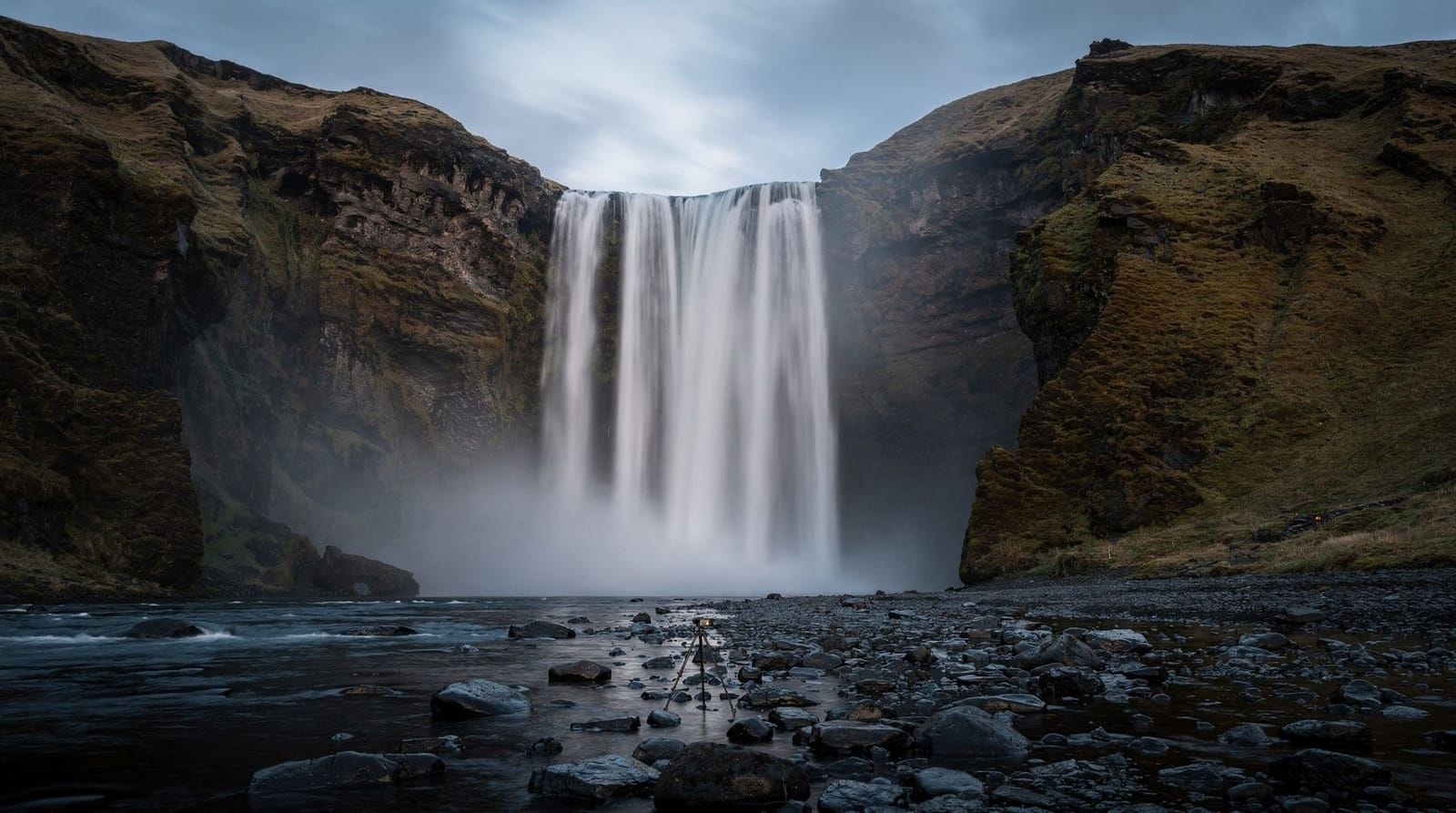
- Skógafoss (early morning): arrive before the tour buses. Fly over the falls, staying below 120 m and clear of the handful of other early visitors. No permit needed — this area sits outside all national park boundaries.
- Reynisfjara black sand beach: check for people at the base of the basalt columns before takeoff; the beach is not within a restricted zone, but crowds build fast once tour buses arrive. Avoid flying near Dyrholaey if it is nesting season — that headland closes to all access at those times.
- Skaftafell / Vatnajökull National Park: this is where the day changes. Any drone flight inside Vatnajökull National Park — which includes Skaftafell and the approach to Jökulsárlón — needs advance written permission from the park authority. Without it, keep the drone packed away here and shoot from ground level instead.
- End of day: back up footage before continuing — a corrupted SD card after a full day of shooting is the second most common source of photographer heartbreak on this route, after a drone lost to wind.
The lesson generalises: assume every named national park or nature reserve on your route requires either a permit or no flight at all, and treat the open coastline and farmland between them as your flying opportunities.
Frequently asked questions about drone rules in Iceland
Can I fly my drone at Reynisfjara black sand beach?
Reynisfjara is not within a national park. Standard Open Category rules apply. However, the beach is crowded in season and flying over uninvolved people violates A1/A2 regulations. Early morning (before tours arrive) is the only practical window. The nearby Dyrholaey headland is a seabird protection area and closes entirely during nesting season — do not fly drones there.
Is it legal to fly a drone over Icelandic waterfalls like Skógafoss or Seljalandsfoss?
These specific falls are not within national parks. Open Category rules apply. The main restriction is flying over uninvolved people at the base of the falls. Early morning visits when crowds are minimal allow legal flights above the water while maintaining required distances from any visitors below.
Does Iceland require a drone licence?
For Open Category operations, no formal licence is required beyond completing the A1/A3 online training in your home country. For Specific Category operations, a formal operational authorisation from Samgöngustofa is required. Commercial aerial photography that goes beyond what is permitted in Open Category requires Specific Category approval.
Where can I rent or repair a drone in Iceland?
Drone rental services in Iceland are limited. Reykjavík has electronics stores (Elko, Nettó electronics departments) that sometimes carry DJI accessories. For repairs, you are largely dependent on sending the drone to manufacturer service centres outside Iceland. Budget for your drone surviving the trip intact — bring a spare battery and propellers at minimum.
Can I fly a drone over the Blue Lagoon or Golden Circle?
The Blue Lagoon area is private property outside national park boundaries, but the facility itself does not permit drone flights over guests for privacy reasons — do not attempt it. On the Golden Circle, Þingvellir is fully restricted without a permit, while Geysir and Gullfoss sit outside park boundaries and allow standard Open Category flights away from crowds.
Do I need travel insurance that specifically covers drones?
Only if your existing travel or home insurance excludes aerial vehicles, which many policies do by default. Check the small print before your trip — if there is no coverage, a short-term policy from a specialist like Coverdrone (from roughly €15–25/day) covers the gap for the duration of your visit.
Top experiences
Best-rated activities across GetYourGuide and Viator.