Seljalandsfoss guide — how to walk behind the waterfall
Reykjavik: South Coast black Beach waterfalls full day
Can you really walk behind Seljalandsfoss?
Yes — a footpath circles behind the 60 m curtain through a shallow cave. The path is wet and slippery year-round and is often closed from November to March when ice makes it dangerous. Waterproof jacket and grippy footwear are non-negotiable. Parking costs 900 ISK (~€6).
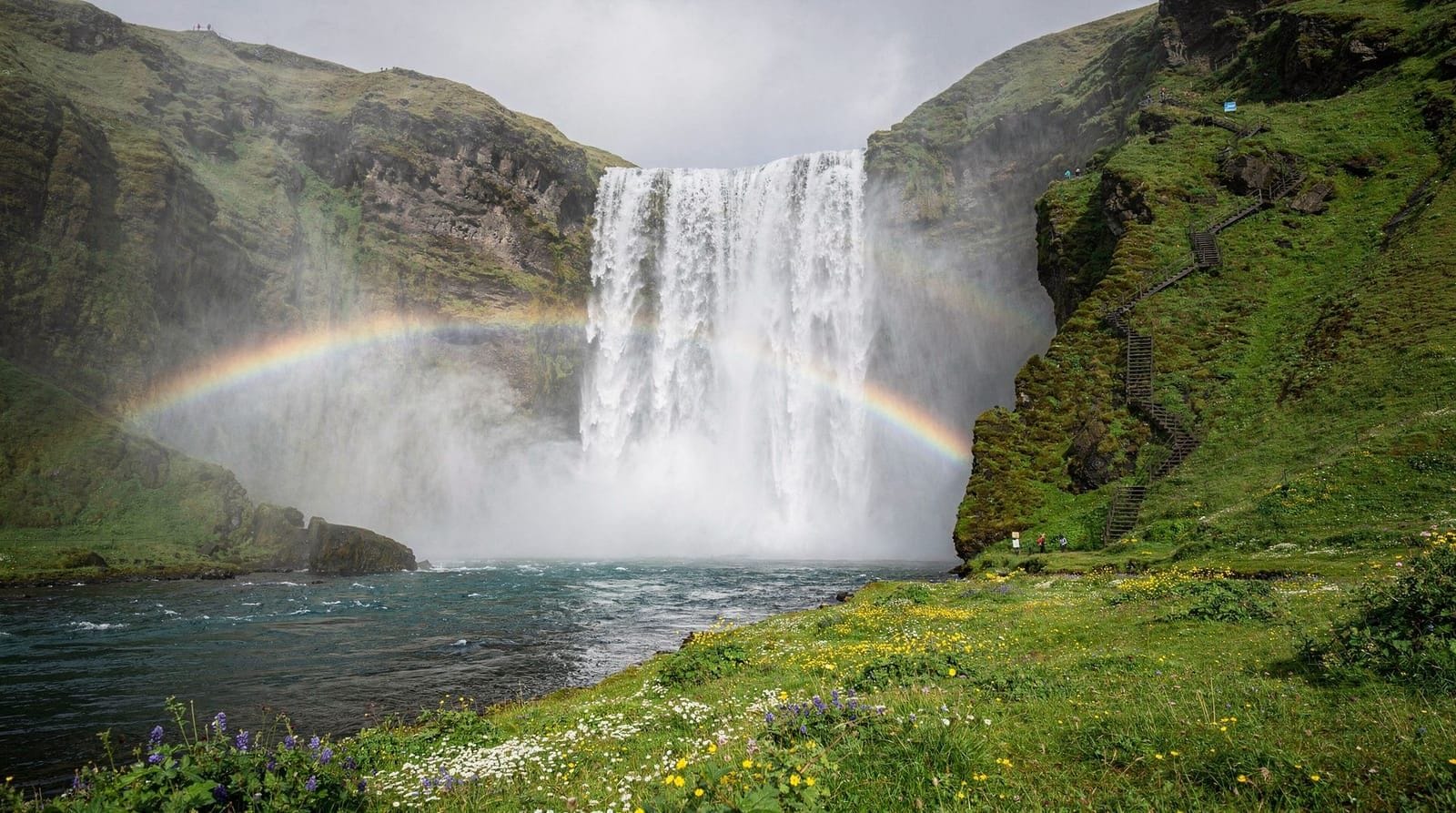
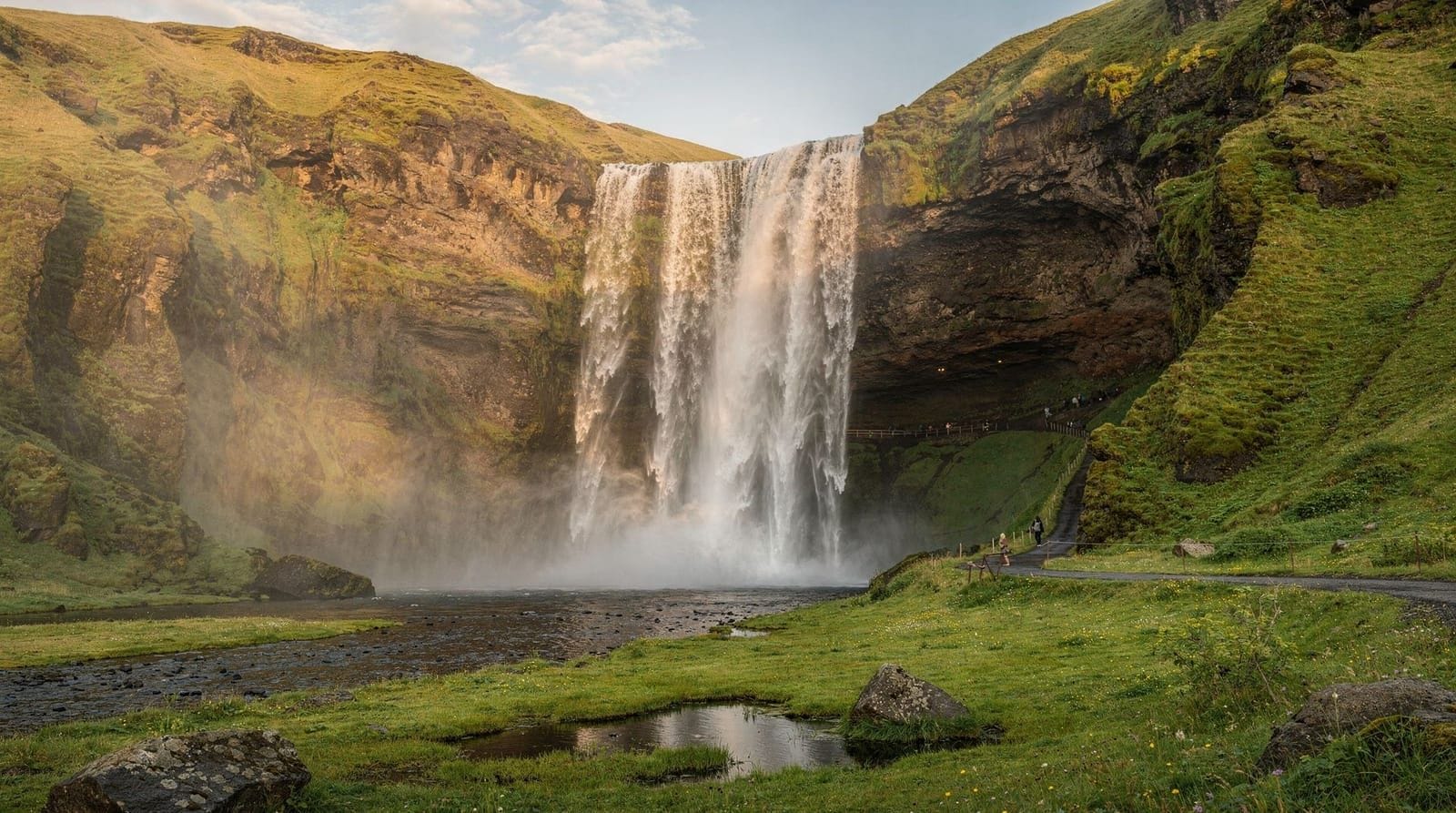
Seljalandsfoss is 120 km east of Reykjavík on the south coast — a single-curtain waterfall that drops 60 m from the lip of an old sea cliff. What separates it from Iceland’s dozens of other impressive falls is the footpath that runs behind the curtain through a shallow cave. It takes about 10 minutes to walk the full loop behind the falls; it takes considerably more planning to do it without getting soaked.
This guide covers the walk-behind path in detail, when it’s actually open, the nearby secret falls almost nobody finds, and honest advice about the crowds.
| Where | 120 km east of Reykjavík, south coast Route 1/249 |
| Cost | Parking around 900 ISK (~€6); no other fee |
| Time needed | 30–45 minutes; 1–1.5 hours with Gljúfrabúi |
| Best time | Before 8:30am or after 7pm in summer |
| Winter note | Walk-behind path often closed/icy November–March |
The geology in brief
Seljalandsfoss sits at the boundary of Iceland’s coastal plain and the inland mountains. The Seljalandsá river drains the Eyjafjallajökull glacier plateau and drops over an ancient sea cliff — this entire coastline was under water 10,000 years ago, and the cliffs are remnants of that shoreline. The cave behind the falls is essentially the old cliff face, undercut by centuries of water and ice.
The water drop is nearly vertical, which means the spray from the base shoots outward in all directions. Getting behind the falls does not mean getting less wet — it means getting wet from different angles.
The walk-behind path: what to expect
The path starts at the south side of the falls, follows a narrow track around the base (wet pebbles, sometimes with a small stream crossing), enters the cave behind the curtain, and exits on the north side before looping back to the main viewing area. Total distance is about 200 m; total time at a steady walk is 10–15 minutes.
The cave itself is about 5 m deep, 15 m wide, and 8–10 m high. The back wall is damp basalt. The roar inside is impressive — louder than you expect. Light filters through the curtain in a diffuse way that photographers love in overcast conditions.
Spray: You will get wet. At the entrance and exit to the cave, the spray zone is unavoidable. On windy days, the spray extends 30–40 m from the base of the falls. A basic rain jacket will be soaked through within seconds. You need waterproof trousers too if you plan the full loop.
Footing: The path is worn basalt and fine gravel, perpetually damp. In summer it is manageable in standard hiking boots. From October onward, ice begins forming on the path intermittently. From November through March, the path typically freezes solid and becomes genuinely dangerous.
When the path is closed
There is no single fixed date. Rangers or site staff (when present) put up warning signs, but there are no formal barriers — some visitors go through anyway and occasionally fall. Injuries from ice on this path are reported every winter season.
Practical rule: If the air temperature at Seljalandsfoss has been below 0°C overnight, the path behind the falls is icy. Check weather forecasts for the south coast the morning you visit. In January and February, the path should be assumed closed unless stated otherwise. In April, conditions improve but remain unpredictable.
In winter, the falls themselves are spectacular — partial freeze creates ice formations on the cliff face — and the standard frontal viewing area is perfectly safe and beautiful. See our Iceland in winter guide for the full winter visiting picture.
Gljúfrabúi — the hidden waterfall 10 minutes away
This is the most underrated 10-minute detour in south Iceland. From the main Seljalandsfoss car park, walk north along the base of the cliff for about 400 m. You’ll see a narrow gorge entrance — a crack in the cliff face perhaps 2 m wide, where a stream trickles out.
Walk into the gorge. It opens into a cathedral-like canyon with a 40 m waterfall tumbling into a pool. You can’t see any of this from outside.
Most visitors to Seljalandsfoss never know Gljúfrabúi exists. On busy days in summer, you’ll find the main falls area has 300–400 people; Gljúfrabúi will have 15–20. To photograph the falls from inside the gorge, wade through the shallow stream (ankle depth in summer, potentially knee-deep after heavy rain). Waterproof shoes or wellies recommended; the stream temperature is approximately 5°C.
Parking and fees
The car park is on the south side of the falls, off Route 249 (a short spur from Route 1). Fee: approximately 900 ISK (~€6) in 2025, paid at an automated machine. The machine accepts Visa/Mastercard and ISK cash.
There is no formal penalty for parking on the verge of Route 1 and walking down, but it is inadvisable — the road shoulder is narrow and the traffic is fast.
Facilities: portable toilets at the car park (basic but present). No café at Seljalandsfoss itself. The nearest services are at a petrol station on Route 1 near the junction (Seljalandsvegur/Route 249 junction), about 2 km from the falls.
Crowds and timing
Seljalandsfoss is one of the three stops on the standard south coast day tour from Reykjavík, which means it receives visitors in bus-load quantities from about 9:30 am to 5 pm in summer. Between those hours, the area around the base of the falls is genuinely crowded — families with small children, tour groups, photography workshops — and the path behind the falls becomes a slow queue.
To visit with reasonable peace: arrive before 8:30 am or after 7 pm in summer. In late June, you’ll have usable natural light until nearly midnight.
Winter visits (weather permitting, path conditions willing) are significantly less crowded. A November or December visit to the frontal area in the low-angle winter light can be extraordinary.
Small-group south coast tours that stop at Seljalandsfoss usually arrive before or after the bus convoys, and guides tend to know the better photographic angles. Group size matters here — 12 people is a different experience from 50.
Photography
For the walk-behind view: a wide-angle lens (16–24 mm equivalent) captures the curtain and cave in the same frame. Overcast days produce the best exposures inside the cave — bright sunshine creates harsh contrast between the lit curtain and the dark cave interior.
For the frontal view: the classic composition frames the full 60 m drop with green cliff walls on either side. Include the base pool if conditions allow. In summer, the falls are illuminated artificially at night — some visitors consider this atmospheric, others find it garish.
For Gljúfrabúi inside the gorge: bring a wide-angle and accept that you’re going to get the lens wet. A UV filter you can wipe dry is useful. Long exposures are possible inside the gorge because you’re sheltered from wind.
See the Iceland photography guide and long-exposure waterfall photography for full technique details.
Combining with the south coast day trip
Seljalandsfoss is typically the first major stop heading east from Reykjavík. The standard pairing is:
- Seljalandsfoss + Gljúfrabúi (1.5 hours total)
- Skógafoss + optional staircase climb (1.5 hours)
- Reynisfjara black sand beach (1 hour)
- Return to Reykjavík
This is a comfortable full day. Add Dyrhólaey if you have time. See the detailed south coast day trip guide and south coast 3-day itinerary.
If you want to cover the south coast efficiently with a guide, look for tours that include both Seljalandsfoss and Skógafoss alongside Reynisfjara — these three together in a single day is the classic south coast experience. Some tours extend to include Sólheimajökull glacier or Vík village.
What to wear and bring
This is not a hike — Seljalandsfoss requires zero fitness — but it does require specific gear:
- Waterproof jacket (not water-resistant, fully waterproof with sealed seams)
- Waterproof trousers for the walk-behind path
- Grippy shoes or hiking boots (trail runners work; leather soled shoes are genuinely dangerous on the wet path)
- Dry bag or waterproof phone case for cameras
For the longer visit that includes Gljúfrabúi gorge:
- Waterproof footwear with ankle support (the gorge stream wading requires this)
- Change of socks in the car
Frequently asked questions about Seljalandsfoss
How long does a visit to Seljalandsfoss take?
Just the frontal view and walk-behind path: 30–45 minutes. Add Gljúfrabúi: 1–1.5 hours total. If you’re photographing both extensively, budget 2 hours.
Is Seljalandsfoss open in winter?
The waterfall itself is always there. The walk-behind path closes (or becomes dangerous) when it freezes, typically November–March. The frontal viewing area is accessible year-round and is often beautiful in winter light.
Can children do the walk-behind path?
Yes, in summer when the path is dry. Children under 5 or 6 will find the wet path difficult, and the spray is intense. In winter, the frozen path is genuinely unsafe for small children. Families with young children should assess conditions carefully on arrival.
Is there a café at Seljalandsfoss?
No café at the falls. Bring your own food and water. The nearest petrol station with snacks and coffee is about 2 km away on Route 1.
How far is Seljalandsfoss from Reykjavík?
120 km by road, approximately 1.5 hours in normal conditions without stops. It’s easily a half-day trip from the capital, or a full day if you continue east along the south coast.
Is the waterfall lit at night?
Yes, during summer months, Seljalandsfoss is illuminated from dusk (which is late or nonexistent in June) through midnight. The artificial lighting creates dramatic photography opportunities but the “golden hour” natural light in the early morning hours is generally preferable for quality.
Can I drive to Seljalandsfoss in winter without a 4WD?
Yes, in most winter conditions. Route 1 and Route 249 are both maintained and plowed. A 2WD with winter tyres handles the approach in normal winter conditions. Heavy snowfall may require 4WD temporarily — check road.is on the morning you travel.
Is Seljalandsfoss worth visiting if the walk-behind path is closed?
Yes. The frontal view of the 60 m curtain against the basalt cliff is impressive on its own, and Gljúfrabúi — the hidden gorge waterfall 400 m north — is unaffected by the main path’s condition since its entry involves wading a shallow stream rather than an icy path. A closed walk-behind path shouldn’t be a reason to skip the stop entirely.
Should I visit Seljalandsfoss on the way to or from Jökulsárlón?
Either works, but if light quality matters to you across the whole South Coast, the same logic that favours a counterclockwise Ring Road direction applies here too — arriving from the east in the afternoon generally gives better light on this stretch than a first-thing morning arrival heading out from Reykjavík.
Understanding the Seljalandsá river
The Seljalandsá river drains the southern slopes of Eyjafjallajökull glacier (the same volcano that erupted in 2010 and disrupted European air travel). From the glacier plateau at roughly 900 m altitude, the river descends quickly across a series of lava fields before reaching the old sea cliff at Seljalandsfoss.
The volume of the falls varies significantly through the year. Peak flow occurs in May–June when glacial snowmelt adds to normal rain-driven runoff. In late summer (August–September), flows are lower and the curtain is noticeably narrower. Autumn rainstorms can temporarily increase flow dramatically.
The cliff itself is approximately 8,000–10,000 years old — a remnant of the shoreline from when sea levels were higher after the last ice age. The entire south coast plain between the current shoreline and these cliffs was underwater during this period. The cave behind the falls is the undercut base of the old sea cliff, carved by wave action when the cliff faced the ocean directly.
The artificial lighting debate
Seljalandsfoss is illuminated at night by spotlights installed by the site operators. The lighting extends the photography window for evening and night visitors and is popular for winter visits when daylight is short.
The debate among photographers: natural light proponents find the artificial orange-white lighting unflattering and “incorrect” compared to the cool blue tones of the natural falls. Artificial light advocates point out that the night illumination creates unique photographic opportunities in winter (snow, ice, no daylight competition).
Both positions have merit. If you’re going for pure natural photography, plan for the pre-dawn natural light window in summer. If you want dramatic night-lit winter shots, the artificial lighting works well from the south frontal viewpoint.
What happens if you get to Seljalandsfoss and it’s crowded?
The falls at peak times (10 am–4 pm in summer) are genuinely packed. Practical options when the crowd is frustrating:
- Walk north to Gljúfrabúi immediately (10 minutes away, always less crowded)
- Walk south along the cliff base for 200–300 m — the view of Seljalandsfoss improves with distance and the perspective changes significantly
- If you have flexibility: wait. Tour buses come and go in waves. A 30-minute wait at the car park often produces a 20-minute window of significantly lighter crowds as one wave departs before the next arrives.
- Photograph Gljúfrabúi thoroughly, then return to Seljalandsfoss in the late afternoon when the light is good and most tour buses have departed.
Nearby geological context
The Eyjafjallajökull volcano, source of the Seljalandsá river, is visible to the north from Seljalandsfoss — or would be on a clear day. The glacier cap on the summit is distinguishable by its flat top. The 2010 eruption sent ash plumes over the falls and surrounding farms; ash from that eruption is still detectable in sediment layers in the area.
The broader south coast is one of the most geologically active zones in Iceland. Within 50 km of Seljalandsfoss, you have: Eyjafjallajökull volcano, Mýrdalsjökull glacier (covering Katla volcano), and the Skógar/Sólheimajökull glacier complex. The flat plain between the mountains and the sea is built from centuries of volcanic ash and glacial outwash. It is among the most fertile agricultural land in Iceland for this reason.
Budget and time planning
A Seljalandsfoss stop costs only the parking fee (900 ISK / ~€6). There are no further expenses unless you buy snacks from the petrol station nearby. It is one of the few genuinely famous Icelandic natural sites where the experience is essentially free.
For time: the minimum meaningful visit is 30 minutes (front viewpoint, behind the falls). A thorough visit including Gljúfrabúi and photography from multiple angles runs 1.5–2 hours. Combined with Skógafoss and Reynisfjara, you have a full day’s south coast loop.
For accommodation strategies near the falls, see the budget accommodation Iceland guide — the camping option at Skógar (30 km east) is the most popular for south coast early-morning access.
Seljalandsfoss as part of the south coast experience
Seljalandsfoss sits at the western end of Iceland’s most popular tourist corridor — the south coast between Reykjavík and Jökulsárlón glacier lagoon. Understanding where it fits in the full picture helps with planning.
Key south coast distances from Seljalandsfoss:
- Skógafoss: 30 km east, 30 minutes
- Dyrhólaey: 55 km east, 50 minutes
- Reynisfjara and Vík: 60 km east, 1 hour
- Skaftafell: 200 km east, 2.5 hours
- Jökulsárlón: 250 km east, 3 hours
A day trip from Reykjavík to Seljalandsfoss + Skógafoss + Reynisfjara is 350 km round trip and comfortably fits in one summer day (16+ hours of daylight). Adding anything beyond Reynisfjara requires staying overnight at Vík or further east.
What to do if the walk-behind path is closed
When the walk-behind path is frozen or closed for maintenance, Seljalandsfoss is still worth visiting. The frontal view of the 60 m falls against the basalt cliff is impressive in its own right. Options to enhance the visit:
- Gljúfrabúi gorge: The hidden falls 400 m north are accessible regardless of the Seljalandsfoss path condition (the gorge entry involves wading a shallow stream, not an ice path)
- Northern cliff walk: Continue north from Gljúfrabúi along the base of the cliff — the escarpment extends for several kilometres and reveals smaller cascades and cave entrances
- Photography from the south: 100–200 m south of the falls on the flat plain, the 60 m curtain is framed against sky — a different composition than the standard close-up viewpoint
The photography challenge of Seljalandsfoss’s walk-behind
The walk-behind shot is harder to execute well than it looks. Common problems:
Spray on the lens: Even from inside the cave, spray reaches the front element in most wind conditions. Solution: wipe the lens between every shot, use a UV filter you can clean more aggressively, or shoot in burst mode and hope one frame is sharp.
Exposure balance: Inside the cave, the curtain of falling water is much brighter than the dark cave walls and floor. Auto-exposure will either blow the water or underexpose the cave. Shoot in manual mode, expose for the water curtain (slightly underexposed is better than blown), and let the cave walls go dark.
Composition: The classic inside shot has the water curtain as the main element with the green cliff beyond visible through the curtain. Avoid centering the frame — offset to one side shows both the cave interior and the curtain simultaneously. A 16–24 mm lens captures the full height from inside.
Morning light through the curtain: The light diffused through the water curtain in the early morning (east-facing) creates a luminous effect. This is the best light for this specific photograph and it only lasts 1–2 hours.
See the Iceland photography guide for full technique and the long-exposure waterfalls guide for specific shutter speed recommendations.
Comparing Seljalandsfoss to nearby waterfalls
Visitors with limited time on the South Coast sometimes ask whether Seljalandsfoss or Skógafoss deserves priority if they can only stop at one. They are different experiences rather than a strict better/worse comparison:
| Seljalandsfoss | Skógafoss | |
|---|---|---|
| Signature feature | Walk-behind path | Climbable staircase to the top |
| Crowd level | Very high, tour-bus convoy | High, but the staircase thins the crowd |
| Time needed | 30–45 minutes | 45–90 minutes with the climb |
| Weather sensitivity | Path closes/ices in winter | Frontal view accessible year-round |
| Best for | Photography inside the cave | Views from above the falls |
Neither is skippable on a proper South Coast day — most itineraries include both, plus Reynisfjara, as the classic three-stop day covered in the south coast day trip guide. If genuinely forced to choose one, Seljalandsfoss’s walk-behind path is the more unusual experience; Skógafoss’s staircase view rewards those who want a workout with their waterfall.
Visiting with limited mobility
The frontal viewing area at Seljalandsfoss is reachable on a flat, paved-adjacent path from the car park, making it one of the more accessible major sights on the South Coast for visitors with limited mobility or wheelchair users, though the surface is uneven gravel rather than a fully paved path in places. The walk-behind path itself is a different matter — wet, uneven basalt and gravel with no handrails, genuinely difficult terrain even for confident walkers, and not realistically accessible for wheelchair users or anyone with significant mobility limitations. Gljúfrabúi involves wading a stream and is not accessible at all. If mobility is a concern, plan for the frontal view only and treat the walk-behind and Gljúfrabúi as bonus stops for those who can manage them.
A realistic half-day itinerary combining Seljalandsfoss
For visitors who want to make Seljalandsfoss the centrepiece of a half-day rather than a quick 30-minute stop on the way to somewhere else, a fuller morning looks like this:
08:00 — Depart Reykjavík, arriving before the tour-bus convoys. 09:30 — Arrive Seljalandsfoss. Frontal view and walk-behind path (30–40 minutes). 10:10 — Walk north to Gljúfrabúi (10 minutes), explore the gorge (20–30 minutes). 11:00 — Return to the car park, continue east toward Skógafoss (30 minutes’ drive) to complete a South Coast morning before the afternoon crowds peak at either site.
This sequencing gets you to both of the South Coast’s most-visited waterfalls before the bulk of Reykjavík’s day-tour departures arrive, which is the single highest-leverage timing decision for this stretch of coast.
If you’re staying overnight near Vík or Skógar rather than day-tripping from Reykjavík, the same early-arrival logic applies in reverse: an evening visit after 7pm, driving from the east, achieves the same quiet-crowd effect without the early alarm, and in June’s near-endless daylight this is a genuinely comfortable way to see the falls without either extreme.
Top experiences
Bookable activities with verified prices and instant confirmation on GetYourGuide.
Top experiences
Best-rated activities across GetYourGuide and Viator.

Ice Cave by Katla Volcano Super Jeep Tour from Vik
- Viator

Puffin and Volcano Tour with Ebbi
- Viator

Dynjandi Waterfall & Farm Visit Tour from Isafjordur Port
- Viator

3,5-Hour Sightseeing Tour To Dynjandi Waterfall
- Viator

Volcano ATV Tour
- Viator

Lake Myvatn Day Tour and Godafoss Waterfall for Cruise Ships from Akureyri Port
- Viator