Goðafoss guide — the waterfall of the gods on Route 1
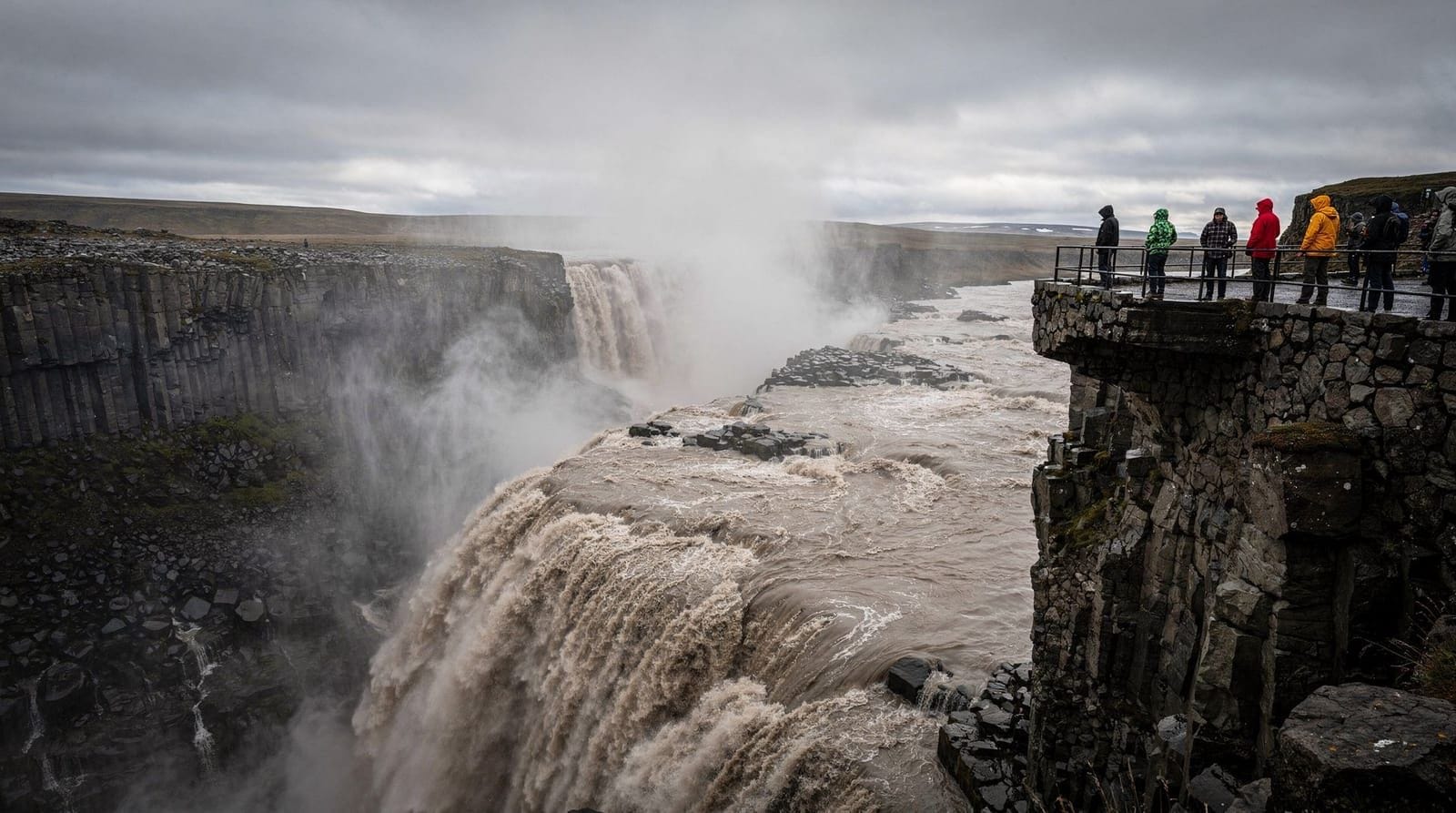
Akureyri: Dettifoss and Godafoss waterfalls
What is Goðafoss and how do I visit it?
Goðafoss ("Waterfall of the Gods") is 50 km east of Akureyri on Route 1, directly on the Ring Road. It's 12 m high and 30 m wide, viewable from both banks. Free parking. Allow 45 minutes. The name commemorates Iceland's conversion to Christianity in the year 1000.
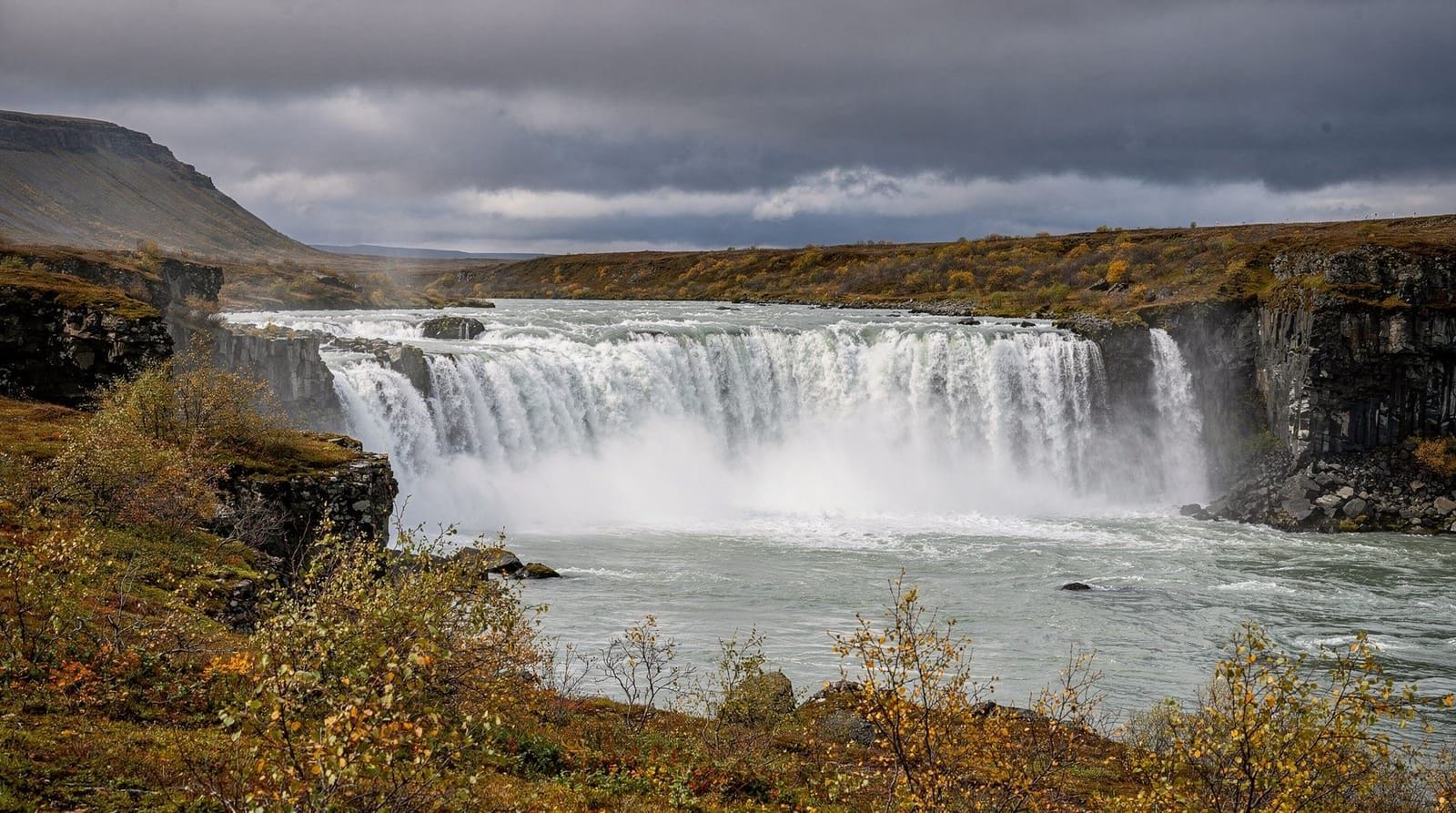
Goðafoss is the easiest major waterfall in Iceland to reach — it sits directly on Route 1 (the Ring Road), 50 km east of Akureyri, accessible from the road in less than five minutes’ walk. The falls themselves are not the most powerful in Iceland, but they spread in a beautiful horseshoe arc across the Skjálfandafljót river, and they carry a historical weight that most Icelandic natural sites do not.
This guide covers the practical visit details, the story behind the name, and how to fit Goðafoss into a north Iceland itinerary.
| Where | Route 1, 50 km east of Akureyri |
| Cost | Free (parking free too) |
| Time needed | 30–45 minutes for both banks |
| Best time | Morning for light; before 9am or after 5pm for fewer coaches |
| Getting there | Self-drive (paved Route 1) or Akureyri port/Diamond Circle tour |
The story of the gods’ waterfall
In the year 1000 CE, the Icelandic parliament (Alþingi) at Þingvellir was under pressure to adopt Christianity as the country’s official religion. The task of making the decision fell to the law-speaker (lögsögumaður), Þorgeir Ljósvetningagoði, who meditated under a cloak for a day and night before announcing that Iceland would become Christian — to prevent the country splitting into warring factions.
On his return journey north, Þorgeir stopped at this waterfall and threw his statues of Norse gods into the falls. The gesture marked Iceland’s official transition. Hence: Goðafoss, “waterfall of the gods.”
The historical record is based on the saga accounts written 200+ years later, and some historians question the details. But the name stuck, and the falls carry the story visibly.
The waterfall itself
The Skjálfandafljót river, fed by meltwater from Tungnaárjökull glacier, spreads across a basalt shelf here in a horseshoe arc, dropping 12 m in two main channels separated by a small island. The combined width is approximately 30 m. The water is notably clearer and bluer than at Dettifoss — the Skjálfandafljót carries much less glacial sediment.
In volume terms, Goðafoss flows at roughly 50–60 m³/s in summer, which is respectable but far below Dettifoss (500 m³/s). What Goðafoss lacks in raw power it makes up in accessibility and visual elegance — the symmetrical horseshoe shape photographs well from either bank, and the river upstream and downstream is photogenic too.
Viewing from both banks
East bank: Reached from the main parking area off Route 1 (east side). The viewing platform here looks directly at the main falls from a raised terrace. This is the standard viewpoint for most visitors. Distance to the best viewing position: 2 minutes’ walk from the car park.
West bank: Crossed via a footbridge just above the falls. This viewpoint looks downstream, showing the full spread of the horseshoe and the gorge below. The light on the west bank is better in the morning (sun from the east). Many visitors do both banks in a single visit, which takes about 30–40 minutes total.
Between the banks, the short section of river above the falls is calm and clear — local people sometimes fish here (salmon, when in season).
Practical details
Location: Route 1, about 50 km east of Akureyri, at the junction with Route 845. Well-signposted from the Ring Road.
Parking: Free. Two car parks — one on each side of the bridge over Route 1. The east bank lot is larger.
Facilities: A small café/visitor centre on the east bank (seasonal — typically open June–August) serving hot drinks and light snacks. Toilets at the car park.
Admission: Free.
Time needed: 30–45 minutes for a standard visit including both banks. Longer if you walk upstream on either bank.
Driving from Akureyri
From central Akureyri, take Route 1 east. The road follows the Fnjóská river valley before crossing to the Skjálfandafljót river basin. Goðafoss is well-signposted at the Route 845 junction. Total drive: 50 km, approximately 45 minutes.
The road is fully paved and Route 1 is maintained year-round. A 2WD handles this drive in any condition. Goðafoss is an easy half-day from Akureyri — see it combined with Forest Lagoon (30 minutes west of Goðafoss toward Akureyri) for a good day out.
If you’re arriving in Akureyri by cruise ship, port day tours to Goðafoss are a straightforward choice — the falls are close enough to cover comfortably in a half-day from the port with time to spare for Akureyri itself. Check departure times carefully against your ship’s departure.
Combining Goðafoss with other north Iceland sites
Goðafoss sits at the western end of the Diamond Circle route and is easily combined with:
- Lake Mývatn: 50 km east of Goðafoss. Pseudo-craters, geothermal hot springs, volcanic landscape. Add 3–4 hours.
- Dettifoss: 100 km east of Goðafoss via Route 87/85. Add 4–5 hours including the drive.
- Forest Lagoon (Skógarböð): A geothermal swimming facility 10 km west of Goðafoss with views over the Fnjóská valley. Excellent after a day of driving. Entrance costs approximately 5,900 ISK (~€40).
The north Iceland 4-days itinerary builds a complete circuit including Goðafoss, Mývatn, Dettifoss, and Ásbyrgi.
A Diamond Circle guided tour from Akureyri covers Goðafoss, Mývatn, and Dettifoss in a single long day. It’s a full 10–12 hours, so consider whether you want to drive it yourself over two days instead for a more relaxed pace.
Photography at Goðafoss
The horseshoe shape works best from slightly elevated positions above the water level. From both banks, the main photography challenge is that the falls are wide and relatively low — getting the whole spread in frame requires a moderate wide-angle (24–35 mm).
Best light: Morning (east bank viewpoint faces west, so morning light hits the falls directly). Arrive at 7–8 am in summer for low-angle warm light and no crowds.
Long exposures: Possible from the east bank terrace with a tripod — the falls are stable, wind is usually moderate, and the viewing platform gives a solid surface. Aim for 1–2 second exposures to soften the water.
Upstream compositions: Walk 200 m upstream from either bank for views of the river approaching the falls. The clear blue water and basalt riverbed photograph well with a polariser.
See the Iceland photography guide for general technique and the best photo spots in Iceland guide for north Iceland location recommendations.
When to visit
Goðafoss is accessible and worthwhile year-round:
- Summer (June–August): Crowds peak when cruise ships dock at Akureyri. Arrive before 9 am or after 5 pm to avoid tour groups. Crowds here are lower than at south coast waterfalls but still noticeable in peak season.
- Autumn (September–October): Reduced crowds, possible northern lights in dark skies around the falls at night, beautiful coloured vegetation on the banks.
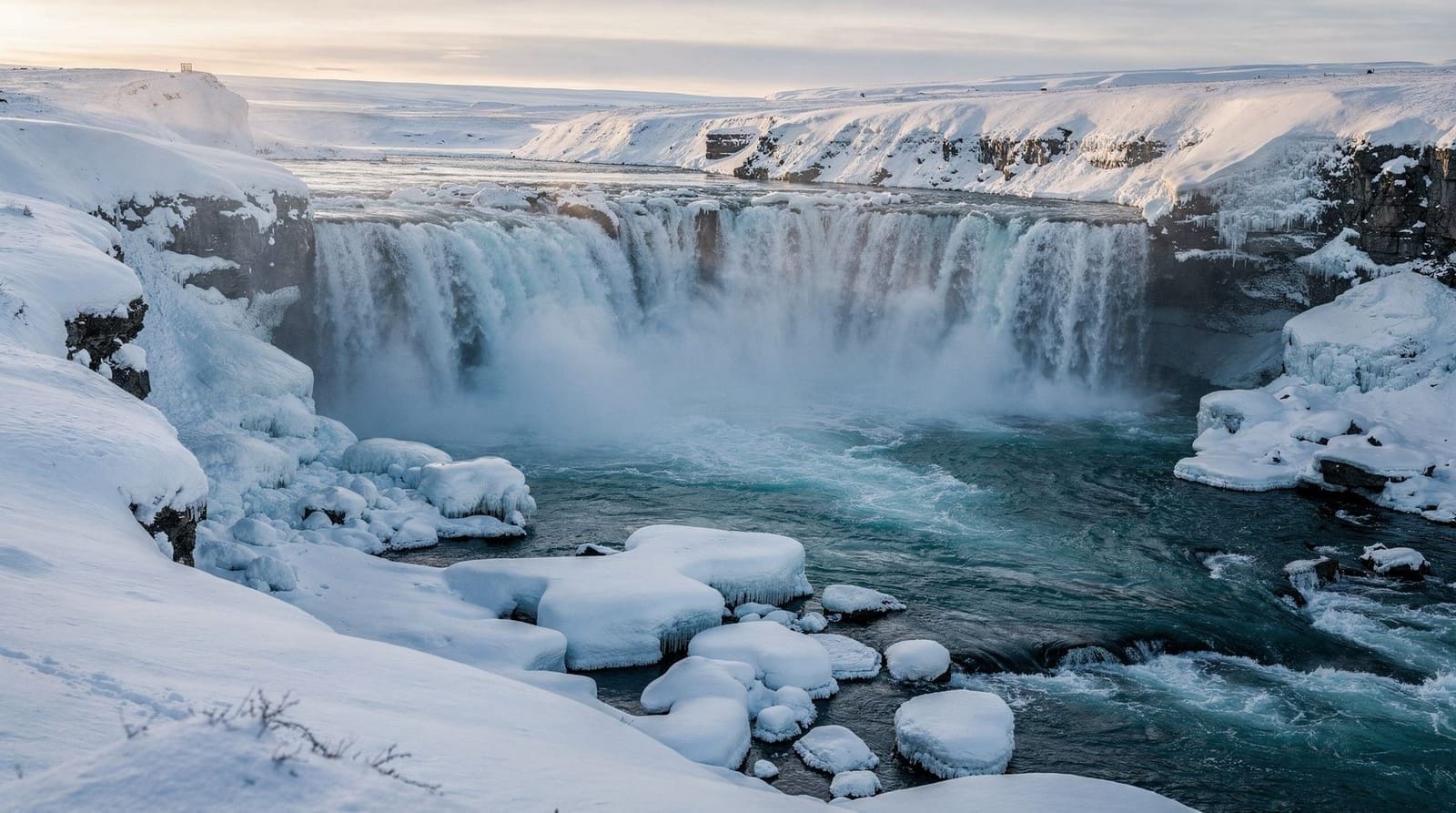
- Winter (November–March): Ice formations on the falls edge, snow on the surrounding landscape, extremely low visitor numbers. The route from Akureyri is reliably maintained.
- Spring (April–May): Highest water volume of the year from snowmelt; the falls are at their most powerful but weather is unpredictable.
See the best time to visit Iceland guide and the Iceland in winter guide for seasonal context.
Frequently asked questions about Goðafoss
Is Goðafoss worth a stop on the Ring Road?
Absolutely. It’s directly on Route 1, parking is free, and it takes under an hour. Anyone driving the north section of the Ring Road should stop here — the combination of history and visual appeal makes it one of the most satisfying quick stops in Iceland.
How does Goðafoss compare to Seljalandsfoss or Skógafoss?
Goðafoss is smaller and less powerful than the south coast waterfalls, but it’s more accessible and less crowded. The horseshoe shape is distinctive. If you’re doing both the south coast and north Iceland, Goðafoss is worth including because it’s a different character of falls.
Can I swim near Goðafoss?
The pools above the falls are calm and clear, but the water is glacial-fed and cold (5–8°C). Swimming is not recommended in the main river. Some hardy locals have swum in the calmer upstream pools in summer, but this is not officially encouraged.
Is there accommodation near Goðafoss?
The nearest town is Laugar (about 20 km southeast) with a guesthouse and pool complex. Akureyri (50 km west) has the full range of accommodation options. For Goðafoss specifically, it’s best treated as a drive-by stop rather than a destination requiring a base.
What time of day is least crowded at Goðafoss?
Early morning (before 9 am) and evening (after 6 pm) in summer. In cruise season (June–August), the area sees bus groups during the mid-day period when ships are docked at Akureyri.
Is Goðafoss accessible in winter?
Yes. Route 1 is plowed regularly and the falls are accessible year-round. Snow and ice make the viewpoints slightly slippery — wear boots with grip. The winter lighting (low-angle sun through November–February) can produce excellent photography.
Is the footbridge to the west bank safe in wind?
Usually, but hold the handrail and reconsider crossing in genuinely strong gusts. The east bank alone still gives a full, satisfying view of the falls if conditions on the bridge feel unsafe.
Does Goðafoss have a visitor centre or exhibition?
No — infrastructure is deliberately minimal: a seasonal café, car parks, and marked paths, without a large visitor centre or paid exhibition. Many visitors prefer this to more commercialised sites.
The Skjálfandafljót river system
Goðafoss is the most accessible point on the Skjálfandafljót, Iceland’s fifth-longest river (180 km). The river originates at Tungnárver and flows north through the highland interior before passing through the basalt plateau where Goðafoss sits. It enters Skjálfandi bay near Húsavík.
Above and below Goðafoss, the Skjálfandafljót has several notable waterfalls. Aldeyjarfoss (20 m high, surrounded by basalt columns) is 50 km upstream on Route 842. It is one of the least-visited major waterfalls in Iceland and visually exceptional. See the Iceland waterfalls guide for the full river system context.
The salmon fishing on the Skjálfandafljót is considered among the best in Iceland. In July and August, fishing spots near Goðafoss are heavily used by local anglers. The season runs June to September; permits are required and expensive (50,000–150,000 ISK / €330–1000 per day depending on the stretch). If you see anglers working the water below the falls, they’re after Atlantic salmon that run the river from July.
Goðafoss and the Laugar valley
The Route 1 corridor in this area also passes through the Laugar valley — a geothermal zone with several hot spring pools. Laugar swimming pool (30 km south of Goðafoss on Route 845) is a community facility with indoor and outdoor geothermal pools. Prices are around 900–1,100 ISK (~€6–7) — dramatically cheaper than commercial spas. No tourists; genuine community use.
This is a worthwhile addition to a Goðafoss stop if you want to experience Icelandic geothermal bathing at local prices rather than tourist infrastructure pricing. Towel rental available.
Cruising and Goðafoss
Akureyri receives approximately 50–60 cruise ships per summer. When a large ship (2,500–4,000 passengers) is in port, Goðafoss receives a significant proportion of those passengers on excursions. Check cruise schedules if avoiding cruise-day crowds matters to you. The website cruiseportakureyri.is publishes ship call schedules.
Cruise excursions typically arrive at Goðafoss between 9 am and 1 pm. Visiting after 2 pm on cruise days is significantly quieter.
How Goðafoss fits into north Iceland’s attractions
The Diamond Circle route connects four major north Iceland attractions into a cohesive day trip or overnight circuit. Goðafoss is the most accessible of the four and serves as a natural starting or ending point.
Practical combinations from Akureyri:
Half-day option: Goðafoss (1 hour) + Forest Lagoon (2 hours). Total time: 3.5–4 hours including driving. Works well if you only have a morning or afternoon.
Full-day Diamond Circle: Goðafoss + Lake Mývatn volcanic area + Dettifoss + Ásbyrgi. This is 400+ km and 10–12 hours total — a long but satisfying day.
Two-day north Iceland circuit: Day 1 covers Goðafoss and Mývatn, staying overnight at Mývatn or Húsavík. Day 2 covers Húsavík whale watching and Dettifoss/Ásbyrgi before returning to Akureyri. See the north Iceland 4-days itinerary for a fully planned version.
The name Goðafoss in other Nordic languages
“Goði” (plural: “goðar”) was an Icelandic chieftain-priest during the Commonwealth period (930–1262 CE). The goðar held combined religious and secular authority in their local districts. Þorgeir Ljósvetningagoði was the goði of the Ljósavatn district, which explains his authority to make the conversion decision.
The word “foss” (waterfall) is common across the Nordic languages: Norwegian foss, Faroese foss, Swedish fors. This shared vocabulary reflects the deep connection between waterfall features and human settlement patterns in these glacially shaped landscapes. Many Icelandic place names ending in -foss refer to local waterfalls used as landmarks for centuries.
Self-driving to Goðafoss from Reykjavík
Goðafoss is 390 km from Reykjavík via the Ring Road (Route 1) — a 4-hour drive that you would not do just for this waterfall. It is, however, logical as part of a north Iceland loop or Ring Road circuit.
The most practical approach for visitors basing themselves in Reykjavík who want to see north Iceland is: fly to Akureyri (1 hour on a domestic flight, roughly 15,000–25,000 ISK / €100–165 with Air Iceland Connect), rent a car in Akureyri, and drive the Diamond Circle from there. This gives you Goðafoss plus Mývatn, Dettifoss, and Ásbyrgi without the 8-hour Reykjavík round trip.
See the domestic flights in Iceland guide for current options and the north Iceland 4-days itinerary for the full circuit plan.
Goðafoss in context: north Iceland’s overlooked waterfall
Goðafoss is not Iceland’s most powerful, tallest, or widest waterfall. It is, however, consistently rated by visitors as among the most satisfying waterfall experiences in the country. The combination of factors — accessibility, history, horseshoe shape, dual-bank viewpoints, clear blue-green water — works in ways that a simple comparison of dimensions misses.
The best way to understand why: compare photographs of Goðafoss with photographs of Dettifoss, which is far more impressive on paper (500 m³/s vs 50 m³/s, 44 m vs 12 m). Dettifoss is overwhelming; Goðafoss is beautiful. Different purposes for different moments in a north Iceland trip.
For most Ring Road drivers doing the full circuit, both waterfalls appear in the same 200 km stretch. Plan for both, budget 45–60 minutes each, and they complement rather than substitute for each other. The Iceland waterfalls guide ranks both in the broader context of Icelandic waterfall experiences.
Responsible tourism at Goðafoss
The site handles crowds reasonably well because of its dual-bank layout — visitors naturally distribute between the two viewpoints. But the surrounding vegetation (Icelandic lowland grasses and mosses) is vulnerable to trampling off the marked paths.
The request from the site management is simple: stay on the marked paths and resist the urge to approach the riverbanks outside the designated viewing areas. The north bank in particular has sections where the riverbank grass is clearly worn from people walking to the water’s edge.
Iceland’s natural surface vegetation recovers very slowly — a footprint in moss can persist for years. This is not a unique Goðafoss problem; it applies to every natural site in Iceland. When you see marked paths, they exist for both visitor safety and landscape protection.
Goðafoss for visitors with limited mobility
The east bank viewing terrace is reached via a short, mostly flat gravel and paved path from the car park — manageable for wheelchairs and pushchairs with some assistance on the final gravel stretch. The west bank requires crossing the footbridge, which has steps and a narrow deck, and is not wheelchair accessible.
For visitors who can only manage the east bank, the view is still a full frontal perspective on the main horseshoe — not the complete picture, but a genuinely satisfying visit in its own right. The seasonal café and toilets are on the east side, with step-free access from the car park.
Compared to other major Ring Road waterfalls, Goðafoss is among the more accessible stops: Dettifoss requires a longer uneven walk from its car park, and Gullfoss’s lower viewpoint involves a steep gravel descent that Goðafoss’s east bank does not.
Goðafoss in poor weather
North Iceland’s weather is genuinely more variable than the south coast, and Goðafoss sits exposed on the open Route 1 corridor with little shelter. A few practical notes for visiting in less-than-ideal conditions:
Wind: The area can experience strong gusts, particularly on the west bank footbridge crossing. In high wind, hold the handrail and consider skipping the bridge crossing if conditions feel genuinely unsafe rather than merely uncomfortable — the east bank view alone is still worthwhile.
Rain: Both viewpoints are unsheltered gravel and paved paths; a waterproof jacket makes the visit far more pleasant. The café on the east bank (seasonal, June–August) is the only indoor refuge.
Winter ice: The viewing platforms can develop ice in cold snaps. Boots with grip are advisable November through March; the Route 1 approach itself is reliably ploughed.
Checking vedur.is (the Icelandic Met Office) before a north Iceland day trip is worthwhile, particularly if you’re driving yourself rather than joining a tour that monitors conditions professionally.
A brief history of tourism at Goðafoss
Goðafoss has been a stop on organised Icelandic sightseeing routes since at least the mid-20th century, when early tour buses began connecting Akureyri to the emerging Ring Road network. Its position directly on Route 1 — unlike many equally impressive Icelandic waterfalls that require a detour — made it a natural inclusion from the start.
The site’s infrastructure has been developed gradually: the current car parks, viewing platforms, and seasonal café reflect investment through the 2000s and 2010s as visitor numbers to Iceland grew substantially. Unlike some heavily commercialised natural sites elsewhere, Goðafoss has kept its infrastructure relatively minimal — there is no large visitor centre, gift shop complex, or paid exhibition, which many visitors find preferable to the more built-up experience at sites like the Blue Lagoon.
Top experiences
Bookable activities with verified prices and instant confirmation on GetYourGuide.
Top experiences
Best-rated activities across GetYourGuide and Viator.

Ice Cave by Katla Volcano Super Jeep Tour from Vik
- Viator

Puffin and Volcano Tour with Ebbi
- Viator

Dynjandi Waterfall & Farm Visit Tour from Isafjordur Port
- Viator

3,5-Hour Sightseeing Tour To Dynjandi Waterfall
- Viator

Volcano ATV Tour
- Viator

Lake Myvatn Day Tour and Godafoss Waterfall for Cruise Ships from Akureyri Port
- Viator