Gullfoss guide — everything you need to visit Iceland's golden falls
Reykjavik: Golden Circle Gullfoss Geysir Thingvellir full day
What is the best way to visit Gullfoss?
Drive from Reykjavík (125 km, 1.5 hours) or take a Golden Circle day tour. Arrive before 9 am or after 5 pm to avoid peak crowds. The lower viewpoint trail (400 m) gets close enough to feel the spray — bring a rain jacket. Parking costs 700 ISK (~€5).
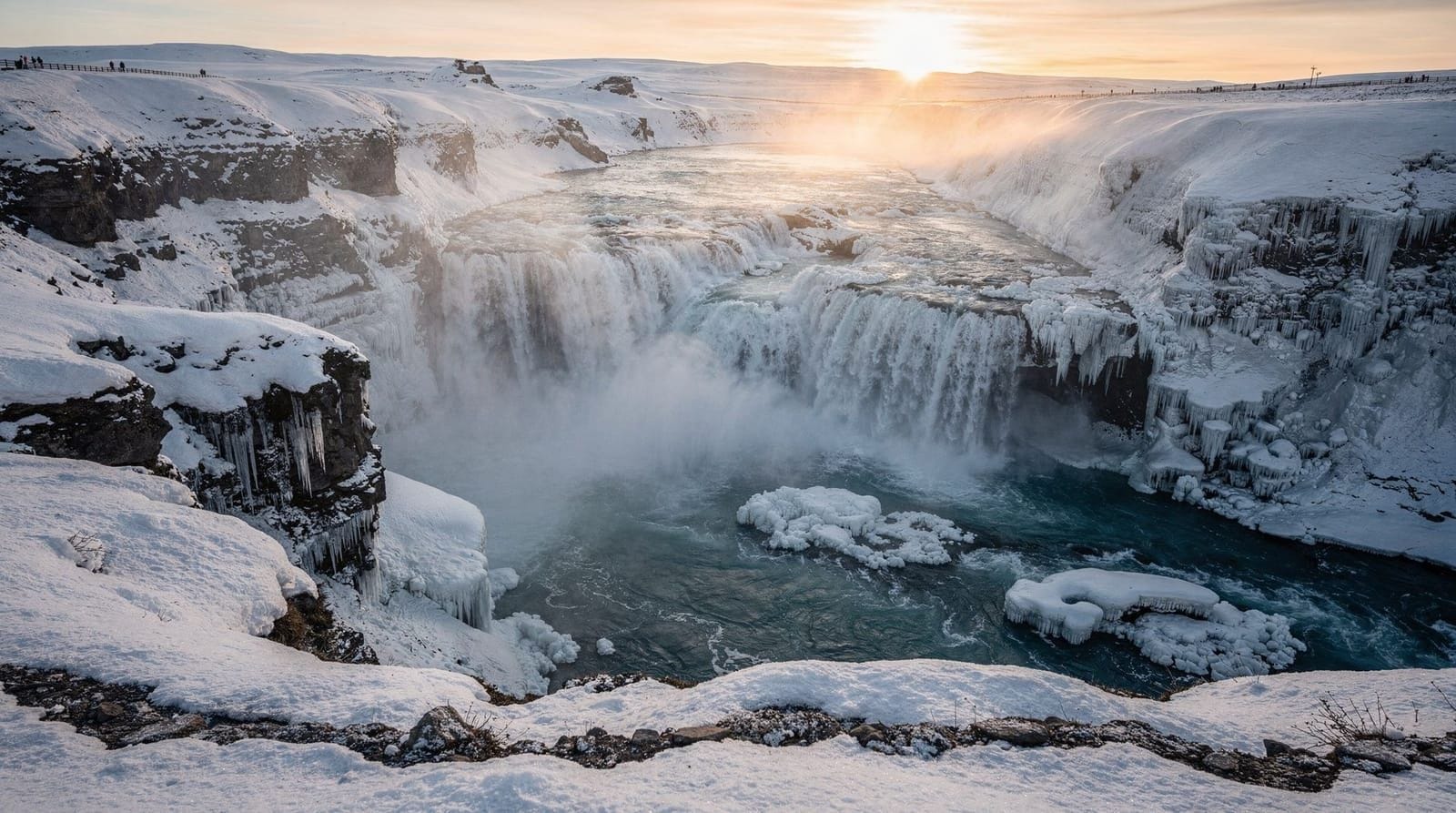
Gullfoss — “Golden Falls” in Icelandic — is the most visited waterfall in Iceland and one of the most photographed natural sites in northern Europe. The name comes not from the water itself but from the golden-yellow light that can illuminate the spray on sunny afternoons. What makes it genuinely impressive is not height (the two-step cascade drops 32 m total, which is modest by Icelandic standards) but raw volume and the optical trick of the river disappearing into a 70 m wide crevice.
This guide covers everything you need to make the most of a Gullfoss visit: the practical details, the viewpoints, the history, and honest advice about what the tourist brochures tend to skip.
| Where | Route 35, 125 km from Reykjavík |
| Cost | Free (parking 700 ISK) |
| Time needed | 45 min quick visit; 1.5 hrs for both viewpoints |
| Best time | Before 8am or after 5pm in summer |
| Getting there | Self-drive (paved) or Golden Circle tour |
What makes Gullfoss different from other Icelandic waterfalls
The Hvítá river drains parts of Langjökull glacier before carving through the Gullfoss canyon. Peak flow in summer can reach 140 m³/s; winter flow drops to around 80 m³/s. The two-step structure means water hits a wide ledge first, then changes direction by about 30 degrees before dropping again into the crevice — this right-angle turn creates a visual effect unlike any other waterfall in Iceland.
The water disappears into the Hvítárgjá gorge, which is actually about 70 m deep but appears from the upper viewpoint to swallow the river completely. The effect is disorienting in the best way. First-time visitors often assume they’re looking at a much larger falls than is actually there, because the gorge hides the scale.
The viewpoints explained
Upper viewpoint (Efri skoðunarstaður)
The easiest option — a flat, paved walkway from the car park to an elevated terrace overlooking both cascades. This is where all the wide-angle photographs come from. In high season (June–August), this platform has 200+ people at any given time between 10 am and 4 pm. Come early or late.
Lower viewpoint (Neðri skoðunarstaður)
A 400 m gravel trail descends from the upper viewpoint to a viewing platform roughly level with the upper cascade. From here you feel the spray directly — waterproof jacket is necessary in all conditions, waterproof trousers are advisable in strong wind. This trail closes in winter when ice makes it too dangerous (approximately November to April, but this varies each season — check the site on arrival).
The lower viewpoint is always significantly less crowded than the upper terrace, even in peak season. The walk takes about 10 minutes each way.
East rim path
A less-maintained path runs along the east rim of the canyon from the parking area, offering top-down views into the gorge and falls from a different angle. No barriers here — approach the edge carefully. Rare in travel guides, almost always uncrowded.
Practical information
Getting there by car: From Reykjavík, take Route 1 east toward Selfoss, then Route 35 north past Geysir. Gullfoss is at the end of Route 35, 125 km from the capital. Allow 1.5 hours without stops; with a Geysir stop you’re looking at 2–2.5 hours.
Parking: A large car park on the south side of the falls. Fee: 700 ISK (~€5) paid at an automated machine accepting card and ISK. Arrive before 8:30 am in summer to secure a space in the main lot; overflow parking exists 300 m down the road.
Facilities: A café (Gullfoss Café) operates year-round, with hot soup and sandwiches. Prices are standard Icelandic tourist level — soup runs around 2,200 ISK (~€15). There is a gift shop attached. Toilets are in the café building (free to use).
Admission: Free. Only parking is charged.
Time needed: 45 minutes for a quick upper viewpoint visit; 1.5 hours if you do both viewpoints and walk the canyon rim.
The Sigríður story
Gullfoss almost became a hydroelectric dam. In the early 20th century, a foreign investor acquired the rights to harness the falls for power. A local farmer’s daughter, Sigríður Tómasdóttir, reportedly threatened to throw herself into the falls and walked barefoot to Reykjavík repeatedly to protest the project. The project ultimately fell through for financial reasons, but Sigríður has been claimed as Iceland’s first environmental campaigner. A stone memorial to her stands near the upper viewpoint. The true history is more complicated — her father actually owned the falls — but the narrative has become part of Icelandic cultural memory.
Combining Gullfoss with the Golden Circle
The Golden Circle connects Þingvellir National Park, Geysir/Strokkur, and Gullfoss in a roughly 300 km loop from Reykjavík. The standard order is Þingvellir → Geysir → Gullfoss, though the reverse is equally viable and sometimes has better light for photography.
A full-day Golden Circle tour from Reykjavík covers all three sites with a local guide who can provide context that you won’t get from reading a sign. Tours typically allow 45–60 minutes at Gullfoss. Look for tours capped at 50 or fewer passengers if you want more breathing room at each stop.
If you’re self-driving, the loop takes a comfortable full day. Add Kerið crater to the return route — it’s only 6 km off Route 35 and takes 30 minutes. See our full Golden Circle self-drive guide for the complete route.
Small-group Golden Circle tours (typically 12–19 passengers) stop longer at each location and often include Kerið crater, which many large-bus tours skip. The per-person cost is higher but the experience is significantly better for photography and pacing.
Photography at Gullfoss
The best light at Gullfoss is in the late afternoon when the sun is at a low angle from the southwest — this is when the golden spray illumination that gives the falls their name actually occurs. In mid-June, this light continues until 10–11 pm.
Overcast days are actually excellent for waterfall photography — no harsh shadows, more even light, and the spray appears white rather than blown out. Iceland in June and July is frequently cloudy, which photographers should see as an advantage.
For compositions:
- Wide angle (16–24 mm equivalent): Upper viewpoint, include both cascades and the canyon
- Standard zoom (35–70 mm): Lower viewpoint, isolate the first cascade with mist in the foreground
- Telephoto (100+ mm): From the east rim, compress the canyon walls
Long exposures require a tripod and will be challenging near the lower viewpoint because of vibration from the falls. Use a remote shutter release. The long-exposure waterfall photography guide has specific settings for Icelandic conditions.
Winter visit
Gullfoss in winter can be extraordinary — partial freeze creates ice formations around the falls’ edges, and snow on the surrounding plains creates strong visual contrast. However:
- Lower viewpoint trail is closed or extremely dangerous from approximately November to April
- The east rim path is icy and requires crampons or Yaktrax
- Sunrise in December doesn’t happen until about 11:30 am; the light window is short but beautiful
- Car access remains reliable all winter because Route 35 is a major road and gets regular plowing; Gullfoss itself sits below snowline most years
For winter driving conditions, always check road.is before departing.
Nearby stops worth adding
- Geysir and Strokkur: 8 km south on Route 35, 10 minutes. Strokkur erupts every 5–10 minutes. Add 1 hour.
- Brúarfoss: 8 km south, then 3.5 km walk each way. Famous for electric-blue water. Almost entirely unknown to tour groups.
- Þingvellir National Park: 50 km southwest on Route 365, about 45 minutes. The continental rift and Icelandic parliament birthplace. Add 1.5–2 hours.
- Secret Lagoon at Flúðir: 40 km southwest, warm geothermal pool that costs a fraction of the Blue Lagoon. Excellent post-waterfall option.
Frequently asked questions about Gullfoss
Is Gullfoss worth visiting if I’ve already seen Niagara Falls?
Yes — they’re completely different experiences. Niagara is about volume and industrial scale. Gullfoss is about the canyon, the geology, and the absence of any development within sight. You’re standing in an essentially wild landscape with a thundering waterfall and no buildings visible from most viewpoints.
Can I walk behind Gullfoss like at Seljalandsfoss?
No. Gullfoss has no walk-behind path. The falls are recessed into a canyon, and the spray zone is too large and the cliffs too unstable for any approved path near the base.
Is the lower viewpoint trail wheelchair accessible?
No. It’s a gravel and packed-earth trail with uneven sections and a significant descent. The upper viewpoint terrace is paved and accessible from the car park via a flat path.
How early should I arrive in peak season?
By 8 am if you want the upper viewpoint terrace with fewer than 20–30 people in your frame. By 10 am it is already crowded. By noon the car park is typically full and visitors queue from the overflow area.
What should I wear to Gullfoss?
Waterproof outer layer is essential if you’re going to the lower viewpoint — the spray reaches 50+ metres in any wind conditions. For the upper viewpoint on a calm day, a fleece mid-layer and windproof jacket are usually adequate even in summer. Temperatures at Gullfoss average 8–12°C in July, 0 to -5°C in January.
Is Gullfoss open at night?
The site has no opening hours — it is an outdoor natural site accessible at all hours. In summer, the midnight sun means people visit at 1–2 am with perfectly good natural light. This is one of the best strategies for crowd-free photography.
Is there a less-photographed angle at Gullfoss?
Yes. The east rim path and the lower viewpoint both offer compositions that most visitors, who stop only at the upper terrace, never see — particularly the top-down gorge perspective from the east rim, which isn’t signposted.
Can I drive to Gullfoss in a regular car?
Yes, year-round. Route 35 is fully paved and maintained. A 2WD is fine in summer and most of autumn and winter. Only in heavy snowfall or black ice conditions would a 4WD provide meaningful advantage. See our driving in Iceland guide for conditions information.
How much does a Golden Circle day tour cost?
Prices in 2025–2026 range from approximately 10,000–18,000 ISK (€65–120) per adult for a standard bus tour, to 20,000–35,000 ISK (€130–230) for a small-group tour. Private full-day tours from Reykjavík run 50,000–90,000 ISK (€330–600) for the vehicle. Self-driving the Golden Circle in your own rental car costs only fuel — roughly 3,000–4,000 ISK (€20–27) for the round trip from Reykjavík.
Understanding the Hvítá river system
The Hvítá river is the largest in southwest Iceland by volume, draining the Langjökull glacier basin. At Gullfoss, it carries the combined meltwater of Iceland’s second-largest glacier into the canyon.
The river’s colour shifts seasonally. In spring (April–May), peak snowmelt gives a grey-white glacial colour with maximum turbidity. By mid-summer (July–August), the colour is lighter — a milky grey-green. In autumn and winter, lower melt volumes produce relatively clearer water with a slightly blue-green tint.
The Hvítárgjá canyon — the crevice into which Gullfoss falls — continues for approximately 2.5 km below the falls before widening. The canyon was not created by the current river but by earlier periods of more intense glacial flooding. The current river is maintaining a feature that was cut largely during catastrophic post-glacial floods.
Gullfoss in the context of Icelandic tourism
Gullfoss opened to organised tourism in the early 20th century and has been on every itinerary since. It was one of the first Icelandic natural sites to have a purpose-built infrastructure — the original guesthouse near the falls dates to the 1940s.
The site’s integration into the Golden Circle route means it never has an “off season” in terms of visitor pressure. Even in January, organised coach tours run daily from Reykjavík. The winter version of Gullfoss — with snow-covered plains, partial ice on the canyon walls, and dramatically low winter light — is genuinely different from the summer experience and not inferior to it.
The café at Gullfoss (Gullfoss Café, operated by the site management) is one of the more commercially transparent in Iceland. The gift shop has standard Icelandic tourist items. The restaurant offers a view of the falls from inside on cold days. It is not a trap; it is simply a café that could be better with the right ownership.
Other things to do near Gullfoss
Hvítárvatn lake: 20 km north on the rough highland road F35 (4WD only), Hvítárvatn is the glacial lake fed by Langjökull glacier. The glacier face is visible at the far end of the lake. This is the water source for the entire Hvítá river system including Gullfoss. Access July–September only.
Haukadalsvegur heritage route: The Route 35 corridor from Selfoss to Gullfoss passes several farms of historical significance, including Friðheimar tomato farm (a greenhouse operation that produces year-round tomatoes and a popular restaurant). Friðheimar is approximately 15 km from Geysir and is on most Golden Circle tour agendas.
Kerid crater lake: 8 km southeast of Selfoss, a volcanic crater containing a vivid turquoise lake. Small entrance fee (~700 ISK). Add 30 minutes to the Golden Circle return route. See the Kerið crater destination page for full details.
Ring Road to east: Route 1 east of Selfoss heads toward the south coast and eventually Jökulsárlón. If you’re extending beyond the Golden Circle, the south coast is the obvious direction. See the south coast day trip guide and the Ring Road complete guide.
Gullfoss for photographers: the complete guide
Gullfoss is technically demanding for photography because of the spray, the high-contrast lighting conditions, and the crowds. Advice by situation:
Overcast day photography: This is actually the best condition. Soft diffuse light allows you to expose for the water without blown highlights or deep shadows in the canyon. Upper and lower viewpoints both work. Bring a UV filter to wipe spray off the lens.
Clear day, morning (before 9 am): The east-facing canyon walls are in shadow early, creating cool-toned images. The water appears whiter against the shadow. Move to the lower viewpoint for the best conditions.
Clear day, late afternoon (after 5 pm): The western sun begins illuminating the spray from the side. This is when the “golden falls” light effect is most likely — the spray and mist turn golden-amber in the late afternoon sun. This is the best time for the distinctive light effect the name implies.
Long exposure technique at Gullfoss: Set up on the lower viewpoint platform. The surface is solid stone and relatively stable for a tripod. Use ISO 100, aperture f/8 to f/11, and exposure times from 0.5 to 4 seconds depending on the look you want. Wipe the front lens element between shots — spray accumulates every 10–20 seconds. A remote shutter release and a lens cloth within arm’s reach are the key accessories.
Avoiding the crowd in compositions: The upper terrace will always have people in it between 9 am and 5 pm in peak season. The east rim path (north of the main terrace, less used) gives a different angle that shows the canyon without the terrace in frame. In low winter light or during shoulder season, the terrace itself clears regularly enough to shoot clean.
The Golden Circle by car vs bus vs small group
Self-drive: Maximum flexibility, no schedule pressure. The Golden Circle works perfectly as a self-drive — all three sites are on the same paved road (Route 35/365), parking is straightforward, and you can adjust your time at each site. Cost: fuel + parking (approximately 3,000–5,000 ISK / €20–33 total). Recommended.
Bus tour (large format, 30–50 people): Most affordable (approximately 10,000–14,000 ISK / €65–93 per person). Strict schedule — typically 45 minutes at Gullfoss. Operates well for those who don’t want to navigate independently.
Small-group tour (max 12–19 people): Higher cost (15,000–22,000 ISK / €100–145 per person) but more time at each stop, better guide-to-passenger ratio, and often includes Kerið crater or Friðheimar that larger tours skip. Worth the premium if you’re interested in geological and cultural context.
See the self-drive vs guided tour guide for an honest comparison of both approaches in Iceland generally.
Gullfoss in different seasons, side by side
Spring (April–May): Peak snowmelt from Langjökull pushes flow toward its annual maximum. The falls are at their most powerful but the lower viewpoint trail can be muddy or still partially closed depending on the season’s timing. Fewer crowds than summer.
Summer (June–August): Reliable access to both viewpoints, the longest daylight window (allowing very early or very late visits to dodge crowds), and the highest visitor numbers of the year. The “golden falls” late-afternoon light effect is most visible in this season’s long evenings.
Autumn (September–October): Flow begins dropping from summer levels, crowds thin out noticeably after early September, and the surrounding plains take on autumn colour. The lower viewpoint trail typically remains open into October, weather permitting.
Winter (November–March): Flow drops to its annual low (~80 m³/s), partial ice formations appear at the canyon edges, and the lower viewpoint trail closes for safety. The upper terrace remains accessible and arguably provides the most dramatically different seasonal experience of the four — snow-covered plains against dark basalt and roaring, semi-frozen water.
Gullfoss for visitors with limited mobility
The upper viewpoint terrace is paved and flat from the car park, making it genuinely accessible for wheelchairs and pushchairs — one of the more accommodating major waterfall viewpoints in Iceland. The lower viewpoint, by contrast, is a gravel and packed-earth trail with a real descent and is not wheelchair accessible.
For visitors who can only manage the upper terrace, the view still captures both cascades and the full canyon perspective — the lower viewpoint adds proximity and spray but isn’t essential to appreciating the falls. The café, toilets, and gift shop are all step-free from the accessible car park, and accessible parking spaces are marked close to the terrace entrance.
Compared to other Golden Circle stops, Gullfoss’s upper viewpoint is the most consistently accessible of the three main sites, alongside the flat gorge path at Þingvellir. Geysir’s boardwalk circuit is similarly flat and accessible, meaning a mobility-limited visitor can complete a satisfying version of the full Golden Circle without needing the more demanding sections of any of the three sites.
A short history of Gullfoss photography
Gullfoss has been photographed since the earliest days of Icelandic tourism in the late 19th and early 20th centuries, and it remains one of the most reproduced Icelandic images internationally — postcards, calendars, and stock photography libraries are saturated with near-identical upper-viewpoint shots. This ubiquity is worth knowing before you visit: the “obvious” composition has been made many thousands of times before you arrive.
The lower viewpoint and the east rim path (both covered above) offer genuinely less-photographed angles. If your goal is a distinctive image rather than a well-executed version of the standard shot, these two positions are where the more interesting compositions tend to come from — particularly the east rim’s top-down perspective into the gorge, which most visitors never discover because it isn’t signposted.
Top experiences
Bookable activities with verified prices and instant confirmation on GetYourGuide.
Top experiences
Best-rated activities across GetYourGuide and Viator.

Ice Cave by Katla Volcano Super Jeep Tour from Vik
- Viator

Puffin and Volcano Tour with Ebbi
- Viator

Dynjandi Waterfall & Farm Visit Tour from Isafjordur Port
- Viator

3,5-Hour Sightseeing Tour To Dynjandi Waterfall
- Viator

Volcano ATV Tour
- Viator

Lake Myvatn Day Tour and Godafoss Waterfall for Cruise Ships from Akureyri Port
- Viator