Geysir and Strokkur guide — Iceland's famous hot spring area
Reykjavik: Golden Circle Gullfoss Geysir Thingvellir full day
How often does Strokkur erupt at Geysir?
Strokkur erupts every 5–10 minutes, reaching 15–40 m depending on conditions. The original Geysir geyser is dormant — it erupts only occasionally after earthquakes. Visiting takes 30–45 minutes for most people; the whole hot spring area has several smaller features worth exploring.
The Haukadalur geothermal field is the most visited natural attraction in Iceland after the Blue Lagoon and the Golden Circle of which it forms a part. At its centre: two geysers, Geysir and Strokkur, which between them gave the English language the word “geyser” and still demonstrate why. Strokkur erupts reliably every 5–10 minutes; the larger Geysir has been largely dormant for decades but erupted massively and regularly enough in the 18th and 19th centuries to establish the vocabulary.
This guide covers exactly what you’ll see, how long to spend, what the crowds are like, and what people usually miss.
| Where | Haukadalur valley, Route 35, 115 km from Reykjavík |
| Cost | Free (parking free too) |
| Time needed | 30 min minimum, 60–75 min for the full circuit |
| Best time | Before 9am or after 6pm to avoid coach groups |
| Getting there | Self-drive (paved road) or Golden Circle tour |
Geysir vs Strokkur — the two geysers explained
Geysir (also spelled Geyser) is the patriarch — the original from which all others are named. At its peak activity, it erupted every 30 minutes to a height of 80 m. Geysir hasn’t erupted reliably since the 1916 earthquake-induced period. Minor eruptions occurred in 2000 after a 6.5 magnitude earthquake, and periodically since, but it is fundamentally dormant. You’ll see a large hot spring pool but no eruption.
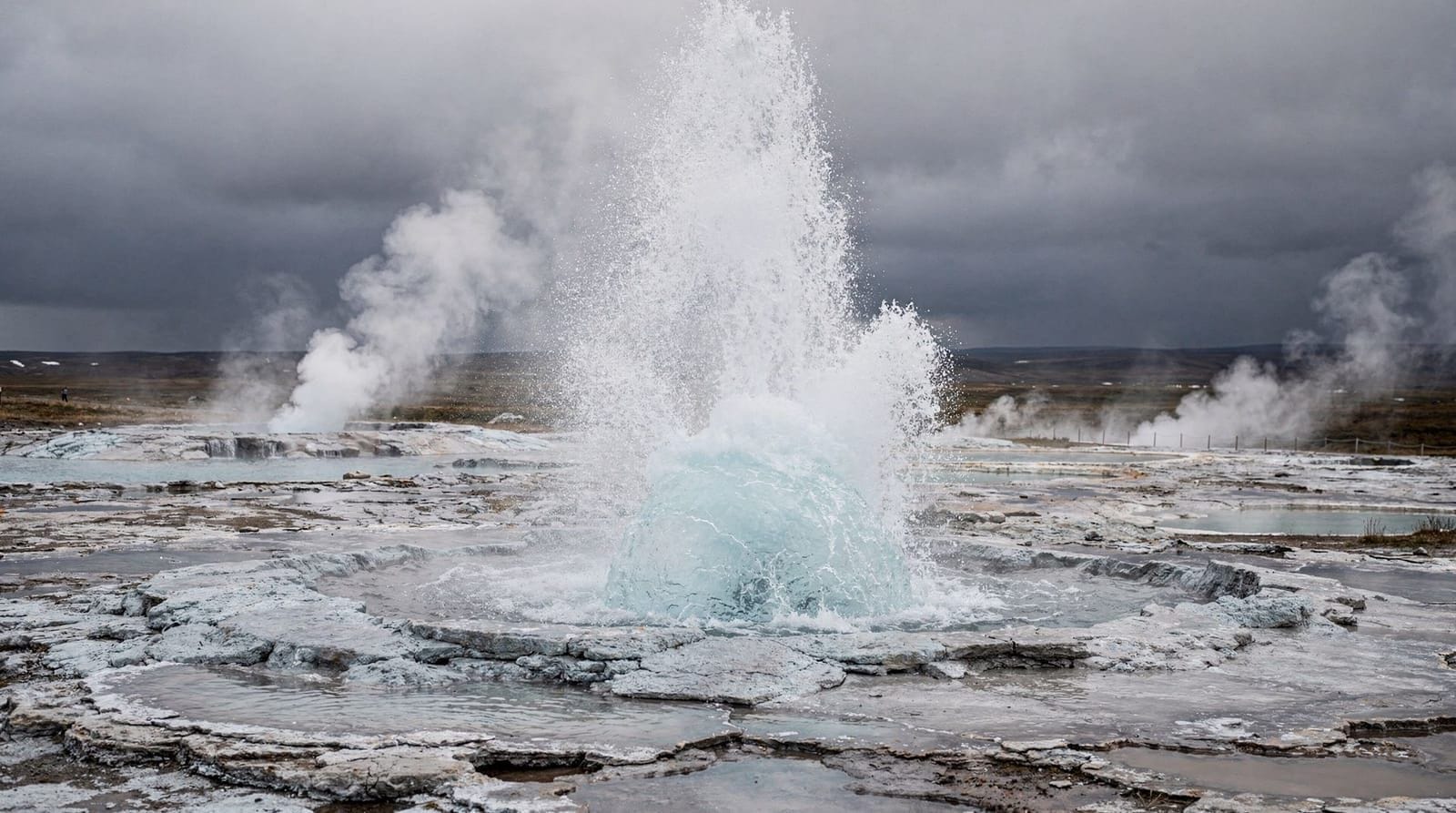
Strokkur (“butter churn”) is 50 m southeast of Geysir and is the active star of the show. It erupts every 5–10 minutes to heights of 15–40 m, depending on geothermal pressure at that moment. The eruption sequence is visible — the water surface domes up, turns blue-green, then shoots. You learn to recognise the dome and brace with your camera.
Both sit in the Geysir/Haukadalur destination area.
The eruption sequence — photographing Strokkur
This is the main photography challenge at Haukadalur. The eruption cycle is predictable in frequency but not in exact timing within any given minute. Photographing the full eruption requires:
- Pre-dome: Water surface rises slightly, takes on a blue-green colour. This is your 3-second warning.
- Dome: A clear water bubble (1–2 m tall) forms before the eruption proper. This is the most distinctive and least-photographed phase.
- Column: Water shoots up 15–40 m. Peak height for 0.5–1 second.
- Collapse: Water falls back, steam billows.
At the peak height, the eruption lasts about half a second. Burst-mode photography (continuous shooting at 5–10 fps) gives the best chance of catching the column at maximum height. With a telephoto lens, pre-focus on the vent, set to continuous AF or manual focus on a fixed point, and shoot bursts when you see the dome beginning.
The wind direction matters significantly — steam from the eruption shifts toward downwind visitors. Circle the area to find the upwind position before committing to a spot.
What else is in the Haukadalur area
The boardwalk circuit around the hot spring area covers approximately 600 m and passes:
- Blesi: Two pools connected underground — one cloudy, one clear blue. Side by side, the visual contrast is striking.
- Litli Geysir: A small active geyser that erupts irregularly, sometimes to 2–3 m. Often erupting when most visitors are crowded around Strokkur.
- Konungshver: A large, deep blue hot spring pool that steams continuously but doesn’t erupt.
- Multiple small fumaroles (steam vents) and coloured mineral deposits (the oranges and yellows are iron compounds; the greys are silica).
Most visitors spend their entire time waiting for Strokkur and miss all of this. Doing the full boardwalk circuit takes about 25 additional minutes and is significantly more interesting than standing in one spot.
Practical information
Location: Haukadalur valley, on Route 35, 115 km northeast of Reykjavík, 10 km northwest of Gullfoss. The junction off Route 1 at Selfoss leads north to Route 35.
Parking: Free, large car park adjacent to the visitor centre.
Admission: The outdoor geothermal area is free. The visitor centre (Geysir Centre) has shops and restaurants.
Facilities: The Geysir Hotel complex includes a restaurant and café. The hotel café serves a bowl of lamb soup for approximately 2,200 ISK (~€15). The gift shop is extensive and overpriced, as expected.
Time needed: 30 minutes to see Strokkur erupt a couple of times and briefly walk the circuit. 60–75 minutes if you do the full boardwalk and explore the upper hillside.
Crowds and timing
Haukadalur receives between 1.5 and 2 million visitors per year. It is crowded. Between 10 am and 4 pm on any day in June–August, there will be several hundred people around Strokkur at any given moment.
The reliable mitigation strategy: arrive before 9 am or after 6 pm. Strokkur erupts identically at 7 am as it does at noon — the experience differs only in the number of people around you.
A Golden Circle guided tour covers Þingvellir, Geysir/Strokkur, and Gullfoss with a local guide who provides geological and cultural context. The guide can also position you for the best Strokkur photography angles and help you find the less-visited features of the geothermal field.
The Golden Circle context
Haukadalur/Geysir is the middle stop of the Golden Circle day trip, between Þingvellir National Park and Gullfoss. The three stops represent three of Iceland’s four main geological spectacles (the fourth being volcanoes). Þingvellir shows the continental rift and tectonic plate boundary; Geysir demonstrates geothermal energy at surface level; Gullfoss shows glacial meltwater in its most dramatic form.
Small-group Golden Circle tours typically allow 45–60 minutes at the Geysir area, which is enough time to see multiple Strokkur eruptions and walk the main circuit. The smaller format means you’re not jostling with 40 others for the front position around the geyser.
Self-driving the Golden Circle: see the complete Golden Circle self-drive guide for route details, timing, and add-on options including the Secret Lagoon at Flúðir and Kerið crater.
The word “geyser”
A genuine linguistic footnote: the English word “geyser” (and its cognates in dozens of other languages) derives directly from this place. “Geysir” comes from Old Norse “geysa,” meaning to gush or rage. The term was applied to hot spring phenomena globally after European naturalists described Haukadalur in the late 17th century. The first scientific description in English appeared in 1814.
The naming creates a slightly circular situation where visitors come to see “the geyser” — the original one, the one that defined the word — and find it dormant, surrounded by English-speaking tourists learning that “geyser” comes from here.
Frequently asked questions about Geysir and Strokkur
Is it safe to stand near Strokkur?
The boardwalk and the marked standing areas are safe. Visitors are warned not to walk into the spring pools themselves — the water temperature near the vent exceeds 100°C and the surrounding ground can be unstable (thin crust over hot mud). Stick to the boardwalk and the open standing areas around the main geyser zone. Children should be supervised closely.
Can you predict exactly when Strokkur will erupt?
Not to the minute, but you can expect an eruption within 5–10 minutes at any given moment. The average interval is around 7 minutes. In practice, if you wait 8–10 minutes without an eruption, one is imminent. Watch the water surface for the doming effect as the precursor.
Does Geysir ever erupt anymore?
Occasionally. The 2000 earthquake triggered a period of activity. Since then, minor eruptions have been reported a few times per decade, usually after seismic events. You should assume you won’t see it erupt on your visit.
How does Haukadalur compare to Yellowstone’s geysers?
Old Faithful (Yellowstone) erupts to similar heights (20–55 m) but on a longer interval (90 minutes average). Strokkur erupts much more frequently. Yellowstone’s geyser basin is much larger with more active features overall, but Haukadalur’s Strokkur offers a more reliably dramatic experience per unit of time spent watching.
What temperature is the geyser water?
The water erupting from Strokkur is approximately 100°C (boiling point) at the vent. The steam post-eruption is slightly cooler. The standing pools in the area range from 50–90°C. None are safe to touch.
Is the Geysir area worth it in winter?
Yes. In winter, the steam from the geothermal field is much more dramatic against cold air — the entire field appears to be smoking. Fewer visitors. Strokkur erupts identically year-round. The access road is maintained and a 2WD is fine in normal winter conditions.
Which side of Strokkur has the best view?
The east and north sides of the marked viewing area are usually less crowded than the south side, where most visitors arriving from the car park naturally cluster. Circling the geyser before settling on a spot is worth the extra minute.
Is the upper hillside walk above Haukadalur worth the extra time?
Yes, if you have 15–20 minutes to spare. The short unpaved climb gives an overview of the whole geothermal basin that almost no coach-tour visitor sees, since it isn’t part of the standard 45-minute stop.
The geothermal science behind Strokkur
A geyser requires three things: a source of water, a heat source, and a specific plumbing system — an underground chamber with a constricted channel to the surface. Iceland’s geological setting provides all three abundantly.
Strokkur’s eruption cycle works as follows: groundwater percolates down to a heated aquifer. The water at depth superheats above boiling point but remains liquid under pressure. As the water column above the heated zone gradually heats from below, it reaches a point where the pressure from above can no longer contain the steam pressure from below. The entire column flashes to steam explosively. Water ejects from the vent, pressure releases, the system refills from the aquifer, and the cycle restarts in 5–10 minutes.
The specific “dome” visible just before each eruption is the water in the vent being pushed upward as steam pressure builds in the lower chamber — the column rises above the surrounding pool level, forming a clear bubble before the explosion.
The reason the original Geysir stopped erupting reliably is partly geological (the vent channel changed shape and no longer produces the right pressure dynamics) and partly human (Victorian tourists dumped soap into it to trigger eruptions on demand, which damaged the plumbing). This is a practice that was genuinely common in the 19th century.
The broader geothermal landscape of the Golden Circle
The Golden Circle covers three distinct geological phenomena: the continental rift at Þingvellir, the geothermal hot spring system at Haukadalur, and the glacial river at Gullfoss. Together they represent Iceland’s geology in concentrated form.
What makes Haukadalur specifically interesting is the juxtaposition — the hot springs are entirely natural, with no heating infrastructure. The underground temperature is purely from geothermal gradient. Meanwhile, most of Reykjavík’s heating (95% of the city’s homes) is geothermal district heating. Iceland is effectively using its geology as a free energy source on a national scale.
If the Geysir energy centre visitor exhibition is open during your visit, it covers this geothermal-to-infrastructure connection in accessible terms. The exhibition is inside the Geysir Hotel complex and is included with the hotel visit.
Self-drive vs guided tour for the Golden Circle
The Golden Circle is Iceland’s most self-drive-friendly major route. All three main sites are directly on Route 35 (a well-maintained paved road), there is ample parking, and the distance from Reykjavík is about 125–130 km each way.
Self-driving advantages: your own timing, ability to linger at sites that interest you more, add stops like Brúarfoss or Friðheimar farm without tour constraints.
Guided tour advantages: someone else drives, guide context (the geological and historical information at Haukadalur is substantial and not obvious from signs), can include Kerið crater and Secret Lagoon as standard add-ons.
For first-time visitors who are confident drivers in Iceland, self-driving is perfectly fine. For those who’d rather not navigate, a good small-group tour is the better experience. See the self-drive vs guided tour guide for a direct comparison.
Pricing context for the Golden Circle area
The Haukadalur area (Geysir) is one of the few major Icelandic attractions with no admission fee for the outdoor geothermal area. This is worth appreciating — most comparable natural attractions in other countries charge 15–25 EUR per adult.
Eating in the Geysir Hotel restaurant: approximately 2,500–4,000 ISK (~€17–27) for a main course. Comparable to Reykjavík restaurant pricing. The café menu (soup, sandwiches, cakes) runs 1,500–2,500 ISK.
Combined Golden Circle trip costs for self-driving: parking at Þingvellir (750 ISK), no charge at Haukadalur, parking at Gullfoss (700 ISK), fuel for the round trip from Reykjavík (approximately 3,500 ISK). Total non-accommodation cost for the day: under 6,000 ISK (~€40) per car, not per person.
After Haukadalur — what to do in the area
Friðheimar Tomato Farm: 15 km south on Route 35, an Icelandic greenhouse tomato operation with a restaurant serving tomato-based dishes and home-brewed tomato beer. Unusual, genuinely interesting, and the food is better than expected. Prices are mid-range. Booking recommended in summer.
Secret Lagoon (Gamla Laugin) at Flúðir: 35 km south of Geysir. A natural hot spring pool in a rural setting, operational since the 1890s. Entrance approximately 3,500 ISK (~€23). Much less infrastructure than the Blue Lagoon; you swim in a natural pool beside a small geyser that erupts periodically. See the Secret Lagoon guide.
Þingvellir National Park: 45 km west of Haukadalur on Route 365. The rift valley where the Eurasian and North American plates are separating at the surface. Also the site of Iceland’s original parliament (Alþingi, established 930 CE). See our Golden Circle day trip guide.
Geysir field etiquette and safety
The Haukadalur hot spring field is one of the easiest places in Iceland to cause accidental harm to yourself or others through inattention. Practical rules:
Near Strokkur vent: Stand at least 5 m from the vent. The eruption itself goes upward, but the steam and spray around the base catches visitors who are too close. The back-splash from a large eruption extends about 3 m in calm conditions.
Wind direction: Steam from post-eruption Strokkur drifts downwind. Read the wind direction and position yourself upwind. The steam is not dangerously hot at visitor distances but is unpleasant and soaks clothing.
Hot spring pools: Never approach the edge of any pool — the mineral-rich water is acidic and hot (50–100°C), and the edges are often encrusted with silica that can break. The brilliant blue colour of Geysir’s main pool is due to silica precipitation, not safe water.
Photography crowd management: Strokkur creates a pushing-forward dynamic as photographers try to get closer. Be aware of who is around you and resist the urge to edge forward — accidents at geysers are almost always caused by someone taking one step too many at the wrong moment.
The Haukadalur thermal field in winter
In winter, the thermal field becomes visually exceptional. Cold air temperatures mean the steam from all the hot springs rises high and dramatically visible. The fields look literally steaming, with dozens of individual steam columns rising simultaneously. The smell of sulfur is stronger in cold, still air.
Strokkur erupts identically in winter — the eruption goes just as high, though the steam persists longer in cold air. Winter photography of the eruption, with a snow-covered landscape and dramatic steam cloud, is noticeably more atmospheric than summer shots.
Visiting Haukadalur in December or January requires warm clothing — temperatures in the highland location are typically 5–10°C colder than Reykjavík. The parking area and main path are maintained, but the secondary paths may have ice. Winter sunrise (late, around 11:30 am) means you can arrive at a reasonable hour and still get early-morning quality low-angle light.
See the Iceland in winter guide for full seasonal planning context and the Iceland weather explained guide for what to expect in different months.
What most visitors get wrong at Geysir
The single most common mistake is treating Haukadalur as a two-minute photo stop rather than a small hiking area with more to see than Strokkur alone. Coach tours reinforce this — a 45-minute stop leaves barely enough time to watch two eruptions and buy a coffee, let alone walk the full circuit past Blesi, Litli Geysir, and Konungshver.
The second common mistake is standing in the same spot as everyone else. The crowd naturally clusters on the south side of Strokkur, directly opposite the main viewing rope, because it is the first position most people reach from the car park. Circling to the east or north side of the geyser (still within the marked safe area) gives a less obstructed view and, on most days, better light for photography since the sun tracks from the east through midday.
The third mistake is skipping the upper hillside path above the geothermal field. A short climb (10 minutes, unpaved) leads to a viewpoint overlooking the entire Haukadalur basin — steam vents, the two geysers, the Geysir Hotel complex, and the birch reforestation project on the slopes. Almost no coach-tour visitor makes this climb; independent visitors with the extra 15–20 minutes get a genuinely different perspective on the scale of the geothermal field.
Accessibility at Haukadalur
The main boardwalk circuit around Strokkur and Geysir is flat, hard-packed gravel and reasonably accessible for wheelchairs and pushchairs, with the standard viewing area for Strokkur reachable without steps from the main car park. The upper hillside path described above is not accessible — it is a natural dirt trail with a moderate incline.
The Geysir Hotel building, café, and gift shop have step-free entrances. Accessible toilets are available inside the visitor centre. For visitors planning a Golden Circle day with mobility considerations, Haukadalur is one of the easier stops on the route — more so than the lower viewpoint at Gullfoss, which involves a descent on gravel.
Combining Geysir with a longer south Iceland day
For visitors extending beyond the standard Golden Circle loop, Haukadalur sits conveniently between Reykjavík and the south coast. Route 35 continues south to Route 30, which connects to Route 1 near Hella — meaning a Geysir stop can be built into a day heading toward Seljalandsfoss and Skógafoss rather than only the standard Þingvellir–Geysir–Gullfoss loop.
This works best for travellers with 2+ days who want to avoid backtracking: visit Þingvellir and Geysir on the outbound leg, then continue south rather than returning directly to Reykjavík via Gullfoss, picking up Gullfoss on a separate day trip or skipping the strict Golden Circle order entirely. It adds route flexibility at the cost of doing the “circle” in a less conventional shape — a reasonable trade for travellers not fixated on ticking off the three sites in sequence.
Top experiences
Bookable activities with verified prices and instant confirmation on GetYourGuide.
Top experiences
Best-rated activities across GetYourGuide and Viator.

Ice Cave by Katla Volcano Super Jeep Tour from Vik
- Viator

Puffin and Volcano Tour with Ebbi
- Viator

Dynjandi Waterfall & Farm Visit Tour from Isafjordur Port
- Viator

3,5-Hour Sightseeing Tour To Dynjandi Waterfall
- Viator

Volcano ATV Tour
- Viator

Lake Myvatn Day Tour and Godafoss Waterfall for Cruise Ships from Akureyri Port
- Viator