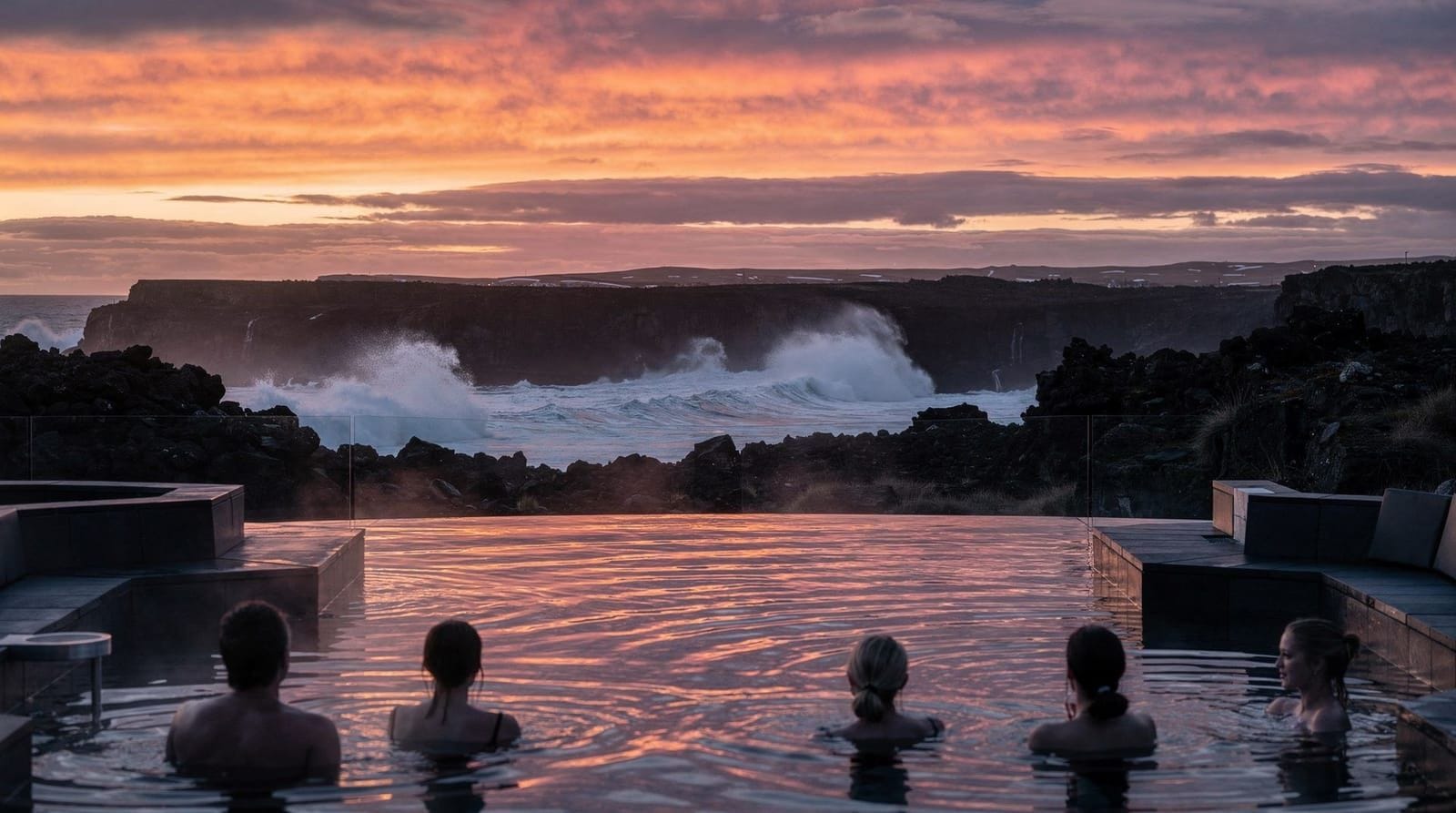
Secret Lagoon guide — Iceland's oldest natural pool in Flúðir
Reykjavik: Iceland Secret Lagoon admission ticket
What is the Secret Lagoon and how much does it cost?
The Secret Lagoon (Gamla Laugin) in Flúðir is Iceland's oldest natural pool, operating since 1891. Admission is ISK 3,500 (approximately EUR 24) for adults — about one-quarter the price of the Blue Lagoon. It has no frills: just hot geothermal water in a lava-surrounded outdoor pool with active hot springs bubbling alongside.
What is the Secret Lagoon?
The Secret Lagoon — known locally as Gamla Laugin (the Old Pool) — is a geothermally heated natural pool in the village of Flúðir in southern Iceland. It claims to be the oldest operating swimming pool in Iceland, first used in 1891 when Sigríður Sigurdardóttir, a local woman, organised community bathing here.
The pool fell out of use for decades and was rediscovered by tourists in the 2010s, when a local family restored the infrastructure and opened it commercially. “Secret” has been somewhat ironic for the past several years — it now appears on most Golden Circle itineraries and sees tens of thousands of visitors annually. But it remains genuinely different from the Blue Lagoon and Sky Lagoon in character: minimal infrastructure, no swim-up bar, no face mask stations, no resort pricing.
What you get is a large natural pool (about 30 metres long, 20 metres wide) held at 38–40°C by a geothermal spring that feeds it continuously. Around the pool, several smaller hot springs boil and bubble visibly — you can stand beside one and watch the water surge up from the earth. A geyser erupts on a small mound at the pool’s edge every few minutes. The surrounding landscape is green tundra scrub, with steam rising in all directions on cold days.
| Where | Flúðir, ~115 km southeast of Reykjavík |
| Cost | around ISK 3,500/adult, children under 14 free |
| Time needed | 1.5–2 hours including changing |
| Booking | Not required — walk-ins accepted |
| Best time | Early morning or after 17:00 to avoid tour groups |
Price and what is included
Admission is ISK 3,500 per adult (approximately EUR 24). Children under 14 are free. No timed entry is required — you turn up, pay, get changed, and get in.
The price includes use of changing rooms (basic but clean), a locker, a towel, and a wristband that opens the locker. There is no bar, no restaurant, no face mask. Bring your own if that matters to you. There is a small café-style kiosk that sells hot drinks and light snacks.
At roughly one-quarter the price of the Blue Lagoon base ticket, this is one of the best value thermal bathing experiences in Iceland.
Secret Lagoon admission ticket — Gamla Laugin, FlúðirLocation and getting there
Flúðir is in the Hvítá valley, about 115 km southeast of Reykjavík and 20 km south of the main Golden Circle route. It sits off Route 30, reached most naturally by turning south at Selfoss or at the Kerið crater junction during a Golden Circle loop.
By car: From Reykjavík, take Route 1 south to Selfoss, then Route 30 north toward Flúðir. Journey time is about 1 hour 20 minutes. Parking at the Secret Lagoon is free. The building is clearly signed from the village.
On a guided tour: Many Golden Circle day tours include a Secret Lagoon stop as an optional add-on. These tours pick up from Reykjavík hotels, which makes the logistics simple if you do not have a rental car.
By public transport: Not practical. Flúðir has no regular bus service from Reykjavík. A rental car or tour is required.
Golden Circle and Secret Lagoon full-day tour from ReykjavíkCombining with the Golden Circle
The Secret Lagoon sits naturally at the end of a southbound Golden Circle loop. A typical routing:
- Reykjavík south to Þingvellir via Route 36.
- East to Geysir via Route 365.
- North to Gullfoss via Route 35.
- Southeast to Flúðir via Route 35/30.
- Return to Reykjavík via Route 30/1 through Selfoss.
This adds about 40 km and 40 minutes to the classic Golden Circle route. Budget an extra 90 minutes at the Secret Lagoon itself, including changing.
The Kerið crater and the Friðheimar tomato farm are other common add-ons on this route — both are close to the Selfoss–Flúðir road.
The atmosphere compared to Blue Lagoon and Sky Lagoon
The Secret Lagoon is intentionally minimal. There is no music, no Instagram backdrop, no silica mud mask station. The changing rooms are functional but modest. The pool itself has a rough lava bottom in places, and the temperature varies between sections.
This is entirely the point. The Secret Lagoon feels like what it is: a genuine old community pool in a small Icelandic village, with geothermal water that happens to be about the same temperature as the Blue Lagoon but costs a quarter of the price.
For some visitors this is exactly the right experience. For others — particularly those who want a polished spa environment — the Blue Lagoon or Sky Lagoon may be a better fit.
One concrete difference: the surrounding active hot springs. At the Secret Lagoon, you can watch small geysers erupt, step between different temperature zones, and observe the raw geothermal energy up close without barriers. This is educationally interesting and something neither the Blue Lagoon nor Sky Lagoon offers in the same way.
When to visit and crowd levels
The Secret Lagoon attracts fewer visitors than the Blue Lagoon but has no capacity cap. In July and August, expect 50–100 people sharing the pool at peak midday hours. Early morning (before 10:00) and late afternoon (after 17:00) are noticeably quieter.
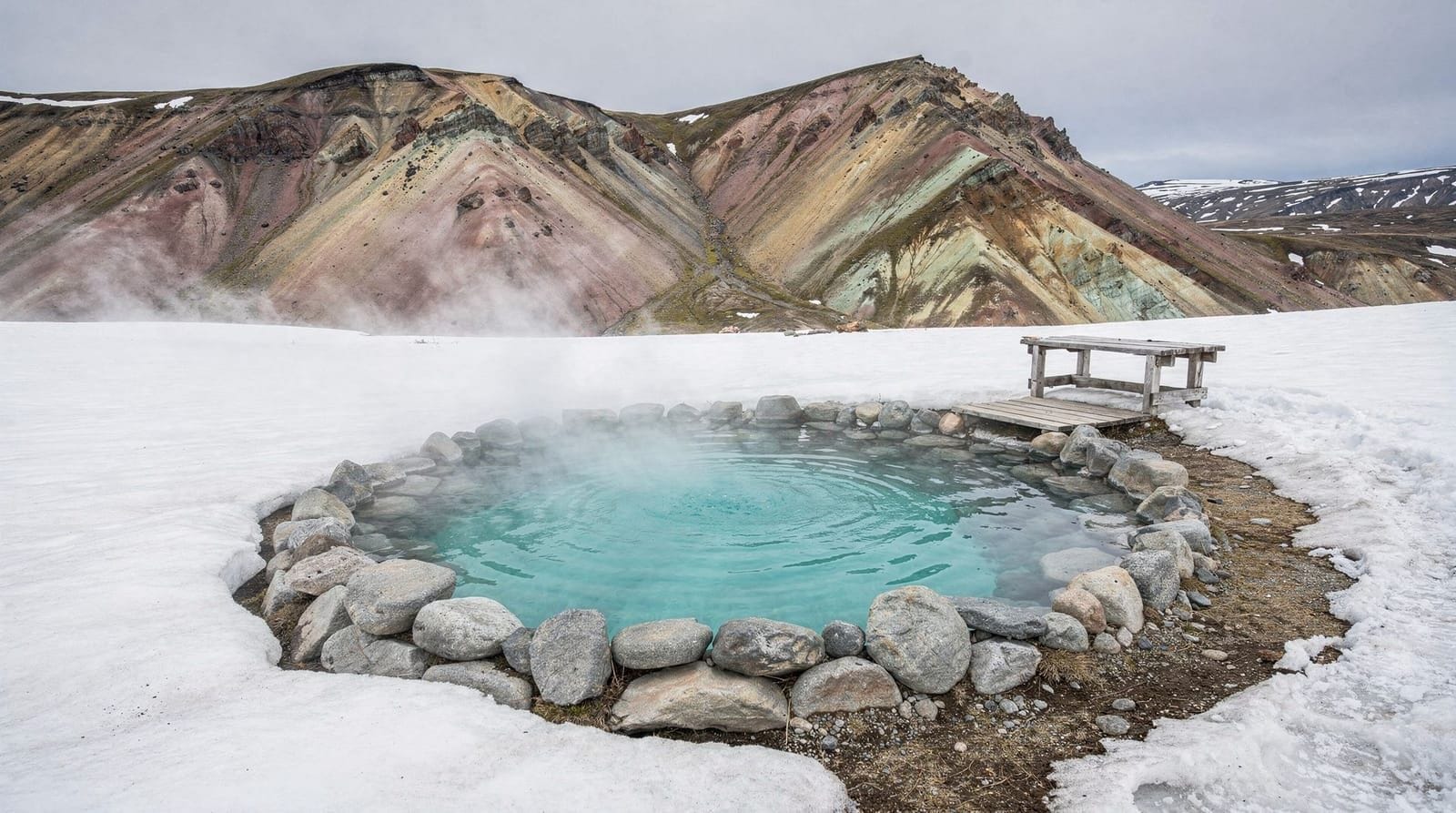
In winter — November through March — visitor numbers drop significantly. The experience of soaking in hot water while surrounded by snow and steam is one of Iceland’s genuine highlights. Bring a waterproof bag for your phone.
The pool does not close for winter. It operates year-round, except on public holidays and for occasional maintenance. Opening hours vary by season: roughly 10:00–22:00 in summer, with shorter hours in winter. Check the website before making a special trip.
What to bring
The Secret Lagoon provides towels and lockers. Bring your own swimsuit and flip-flops. Shampoo and shower gel are available in the changing rooms.
If you have dry or sensitive skin, the natural mineral water is gentler than the Blue Lagoon’s silica-rich water. No specific preparation is needed. The pool temperature is consistent and comfortable.
For winter visits, bring a dry bag for your phone. The walk from the changing rooms to the pool crosses open ground and can be cold in wind. Moving quickly in slippers works.
Honest assessment of the “Secret” claim
The Secret Lagoon is no longer secret. It appears in mainstream guidebooks, on most Golden Circle tour packages, and in the GYG catalogue as a standard activity. However, it has not tried to become something it is not. The pricing is honest, the experience is genuine, and the crowds — while real — are manageable compared to the Blue Lagoon.
If you are looking for actual wild and undeveloped natural pools, read the wild hot springs in Iceland guide, which covers remote bathing spots that require hiking to reach and see far fewer visitors.
Frequently asked questions about the Secret Lagoon
How long should I spend at the Secret Lagoon?
Allow 1.5–2 hours: 20 minutes for changing and orientation, 60–90 minutes in the water, and time to watch the small geysers and hot springs around the pool. There is no need to rush, and there is no time-limited entry.
Is the Secret Lagoon suitable for children?
Yes. Children under 14 are free, and the pool is family-friendly. The water temperature (38–40°C) is comfortable for children. Note that the bottom is not entirely smooth in all sections — younger children who cannot stand confidently may need supervision.
Does the Secret Lagoon require advance booking?
No advance booking is required. Walk-ins are accepted during opening hours. This is a significant practical advantage over the Blue Lagoon, which requires pre-booked timed slots.
What is the water temperature at the Secret Lagoon?
The main pool sits at 38–40°C throughout. Some areas are cooler near where cold stream water enters the geothermal flow. The small surrounding hot springs and geyser area are much hotter — do not enter these.
Can I visit the Secret Lagoon in winter?
Yes, and many visitors prefer it in winter. Snow on the surrounding ground, steam rising from the water, and low visitor numbers make it a genuinely atmospheric experience. Opening hours are shorter in winter — check ahead.
Is the Secret Lagoon accessible by public transport?
No practical public transport option exists. A rental car or a guided Golden Circle tour that includes the Secret Lagoon stop is necessary.
How does the Secret Lagoon compare to Mývatn Nature Baths?
Both are natural geothermal pools without resort-scale infrastructure. The Secret Lagoon is on the Golden Circle route (near Reykjavík), costs less (ISK 3,500 vs ISK 6,900), and is smaller and more crowded relative to its capacity. Mývatn Nature Baths are in northern Iceland, in a far more remote volcanic landscape, and are worth the journey if you are doing the Diamond Circle or Ring Road north.
Is the Secret Lagoon worth it compared to skipping thermal bathing altogether on a short trip?
Yes, if a lagoon visit is on your list at all. At around a quarter of the Blue Lagoon’s price and with no advance booking required, the Secret Lagoon is the lowest-friction way to fit geothermal bathing into an already-packed Golden Circle day without derailing the schedule. If your day is genuinely too tight for even 90 extra minutes, skip it rather than rush — the pool rewards an unhurried visit.
Does the Secret Lagoon get overcrowded like the Blue Lagoon?
Less so, but it does get busy. Because there’s no timed-entry cap, midday in July–August can mean 50–100 people sharing the pool — noticeably more relaxed than the Blue Lagoon’s peak crowds, but not empty. Early morning or after 17:00 remain the reliable ways to get a quieter visit.
The Secret Lagoon’s history in context
The story of the Secret Lagoon begins with a woman named Sigríður Sigurdardóttir, who organised regular bathing at the spring from 1891. The pool was formalised as a community bathing facility shortly afterward, and a small infrastructure of wooden changing rooms and steps was constructed. This makes it functionally the oldest operating pool in Iceland, predating the establishment of Reykjavík’s municipal pool system.
The pool fell out of regular use as Flúðir’s population shifted and more convenient facilities were built. For decades it sat partially maintained by locals, used occasionally by farmers and residents. Its rediscovery in the context of Iceland’s tourism boom happened around 2012–2014, when the area was promoted as part of the extended Golden Circle itinerary.
The family that currently operates the facility invested in restoring the changing rooms, adding a basic kiosk, and installing the wristband-lock system. The philosophy was to modernise the minimum necessary while preserving the character of a genuine old community pool — not to build a resort.
Flúðir village and the surrounding area
Flúðir (population around 550) is a small agricultural town in the Hvítá river valley. It is not a significant tourist destination in its own right, but the surrounding area has a few points of interest worth noting if you are spending time here.
Friðheimar tomato farm: Located about 15 km north of Flúðir on Route 35, this family farm grows tomatoes in geothermal greenhouses and operates a well-regarded lunch restaurant serving an all-tomato menu. Reservation required; lunch typically costs ISK 4,500–6,500. It is one of the more distinctive food experiences on the Golden Circle route — geothermally grown produce eaten in an active greenhouse.
Þjórsárdalur valley: The Þjórsá river valley to the south contains Stöng, a Viking-age farmstead excavated in the 1930s that was buried by the 1104 eruption of Hekla. The replica at Þjóðveldisbær (about 40 km south) gives a good sense of 10th-century Icelandic farm construction. Worth combining if you have an afternoon and are interested in Icelandic history.
Kerið crater: About 30 km north of Flúðir on Route 35, Kerið is a striking volcanic crater with bright green water at its base. Entry costs ISK 700. Worth 30 minutes on the Golden Circle loop.
Planning a full Golden Circle day including the Secret Lagoon
A practical full-day circuit from Reykjavík including the Secret Lagoon:
07:30: Depart Reykjavík via Route 1 to Route 36. 09:00–10:30: Þingvellir National Park — continental rift, history, Öxará river walk. 11:30–12:30: Geysir and Strokkur — geyser eruptions every 5–10 minutes. 13:00–14:00: Gullfoss waterfall. 14:30–16:30: Secret Lagoon in Flúðir — allow 2 hours including the drive from Gullfoss (45 minutes) and 90 minutes bathing. 17:30: Return to Reykjavík via Route 30/1 through Selfoss. Arrive approximately 18:30.
This adds 90 minutes to a standard Golden Circle day but produces one of the more satisfying full-day itineraries from Reykjavík. Total driving: approximately 270 km.
Alternative: add Kerið crater between Geysir and the Secret Lagoon for a longer loop that includes four distinct sights.
The geothermal setting — what you actually see
A few things you will observe at the Secret Lagoon that are worth understanding:
The main pool’s edge geology: The pool is contained by rough basalt at its edges. The geothermal spring enters from one end and there is a slight current toward the outlet at the other. You can feel the current difference between the warmer spring-entry area and the cooler outlet end.
The small geysers and hot springs: Around the pool perimeter, several small springs bubble at the surface and one small geyser mound erupts every few minutes, sending a column of water 50 cm to 1 metre into the air. The temperature at these features is significantly higher than the pool — do not approach them closely. Viewing from the poolside path is safe.
Steam vents: On cold days, steam rises from several points in the surrounding grass, marking geothermal activity just below the surface. This is the same volcanic heat that warms the pool.
The water colour: The pool water is generally clear to slightly grey-green. It lacks the milky-blue appearance of the Blue Lagoon because the silica content is different. After heavy rainfall, the pool may temporarily appear murkier as surface water mixes in.
What visitors commonly get wrong
Assuming it is truly hidden: The “Secret” is marketing vocabulary from the 2010s tourism boom. The pool is signed, appears on Google Maps, and features on most Golden Circle tour itineraries. In peak summer it holds 50–100 people simultaneously.
Arriving without a swimsuit: A few visitors each week apparently believe the “natural pool” designation means clothing-optional. It does not. Swimsuits are required, as at any Icelandic public pool.
Ignoring the surrounding hot springs: The geyser and hot spring features around the pool are part of the attraction. Walking the path around the pool edge before entering is worthwhile.
Underestimating the drive from Geysir: Flúðir is 45 minutes from Geysir, not 15 minutes as some online guides claim. The route goes south via Route 35 to the Flúðir junction then west on Route 30 — pleasant agricultural landscape but the distance is real.
Natural geothermal processes visible at the pool
The Secret Lagoon offers something that commercial spas like the Blue Lagoon and Sky Lagoon deliberately minimise: visible geological activity at close range. The small geyser mound at the pool’s edge erupts regularly — not on a precise timer like Strokkur at Geysir, but every 5–10 minutes on average. The eruption sends a column of water and steam 50 cm to 1 metre into the air.
Around the pool’s perimeter, several springs bubble at the surface. The temperature at these features is significantly higher than the pool — in the 60–90°C range — and approaching them too closely is not safe. The operational layout of the Secret Lagoon keeps visitors at a safe distance through the pool’s edge positioning, but curiosity sometimes draws people too close to the bubbling areas. Follow the path markers.
The most visually striking moment at the Secret Lagoon often happens when temperature inversions create dense steam on cold mornings. The steam sits at pool surface level and dissipates slowly as the air warms. Arriving at 10:00 on a cold October morning produces conditions that are substantially more atmospheric than the August midday rush.
What the experience is like at different times of day
Morning (10:00–12:00): The quietest daytime period. Tour groups typically arrive late morning, so arriving right at opening (the exact opening time varies by season) gives 60–90 minutes of relative solitude. Cold mornings produce the best steam effects.
Midday (12:00–15:00): Peak crowd period in summer. Tour group buses arrive and depart, cycling through the facility. The pool is navigable but busy. The geyser area becomes congested with photography.
Afternoon (15:00–18:00): Tour groups thin out; independent visitors and late-day travellers remain. A reasonable time to visit in summer if morning is not possible.
Evening: The Secret Lagoon is open until 20:00–22:00 in summer (hours vary). An evening visit after a day on the Golden Circle, while driving back toward Reykjavík, is a natural closing element to a long day.
For the Golden Circle one-day itinerary, including the Secret Lagoon as the final activity before the 90-minute drive back to Reykjavík is the standard approach.
Who the Secret Lagoon suits — and who it doesn’t
The Secret Lagoon suits travellers who want genuine geothermal bathing without the production values, the pricing, or the advance-booking pressure of the Blue Lagoon or Sky Lagoon. It particularly rewards visitors who are curious about the raw geology — the surrounding hot springs and small geyser are a rare chance to watch active geothermal features at close range without a barrier.
It suits less well: visitors specifically wanting a polished spa experience with a swim-up bar, silica mud masks, or an architecturally striking setting — Blue Lagoon and Sky Lagoon are built for exactly that and deliver it more consistently. It also isn’t the right choice for anyone hoping for genuine solitude — despite the “secret” name, expect other visitors at any time of day in summer; for that, the wild hot springs guide covers spots that actually require effort to reach.
Booking a tour vs going independently
Since the Secret Lagoon requires no advance booking, the main decision is whether to drive yourself or join a tour. Self-driving gives full control over timing — you can arrive at opening to beat the crowds, or linger as long as you like before the return drive. A guided Golden Circle tour that includes the Secret Lagoon stop removes the driving and navigation entirely, which suits visitors without a rental car or those who prefer not to drive Route 35/30’s rural roads themselves. The trade-off is a fixed time allocation at the lagoon, typically 60–90 minutes on a packaged tour versus open-ended timing if you drive yourself.
Golden Circle, Kerið crater, and Secret Lagoon tour from ReykjavíkFor travellers who want the Secret Lagoon paired with the Friðheimar tomato farm lunch rather than Kerið, a different tour combination covers that route instead — check the specific stops listed before booking, since Golden Circle day tours vary in which secondary sites (Kerið, Friðheimar, Secret Lagoon) they include.
What to expect if you visit right at opening
Arriving at or just before opening is the single most effective way to have the Secret Lagoon largely to yourself, more reliable than any other timing strategy on this page. Tour buses generally do not arrive before 10:30–11:00, so the first hour of operation belongs mostly to independent early risers. On a cold morning, this is also when the steam effect over the pool is most dramatic, since overnight cooling maximises the temperature contrast between the water and the air. Changing rooms are quiet, there is no queue for the kiosk, and the small geyser mound is unobstructed for photography — worth the earlier alarm if photography or genuine quiet matters to your visit.
Top experiences
Bookable activities with verified prices and instant confirmation on GetYourGuide.
Top experiences
Best-rated activities across GetYourGuide and Viator.

Top-Rated Family Rafting – Drysuits & Geothermal Hot Cocoa
- Viator

Skip the Line: Secret Lagoon Entrance Ticket
- Viator

Landmannalaugar Guided Hike & Hot Springs - From Reykjavík
- Viator

Goðafoss Waterfall & Forest Lagoon from Akureyri Port
- Viator

Vök Baths Admission Ticket
- Viator

Day Trip to Lake Mývatn And The Nature Baths from Akureyri
- Viator