Sky Lagoon guide — the 7-step ritual, prices, and practical tips
Reykjavik: Sky Lagoon pure pass 7 step ritual
What is Sky Lagoon and how much does it cost?
Sky Lagoon is a geothermal spa 5 km from central Reykjavík, set on a cliff above the North Atlantic. It costs ISK 9,490 for the Pure Pass (lagoon access only) or ISK 13,490 for the Pure Lite Pass that includes the 7-step Skjól ritual — cold plunge, sauna, steam, scrub, and shower sequence.
Sky Lagoon at a glance
| Where | Kársnes Harbour, Kópavogur — about 5 km from central Reykjavík |
| Cost | Around ISK 9,490 (Pure Pass) to ISK 13,490 (Pure Lite, with ritual) |
| Time needed | 2.5–4 hours including changing and the ritual |
| Getting there | Strætó bus 35, taxi/ride-share, self-drive, or organised transfer |
| Best time | Early morning (08:00–10:00) or evening after 19:00 on weekdays |
Sky Lagoon opened in May 2021 and immediately established itself as one of the best geothermal bathing options in Iceland — and one of the few genuine alternatives to the Blue Lagoon that does not feel like second prize.
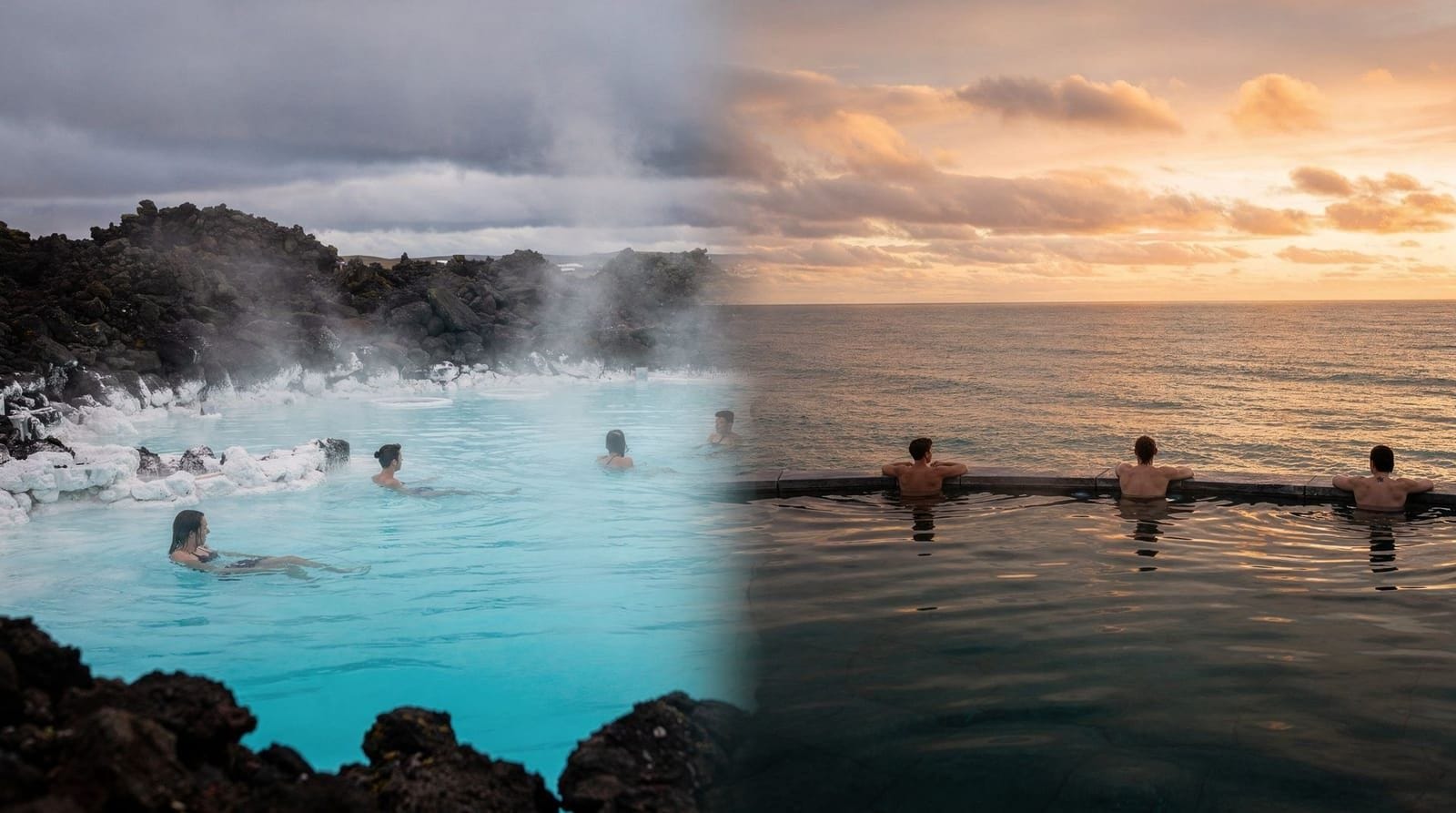
Located in Kársnes Harbour in Kópavogur, about 5 km south of central Reykjavík, Sky Lagoon sits on a cliff edge with an infinity edge that faces the North Atlantic. On a clear day you can see the Snæfellsjökull glacier 100 km across the bay. On a moody stormy day — which is much of the year — the effect is equally dramatic.
The main bathing pool is geothermal, heated to 38–40°C, with a salinity level close to ocean water. The pool is large enough to feel uncrowded even when occupied, a meaningful contrast to peak Blue Lagoon conditions. Capacity is strictly capped through timed entry, which prevents the locker-room crush common elsewhere.
Tickets and the Skjól 7-step ritual
Sky Lagoon sells two main passes:
Pure Pass (ISK 9,490 / approximately EUR 64): Access to the infinity lagoon and the Gelmir lagoon (a smaller, more sheltered indoor pool), the changing facilities, and the Sky Bar. Does not include the Skjól ritual.
Pure Lite Pass (ISK 13,490 / approximately EUR 90): Everything in Pure plus one complete round of the 7-step Skjól ritual — the structured warm/cold/sauna sequence (described below).
Children under 12 are not permitted at Sky Lagoon, making it effectively an adult-only facility. This is not prominently advertised — if you are planning a family trip to Iceland, note this restriction before booking.
Sky Lagoon Pure Lite Pass — lagoon access plus the full 7-step Skjól ritualThe Skjól 7-step ritual explained
The ritual is the defining feature that separates Sky Lagoon from a simple heated pool. “Skjól” means shelter in Icelandic, and the ritual draws on traditional Nordic bathing culture combined with Icelandic thermal principles. Each step is optional in the sense that staff do not chase you through it, but the sequence is designed to move you from warm to cold to steam, building a contrast effect that genuinely affects how your muscles feel afterward.
Step 1 — Lagoon: Begin in the main geothermal pool at 38–40°C. Swim toward the infinity edge and float facing the ocean.
Step 2 — Cold plunge: A cold pool at 5–7°C. Thirty to sixty seconds is enough; the initial shock passes quickly. This step triggers circulation rebound, which is why the remaining steps feel more vivid afterward.
Step 3 — Sauna: A large wood-panelled sauna with windows onto the lagoon, heated to 80–90°C. The view prevents it from feeling confined. Ten to fifteen minutes is typical.
Step 4 — Cold fog mist: A fine cold mist sprayed overhead. Refreshing, brief, and a transition rather than a full cold immersion.
Step 5 — Sky body scrub: A salt and oil scrub applied with a provided exfoliation bag. This is the tactile highlight of the ritual. You apply it in a dedicated room and rinse in a warm shower. The scrub leaves skin noticeably smooth.
Step 6 — Steam: A steam room scented with Icelandic herbs. Slightly cooler than a traditional sauna at around 45–50°C with high humidity. Five to ten minutes.
Step 7 — Warm shower: A final rinse that closes the temperature cycle and prepares you to return to the main lagoon feeling properly loosened.
The ritual takes 45–75 minutes depending on how long you spend at each step. You can repeat individual elements; many guests do a second cold plunge partway through.
Getting there from Reykjavík
By bus: The Strætó 35 bus runs from Hlemmur square in central Reykjavík to Kársnes, stopping near Sky Lagoon. Journey time is about 20 minutes, fare around ISK 490. A timed connection back is straightforward since buses run frequently.
By taxi or ride-share: Approximately ISK 2,000–3,000 from the city centre. Hreyfill is the main taxi operator; app-based ride-hailing like Bolt is available. Worth doing if you are 3–4 people sharing.
By car: Free parking is available at Sky Lagoon. The drive from central Reykjavík takes 10–15 minutes. This is the easiest option and makes combining Sky Lagoon with other sights on the Reykjanes Peninsula simple.
By organised transfer: Several tour operators include a transfer from your hotel as an add-on to the Pure Pass or Pure Lite Pass.
Sky Lagoon admission with hotel transfer from Reykjavík includedBest time to visit
Sky Lagoon enforces timed entry slots, which helps prevent extreme overcrowding, but some periods are noticeably better than others.
Quietest slots: 08:00–10:00 and after 19:00 on weekdays. The facility is open until 23:00 on weekdays and midnight on weekends, making an evening visit — especially in winter when it is dark early — particularly atmospheric.
Busiest periods: Midday and early afternoon on weekends from June through August. If you can only visit at these times, book the earliest slot available and arrive promptly.
Winter: Between November and March, visiting after dark turns the infinity edge into a dark ocean horizon punctuated by distant lights. If northern lights are active, they are occasionally visible from the lagoon, though the sky is too bright near the facility for dedicated aurora photography. For proper northern lights viewing, see the northern lights from Reykjavík guide.
Summer: The midnight sun makes late evening visits surreal — bathing in full daylight at 22:00 feels genuinely alien. See midnight sun Iceland for context.
What to bring
Sky Lagoon provides towels, lockers, hairdryers, and basic toiletries. You need only your swimsuit and flip-flops. If you have long hair, bring a hair tie.
The bar serves light meals, snacks, and drinks. Expect ISK 1,500–2,200 for a beer, similar to Reykjavík bar prices. The Smakk Bar has a reasonable selection of Icelandic snacks (skyr cake, fish bites) if you want food after bathing. A full restaurant (Gelmir) is on-site for larger meals.
Lockers use a RFID wristband — no coins needed. Deposits are handled digitally.
How Sky Lagoon compares to alternatives
The Blue Lagoon vs Sky Lagoon guide covers the full comparison in detail, but the short version: Sky Lagoon is cheaper, closer to Reykjavík, less crowded, newer infrastructure, and has the structured ritual as a genuine differentiator. The Blue Lagoon has more international name recognition, a larger pool, and a more dramatic lava field setting.
For budget travellers, the Secret Lagoon in Flúðir costs ISK 3,500 and is entirely natural. For a free option after a hike, Reykjadalur hot river near Hveragerði requires only the energy to walk 3 km uphill.
Practical details
Opening hours: Monday–Friday 11:00–23:00; Saturday–Sunday 10:00–24:00 (midnight). Hours change by season — check the Sky Lagoon website before visiting.
Booking: Strongly recommended, especially on weekends and in summer. Walk-ins are technically possible if slots remain, but you may be turned away at peak times. Book online at least 1–2 weeks ahead in summer.
No children under 12: This is a firm policy, not discretionary.
Alcohol: Available at the Sky Bar (in the water) and Smakk Bar. Included with some premium combinations but not in the basic pass. Iceland’s legal drinking age is 20; photo ID may be requested.
Accessibility: The facility was designed with accessible pathways, and staff can assist with pool entry. Contact Sky Lagoon in advance to confirm specific requirements.
Frequently asked questions about Sky Lagoon
How is Sky Lagoon different from Blue Lagoon?
Sky Lagoon is 5 km from central Reykjavík (versus 50 km for Blue Lagoon), costs roughly 35 percent less, has an infinity edge with ocean views, and includes a structured wellness ritual in the higher tier. The Blue Lagoon has milky silica-blue water, is situated in a lava field, and is more famous internationally. Sky Lagoon tends to be less crowded due to capacity caps. See the full Blue Lagoon vs Sky Lagoon comparison.
Do I have to complete the full Skjól ritual?
No. The ritual is structured but self-paced. You can skip individual steps if you prefer, spend more time in the sauna, or re-enter the main lagoon between steps. Staff give an introductory explanation but do not supervise your progression through the steps.
How long does a visit to Sky Lagoon take?
Plan for 2.5–4 hours. Pure Pass visitors typically spend 1.5–2.5 hours in the lagoon. Adding the Skjól ritual extends the visit by 45–75 minutes. Add time for changing, the bar, and shower after.
Can I visit Sky Lagoon at night?
Yes. Sky Lagoon stays open until 23:00 on weekdays and midnight on weekends. An evening visit after dinner in Reykjavík is popular. In winter, the dark sky and ocean horizon create a particularly atmospheric experience.
Is Sky Lagoon good for families?
No. Children under 12 are not permitted. If you are travelling with young children, consider family-friendly Iceland activities that include outdoor natural pools.
What is the temperature of the Sky Lagoon water?
The main geothermal pool is maintained at 38–40°C. The cold plunge is 5–7°C. The sauna reaches 80–90°C, and the steam room sits at around 45–50°C with high humidity.
Is there food at Sky Lagoon?
Yes. The Smakk Bar serves snacks and drinks, including Icelandic-inspired light bites. Gelmir is a full restaurant on-site for more substantial meals. Dining requires a separate reservation from your lagoon ticket and is not included in any standard pass.
Can I combine Sky Lagoon with the Golden Circle in one day?
It’s tight but doable if Sky Lagoon is the last stop. The Golden Circle day trip itself takes 6–8 hours; adding an evening Sky Lagoon slot (19:00 or later) after returning to Reykjavík works better than trying to fit both into daylight hours. Some tour operators sell a combined Golden Circle and Sky Lagoon day tour that handles the logistics for you.
Do I need to book a specific time slot?
Yes. Sky Lagoon uses timed entry rather than open access, so you choose an arrival window when booking. You are not required to leave at a fixed time once inside, but you must arrive within your booked slot — arriving significantly late can mean forfeiting the booking on sold-out days.
Sky Lagoon in Reykjavík’s wider spa landscape
Sky Lagoon did not invent the concept of a premium geothermal spa in Iceland, but it significantly raised the design bar when it opened in 2021. The Blue Lagoon, which had been operating commercially since the 1980s, had developed a resort-scale infrastructure that works efficiently at high volume. Sky Lagoon took a different approach: smaller, more curated, with a stronger emphasis on the ritual wellness experience rather than the iconic visual spectacle.
The result is that Sky Lagoon and the Blue Lagoon serve somewhat different traveller profiles. Visitors who want the world-famous milky-blue water in a volcanic lava field tend toward the Blue Lagoon. Visitors who want a closer-to-Reykjavík, less crowded, more spa-focused experience with an ocean view tend toward Sky Lagoon. The Blue Lagoon vs Sky Lagoon comparison guide covers this in detail.
What both have in common: they are significantly more expensive than Iceland’s community swimming pools and natural alternatives. The municipal sundlaug (swimming pools) in Reykjavík charge ISK 1,000–1,250 and offer geothermally heated pools and hot pots. If your goal is simply to soak in warm water, the local pool is the budget solution. Sky Lagoon justifies its ISK 9,490+ price through design, atmosphere, and the structured ritual.
The Sky Lagoon infinity edge — what makes it work
The infinity edge is not a new architectural concept, but the Sky Lagoon’s execution is particularly effective. The pool’s edge aligns with the horizon line of the North Atlantic at specific viewing angles, creating an illusion of water merging with the ocean. This is a deliberate optical construction — the pool is elevated above sea level and the edge is designed to cut off the intervening ground.
In summer, the sun in the evening (10 PM in midsummer) hangs low over the ocean, producing long horizontal light across the water. In winter, the same horizon is used differently: on clear nights, the dark water below and the sky above create a stark delineation, and if the aurora is active — not guaranteed, but possible — the northern display can occasionally be seen from the lagoon edge.
The pool’s water is not silica-blue like the Blue Lagoon’s. It is clear to light grey-green, and the mineral content is different: the Sky Lagoon uses geothermal water that has not passed through the same silica-rich volcanic geology as Svartsengi. The water is treated differently and appears transparent rather than milky.
Getting the most from the cold plunge
The cold plunge is the step in the Skjól ritual that most visitors approach with the most hesitation and leave feeling the most surprised by. The pool temperature of 5–7°C is genuinely cold — equivalent to glacier-fed river water. The hesitation is rational: the shock is significant.
The practice of cold immersion after heat exposure (contrast therapy) has measurable physiological effects. The cold triggers vasoconstriction — blood vessels near the skin surface constrict rapidly, pushing blood inward. When you get out and warm up, the vessels dilate again. This alternation is believed to improve circulation and reduce muscle soreness.
Practically: enter the cold pool up to the neck. The initial shock passes in 15–20 seconds as the body acclimates. Most people find they can manage 30–60 seconds comfortably on the first attempt. After the sauna step (which comes after the cold plunge in the ritual sequence, and which most visitors find significantly easier), return to the main lagoon and notice the difference in how the warm water feels on sensitised skin.
You are not required to submerge your head. Neck-deep is effective.
Combining Sky Lagoon with Reykjavík activities
Sky Lagoon fits naturally into a Reykjavík half-day because the travel time is negligible. Practical combinations:
Morning sightseeing + afternoon Sky Lagoon: Walk Reykjavík in the morning — Hallgrímskirkja, Harpa concert hall, the old harbour — then arrive at Sky Lagoon for a 14:00–16:00 slot. Return to the city for dinner.
Sky Lagoon + Reykjavík evening: Book a 19:00–20:00 Sky Lagoon slot, spend 2 hours soaking and in the ritual, then return to Reykjavík for a late dinner. Reykjavík restaurants stay open until 22:00–23:00 on most evenings.
Ring Road departure day: If starting a Ring Road trip from Reykjavík, a morning Sky Lagoon slot (08:00–10:00 admission) before driving east is a relaxed way to begin a longer journey. South Iceland and Vík are 2.5–3 hours from Reykjavík.
Northern lights combination: Sky Lagoon keeps late hours (until 23:00 on weekdays). On a clear winter night, arriving at 20:00 and soaking until 22:30 puts you outdoors in good dark-sky conditions afterward for potential aurora viewing. The northern lights from Reykjavík guide has location suggestions for viewing after your soak.
Sky Lagoon’s environmental and water management approach
The geothermal water used at Sky Lagoon comes from a drilled well accessing a geothermal source in the Kársnes area. The facility filters, monitors, and manages the water quality continuously without traditional chlorination. The mineral content of the water — primarily sodium chloride (from the ocean proximity), silica in lower concentrations than Blue Lagoon, and various trace minerals — provides natural microbial management.
The water temperature maintenance uses heat exchange systems rather than electric heating. The geothermal source provides water at naturally elevated temperatures that the facility regulates down to the target 38–40°C. Net energy consumption for pool heating is therefore lower than it would be for an electrically heated facility of comparable size.
Sky Lagoon has committed to carbon neutrality targets consistent with Iceland’s national energy strategy, which is relatively straightforward given that Iceland’s electricity is generated almost entirely from geothermal and hydroelectric sources.
What Sky Lagoon looks like on a rainy day
This is worth addressing because Iceland has a lot of rainy days. Sky Lagoon is fully outdoor (apart from the changing rooms, sauna, and steam room sections of the ritual). In light rain, the experience is actually pleasant — the rain is typically cold, the pool is warm, and the contrast is part of the outdoor bathing culture.
In a proper storm with strong wind, the situation is different. Wind chill makes the walk between the pool and the indoor sections unpleasant, the pool surface is choppy, and the infinity view is obscured by low cloud. Sky Lagoon does not close in bad weather (except extreme cases), but the experience is diminished.
If your visit falls on a genuinely stormy day, focusing on the indoor ritual elements — the sauna and steam room — and treating the outdoor pool as secondary is a pragmatic adjustment.
Photography at Sky Lagoon
Phones and cameras are permitted at Sky Lagoon, unlike some spa facilities that ban devices entirely, but practicality limits what most visitors actually shoot. A waterproof phone case or pouch is worth bringing if you want photos from inside the lagoon itself — the humidity and splash make an uncased phone risky.
The most photogenic moment is usually from the infinity edge at golden hour: in summer, that means late evening (9–11 pm) when the low sun crosses the water; in winter, a clear late afternoon slot before sunset around 16:00–17:00 gives similar light with far fewer other bathers in frame. Staff are generally relaxed about quick photos but discourage prolonged posed shoots that block the edge for other guests.
Sky Lagoon for solo travellers
Sky Lagoon works particularly well as a solo activity, more so than many Iceland attractions built around group logistics. The self-paced ritual means there’s no awkwardness about pace or company — you move through the seven steps on your own schedule, and the lagoon itself is large enough that solo bathers don’t stand out.
Booking is straightforward for one person, and the Strætó bus or a short taxi ride removes any need to coordinate transport with anyone else. An early morning slot (08:00–10:00) is especially good for solo visitors: the facility is quietest then, and you can linger over each ritual step without feeling like you’re holding anyone up.
For a solo Reykjavík day that includes Sky Lagoon, pairing it with a morning walk through the city centre — Hallgrímskirkja, the old harbour, a coffee stop — followed by an afternoon lagoon slot is a comfortable, unhurried structure that needs no group coordination at all.
Sky Lagoon and jet lag
Arriving in Iceland on an overnight flight and heading straight into a demanding sightseeing day is a common mistake covered in the common Iceland mistakes guide. Sky Lagoon is a genuinely good antidote: it’s close to Keflavík-to-Reykjavík driving routes, requires no physical exertion, and the warm-cold ritual can help reset your system after a long flight better than caffeine alone.
Many visitors book a Sky Lagoon slot for their arrival afternoon, before checking into accommodation, precisely because it eases the transition without wasting a full day. If you’re flying in from North America overnight, an afternoon slot on day one — after a nap but before a proper Icelandic dinner — is a well-tested strategy among repeat visitors.
Top experiences
Bookable activities with verified prices and instant confirmation on GetYourGuide.
Top experiences
Best-rated activities across GetYourGuide and Viator.

Top-Rated Family Rafting – Drysuits & Geothermal Hot Cocoa
- Viator

Skip the Line: Secret Lagoon Entrance Ticket
- Viator

Landmannalaugar Guided Hike & Hot Springs - From Reykjavík
- Viator

Goðafoss Waterfall & Forest Lagoon from Akureyri Port
- Viator

Vök Baths Admission Ticket
- Viator

Day Trip to Lake Mývatn And The Nature Baths from Akureyri
- Viator