Blue Lagoon vs Sky Lagoon — which should you choose?
Reykjavik: Sky Lagoon pure pass 7 step ritual
Should I visit the Blue Lagoon or Sky Lagoon?
Sky Lagoon is closer to Reykjavík, 35 percent cheaper, less crowded, and includes a wellness ritual. The Blue Lagoon has the iconic milky-blue water in a volcanic setting and works well as an airport stop. Choose Sky Lagoon for value and city convenience; choose Blue Lagoon if the visual spectacle or Keflavík logistics matter most.
| Blue Lagoon | From ISK 14,990, 50km from Reykjavík, resort-scale |
| Sky Lagoon | From ISK 9,490, 5km from Reykjavík, ritual-focused |
| Cheaper option | Sky Lagoon, by roughly 35–40% |
| Less crowded | Sky Lagoon, in all seasons |
| Booking | Mandatory for both, especially summer |
Setting the comparison straight
Both the Blue Lagoon and Sky Lagoon are geothermal spas in Iceland built on genuine volcanic thermal infrastructure. Neither is a natural hot spring in the wild-swimming sense — both are developed facilities with admission pricing, changing rooms, bars, and strict booking requirements. The question of which to choose depends on budget, schedule, tolerance for crowds, and what kind of experience you are after.
This guide compares the two honestly, without marketing spin from either operation.
Price comparison
Blue Lagoon starts at ISK 14,990 (approximately EUR 100) for the Comfort tier, which includes one drink, a silica mask, and a towel. The Premium tier runs ISK 22,990 (approximately EUR 155) and adds extra drinks, an algae mask, and a bathrobe. Retreat — the top tier — is ISK 29,990 (approximately EUR 210) and adds access to a separate private spa section.
Transfer from Reykjavík adds another ISK 5,000–8,000 return, or more if you take a private vehicle.
Sky Lagoon starts at ISK 9,490 (approximately EUR 64) for the Pure Pass, which covers lagoon access and the facility. The Pure Lite Pass at ISK 13,490 (approximately EUR 90) adds the 7-step Skjól ritual. Transfer from Reykjavík adds ISK 3,000–5,000, but many visitors can reach Sky Lagoon by city bus or taxi for under ISK 3,000 round trip.
Verdict: Sky Lagoon is approximately 35–40 percent cheaper for a comparable experience, and the logistics cost less too.
Sky Lagoon Pure Lite Pass — lagoon plus 7-step Skjól ritualThe practical gap between the two is transport, not water: Sky Lagoon is a city bus ride away, while a Blue Lagoon round-trip bus transfer has to be booked and timed around your admission slot.
Location and logistics
Blue Lagoon is 50 km from central Reykjavík and 20 km from Keflavík International Airport. It requires either a tour bus, a dedicated transfer, a taxi, or a rental car to reach. The upside is its proximity to the airport, making it a natural stopover on arrival day or as a pre-flight soak. The downside: from the city it is a significant journey that takes 60–75 minutes one way, consuming most of a half-day.
Sky Lagoon is 5 km from central Reykjavík in Kópavogur. Reachable by city bus (Strætó 35 from Hlemmur, about 20 minutes, ISK 490), by taxi in 10–15 minutes for ISK 2,000–3,000, or by car with free parking on-site. If you are based in Reykjavík, you can visit Sky Lagoon, stay for 3 hours, and be back in time for dinner without effort.
Verdict: Sky Lagoon wins on convenience for city-based travellers. Blue Lagoon wins for airport transit visits.
The experience — water, setting, and atmosphere
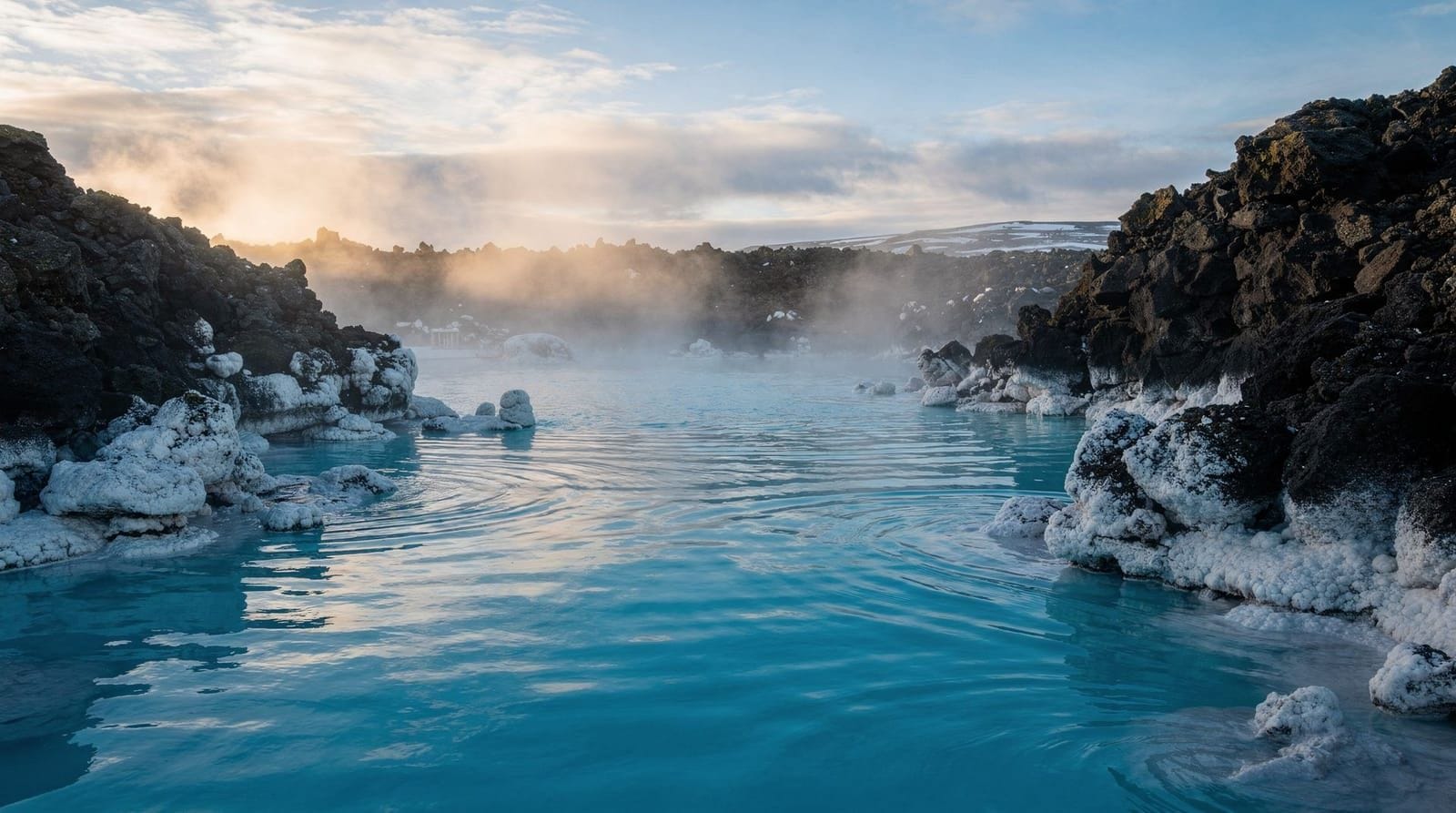
Blue Lagoon: The water is unmistakably striking. The milky-blue colour from suspended silica and algae is visually unique and photographs dramatically. The setting — a lava field in an active volcanic zone on the Reykjanes Peninsula — is genuinely otherworldly. The facility is large: the main pool covers 5,000 square metres. There is a swim-up bar, multiple steam rooms built into lava formations, and a viewing bridge.
The atmosphere, however, is resort-industrial in peak season. Hundreds of tourists circulate at any given time, the locker rooms smell of damp towels, the swim-up bar queue stretches, and the silica coating on every surface gets on everything. It feels like what it is: a very successful tourist attraction.
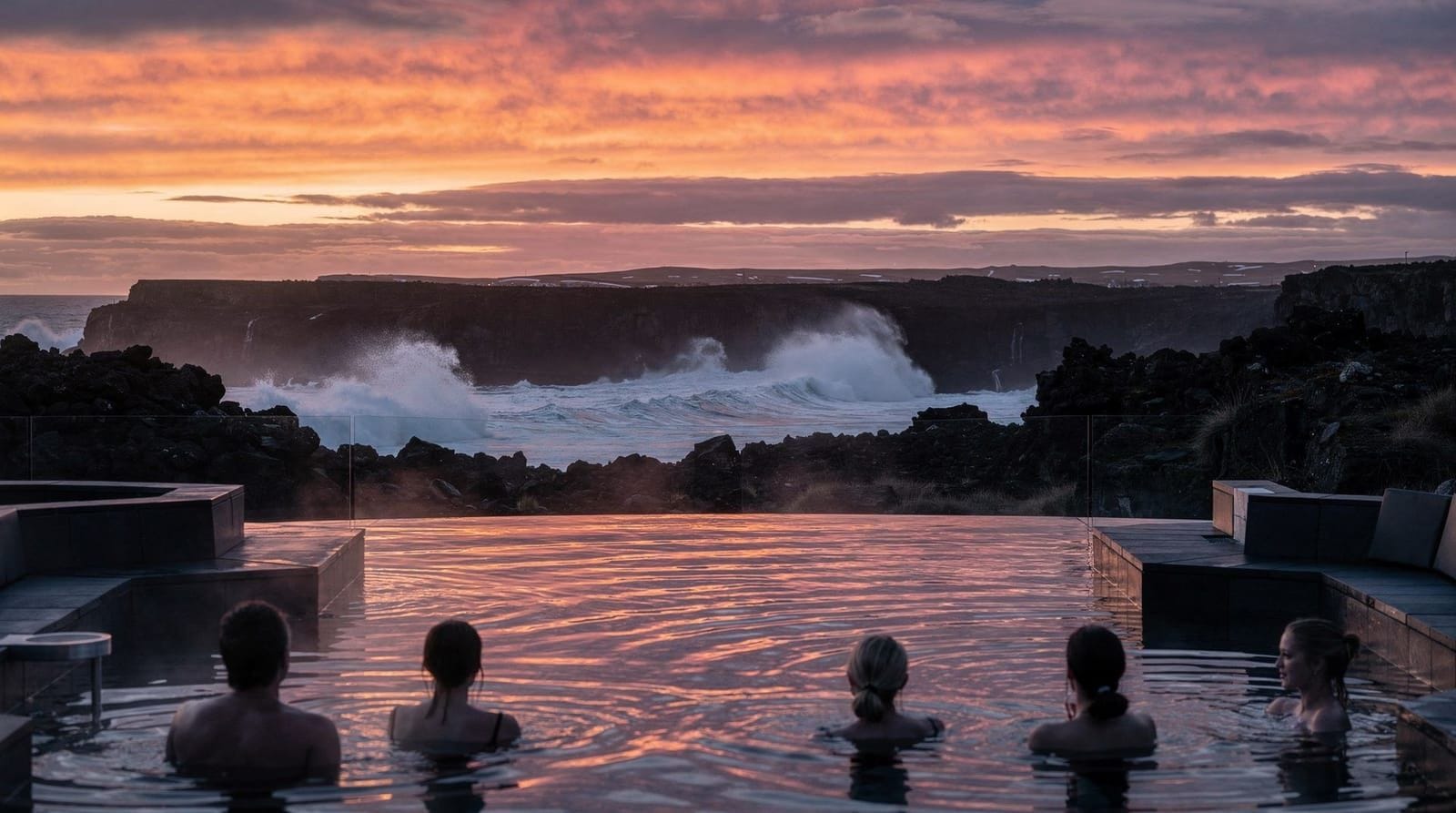
Sky Lagoon: The infinity edge is the signature visual experience — a seamless drop into the North Atlantic horizon. On a sunny day this is spectacular; on a stormy one, with waves and wind, the contrast between warm water and grey ocean is intensely atmospheric. The pool is smaller but feels more curated: less mass tourism, more considered design.
The Skjól ritual adds a genuine wellness dimension. The cold plunge at 5–7°C, the sauna with lagoon views, the sky body scrub — it feels like a proper spa sequence rather than a swimming pool experience. Staff presence is more visible and the facility feels newer (opened 2021 versus the Blue Lagoon’s 1987 commercial opening).
Verdict: Blue Lagoon for visual spectacle and iconic setting. Sky Lagoon for atmosphere quality and the ritual experience.
Crowds
Blue Lagoon receives approximately 1.3 million visitors per year — slightly exceeding Iceland’s total resident population. Timed entry manages flow, but peak hours (11:00–15:00) from May through September can mean: 15-minute queues at the swim-up bar, full lockers, packed changing rooms, and little spatial separation in the pool itself.
Sky Lagoon caps capacity more stringently. On a busy Saturday afternoon the difference is still noticeable — Sky Lagoon feels half as populated. The no-children-under-12 policy also filters out a portion of the loudest visitors.
Verdict: Sky Lagoon is meaningfully less crowded in all seasons.
The wellness ritual difference
The Blue Lagoon’s signature wellness element is the silica mud mask — you collect a pot from the poolside stations and apply it yourself. It is low-effort and low-key. There is also an in-water massage table in the Retreat tier.
The Sky Lagoon’s Skjól ritual is a structured 7-step programme: lagoon, cold plunge, sauna, cold mist, body scrub, steam room, warm shower. The sequence is guided by posted signage in each zone, takes 45–75 minutes, and produces a measurable physical effect. The body scrub in particular — done with a salt and oil paste — leaves skin noticeably different from a standard soak.
Verdict: Sky Lagoon’s ritual is a more substantive wellness experience.
Blue Lagoon Comfort admission — silica mask, drink, and towel includedCombining with other activities
Blue Lagoon pairs naturally with a Reykjanes Peninsula day, a Golden Circle loop, or an airport stopover. See getting from Keflavík airport for the airport combination logistics.
Sky Lagoon pairs easily with a Reykjavík half-day, an evening out in the city, or as a recovery stop after a long driving day on South Iceland or the Ring Road.
Which type of traveller should choose which
Choose the Blue Lagoon if:
- You are arriving or departing from Keflavík and want to break up the airport transition.
- You have specifically wanted to visit since seeing it in travel media.
- You are on a multi-week trip where cost is not a constraint.
- You want the iconic silica-blue water backdrop for photography.
- You are doing a Golden Circle day trip or Reykjanes Peninsula tour that passes nearby.
Choose Sky Lagoon if:
- You are based in Reykjavík and want easy access without a half-day journey.
- Budget matters — the savings are meaningful.
- You want a structured wellness experience rather than a resort pool.
- You dislike large tourist crowds.
- You are visiting in winter and want an evening soak with ocean views.
Consider neither if:
- You are on a strict budget — the Secret Lagoon at ISK 3,500 or the free Reykjadalur hot river offer genuine geothermal bathing at a fraction of the cost.
- You want an authentic community swimming pool experience — Iceland’s municipal pools (Laugardalslaug, Sundhöllin) charge ISK 1,000–1,200 and are where locals actually swim.
Can you visit both?
Yes, and some visitors do. If you have 5+ days in Iceland and want to compare the experiences directly, it is entirely feasible. A typical approach: Sky Lagoon early in the trip for convenience, Blue Lagoon on the Keflavík departure day. The best geothermal pools guide covers the full landscape of options if you want to go further.
Frequently asked questions about Blue Lagoon vs Sky Lagoon
Which is better value for money — Blue Lagoon or Sky Lagoon?
Sky Lagoon is better value on price alone. The Pure Lite Pass at ISK 13,490 includes a structured 7-step ritual; the comparable Blue Lagoon Premium at ISK 22,990 includes an algae mask and extra drinks. Both are priced as premium experiences, but Sky Lagoon delivers more per ISK spent.
Is Sky Lagoon newer and better maintained than Blue Lagoon?
Sky Lagoon opened in 2021 versus Blue Lagoon’s gradual commercial development from 1987. The infrastructure is newer, which is evident in the locker rooms and facility layout. However, Blue Lagoon has been heavily renovated over the years and completed major reconstruction after the 2023–2024 eruption-related closures.
Can I visit both Blue Lagoon and Sky Lagoon on the same day?
Technically possible but not recommended. You would spend the day largely moving between two spas, and the combined effect of thermal soaking, cold plunges, and sauna would be physically tiring. Most visitors choose one or the other.
Which has better views — Blue Lagoon or Sky Lagoon?
They offer different visual experiences. Blue Lagoon: lava field, volcanic steam vents, stark Reykjanes Peninsula landscape. Sky Lagoon: infinity edge with a direct view of the North Atlantic and, on clear days, Snæfellsjökull glacier. Both are visually striking, neither is objectively superior.
Is the Blue Lagoon worth the extra cost over Sky Lagoon?
If you want the iconic experience and have the budget, yes. If budget is a constraint or you place weight on convenience and lower crowds, Sky Lagoon is the stronger practical choice. The price gap is approximately EUR 40–50 per person, which in Iceland terms is meaningful but not extreme.
Which is better for a solo traveller?
Sky Lagoon, primarily because of convenience. Solo travellers in Reykjavík can walk out of their accommodation and be at Sky Lagoon in 20 minutes. The ritual also lends itself to a solo experience — it is self-paced and does not require a group dynamic.
Is there a difference in the water quality between the two?
Both use genuine geothermal water. Blue Lagoon water is silica-rich, milky-blue, and slightly salt-influenced. Sky Lagoon water is clearer, saline-influenced by the ocean. Neither is chlorinated in the traditional sense; both are managed for hygiene through water turnover and mineral content. Neither is better or worse — they are different mineral compositions.
Which is better for a group with mixed budgets?
Sky Lagoon’s tiered pricing (Pure vs Pure Lite) gives more flexibility for a group where some members want the full ritual and others just want a soak. Blue Lagoon’s tiers are more expensive at every level, which can make budget mismatches within a group more awkward.
Beyond the two flagships — alternatives worth considering
The Blue Lagoon and Sky Lagoon are the two most discussed options, but they are not the only choices for geothermal bathing in Iceland. Several alternatives offer compelling experiences at lower prices:
Secret Lagoon (ISK 3,500): Iceland’s oldest natural pool in Flúðir, operating since 1891. No advance booking required, no frills, genuine geothermal water. An essential stop on the Golden Circle. See the Secret Lagoon guide for details.
Mývatn Nature Baths (ISK 6,900): Northern Iceland’s equivalent of the Blue Lagoon — volcanic landscape, milky-grey water, fewer tourists. Worth the visit if you are doing the Ring Road or a dedicated north Iceland trip. See the Mývatn Nature Baths guide.
Forest Lagoon, Akureyri (ISK 6,500–9,500): Newer facility (2022) in the hills above Akureyri with fjord and mountain views. Strong alternative to Sky Lagoon for visitors spending time in the north. See the Forest Lagoon guide.
Hvammsvik Hot Springs (ISK 8,500–10,500): Eight tidal pools on Hvalfjörður fjord, 45 km from Reykjavík. The tidal influence — sea water mixing with geothermal springs — is genuinely unique. See the Hvammsvik guide.
Reykjadalur hot river (free): A hike of 3 km reaches a naturally heated river where bathing costs nothing. Best free thermal bathing near Reykjavík. See Reykjadalur hot river.
For a full landscape of options, see best geothermal pools in Iceland.
The practicality of booking both in one trip
If you have 5 or more days in Iceland and a moderate budget, visiting both Sky Lagoon and the Blue Lagoon is entirely feasible. The two experiences are different enough that they do not feel redundant.
A logical approach for a one-week Ring Road trip starting and ending in Reykjavík:
- Day 1 arrival: Blue Lagoon as a Keflavík airport stopover.
- Day 5 or 6 (back in Reykjavík after the Ring Road): Sky Lagoon for a recovery evening soak before your last night.
The total additional cost for both visits over a budget of otherwise moderate spending is approximately EUR 200–300 per person — significant but not unreasonable within the context of an Iceland trip budget.
Booking mistakes to avoid
Blue Lagoon: Do not assume walk-in availability in peak season. Book at least 3–4 weeks ahead in July and August. If you arrive without a booking, the best-case scenario is being offered a slot several hours later; the worst case is no admission at all.
Sky Lagoon: Walk-ins are possible mid-week in low season but not reliable. On a Saturday afternoon in July, a booked slot is essential. The Pure Pass and Pure Lite Pass are separate products on the booking system — confirm you have selected the ritual-inclusive option if you want the Skjól experience.
Both facilities require a credit or debit card for the locker wristband system — no cash is needed inside, but you need a card to check in and to charge any additional drinks or food.
Icelandic spa etiquette at both facilities
Both Blue Lagoon and Sky Lagoon follow the same basic Icelandic bathing etiquette:
Shower before entering the pool. This is a national norm across all Icelandic pools and strictly required at both facilities. A full shower — swimsuit off — is standard. Attendants may remind you; it is not considered impolite.
No glass in the pool areas. Both facilities use plastic cups and containers. Your drink is served in plastic regardless of what it is.
Respect the steam caves and quiet zones. Blue Lagoon has designated quieter areas; Sky Lagoon’s sauna has a no-phone policy. These are enforced.
Alcohol and behaviour. Iceland’s legal drinking age is 20. Both facilities check ID for alcohol service. Disruptive behaviour from intoxicated guests is taken seriously — the Blue Lagoon has removed guests in the past for this reason.
Photography. Generally permitted in pool areas. Both facilities ask that you avoid photographing other guests without consent, particularly near changing areas. Waterproof phone cases are widely available in Reykjavík shops if you want to take pool-side photos.
The bigger picture: Iceland’s geothermal identity
Iceland’s global reputation is partly built on geothermal energy — the Blue Lagoon is the most visible symbol of this internationally. But the country’s geothermal use goes far beyond tourism: approximately 90 percent of Icelandic homes are heated by geothermal hot water piped through district heating systems. The hot water in Reykjavík hotel showers carries a faint sulphur smell for this reason — it is the same geothermal water, heated underground, flowing through infrastructure.
The Blue Lagoon and Sky Lagoon sit at the luxury end of a spectrum that runs from this domestic geothermal heat supply through to the municipal sundlaug pools (ISK 1,000–1,250 per visit) and on to the wild hot springs accessible for free after a hike. Understanding where both sit on that spectrum helps calibrate expectations and value.
Neither the Blue Lagoon nor Sky Lagoon is a uniquely Icelandic experience in the sense that only Iceland could produce it. Both are purpose-built commercial facilities that happen to use Icelandic geothermal water. The more uniquely Icelandic experience might be the hot pot conversation at Laugardalslaug pool, the hike to Reykjadalur, or a soak at the Secret Lagoon with active geyser activity visible from the pool edge.
This is not an argument against visiting Blue Lagoon or Sky Lagoon. They are both genuinely good experiences. It is an argument for understanding what you are paying for and calibrating your expectations accordingly.
For visitors with more time and curiosity about Iceland’s actual geothermal culture, the best geothermal pools guide maps the full landscape from commercial to wild.
Side-by-side snapshot
| Factor | Blue Lagoon | Sky Lagoon |
|---|---|---|
| Starting price | ISK 14,990 | ISK 9,490 |
| Distance from Reykjavík | 50 km | 5 km |
| Signature feature | Milky-blue silica water | 7-step Skjól ritual, ocean infinity edge |
| Crowd level | Very high (1.3M+ visitors/year) | Moderate, lower at capacity |
| Best paired with | Keflavík transfer, Reykjanes Peninsula | Reykjavík evening, no car needed |
| Minimum age | 2 years | 12 years (main pool) |
Deciding by trip stage rather than preference alone
Rather than picking a favourite in the abstract, it often helps to decide by where the visit falls in your trip. Arrival or departure day via Keflavík Airport strongly favours the Blue Lagoon, since the detour is already built into your transfer. A free evening while based in Reykjavík favours Sky Lagoon, since it fits into a few spare hours without derailing the rest of the day. If you’re combining either with a Golden Circle or Reykjanes Peninsula day, the Blue Lagoon sits closer to the Reykjanes route geographically.
Top experiences
Bookable activities with verified prices and instant confirmation on GetYourGuide.
Top experiences
Best-rated activities across GetYourGuide and Viator.

Top-Rated Family Rafting – Drysuits & Geothermal Hot Cocoa
- Viator

Skip the Line: Secret Lagoon Entrance Ticket
- Viator

Landmannalaugar Guided Hike & Hot Springs - From Reykjavík
- Viator

Goðafoss Waterfall & Forest Lagoon from Akureyri Port
- Viator

Vök Baths Admission Ticket
- Viator

Day Trip to Lake Mývatn And The Nature Baths from Akureyri
- Viator