Hvammsvik hot springs — tidal geothermal pools on Hvalfjörður fjord
What is Hvammsvik and how is it different from other Icelandic spas?
Hvammsvik is a cluster of eight outdoor geothermal pools on the shore of Hvalfjörður fjord, about 45 km north of Reykjavík via the tunnel. What makes it unique is tidal influence — at high tide, sea water mixes with the geothermal springs, changing pool temperatures and salinity. It opened in 2021 and offers a less crowded, more natural experience than Blue Lagoon at a lower price.
What Hvammsvik is
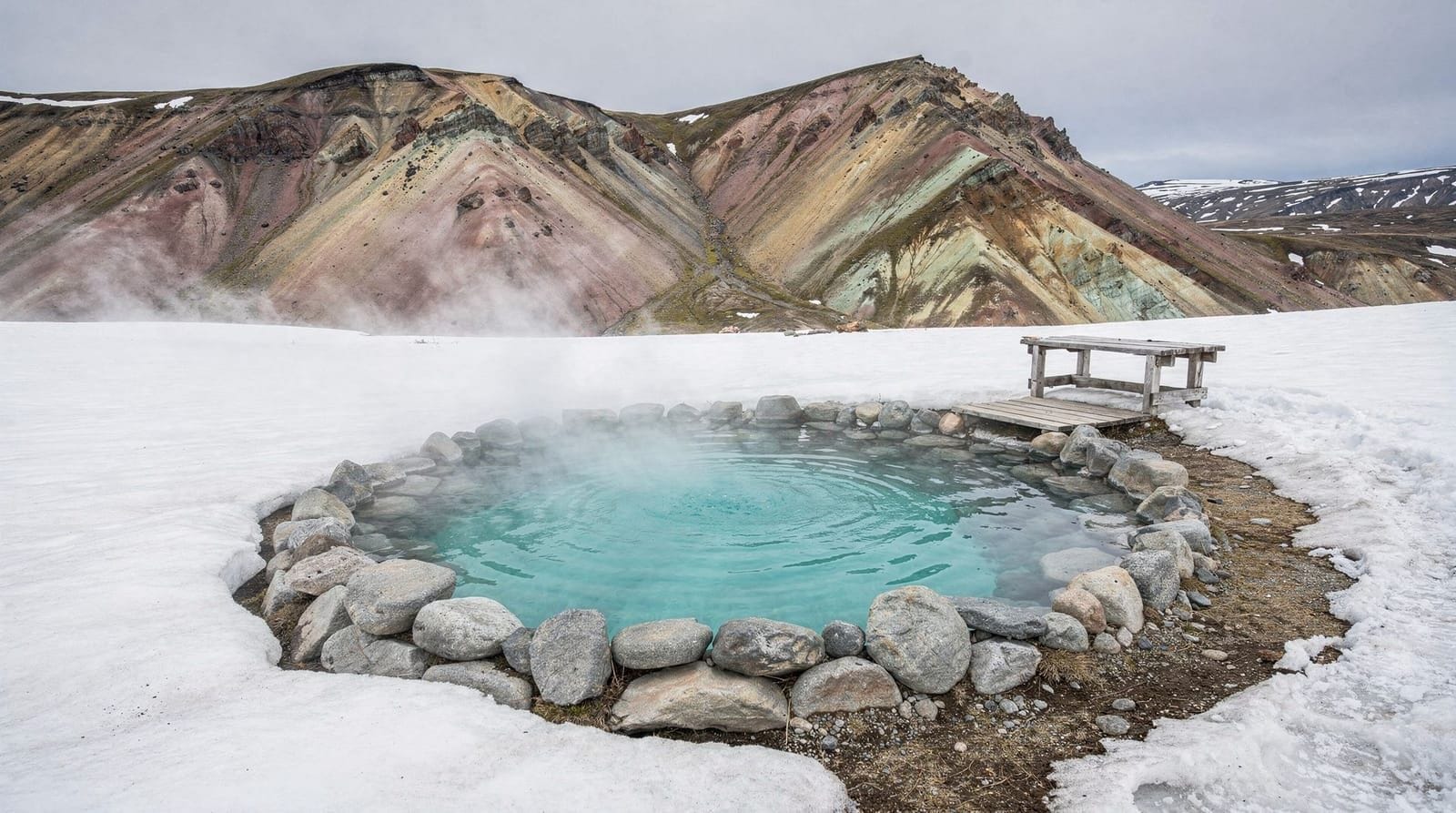
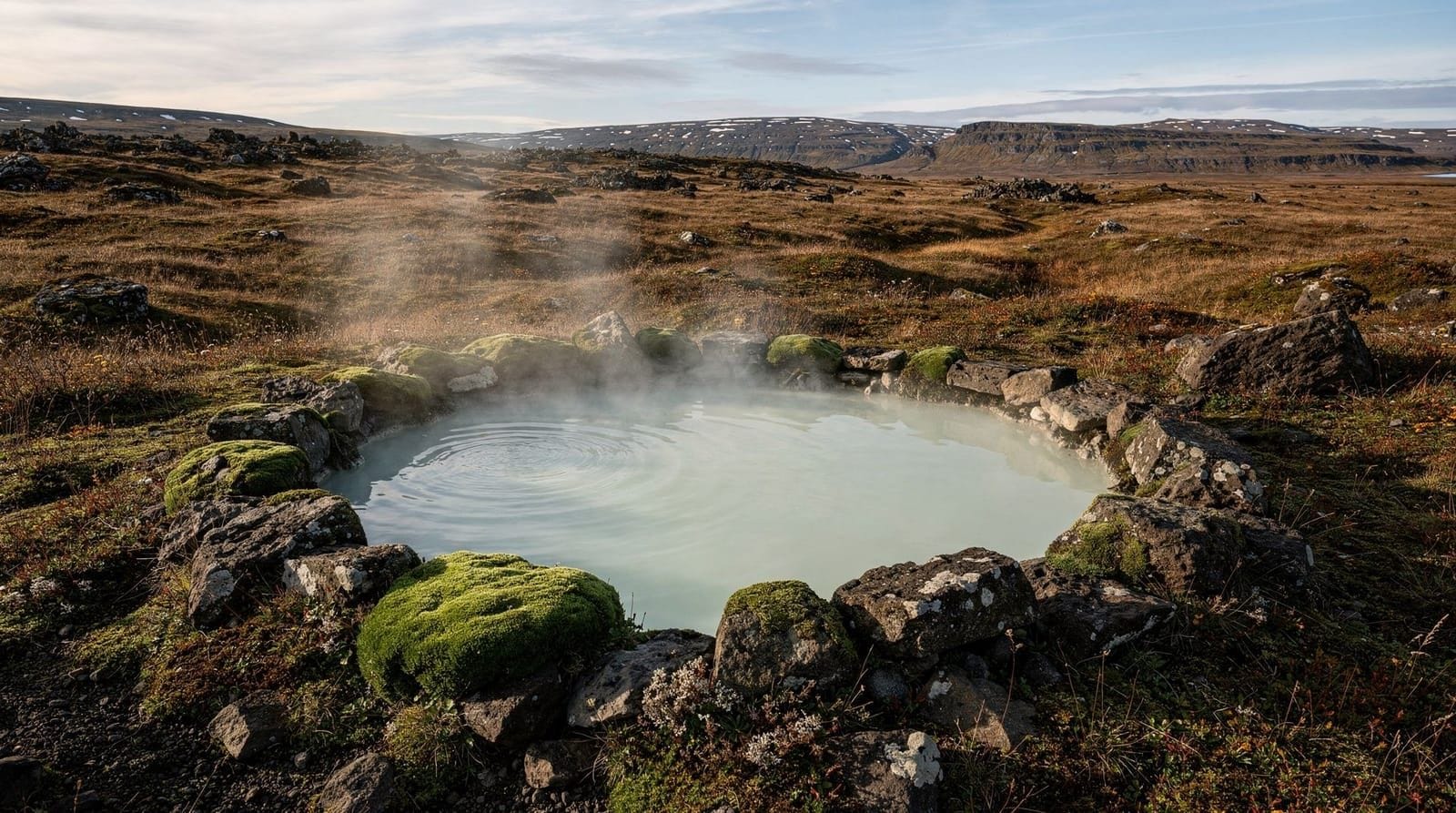
Hvammsvik is a geothermal bathing facility opened in 2021 on the southern shore of Hvalfjörður (Whale Fjord), about 45 km north of Reykjavík by road. It occupies a tidal zone where geothermal springs bubble up through the foreshore at the base of a mountain slope, meeting the fjord at the water’s edge.
| Where | Hvalfjörður fjord, ~45 min north of Reykjavík |
| Cost | around ISK 8,500–10,500 per adult |
| Time needed | half a day, longer with Glymur hike |
| Getting there | self-drive via Hvalfjörður Tunnel (toll) |
| Best time | year-round; low tide for warmest pools |
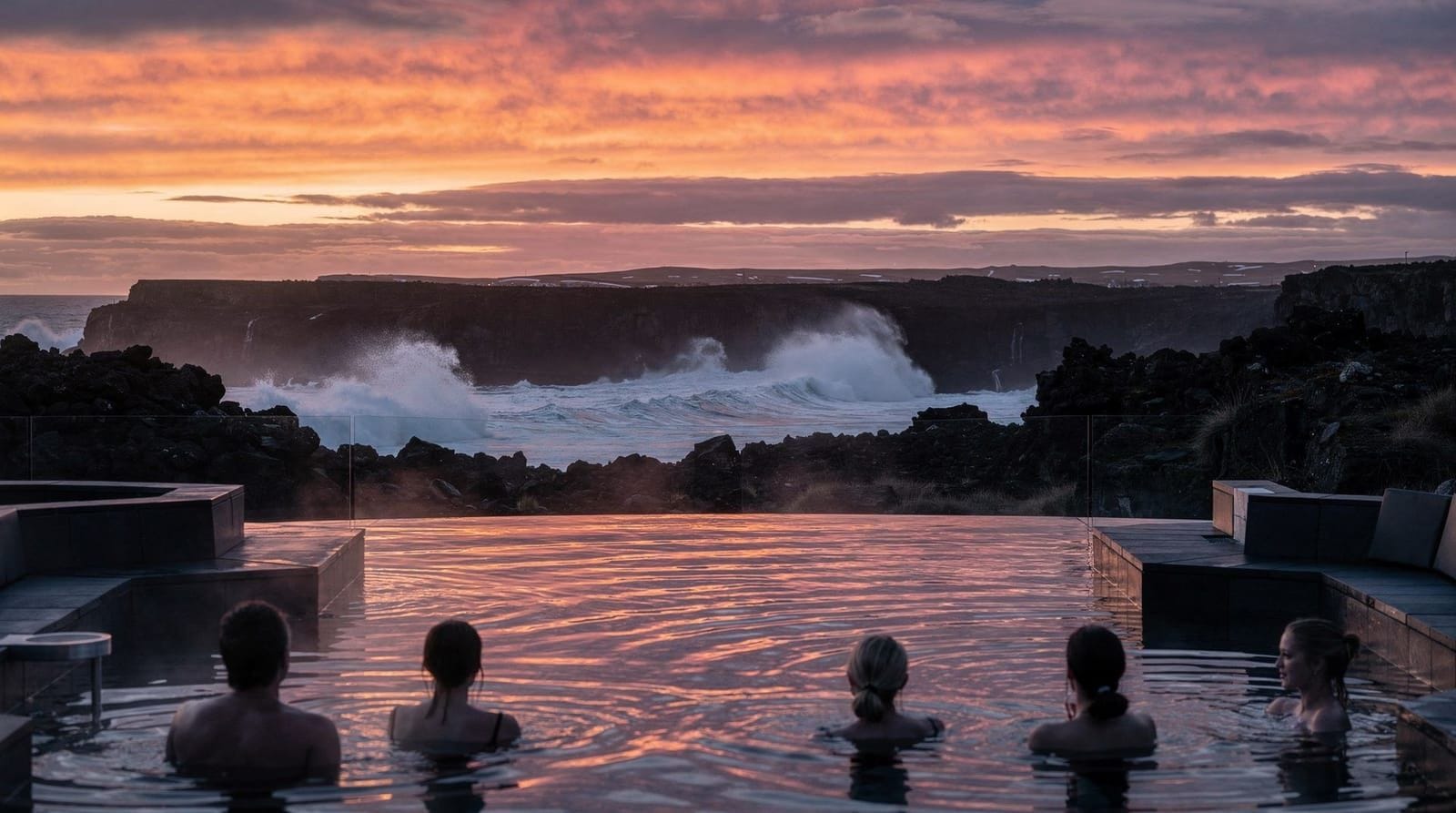
There are eight distinct pools, varying in size and temperature. The smallest hold only a handful of people; the largest could accommodate 20–30. All are outdoors, exposed to weather, and framed by the steep fjord walls and the water. The setting is closer in character to a wild hot spring than a resort spa — no infrastructure dominates the space, no changing rooms visible from the pools, no artificial lighting trying to create mood.
The tidal factor
What genuinely distinguishes Hvammsvik from every other commercial spa in Iceland is the tidal influence. Several pools are positioned at the fjord edge in the intertidal zone. At high tide, sea water washes in and mixes with the geothermal spring water, which has two effects:
Temperature: The mixing cools pools that would otherwise run hotter. A pool that sits at 42°C at low tide may drop to 36°C as the tide rises. Conversely, at certain states of the tide, the mixing creates temperature gradients — one end warm, the other cooler.
Salinity: The water takes on an oceanic quality as salt water mixes in. The combination of geothermal minerals and salt water is unusual — closer to a natural sea pool with geothermal heating than either a freshwater hot spring or a conventional salt spa.
Tide tables for the visit are available at the reception. Most visitors find it interesting rather than inconvenient, but if you want predictable temperatures, visiting within 2 hours of low tide gives the most consistent warm-pool conditions.
Prices and booking
As of 2026, Hvammsvik charges ISK 8,500–10,500 per adult depending on the package and season. A basic admission includes access to all eight pools, the changing facilities, and a towel. A higher tier adds an outdoor sauna session overlooking the fjord and access to a cold plunge pool.
Children under 10 are not permitted. Check current prices on the Hvammsvik website before booking, as pricing has been adjusted several times since opening.
Advance booking is recommended in summer and on weekends. Capacity is deliberately limited to preserve the atmosphere, which means slots sell out faster than facilities with larger pool areas.
Getting there from Reykjavík
By car: Take the Hvalfjörður Tunnel from Reykjavík (toll road, approximately ISK 1,400 for a standard car in each direction). Exit toward Borgarfjörður and follow Route 47 to the signposted Hvammsvik turn. Journey time from central Reykjavík: 35–45 minutes. Free parking at the facility.
Without the tunnel, the route around the fjord adds about 45 minutes. Most visitors use the tunnel.
By public transport: No direct bus service. A private transfer or rental car is required.
From Borgarnes: The facility is 20–25 minutes south on Route 47. Useful if combining with a West Iceland or Snæfellsnes Peninsula trip.
The landscape: why Hvalfjörður matters
Hvalfjörður is one of Iceland’s long fjords — about 30 km from mouth to head — with steep mountain walls on both sides rising to 600–800 metres. The fjord was used as a key Allied naval base during World War II and a whaling station operated at its head until 1989 (the station, Hvalfjörður Whaling Station, is decommissioned but the building remains).
The fjord landscape is dramatic without the tourist infrastructure of the Reykjanes Peninsula or the Golden Circle. On the drive in along Route 47, look for the Glymur waterfall sign — Glymur is Iceland’s second tallest waterfall (198 m), accessed by a 2-hour hike from the fjord road, and is worth combining with a Hvammsvik visit.
Comparing Hvammsvik to Blue Lagoon and Sky Lagoon
Hvammsvik sits between the wild-spring experience and the commercial resort. It is more developed than Reykjadalur but less resort-like than Blue Lagoon or Sky Lagoon.
Against Blue Lagoon: Hvammsvik costs about 40 percent less, is less crowded, has a more natural setting, and does not require crossing a lava field. The Blue Lagoon’s silica-blue water and iconic setting are more visually dramatic. Blue Lagoon is closer to the airport.
Against Sky Lagoon: Sky Lagoon has the 7-step ritual, ocean views, and is only 5 km from central Reykjavík. Hvammsvik is 45 minutes from Reykjavík, has the tidal pools as a genuine differentiator, and is slightly cheaper. Neither is definitively better — they offer different experiences.
For the full range of options, see best geothermal pools in Iceland.
| Hvammsvik | Blue Lagoon | Sky Lagoon | |
|---|---|---|---|
| Distance from Reykjavík | ~45 min | ~45 min (near KEF) | ~10 min |
| Cost (adult, basic tier) | around ISK 8,500–10,500 | around ISK 7,900+ | around ISK 5,490+ |
| Setting | tidal fjord pools | lava field, milky blue water | ocean-view infinity edge |
| Under-10s | not admitted | admitted with adult | admitted with adult |
| Signature feature | tidal temperature mixing | silica mud masks | 7-step ritual |
None of the three is objectively “best” — they suit different priorities. Choose Hvammsvik for quiet and genuine landscape, Blue Lagoon for the iconic bucket-list setting near the airport, Sky Lagoon for convenience and design without leaving the city.
What to expect on the day
Weather exposure: Hvammsvik pools are fully outdoor. Wind off the fjord is a frequent factor. The combination of warm water and cold wind creates the temperature contrast that defines outdoor hot spring bathing, but if severe weather concerns you, check forecasts before visiting. Iceland’s mountain and coastal weather changes quickly.
The changing rooms and facilities: Modern changing rooms with showers, lockers, and hairdryers. The standard is comparable to Sky Lagoon — clearly designed as part of an aesthetic whole rather than an afterthought.
The café: On-site with hot drinks, soup, and light food. Expect ISK 1,500–2,000 for a drink, consistent with Icelandic spa pricing.
Photography: Hvammsvik’s setting photographs well — particularly the pools closest to the water at certain tidal states. The fjord reflection, mountain backdrop, and steam create compelling images. Drone photography is possible on calm days but check airspace rules for the area.
Practical details for planning
Opening hours: Typically 11:00–22:00 on weekdays, 10:00–23:00 on weekends in summer. Hours reduce in winter. Always check the Hvammsvik website.
Winter visits: Hvammsvik is accessible year-round. The Route 47 along the fjord is paved and maintained. Winter visits — particularly in northern lights season — are popular: the fjord reflects the sky, the pools are quieter, and the aurora can be visible from the facility on clear nights.
Combining stops: Glymur waterfall is 10 minutes north along the fjord road. A morning hike to Glymur followed by an afternoon soak at Hvammsvik is a good full-day circuit from Reykjavík. See the Glymur waterfall hike guide for trail details.
Frequently asked questions about Hvammsvik hot springs
How many pools are at Hvammsvik and what temperatures are they?
There are eight distinct pools. Temperatures range from approximately 34°C to 44°C depending on the tide state. At low tide, pools closest to the geothermal source run hotter (40–44°C). At high tide, mixing with sea water brings temperatures down. A cold plunge pool is also available as part of the sauna experience.
Do you need to book Hvammsvik in advance?
Yes, particularly in summer and on weekends. Capacity is intentionally limited. Online advance booking through the Hvammsvik website is the standard method. Walk-ins are sometimes possible mid-week in low season.
Is Hvammsvik suitable for children?
No. Children under 10 are not admitted. This is a firm policy, making Hvammsvik an adult-focused facility like Sky Lagoon. For family-friendly geothermal bathing, municipal pools across Iceland are the best option.
How does the tide affect my visit?
At high tide, pools near the fjord edge mix with sea water and cool somewhat. At low tide, pools are at their warmest (nearest geothermal temperature). The change is interesting rather than disruptive — most visitors find it adds character. Tide tables are available at reception so you can understand what state to expect during your visit.
Is there anything else to see near Hvammsvik?
Glymur waterfall (Iceland’s second tallest at 198 m) is accessible from the fjord road, about 10 minutes north. The Hvalfjörður WWII submarine net station history is visible from the road near the fjord mouth. Borgarnes — a small town with a good saga museum — is 35 km north on Route 1.
What is the best time of year to visit Hvammsvik?
Summer (June–September) for the best weather and longest daylight, though crowds are higher. Winter (October–March) for northern lights potential, lower visitor numbers, and the dramatic contrast of warm fjord water under a cold sky.
How does Hvammsvik compare to a wild hot spring like Reykjadalur?
Hvammsvik is built and managed — proper changing rooms, a café, staff, and an admission fee — whereas Reykjadalur is a genuinely wild river you hike to for free. Hvammsvik gives up the wild-spring authenticity but gains comfort, reliability, and the unique tidal-mixing effect that no wild spring offers. Choose Reykjadalur for the hike-and-earn-it experience, Hvammsvik for comfort with a still-natural feel.
Can I do Hvammsvik as a half-day trip without a full day committed?
Yes. Allow about 3 hours for the pools themselves (changing, soaking, café break) plus roughly 1.5 hours of driving round trip from Reykjavík — a realistic half-day of around 4.5–5 hours door to door. Pairing it with the Glymur hike turns it into a full day; skipping Glymur keeps it a manageable afternoon activity.
Hvalfjörður’s WWII history
Hvalfjörður (Whale Fjord) was a critical Allied naval base during World War II. Between 1940 and 1945, thousands of Allied ships — mainly British and American — used the fjord as a staging point, convoy assembly area, and repair location. At peak wartime use, the population of temporary military facilities along the fjord exceeded the population of Reykjavík.
The submarine net at the fjord mouth — a steel mesh barrier lowered to prevent U-boat entry — was one of the operational infrastructure pieces. The steel pylons that held the net are still visible from the road near the fjord entrance.
In 1942, a US Navy flying boat base was established at Meðalfellsvatn, at the fjord’s head. The remains of several wartime structures can be identified with some knowledge of what to look for, though they are not formally marked.
Historians of WWII naval operations or the Battle of the Atlantic find Hvalfjörður particularly interesting. For general visitors, the wartime context adds depth to what is otherwise experienced as a scenic fjord drive.
Glymur waterfall — the natural combination
Glymur is Iceland’s second-tallest waterfall at 198 metres, accessible from a signed car park on Route 47 about 10 minutes north of Hvammsvik. The hike to the base and upper viewpoint takes 1.5–2.5 hours round trip depending on which of the two loop options you choose.
The classic approach crosses a log bridge at the base of the canyon, climbs steeply to a viewpoint on the canyon rim, and optionally continues to the top of the falls. The longer loop crosses the river near the top and returns via the opposite canyon wall — requires wading through a shallow section or using a log bridge that appears seasonally.
Glymur is not heavily crowded by Iceland standards. The hike involves scrambling in places and is not suitable for young children or visitors with limited mobility. But for anyone who can manage a 200 m elevation gain over 2 km, the views of the canyon and falls are exceptional.
Combining Glymur in the morning with Hvammsvik in the afternoon is a very strong full-day programme from Reykjavík — waterfall hiking before thermal soaking.
The Borgarnes and Borgarfjörður area
35 km north of Hvammsvik on Route 1, Borgarnes is a small town on a peninsula where the Borgarfjörður fjord meets the sea. It is not a significant destination independently, but the Egils Saga Centre (Settlement Museum of Borgarnes) is one of the better saga museums in Iceland — interactive, well-designed, and focused on the story of Egill Skallagrímsson, one of the most complex figures in Icelandic saga literature. Entry is ISK 2,200.
Beyond Borgarnes, the Borgarfjörður valley leads north to Reykholt (where Snorri Sturluson — the 13th-century historian who wrote the Prose Edda — lived and was murdered) and to the Húsafell area (a popular camping and recreation spot).
This combination — Borgarnes for history, Hvammsvik for thermal bathing — makes a coherent west-from-Reykjavík day or overnight trip that avoids the heavily-trafficked Golden Circle route.
Environmental considerations at Hvammsvik
The tidal pools at Hvammsvik exist in an intertidal ecological zone — the interface between marine and terrestrial systems that supports specialised organisms. The geothermal springs that feed the pools are a geological feature of the Borgarfjörður area’s minor geothermal activity (lower intensity than the Reykjanes Peninsula or Mývatn, but present).
The facility’s management of visitor impact on this sensitive zone is a consideration. The pools are built structures rather than natural wild pools — concrete or engineered stone containment that channels the geothermal flow and creates usable bathing areas without fundamentally altering the adjacent tidal zone.
Best practices for visitors:
- Do not enter pool areas outside the designated bathing pools — the adjacent rock and tidal zone is ecologically active.
- No soap or shampoo in the pools.
- Photography of the tidal zone is welcome; collecting organisms or disturbing the substrate is not.
Combining Hvammsvik with the Snæfellsnes Peninsula
For a multi-day west Iceland trip, Hvammsvik fits naturally as a day 1 or day 2 stop before heading north to the Snæfellsnes Peninsula:
- Day 1: Reykjavík to Hvammsvik (afternoon arrival), Glymur hike in morning, Hvammsvik soak in afternoon, overnight in Borgarnes area.
- Day 2: Drive to Snæfellsnes, clockwise circuit via Grundarfjörður, Kirkjufell, and Snæfellsjökull.
- Day 3: Return to Reykjavík or continue on Ring Road.
The Snæfellsnes day trip guide covers the peninsula route in detail. The west Iceland destination guide provides broader regional context.
The broader context of geothermal bathing in west Iceland
West Iceland and the Borgarfjörður area sit within the Western Volcanic Zone — the section of the Mid-Atlantic Ridge that crosses Iceland from the Reykjanes Peninsula through Þingvellir and north toward Langjökull glacier. This zone produces geothermal activity at lower intensity than the Reykjanes Peninsula’s concentrated systems, but the heat is present and exploited at several points.
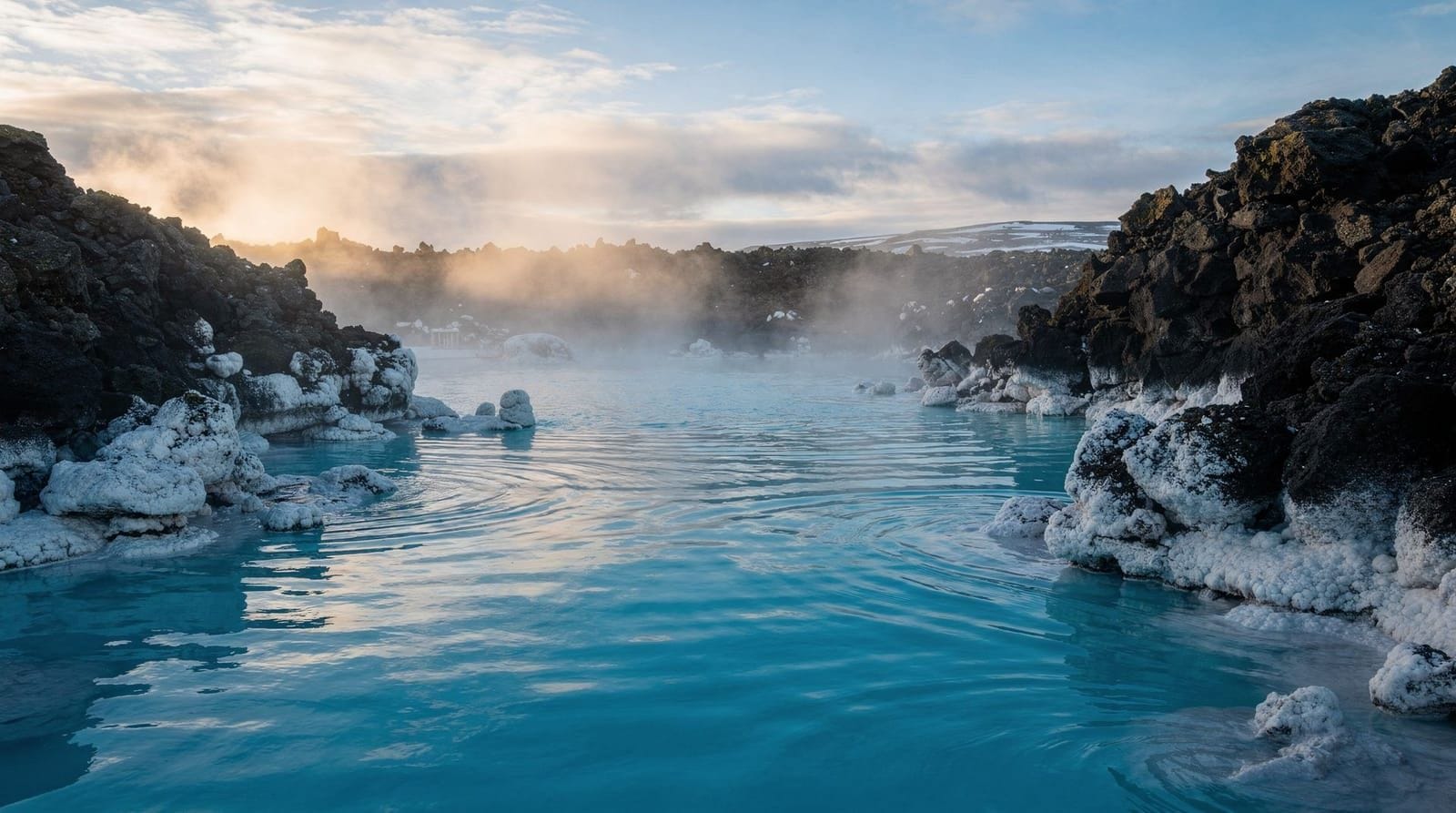
Hvammsvik’s geothermal springs are relatively low-temperature sources compared to the Blue Lagoon’s 240°C deep system or Mývatn’s intense sulphur venting. The pools sit at 34–44°C, the water is clear rather than milky, and the mineral content is influenced by the tidal mixing. This places Hvammsvik firmly in the middle range of Icelandic thermal experiences — more developed than a wild spring, less industrial than a power plant by-product facility.
The area’s geology is less visually dramatic than the Reykjanes lava fields or the Mývatn pseudo-craters, but the fjord setting creates its own distinct character. Hvalfjörður is one of Iceland’s least-visited significant fjords precisely because the tunnel bypass removes the incentive to drive its length. Visitors who take the time to drive the fjord road encounter a landscape that feels genuinely different from the Iceland most tourists experience.
Planning a Hvammsvík visit in practical terms
Getting there without a car: Hvammsvík has no public transport connection. A private transfer from Reykjavík or car hire are the only realistic options. Some visitors join an organised tour that includes the pools as a stopping point on a wider Snæfellsnes or Borgarfjörður itinerary.
What to bring: The pools are outdoor, fully natural-feeling, and exposed to fjord wind. A windproof layer for the walk between pools is worthwhile even in summer. Good shoes for the short walks on the property. A waterproof bag for your phone if you plan to photograph from the water.
Booking window: Hvammsvík manages visitor numbers carefully to preserve the quiet atmosphere. Weekend bookings fill several weeks in advance during summer (June–August). Weekday visits in September and October are easier to secure and the autumn light — low-angle gold over the fjord — is exceptional. Winter visitors (November–February) may experience the northern lights from the pools, which is the reason some travellers plan their entire Iceland trip around a Hvammsvík booking.
Combined route from Reykjavík: Drive west on Route 1 through Mosfellsbær and into the Hvalfjörður tunnel (toll: ISK 1,000 in a standard car), emerge on the north side of the fjord, and follow signs for Hvammsvík. Total drive: approximately 55 minutes. Return the same way or continue north toward Borgarnes and join the Ring Road for a wider West Iceland loop.
Honest cost expectation: Admission plus optional food and drink easily reaches ISK 15,000–20,000 per person for a half-day visit. This is not a budget activity. It is positioned as a premium experience and priced accordingly. For visitors who want the Blue Lagoon concept at smaller scale and with genuine fjord wilderness — rather than the Blue Lagoon’s industrial lava field setting — Hvammsvík delivers on that premise.
Packing checklist specific to Hvammsvik
Beyond the general swimwear and towel basics that any Icelandic pool visit requires, a few Hvammsvik-specific items make the visit smoother. A pair of water shoes or sturdy sandals helps on the uneven natural stone between pools, which can be slippery near the tidal zone. A dry bag or waterproof phone pouch is worth the space in your daypack if you want photos from the water — the phone-in-a-plastic-bag approach that works at Blue Lagoon feels riskier here given the tidal rocks. Because the pools sit right at the fjord edge, a warm layer for the walk from the changing rooms matters more here than at a sheltered facility like Sky Lagoon; the wind off Hvalfjörður is rarely blocked by any structure.
Who Hvammsvik suits best
Hvammsvik rewards visitors who already know they enjoy Iceland’s geothermal bathing culture and want something quieter and more textured than the big-name lagoons. It particularly suits: travellers doing a west-Iceland loop who want a thermal stop that isn’t the Blue Lagoon; couples or small groups looking for a calmer, adults-only atmosphere (no children under 10 changes the soundscape entirely); and photography-minded visitors drawn to the tidal mixing and fjord backdrop. It suits less well: families with young children (barred by policy), travellers on a tight budget who’ve already spent on Blue Lagoon or Sky Lagoon, and anyone without a car, since there is no public transport option at all.
Top experiences
Bookable activities with verified prices and instant confirmation on GetYourGuide.
Top experiences
Best-rated activities across GetYourGuide and Viator.

Top-Rated Family Rafting – Drysuits & Geothermal Hot Cocoa
- Viator

Skip the Line: Secret Lagoon Entrance Ticket
- Viator

Landmannalaugar Guided Hike & Hot Springs - From Reykjavík
- Viator

Goðafoss Waterfall & Forest Lagoon from Akureyri Port
- Viator

Vök Baths Admission Ticket
- Viator

Day Trip to Lake Mývatn And The Nature Baths from Akureyri
- Viator