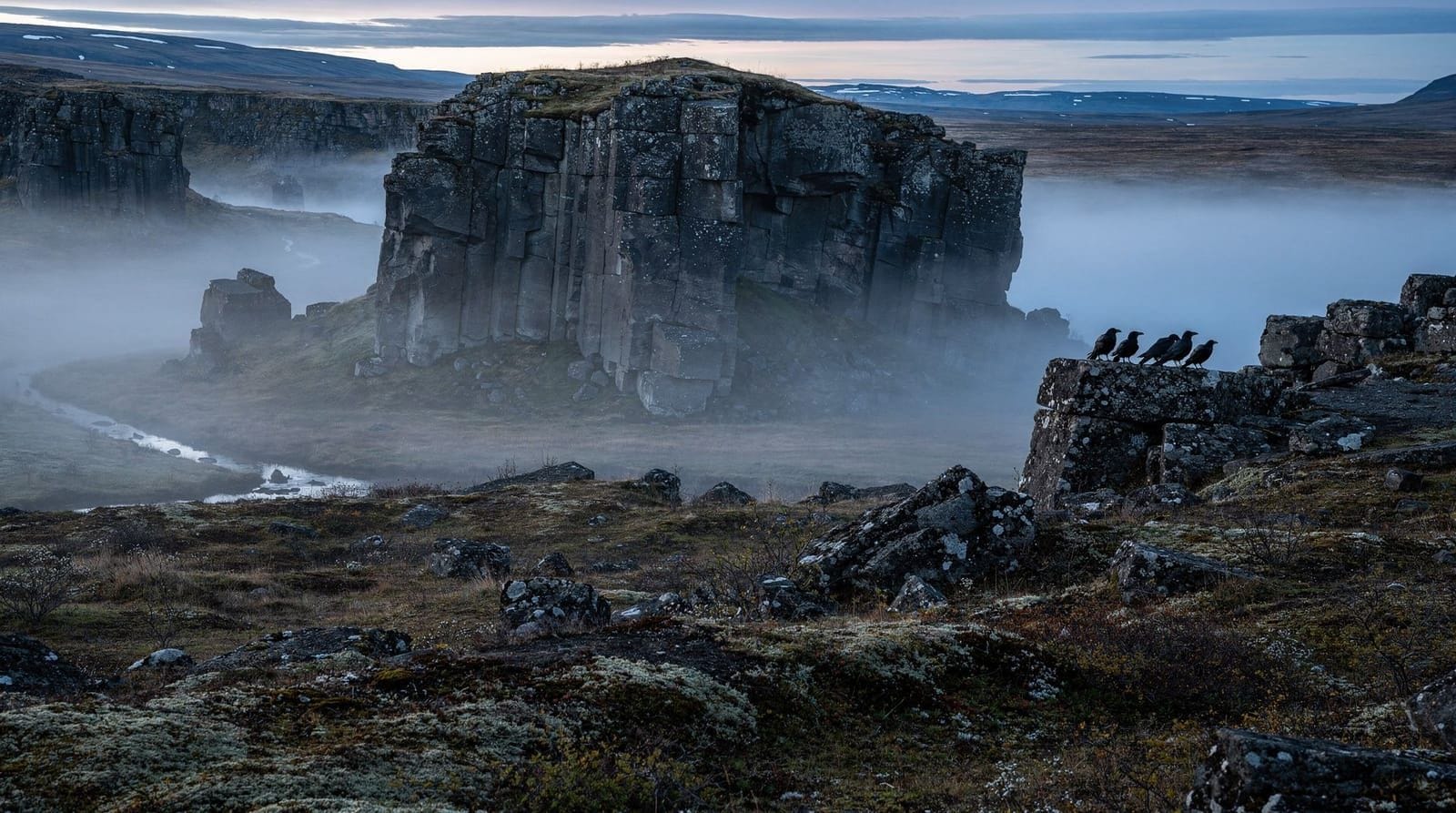
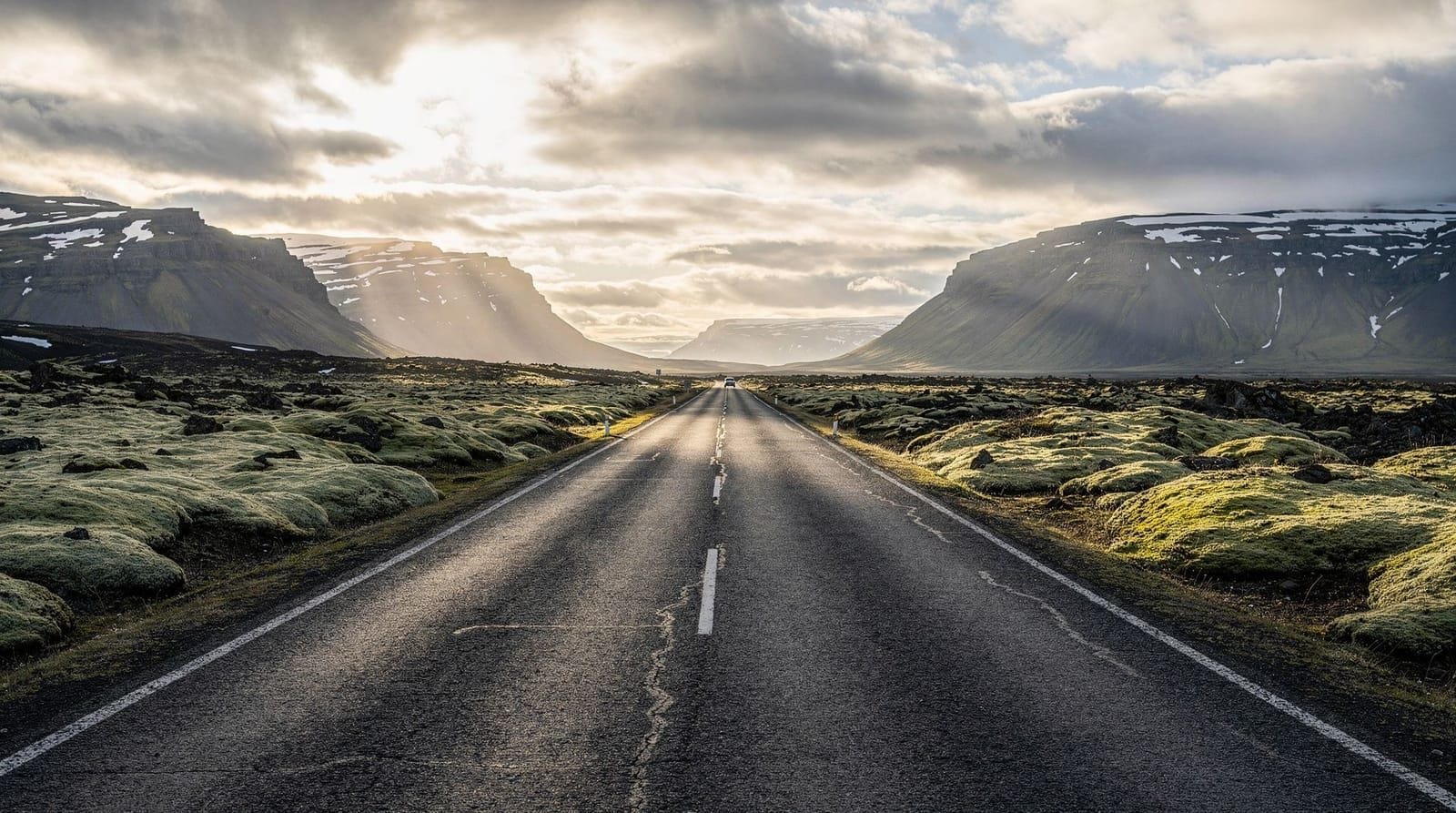
Borgarfjörður valley
West Iceland's Borgarfjörður valley holds Hraunfossar lava waterfalls, Deildartunguhver hot spring, Reykholt saga sites, and the service town of Borgarnes.
Iceland: Private Snaefellsnes peninsula tour from Reykjavik
Quick facts
- Best time
- Year-round; summer for full access to all sites; winter for quiet roads
- Days needed
- Half day from Borgarnes to cover all three main sites; combine with Snæfellsnes for a full day
- Getting there
- 1 hour from Reykjavík to Borgarnes; Hraunfossar is 55 km further (45 minutes on Rte 50)
- Budget per day
- Free for Hraunfossar and Deildartunguhver; museum 2,000 ISK / €13; pool 1,500–2,000 ISK / €10–€14
The Borgarfjörður valley extends inland from the service town of Borgarnes along the Hvítá river, past farms and geothermal fields toward the highland edge. It is not Iceland’s headline destination, but it holds three specific attractions that are either entirely free or very cheap and receive a fraction of the visitor numbers that comparable south coast attractions get. Anyone driving from Reykjavík to the Snæfellsnes peninsula or the Westfjords passes through this valley; spending a half-day exploring it properly costs almost nothing and rewards the effort.
| Where | West Iceland, inland from Borgarnes along the Hvítá river |
| Cost | Free for Hraunfossar/Deildartunguhver; museum ~2,000 ISK |
| Time needed | Half day for the three main sites |
| Getting there | 1h from Reykjavík to Borgarnes; Hraunfossar 45 min further |
| Best time | Year-round; summer for full access, winter for quiet roads |
Borgarnes: practical stop
Borgarnes is a town of around 3,800 people on a spit of land where the Borgarfjörður fjord meets the Hvítá river estuary. It has a large supermarket (Nettó), fuel (N1 and Orkan), a pharmacy, and the Settlement Centre museum. For most visitors it is a logistics stop — fuel and groceries before heading further west. The Settlement Centre (Landnámssetur Íslands) is the exception: it covers the Viking settlement of Iceland and Egil’s Saga through audio-guide exhibitions that run about 75 minutes in total, entry around 2,000 ISK (€13). Skip the tourist-trap souvenir shops on the main street.
The Egilsbúð restaurant in Borgarnes does solid langoustine soup and local lamb. Prices run 3,000–5,000 ISK (€20–€34) for a main course.
Hraunfossar lava waterfalls
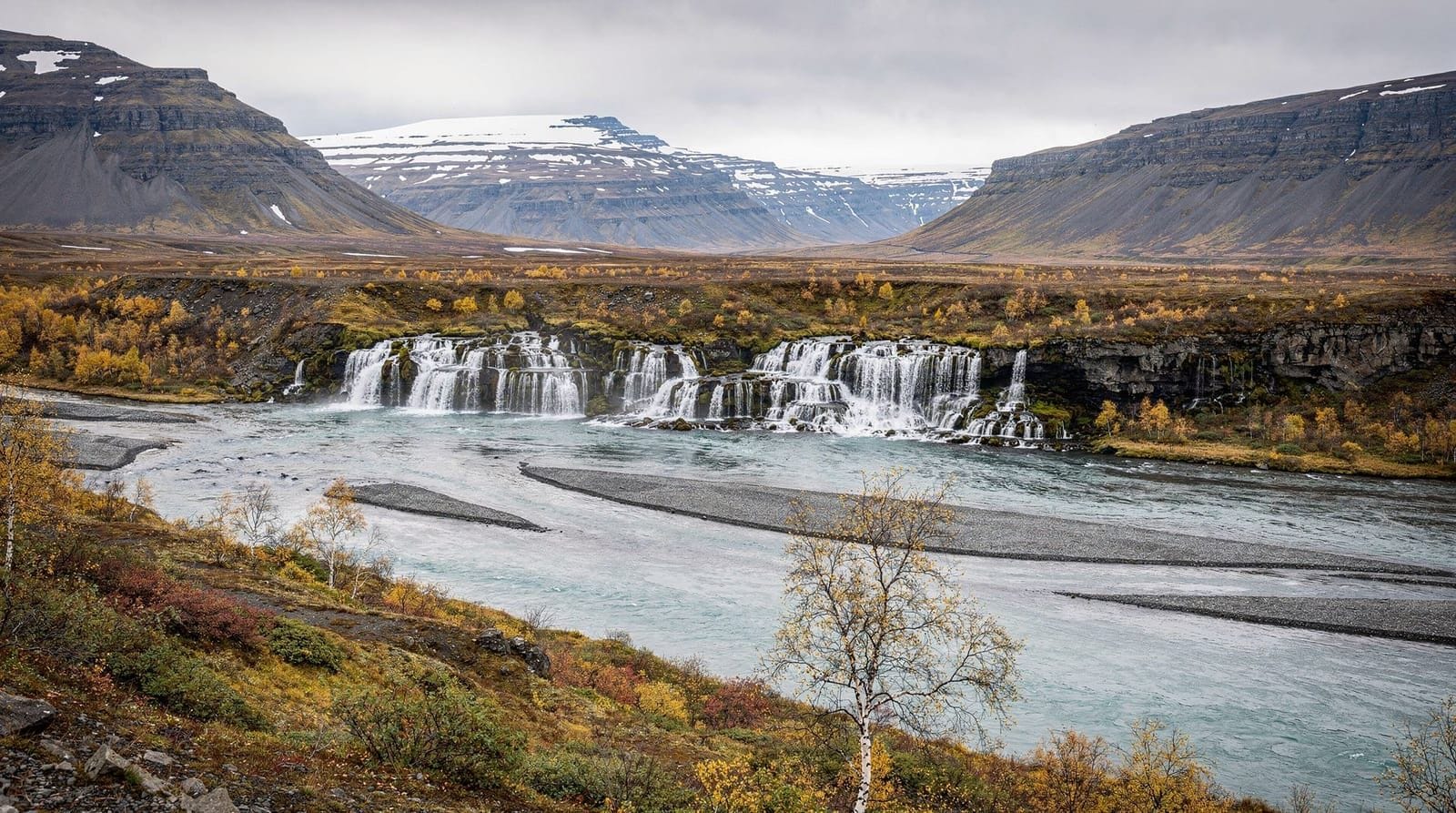
Hraunfossar is an 800-metre stretch of waterfalls that emerge directly from a lava field rather than from a riverbank. The water seeps through the porous Hallmundarhraun lava field for kilometres underground, then surfaces in hundreds of small cascades at the lava’s edge and flows into the Hvítá river below. The visual effect — blue-green water appearing from under solid rock in long parallel lines — is genuinely unusual.
Access is via a signed turnoff on Route 518, about 55 km from Borgarnes (45 minutes). Boardwalks run along the lava edge above the cascades, accessible year-round with no barriers except winter snow. Entry is free. Facilities include car parking, toilets, and a small café (Hraunfossar café, seasonal in summer). The café sells soup and coffee at reasonable prices (around 1,500 ISK for soup).
Immediately upstream from Hraunfossar is Barnafoss — a narrow canyon where the Hvítá river squeezes through a basalt gorge. The two can be seen in a single 30–45 minute walk. In winter, the lava field above is frozen and the waterfalls may be partially iced, creating different but photogenic conditions.
Deildartunguhver hot spring
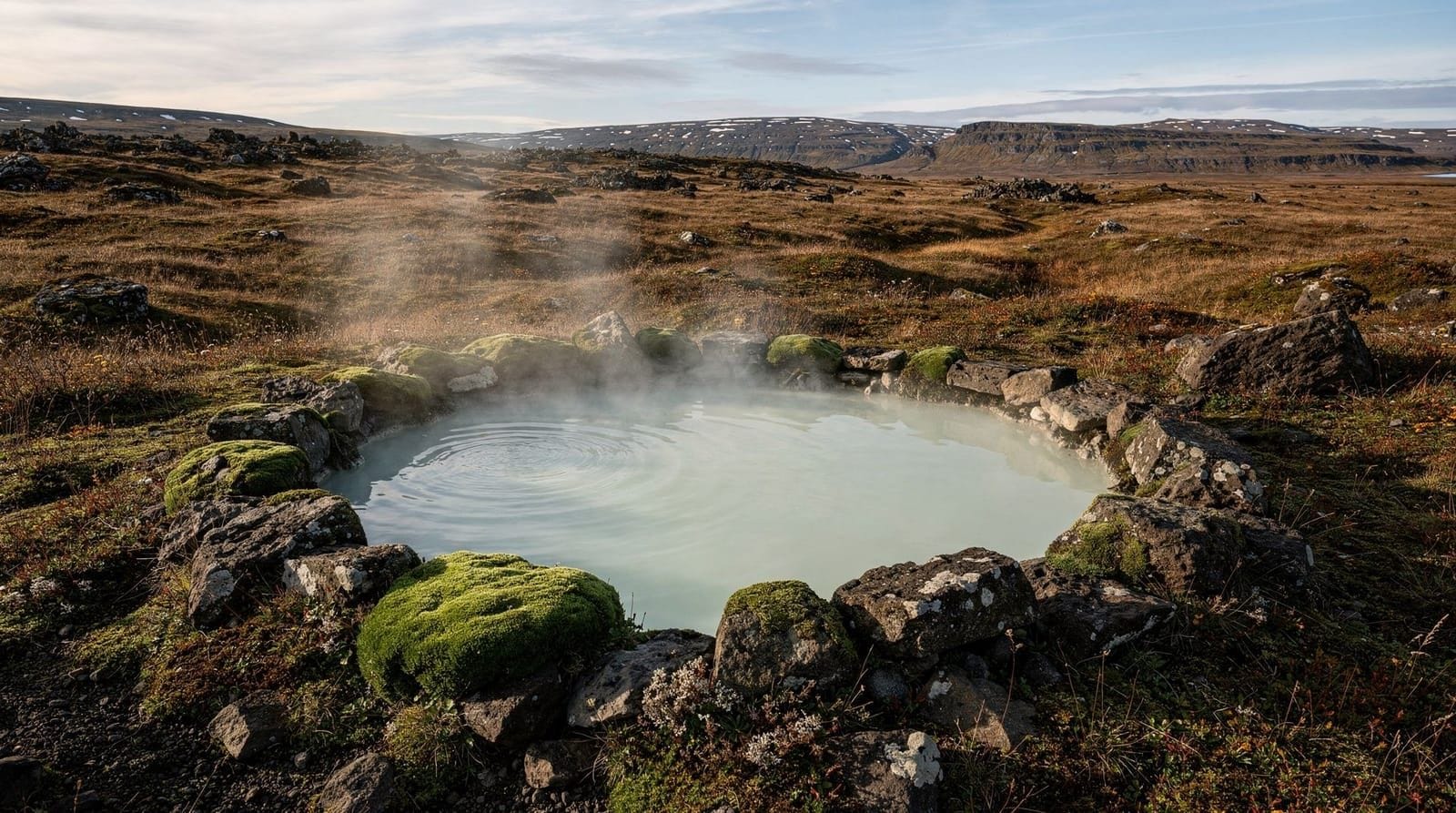
Europe’s highest-flow geothermal spring, producing 180 litres of boiling water per second at 97°C. The spring is at Reykholt (a different Reykholt from the historical farm — this is a small geothermal development area on Rte 50). Entry to view the spring is free; a boardwalk takes you close enough to see the boiling water and smell the sulphur. Do not go off the path — the water is lethal.
The hot spring water is piped to Borgarnes and Akranes for district heating, making it one of Iceland’s most economically useful geothermal sites. On cold days the steam column from Deildartunguhver is visible from several kilometres away.
Adjacent to the spring is Krauma spa — a purpose-built geothermal bathing facility using the Deildartunguhver water (cooled to bathing temperature). Prices run around 5,500–7,000 ISK (€37–€47) for adults, making it more expensive than most municipal pools but cheaper than the Blue Lagoon or Sky Lagoon. The pools are smaller and less designed for crowds, which some visitors prefer. This is a legitimate alternative to the main Reykjavík-area spa experiences if you are already in the valley.
Reykholt historical farm
Reykholt (the medieval one, about 12 km from Deildartunguhver on Route 518) was the home of Snorri Sturluson — 13th-century historian, poet, and politician who wrote the Prose Edda (a foundational Norse mythology text) and the Heimskringla (a history of Norwegian kings). He was murdered here in 1241. The Snorrastofa cultural centre covers his life and writings, and there is an outdoor hot pool (Snorralaug) that dates to his time — one of the oldest preserved man-made structures in Iceland.
Entry to the Snorrastofa museum is around 1,500 ISK (€10). The medieval pool is small and is viewable from outside the museum grounds. Combined with the Egil’s Saga context from Borgarnes, Reykholt completes a half-day saga route.
The Hvítá river
The Hvítá (White River) drains Langjökull glacier and runs through the valley past Borgarnes to Faxaflói bay. Whitewater rafting is operated from a farm near Húsafell — the upper Hvítá has class 3–4 rapids and day-long rafting tours run from Reykjavík. This is outside the standard Borgarfjörður sights but worth noting for visitors who want an active option without going to the south coast.
Connecting to the interior: Húsafell
Húsafell is a recreational area 100 km from Reykjavík at the valley’s upper end, at the foot of the Langjökull glacier. Langjökull is the site of the Into the Glacier tunnel (a man-made tunnel drilled into the glacier, with guided tours from a base near Húsafell — around 18,000–22,000 ISK per person). This adds 45 minutes of driving from Reykholt. For visitors combining a Borgarfjörður valley day with glacier access, this is an option, but Langjökull is covered under the highlands section.
Húsafell itself has a petrol station, a camping area, a 9-hole golf course, and a geothermal pool. It is a quiet base for hikers and families.
Practical notes
Route: the standard Borgarfjörður valley route from Borgarnes takes Route 50 east to Route 518, then loops through Reykholt (historical) and Hraunfossar before returning. Total loop from Borgarnes back to Borgarnes: about 120 km, 2.5–3 hours including stops.
Combination with Snæfellsnes: add this valley loop as the outbound route on a Snæfellsnes day — leave Reykjavík on Route 1, turn off at Borgarnes, do Hraunfossar and Deildartunguhver, then continue on Route 54 to the peninsula. Return direct to Reykjavík via Route 54 and Route 1. This adds about 1.5 hours and 120 km to the total day.
Facilities: petrol in Borgarnes (essential — the next petrol going west is Grundarfjörður, 70+ km). Toilets at Hraunfossar. Café at Hraunfossar (seasonal).
Seasonal notes for the Borgarfjörður valley
Winter visits
The valley is one of the more year-round accessible areas of west Iceland. Hraunfossar remains visually interesting in winter — the lava field above freezes and the waterfalls may be partially iced, creating different but photogenic conditions. Deildartunguhver looks best in cold weather, when the steam column rises dramatically above the boiling spring. Route 50 and Route 518 are ploughed in winter. The Krauma spa is open year-round and is particularly popular in winter months.
Summer peak (July–August)
Hraunfossar sees its highest visitor numbers in July. The car park fills by midday on weekends. Arriving before 9 a.m. or after 6 p.m. gives a calmer experience. The Hraunfossar café is seasonal (open approximately May–September). Reykholt sees modest volumes; the Snorrastofa museum is rarely crowded even in peak summer.
Autumn shoulder
September brings colour changes to the birch woodland around Reykholt and the valley edges. The valley is genuinely beautiful in autumn light and visitor numbers are lower. This is a strong argument for combining a Borgarfjörður valley loop with a September Snæfellsnes visit.
The valley for specific traveller types
History and culture visitors
The Borgarfjörður valley is one of the densest clusters of saga-relevant sites in Iceland. Egil Skallagrímsson (protagonist of Egil’s Saga) was born at Borg á Mýrum farm, visible from Route 54 near Borgarnes. The Settlement Centre in Borgarnes covers his story and the broader settlement of Iceland. Reykholt’s Snorrastofa museum covers Snorri Sturluson, the greatest figure in medieval Icelandic literature. Our guide to the Icelandic sagas has the fuller background before you visit. The two combined make a coherent half-day historical circuit that most visitors to this region skip entirely in favour of heading directly to the peninsula.
Families
Hraunfossar boardwalk access is pram-friendly for the first section. Children respond well to the Barnafoss gorge (the narrow canyon upstream from Hraunfossar) — the scale is comprehensible, the water movement is dramatic, and the folklore (a bridge over the gorge was reportedly destroyed by a grieving mother after her children fell from it) is age-appropriately vivid. The Krauma spa has family pricing and outdoor pools that work well for families with children old enough to swim.
Budget travellers
The valley’s three main sights — Hraunfossar, Deildartunguhver spring, and the Snorrastofa outdoor pool at Reykholt — cost effectively nothing (the spring and outdoor pool are free; the Snorrastofa museum is 1,500 ISK). This makes it among the cheapest half-day activities in the entire West Iceland region. Compare to the Blue Lagoon (9,000–14,000 ISK entry) or Sky Lagoon (9,000–12,000 ISK) — the Krauma spa at 5,500–7,000 ISK is genuinely competitive for quality at significantly lower cost. For more free and cheap geothermal spots around the country, see our wild hot springs guide.
Krauma spa: honest comparison with Reykjavík-area spas
Krauma opened in 2017 and sits adjacent to the Deildartunguhver spring. It uses water from the spring cooled to 36–44°C. The facility has six pools of varying temperature, a cold pool, a steam room, and a rest room. The design aesthetic is contemporary Icelandic (basalt stone, timber, outdoor vegetation). Prices in 2025: adult entry 6,500 ISK (€44); towel and robe rental extra.
Compared to the Blue Lagoon: Krauma costs about 40% less than Blue Lagoon standard entry and has no equivalent of the Blue Lagoon’s silica mud ritual, but also has none of the Blue Lagoon’s scale or marketing apparatus. Queue time at Krauma is a fraction of the Blue Lagoon’s even in peak season. The setting — next to a boiling spring visible from the outdoor areas — is more authentically geothermal.
Compared to Sky Lagoon: similar price range, similar design philosophy. Sky Lagoon is more conveniently located for Reykjavík visitors; Krauma is the natural choice if you are already in the Borgarfjörður valley.
Húsafell and the Into the Glacier experience
Húsafell, at the upper end of the Borgarfjörður valley, is 100 km from Reykjavík and accessible on fully paved road. It is the staging point for Into the Glacier — a man-made ice tunnel drilled through the Langjökull glacier to a series of ice chambers inside the glacier body. Entry includes snowmobile or modified truck transfer from the Húsafell base to the glacier. Prices run approximately 18,000–22,000 ISK per adult, making it one of Iceland’s more expensive activities. The experience — walking inside a glacier in chambers lit with coloured lighting — is genuinely distinctive and requires no physical exertion.
Into the Glacier is a legitimate addition to a Borgarfjörður valley day for visitors who want a glacier experience without the south coast crowds and who have the budget. The glacier access road is maintained and tours operate daily in season (late May–October).
Húsafell also has a 9-hole golf course, a geothermal pool (around 1,500 ISK entry), and several self-catering cabin accommodations at approximately 30,000–45,000 ISK per night for a 2–4 person cabin. The cabins are popular with Icelandic families in summer and book far in advance.
Frequently asked questions about Borgarfjörður valley
Is Hraunfossar worth stopping for?
Yes. It is one of the more visually distinctive waterfall formations in Iceland — water emerging from a lava field rather than from a traditional riverbed — and costs nothing to visit. The combined stop at Hraunfossar and Barnafoss takes 30–45 minutes.
How hot is Deildartunguhver?
The spring water exits at 97°C — functionally boiling at this altitude. The boardwalk keeps you at a safe distance. Do not approach the water directly. The adjacent Krauma spa uses the water cooled to 38–44°C for bathing.
Is the Borgarfjörður valley on the Ring Road?
No. The Ring Road (Route 1) passes through Borgarnes, but the valley itself requires turning off onto Route 50 and then Route 518. It is a deliberate detour of about 120 km round trip from Borgarnes.
How long should I spend in Borgarnes?
If you are not visiting the Settlement Centre museum, 20 minutes (fuel, groceries) is sufficient. If you visit the museum, allow 90 minutes to 2 hours for Borgarnes before heading into the valley.
Can I combine Borgarfjörður with the Westfjords in one day?
Not comfortably from Reykjavík. The valley adds about 1.5 hours and 120 km to the day; the Westfjords are then another 2–3 hours further. This is a very long day (14+ hours). Better to stay in Stykkishólmur or the Westfjords and visit the valley en route.
Do I need a 4WD for the Borgarfjörður valley?
No. Route 50 and Route 518 to Hraunfossar and Reykholt are sealed and suitable for any standard 2WD rental year-round, with normal winter caution. A 4WD only becomes relevant if you continue further into the highlands toward Húsafell and Langjökull glacier access roads.
Is Krauma spa better than doing a municipal pool instead?
If budget is the priority, a municipal pool (around 1,500–2,000 ISK) does the basic geothermal-soak job at a fraction of Krauma’s 6,500 ISK entry. Krauma’s advantage is the design, the smaller crowds, and its position directly beside the boiling Deildartunguhver spring — a more atmospheric setting than a town pool. Choose Krauma if you want a proper spa stop on the route; choose a municipal pool if you’re minimising costs.
Value comparison: the valley’s three main stops
| Stop | Cost | Time | Why go |
|---|---|---|---|
| Hraunfossar + Barnafoss | Free | 30–45 min | Unusual lava-field waterfalls, easy boardwalk |
| Deildartunguhver spring | Free | 15–20 min | Europe’s highest-flow hot spring, dramatic steam |
| Reykholt (Snorrastofa) | ~1,500 ISK | 45–60 min | Saga history, medieval hot pool |
| Krauma spa (optional) | ~6,500 ISK | 1.5–2 hours | Bathing in Deildartunguhver’s water, quieter than Blue Lagoon |
Top-rated experiences in Borgarfjörður valley
Best-rated activities across GetYourGuide and Viator.