Húsavík travel guide
Húsavík is Iceland's best whale watching town. Honest guide to tours, operators, puffins, Whale Museum, getting there from Akureyri, and the best time to go.
Húsavík: Original whale watching
Duration: 3 hours
Quick facts
- Best time
- Jun–Aug for whales and puffins; Sep–Oct still possible
- Days needed
- Half day to 1 day
- Getting there
- 90 km from Akureyri via Route 85, ~1h 15min drive
- Budget per day
- 15,000–30,000 ISK (€100–€200)
Húsavík is a small fishing and service town of around 2,200 people on the shore of Skjálfandi Bay, 90 km northeast of Akureyri. It has been a working harbour since the 9th century — a Swedish Viking named Garðar Svavarsson wintered here around 870 AD, making it one of the first documented overnight stays in Iceland. Today the town is best known as Iceland’s whale-watching capital, with some of the highest sighting rates in the country for humpback whales and minkes.
The harbour has three or four whale-watching operators, a Whale Museum, a wood-clad church photographed by every visitor, and a handful of cafés and restaurants. There is enough to fill half a day around a whale-watching trip, but not much reason to stay longer unless you are using Húsavík as a night stop on the Diamond Circle.
Whale watching on Skjálfandi Bay
Skjálfandi Bay is about 30 km wide and 40 km deep, with depths up to 200 metres. It channels significant marine traffic — krill, capelin, sand eels — that feeds the whales. Humpback whales are the star attraction, typically arriving in May and staying through September; they are sighted on nearly every trip in July and August. Minke whales are present year-round but more visible in summer. Blue whales pass through, particularly in June. Orcas and sperm whales are rare but documented.
Sighting rates in season: Operators report 98–100% summer sighting rates for some species. This is not marketing exaggeration — Skjálfandi is genuinely reliable, more so than Reykjavík or even Akureyri. The main variable is weather: rough conditions can cancel trips.
Operators
Four main operators work out of Húsavík harbour, with meaningful differences in boat type and approach:
North Sailing: The oldest operator, running since 1995. Uses traditional oak-hulled fishing vessels; one boat is carbon-neutral, running on liquid hydrogen. Trips typically 3 hours; prices around 14,000–16,000 ISK (€95–€110). Slower boats allow whales to approach more naturally.
GeoSea / Gentle Giants: Runs a mix of traditional boats and zodiacs. Prices similar to North Sailing.
Húsavík Adventures: Offers speedboat/RIB options — faster coverage of the bay but noisier and colder.
Friends of Moby Dick: Smaller family operation; indoor heated seating available, which makes a difference on cold or wet days.
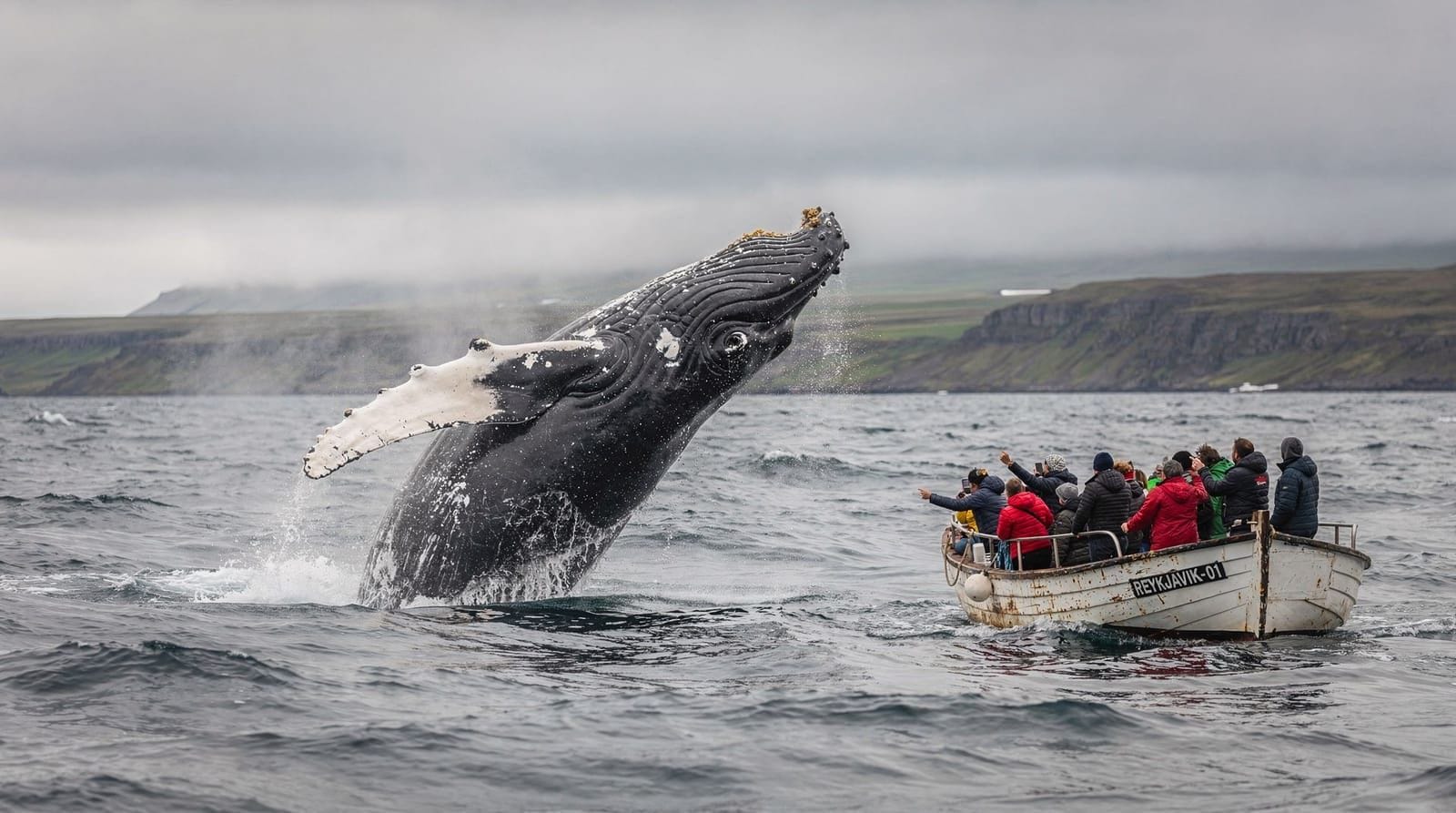
Húsavík’s original 3-hour whale-watching tour — traditional boat, Skjálfandi Bay.
Carbon-neutral oak boat whale watching from Húsavík — North Sailing’s eco option.
Húsavík sits on Skjálfandi bay, where the feeding grounds are close enough that sightings run above ninety per cent in summer: a whale watching trip from Húsavík is the shorter crossing that Reykjavík departures cannot match.
Puffins
Atlantic puffins breed on the small islands in Skjálfandi Bay from late May to mid-August. Several whale-watching operators stop near puffin colonies as part of their route. If puffins are a priority, look for tours specifically advertised as combined whale and puffin trips — they route past Lundey or Puffin Island.
Húsavík speedboat puffin and whale watching — fast RIB, small group, both species.
Practical advice for whale-watching trips
Dress for cold even in summer. Temperatures on the water are 5–10°C colder than shore, and spray adds to the chill. Waterproof trousers and a hat are worth more than an extra sweater. Most operators lend overalls, but wearing your own base layers underneath helps.
Seasickness: Skjálfandi can be choppy. If you are susceptible, take sea-sickness tablets 45 minutes before boarding. The traditional boats are slower but more stable than RIBs.
Cancellations: Tours cancel for safety reasons in rough weather. Operators generally offer refunds or rescheduling; ask about their policy when booking, as peak season rescheduling options can be limited.
The GeoSea Geothermal Sea Baths
GeoSea opened in 2018 on a cliff above the harbour. The pools use naturally warm seawater pumped from 115 metres below the surface, mixed with geothermal water to reach 36–39°C. The view over Skjálfandi Bay is remarkable — on clear days you can see the mountains of Þórsmörk across the bay. Admission is around 5,000–6,000 ISK (€33–€40). Opening hours are roughly 9am–midnight in summer. The combination of whale-watching in the morning and GeoSea in the afternoon is a solid Húsavík half-day.
Húsavík Whale Museum
The GreenHúsavík Whale Museum is in a former slaughterhouse on the harbour — an irony the museum addresses directly. Exhibits include full whale skeletons (including a blue whale at 24 metres), information on whale biology and ecology, and the history of whaling. Well-done, genuinely informative, not a tourist trap. Entry is around 2,900 ISK (€19); 45–60 minutes to do properly.
The church
Húsakírkja, built 1907 in a Scandinavian log-church style, is the most photographed building in Húsavík. It is a working church (Lutheran) and is open during the day. The coloured windows and wooden interior are understated and worth a few minutes inside. Free entry.
Where to eat
Salthúsið: The best restaurant in town, in a converted 1941 salt storage building on the harbour. Fish and seafood — cod, haddock, Arctic char — are cooked properly. Main courses 3,500–5,800 ISK (€23–€39). Book ahead for dinner in July.
Gamli Baukur: The atmospheric waterfront option, popular with post-whale-watching groups. Fish soup, hamburgers, lamb. Prices 2,800–4,500 ISK (€19–€30). Can be loud and busy at peak times.
Naustið: Smaller café near the harbour, reliable for soup and light meals at lower prices.
The Samkaup supermarket on Garðarsbraut handles self-catering basics.
Where to stay
Húsavík has limited accommodation — book ahead, especially for July.
Fosshotel Húsavík: Opened 2019, the most modern and comfortable option. Doubles from 28,000 ISK (€190) in peak season.
North Sailing Guesthouse: Operated by the whale-watching company; serviceable rooms, convenient location. Doubles from 20,000 ISK (€135).
Árból Guesthouse: Long-established family guesthouse. Good value, quiet location a few minutes’ walk from the harbour. Doubles from 18,000 ISK (€120).
Camping: There is a municipal campsite on the edge of town; around 2,000 ISK (€13) per person.
Getting to Húsavík
By car from Akureyri: Take the Ring Road east past Goðafoss, then Route 85 north at Laugar. Total 90 km, approximately 1 hour 15 minutes.
From Ásbyrgi: 65 km southwest on Route 85, about 45 minutes.
From Akureyri as part of the Diamond Circle: Húsavík is typically the last stop on the loop before returning west to Akureyri.
There is no regular bus service to Húsavík. The SBA minibus company runs some summer routes that include Húsavík; check their website. Otherwise, car or organised tour is the only option.
Húsavík and the Diamond Circle
Húsavík sits at the northern apex of the Diamond Circle route. If you are driving the loop from Akureyri, you will typically reach Húsavík after passing through Goðafoss, Mývatn, Dettifoss, and Ásbyrgi. A whale-watching trip or GeoSea visit in Húsavík makes a natural endpoint before the 90 km return drive to Akureyri.
For the full route and logistics, see the Diamond Circle destination page and the north Iceland 4-day itinerary.
Frequently asked questions about Húsavík
What is the best whale-watching operator in Húsavík?
All main operators have high sighting rates and reasonable safety records. The main practical distinction is boat type: traditional oak-hulled vessels (North Sailing, Gentle Giants) are slower and warmer; RIBs cover more ground but are colder and louder. For a first whale-watching trip with mixed groups, a traditional boat is more comfortable. For those who want speed or are short on time, a RIB is efficient. Reading recent reviews on TripAdvisor or GetYourGuide before booking is worthwhile.
What time of year are blue whales in Húsavík?
Blue whales are most frequently sighted in June, when they feed on krill aggregating in Skjálfandi Bay. Sightings are not guaranteed — a blue whale trip is partly luck — but June has the highest probability. By July, humpbacks dominate the bay.
How long are whale-watching trips from Húsavík?
Standard trips run 3 hours on traditional boats. RIB speedboat tours are typically 2–2.5 hours. Longer “midnight sun” trips in June/July sometimes run 3.5–4 hours.
Is Húsavík worth visiting in winter?
Whale watching stops in October and does not resume until May. GeoSea stays open year-round and is particularly atmospheric in winter. The town is quiet and accommodation is cheap (prices drop 40–50%). Northern lights are visible from Húsavík in clear weather from September to March. Unless whale watching is your primary goal, winter is not the main reason to visit.
Can I combine Húsavík and Ásbyrgi in a day trip from Akureyri?
Yes — Ásbyrgi is 65 km from Húsavík, about 45 minutes. A day trip from Akureyri covering both is feasible: drive to Húsavík first (1h 15min), do a morning whale-watching trip (3 hours), lunch, then drive to Ásbyrgi (45 min) and explore the canyon (1–2 hours), then return to Akureyri via Route 85 and the Ring Road. Total driving around 260 km; a 10–11 hour day.
Is puffin season the same as whale season?
Roughly, yes. Puffins breed on coastal cliffs and islands from late May to mid-August, which overlaps with peak whale season. By September, puffins have departed and whale sightings drop. The combined whale-and-puffin tours are only feasible June through mid-August.
The whale-watching industry: what you’re supporting
Húsavík’s whale watching began in 1995 when a local fisherman, Karl Sigurðsson, converted his boat to carry tourists. The industry has grown to several operators and several hundred thousand visitors per year, making it the most significant economic driver in the town. The relationship between the whale-watching industry and whale conservation in Iceland is complicated: Iceland resumed commercial whaling in 1986, suspended it, then resumed limited scientific and commercial catches. Húsavík operators have consistently opposed commercial whaling and some have committed to carbon-neutral operations.
The Húsavík Whale Museum (GreenHúsavík) is explicitly conservation-focused and receives portion of entrance fees for education and research. North Sailing runs a vessel powered by liquid hydrogen, the first of its kind in the tourism industry globally. These are genuine distinctions, not just marketing.
Beyond whale watching: the town itself
Outside the core whale-watching and GeoSea circuit, Húsavík has a few other things worth knowing:
Húsavíkurkirkja: The red wooden church on the hillside above the harbour is one of the most photographed buildings in North Iceland. Built in 1907 in a Scandinavian log style, it looks best in morning light with Skjálfandi Bay behind it. Free entry; the interior has an original 1907 wood organ.
The harbour walk: The working fish processing plant is still active beside the tourist harbour. In summer you can watch the catch being landed — mostly cod, haddock, and capelin. The contrast between the tourist boats and the commercial fishing operation is striking.
Flatey island: A small island in Skjálfandi Bay visible from the harbour. Uninhabited permanently but accessible by kayak or private boat in calm weather. Some whale-watching operators pass close to it.
Húsavík in film
Húsavík became internationally known after appearing in the film Eurovision Song Contest: The Story of Fire Saga (2020), where a fictional song called “Husavik” became a real hit. The song was written by Savan Kotecha and sung by Will Ferrell and Rachel McAdams in the film, then by Molly Sandén. The town embraced the attention — some operators offer “Eurovision tour” add-ons — and the increased visitor interest from the film had a measurable positive effect on bookings.
Planning your Húsavík visit within a Ring Road trip
Húsavík sits at the northern apex of the Diamond Circle and is 90 km from Akureyri via Route 85. For Ring Road travellers, Húsavík requires a 90 km detour north from the Ring Road and back — a 3-hour round trip before whale watching. Most Ring Road guides suggest spending a night in Húsavík to allow a proper morning whale-watching trip without rushed scheduling.
From Húsavík continuing east (rather than returning to Akureyri), you can rejoin Route 85 south through Kópasker and continue along the northeast coast toward Dettifoss and eventually the Ring Road’s eastern section. This is a less-travelled route that avoids backtracking.
For the complete guide to the Ring Road and how North Iceland fits into a full-circle itinerary, see the dedicated guide. For the whale watching comparison guide, which covers all Iceland’s whale watching ports, that page goes into more depth on operator specifics.
Practical checklist for a Húsavík whale-watching trip
Before you arrive:
- Book the whale-watching tour online — July fills up, especially morning slots
- Check the weather forecast (wind above 6–8 m/s may mean rough seas or cancellation)
- Pack waterproof jacket, hat, gloves, and base layers
- Take seasickness tablets if susceptible (45 min before boarding)
In Húsavík:
- Arrive at the operator’s check-in desk 20–30 min before departure
- The harbour is small and walkable from any accommodation
- GeoSea geothermal baths are 10 min walk from the harbour — book in advance for afternoon post-whale-watching slots
- Lunch is best at Salthúsið (book for dinner); Gamli Baukur is reliable for quick post-trip meals
After the trip:
- Whale Museum is 300 metres from the harbour — allow 60–90 min if interested
- Route 85 south toward Ásbyrgi (35 km) if continuing the Diamond Circle
- Route 85 southwest back toward Akureyri via the Ring Road (90 km, 1h 15min)
Húsavík whale watching vs Reykjavík whale watching
| Húsavík | Reykjavík | |
|---|---|---|
| Sighting rate | Higher, especially July | Reliable but less predictable |
| Species variety | Blue whales (June), minke, occasional orca | Mostly minke and humpback |
| Boat type | Traditional oak vessels, slower | Larger ships, some RIBs |
| Price | 12,000–16,000 ISK (€80–107) | 12,000–16,000 ISK (€80–107) |
| Best if | Already in North Iceland | Based in the capital |
The comparison comes up frequently. Both are legitimate options; the distinctions are:
Sighting rates: Húsavík has consistently higher rates for humpbacks, particularly in July. Reykjavík sightings are reliable but less predictable.
Species variety: Húsavík sees more blue whales (June), minkes, and occasional orcas than the Faxaflói bay off Reykjavík.
Boat experience: Húsavík’s traditional oak vessels are slower and more intimate than some Reykjavík operators’ larger ships.
Price: Similar — 12,000–16,000 ISK (€80–€107) at both locations.
Convenience: Reykjavík is the obvious choice if you are based in the capital. If you are already in North Iceland, Húsavík is clearly the right choice.
For the full comparison, see the whale watching Iceland guide which covers all ports, seasons, and species.
Top experiences
Bookable activities with verified prices and instant confirmation on GetYourGuide.
Top-rated experiences in Húsavík travel guide
Best-rated activities across GetYourGuide and Viator.

Whale Watching from Downtown Akureyri
- Viator

Big Whales & Puffins RIB boat tour from Húsavík
- Viator

East Glacial River – Grade 4 Rafting with Drysuits, North Iceland
- Viator

Top-Rated Family Rafting – Drysuits & Geothermal Hot Cocoa
- Viator

Original Big Whale Safari & Puffins Speedboat Tour from Húsavík
- Viator

Lake Myvatn Day Tour and Godafoss Waterfall for Cruise Ships from Akureyri Port
- Viator