Best family itinerary for Iceland — 7 days with children
Reykjavik: From Reykjavik whale watching tour
What is the best 7-day family itinerary for Iceland?
The classic 7-day family circuit covers Reykjavík (Days 1–2), Golden Circle (Day 3), south coast waterfalls (Day 4), Vík and Reynisfjara (Day 5), Jökulsárlón glacier lagoon (Day 6), and return via the Snæfellsnes Peninsula or a second Reykjavík day (Day 7). Self-drive with a rental car is the most practical approach for families.
A 7-day Iceland family itinerary that actually works with children is built on three principles: manageable driving distances each day, activities that land across age ranges, and accommodation with cooking facilities so you are not paying restaurant prices for every meal.
This itinerary assumes a family of 2–4 with children aged 5–14, arriving at Keflavík airport, collecting a rental car, and returning to Keflavík on Day 8. It covers Reykjavík, the Golden Circle, the south coast from Seljalandsfoss to Jökulsárlón, and returns via the Ring Road. For age-specific safety notes that apply throughout, read Iceland with kids alongside this itinerary.
| Length | 7 days driving + 1 arrival/departure buffer day |
| Vehicle | 2WD medium SUV — no 4WD required for this route |
| Cost (in-country) | Around EUR 2,500–3,500 for a family of 4, EUR 1,800–2,200 budget version |
| Best age range | 5–14; adaptable younger or older with the variants below |
| Booking | Book accommodation 4–6 weeks ahead for July, whale watching in advance |
Day-by-day summary
| Day | Region | Overnight |
|---|---|---|
| 1 | Arrival, Reykjavík | Reykjavík |
| 2 | Reykjavík sightseeing | Reykjavík |
| 3 | Golden Circle | Selfoss/Hveragerði |
| 4 | South coast waterfalls | Vík |
| 5 | Reynisfjara, Fjaðrárgljúfur | Kirkjubæjarklaustur |
| 6 | Jökulsárlón, Diamond Beach | Höfn or near lagoon |
| 7 | Return to Reykjavík | Near Keflavík |
Day 1 — Arrival and Reykjavík
Driving: Keflavík to Reykjavík, 50 minutes.
Arrive at Keflavík, collect rental car, and drive to Reykjavík. If arriving late, the priority is supermarket shopping (Bónus near Kringlan mall or Nettó downtown) before accommodation check-in.
Afternoon/evening: if the timing and energy allows, a walk from the Reykjavík Old Harbour to Hallgrímskirkja covers the main city highlights in 2 hours without requiring museums or queues. The harbour seals visible from the Grótta lighthouse area (40 minutes from the Old Harbour by car) are worth a detour if you arrive early.
Accommodation: central Reykjavík apartment with kitchen for two nights. The 101 Hotel area and Hlíðar neighbourhoods both have well-reviewed family apartments.
What to buy today: full supplies for self-catering breakfast and lunch for the week. Skyr, bread, smoked lamb, cheese, instant soups for cold days. Baby supplies if travelling with an infant.
Day 2 — Reykjavík sightseeing and activities
Driving: minimal (Reykjavík stays local).
A full day in the city allows for one paid activity plus free sightseeing. Options by age:
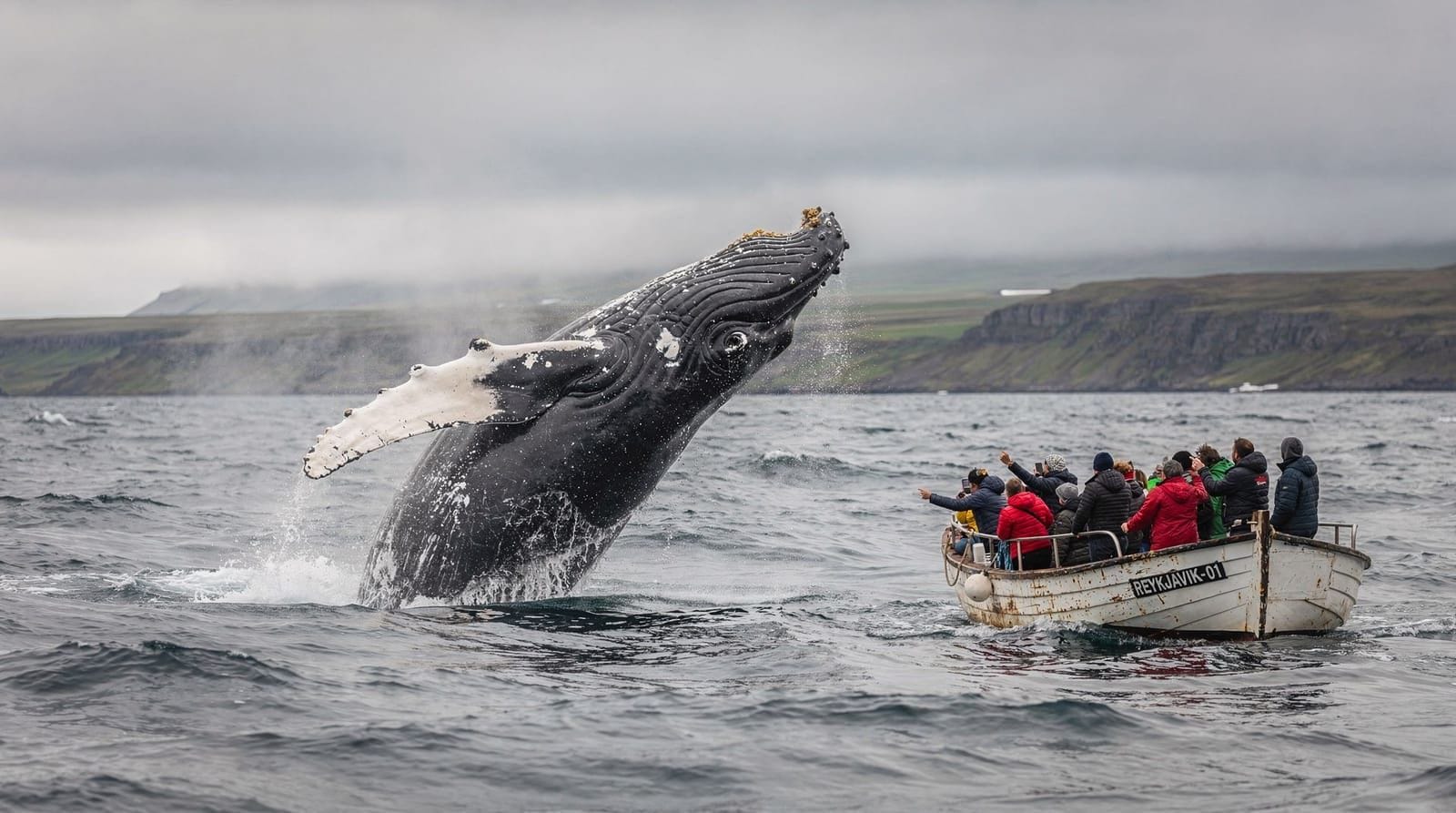
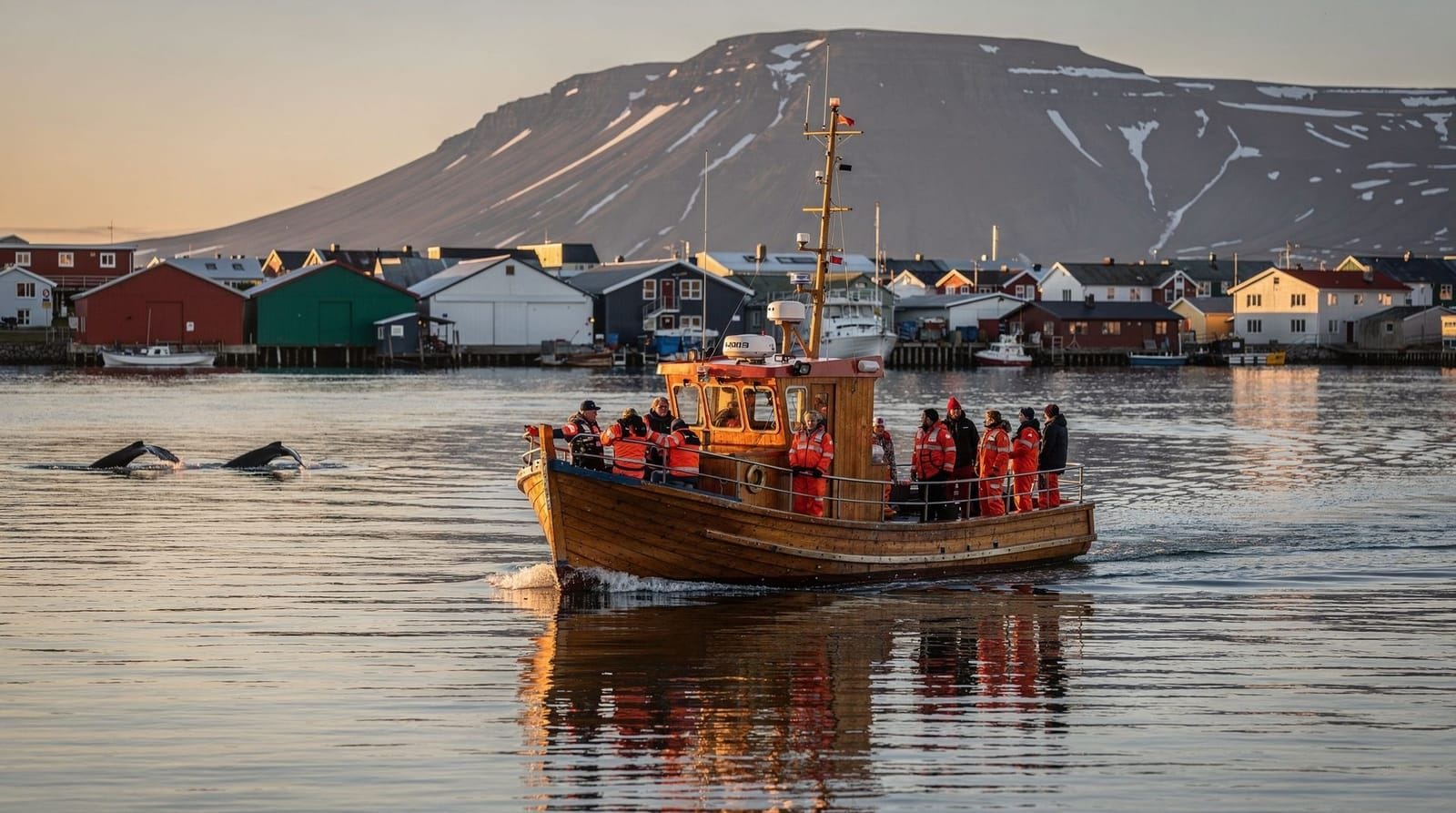
Option A (all ages): Whale watching from the Old Harbour (3 hours, book in advance). Book the large traditional boat tour rather than the RIB — inside seating and a calmer ride. Morning departure usually gives best sea conditions. Return for lunch, then afternoon at the Perlan museum or a city walk.
Reykjavík whale watching tour — traditional boat, indoor seating, departs from the Old HarbourOption B (ages 8+): Laugardalur area — outdoor swimming pool (Laugardalslaug) with water slides, warm pools, and hot tubs. Next to a large park with animal enclosures (Viking-era farm animals). Free entry to the park; pool admission ISK 1,100 per adult.
Option C (rainy day): Perlan museum ice cave and glacier exhibition (ISK 2,500–3,500 per adult; under 7 free) in the morning. Lunch at Bæjarins Beztu Pylsur (the famous hot dog stand — a genuine local institution, ISK 600–700 per hot dog). Afternoon at the National Museum or the Settlement Exhibition.
Day 3 — Golden Circle
Driving: approximately 240 km circuit (Reykjavík–Þingvellir–Geysir–Gullfoss–Selfoss–Reykjavík), 5 hours total driving.
The Golden Circle is the most reliably successful day trip for families in Iceland. Every stop works for different age groups.
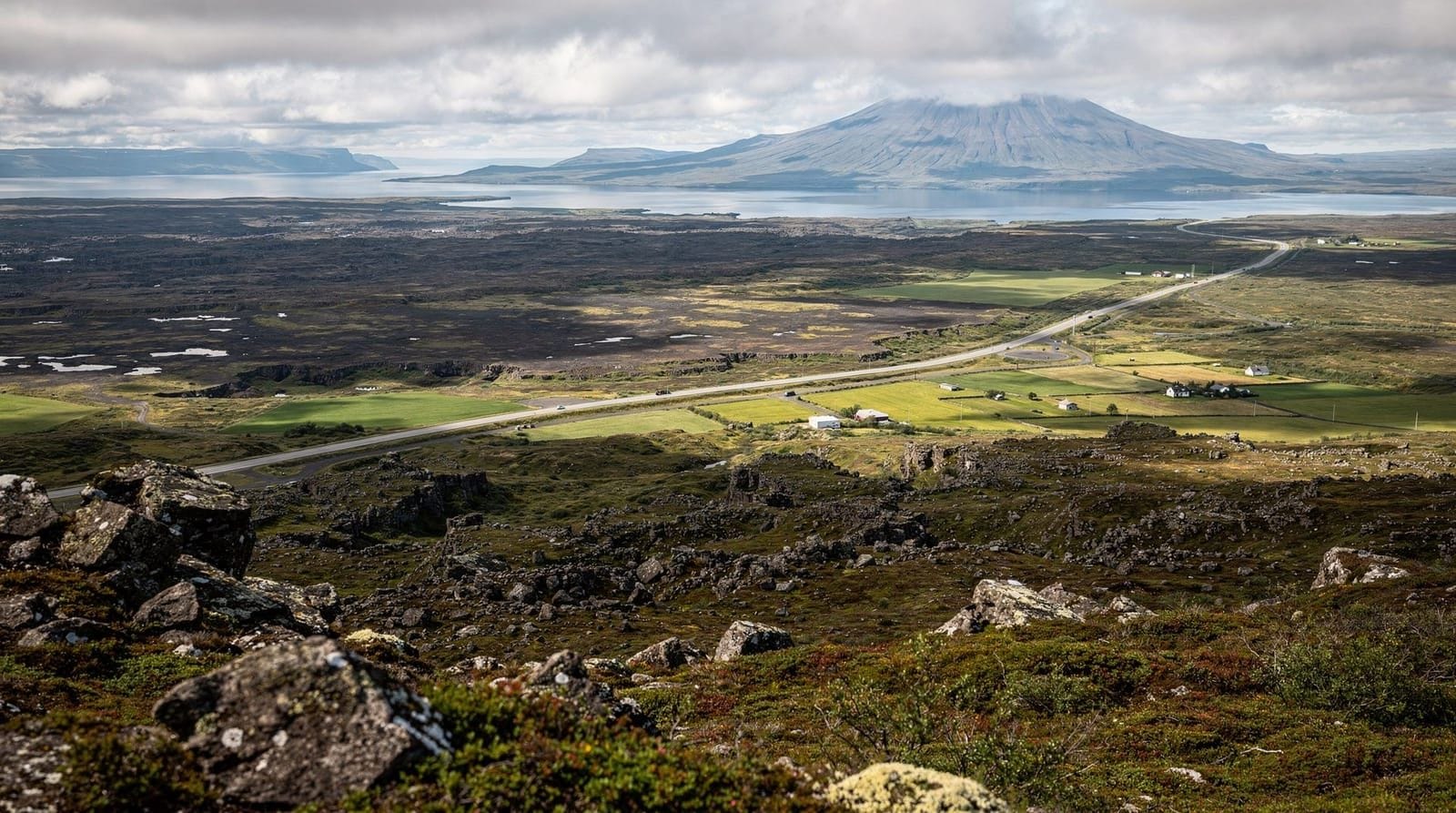
Þingvellir National Park (morning, 1.5–2 hours): flat walking through the tectonic rift valley. The Almannagjá gorge walkway, Öxará river, and the main historical parliament site are all accessible with prams and small children. The tectonic plate explanation (“you are standing between two continents”) is one of the few geology explanations that children retain.
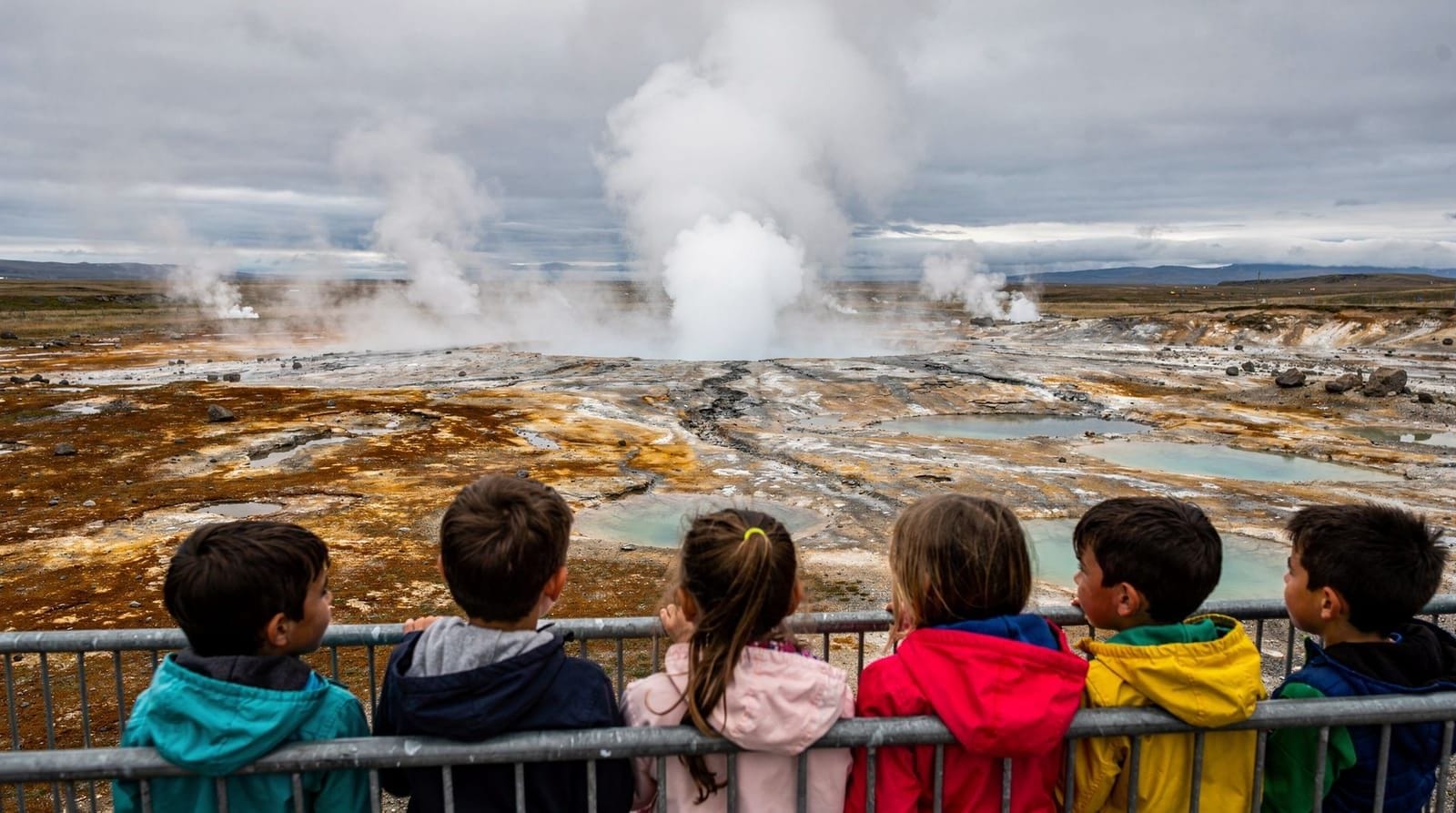
Geysir/Haukadalur (late morning, 1–1.5 hours): Strokkur erupts every 5–8 minutes — the most immediately dramatic Iceland experience for children. The area also has smaller bubbling pools and steam vents. Arrive, watch 3–4 eruptions, eat lunch at the adjacent restaurant or your packed lunch, depart.
Gullfoss (early afternoon, 1 hour): Iceland’s most powerful waterfall is visible from two levels. The upper viewing platform is pram-accessible. The lower platform (closer, wetter) requires careful supervision with young children near the edge. Thunderous and impressive.
Optional additions: Kerid volcanic crater (ISK 800 per adult; 30 minutes) on the drive south. The crater lake is unusual and photogenic.
Night 3: stay near Selfoss or Hveragerði (45 minutes south of Reykjavík). Moving accommodation here saves 90 minutes of driving on Day 4.
Day 4 — South coast waterfalls
Driving: Selfoss to Skógar, approximately 100 km, 1.5 hours.
The south coast waterfall section between Selfoss and Skógar is Iceland’s most visitor-dense stretch and family-friendly for the right reasons — both major waterfalls (Seljalandsfoss and Skógarfoss) are spectacular and accessible.
Seljalandsfoss (morning, 1 hour): the waterfall you can walk behind. Bring waterproof jackets and a change of top — everyone gets wet on the path. Children aged 5+ love this. The footpath is uneven and close to the falls — hold young children’s hands.
Skógarfoss (midday, 1–1.5 hours): the 60 m wide curtain waterfall with a staircase alongside. Walk to the top for views along the south coast. The staircase has railings but is steep — count stairs going up so children know how many to expect coming down.
Afternoon option: drive the remaining 20 km to the Dyrhólaey headland (lighthouse, puffin viewing June–July) or continue to Vík for overnight.
Night 4: Vík or nearby guesthouse (65 km east of Skógar). Many family apartments and guesthouses near Vík.
Day 5 — Reynisfjara black sand beach and Vík
Driving: minimal from Vík (5 km).
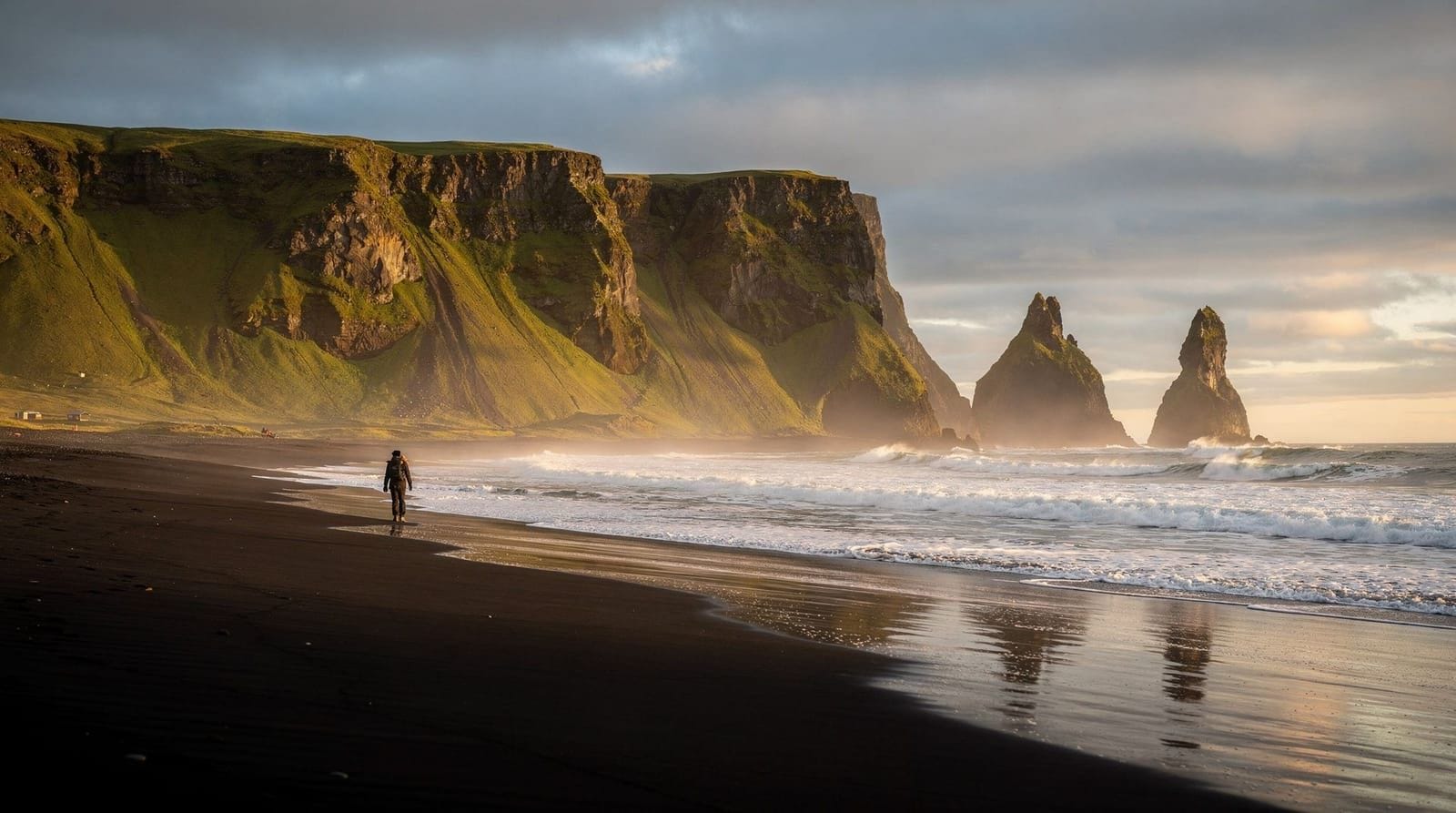
Reynisfjara is Iceland’s most famous black sand beach and one of its most dangerous. The basalt sea stacks (Reynisdrangar) and cave (Hálsanefshellir) are visually extraordinary. The wave danger requires constant attention — see the safety note in Iceland with kids. Never approach the water’s edge. Stand on the dry black sand above the wave zone.
Morning: Reynisfjara (1 hour including photos). The basalt column cave at the beach’s west end is impressive for older children.
Afternoon: drive east toward the glaciers. The road between Vík and Kirkjubæjarklaustur (90 km) runs along the edge of the Mýrdalsjökull and Vatnajökull ice caps. The Fjaðrárgljúfur canyon (10 km from the Ring Road, 20-minute walk each way) is flat and dramatic — a narrow river canyon 100 m deep. Suitable for all ages; prams manage the first 500 m.
Night 5: Kirkjubæjarklaustur area (midpoint between Vík and Jökulsárlón).
Day 6 — Jökulsárlón glacier lagoon
Driving: Kirkjubæjarklaustur to Jökulsárlón, approximately 130 km, 1.5 hours.
Jökulsárlón glacier lagoon is the highlight of the south coast for most children. The turquoise and blue icebergs drifting from the Breiðamerkurjökull glacier into the lagoon before heading to the sea are visually extraordinary. The scale (icebergs the size of cars, some the size of houses) impresses every age group.
Morning: arrive at the lagoon by 10:00. The free viewing area is on the lagoon shore. Book the Amphibian boat tour (ISK 5,500–7,000 per adult; children reduced price) for an on-water experience among the icebergs.
Diamond Beach (opposite side of the road bridge): small ice blocks wash up on the black sand. The contrast of translucent ice on black sand is surreal and children invariably want to touch the ice. Do not walk too close to the wave zone.
Afternoon: optional drive to Skaftafell visitor centre in Vatnajökull National Park (50 km east) for the Svartifoss waterfall walk (5 km return, 150 m ascent, suitable for ages 6+).
Night 6: Höfn (75 km east of Jökulsárlón) or return to a guesthouse nearer the lagoon.
Day 7 — Return to Reykjavík
Driving: return to Reykjavík, approximately 380 km via Route 1, 4–4.5 hours.
A long drive day. Options:
Option A (direct): drive straight back on Route 1 with a stop at the Golden Circle area (already visited on Day 3) or a new stop at the Secret Lagoon at Flúðir (hot spring bathing for the whole family, ISK 2,800 adults, children free — a good end-of-trip treat).
Option B (Snæfellsnes detour): if staying an additional night, detour north after Reykjavík to the Snæfellsnes Peninsula for a half-day at Kirkjufell and Snæfellsjökull National Park before returning to Keflavík area.
Night 7: near Keflavík for an easy airport departure.
Practical logistics throughout the week
Rental car: book a medium SUV (Toyota RAV4 or equivalent) with 2WD — sufficient for the south coast, Golden Circle, and all Ring Road routes on this itinerary. A 4WD is not required for any of these destinations. Book child car seats in advance.
Fuel: fill up at every petrol station opportunity on Day 5 and 6 — the south coast east of Vík has limited stations for long stretches.
Restaurants vs self-catering: aim for 1 restaurant dinner per 2 days. Kronán and Nettó supermarkets have hot food counters in most larger towns — soup and roast lamb are warm, cheap, and filling. Café stops work well for lunch.
Timing: depart each morning by 09:00. Afternoon activities work better than morning for attractions that open at 09:00 — you avoid the tour buses that arrive at 10:00–11:00.
Frequently asked questions about family Iceland itineraries
Should we book all accommodation in advance?
In July, yes — confirmed bookings are essential. In June and August, booking 4–6 weeks ahead is generally sufficient. Farm guesthouses (particularly in the south coast area) offer good family rooms at ISK 18,000–28,000 (EUR 115–180) per family room.
Can children swim in Jökulsárlón?
No. The lagoon water is 0–2°C, the current is unpredictable, and ice blocks can shift. No swimming is permitted. The amphibian boat tours include safety briefings and life jackets.
What should we do on a rainy day?
Reykjavík indoor options: Perlan museum, National Museum, the Settlement Exhibition, Harpa Concert Hall (free to enter the foyer, excellent architecture). South coast rainy day: drive the south coast anyway — rain and cloud make the waterfalls more dramatic, not less. The Golden Circle works in rain.
Is Þórsmörk suitable for families?
The valley is beautiful but the access requires super-jeep transport (no standard car) and the hiking is more demanding than the south coast. Suitable for families with children 10+ who are comfortable hikers. Not suitable for young children or families without significant Iceland driving experience.
Alternative itineraries
5-day short break (first-time families)
For families with limited time, a focused 5-day itinerary hits the main highlights without long drives:
Day 1: Arrive Keflavík, drive to Reykjavík. Supermarket, Old Harbour walk. Day 2: Whale watching morning (book in advance). Afternoon: Perlan museum. Day 3: Golden Circle — Þingvellir, Geysir, Gullfoss. Return to Reykjavík. Day 4: Drive south coast. Seljalandsfoss and Skógarfoss. Overnight near Vík. Day 5: Reynisfjara beach (morning, safety rules observed). Drive back to Keflavík via Route 1.
This itinerary sees the essential Iceland in 5 days with minimal driving complexity.
10-day circuit (families with children 10+)
For families wanting more depth, a 10-day Ring Road circuit includes:
Days 1–2: Reykjavík Day 3: Golden Circle Day 4–5: South coast to Jökulsárlón Day 6: East fjords drive to Egilsstaðir Day 7: North Iceland — Dettifoss, Mývatn Day 8: Akureyri + whale watching (Húsavík option) Day 9: West Iceland — Snæfellsnes Peninsula Day 10: Return to Reykjavík and Keflavík
This circuit works best with an overnight in Höfn (Day 5), Egilsstaðir (Day 6), the Mývatn area (Days 7–8), and Akureyri or Snæfellsnes (Day 9).
Snæfellsnes add-on (2 extra days)
The Snæfellsnes Peninsula is the most undervisited major Iceland attraction for families. Adding 2 days to the standard 7-day itinerary (detouring north after the Golden Circle, before the south coast) includes:
- Kirkjufell mountain and waterfall (the most photogenic spot in Iceland, 1 hour)
- Snæfellsjökull National Park (glacier volcano, lava fields, coastal walks)
- Arnarstapi village (basalt sea arches, birdlife, walkable coastal path)
- Djúpalónssandur beach (lifter’s stones, shipwreck)
The peninsula loop from Reykjavík takes 2 full days, staying overnight near Grundarfjörður or Stykkishólmur.
The driving reality with children
Self-driving with children in Iceland requires honest preparation. Key practical points:
Driving side: Iceland drives on the right. This is only relevant if coming from the UK or Ireland where you drive on the left — adjustment takes a day.
Petrol station intervals: on the south coast and Ring Road sections of this itinerary, petrol stations are every 50–100 km. Never let the tank drop below quarter on any day where you are driving more than 100 km from Reykjavík.
Road surfaces: the Ring Road (Route 1) is tarmac throughout except one short section in the east. Gravel turnoffs to some waterfalls (Seljalandsfoss, Dyrhólaey) require cautious driving but no specialist vehicle.
Driving time with children: add 20–30% to estimated Google Maps driving times when travelling with children under 8. Snack breaks, toilet stops, and the spontaneous need to stop for a roadside horse (a genuine hazard in Iceland) all extend journey times.
Overtaking: limited on single-carriageway roads. Farm vehicles, tourist coaches, and cyclists share Route 1 in summer. Patience, not speed, is the appropriate approach.
Post-trip: what children remember
Informal surveys of families who visit Iceland consistently produce the same top memories for children:
- Strokkur geyser erupting (the scale and sound, the countdown tension)
- Walking behind Seljalandsfoss (the physical sensation of being inside a waterfall)
- Glacier hike crampons (the novelty of walking on ice without slipping)
- Icebergs at Jökulsárlón (the colour and the sheer improbability of the sight)
- Icelandic horses (the size, gentleness, and the unusual tölt ride)
The northern lights are rarely on this list because most families visit in summer. For families who visit in autumn or winter specifically for the aurora, it invariably tops the list. Aurora-focused winter trips with children are feasible from age 8 upward, though the activities available are more limited than summer.
Sustainability and responsible tourism with children
Iceland’s environment is genuinely fragile and teaching children why responsible behaviour matters is easier here than most places:
The volcanic moss that covers highland terrain takes 100+ years to regenerate after being walked on. Showing children the difference between the damaged and intact moss — often visible side by side where trails have widened — makes the “stay on the path” message concrete rather than abstract.
The geothermal areas demonstrate the Earth’s heat visibly. Explaining why the coloured soil is dangerous (hot water close to the surface) gives children a scientific reason to stay on marked paths rather than just a “because we said so” instruction.
The glaciers are visibly retreating — old photographs at glacier visitor centres show the ice margin 10–20 years ago versus today. This is a factual, visible climate lesson with no additional commentary needed.
What to pack specifically for this itinerary
Beyond the usual Iceland packing list, a few items matter specifically for a 7-day family circuit with the driving and activities described above:
Waterproofs for everyone: Seljalandsfoss’s walk-behind path and Skógarfoss’s spray zone soak anyone who gets close. Pack a full waterproof jacket per person, not just a water-resistant one — the difference matters in sustained Icelandic drizzle.
A dedicated bag for wet gear: after Seljalandsfoss and Skógarfoss, damp clothes need somewhere to go that doesn’t soak the rest of the luggage. A large dry bag or bin liner solves this cheaply.
Snacks and a cooler bag: petrol stations along the south coast east of Vík are 50–100 km apart, and children get hungry on a schedule that doesn’t match driving logistics. A small cooler with supermarket snacks avoids both hunger meltdowns and expensive impulse stops.
Car entertainment for the Day 7 return drive: the 380 km return leg is the longest single driving day of the week. Downloaded shows, audiobooks, or simple car games make a meaningful difference to how the day feels for children under 10.
Sun protection even in cool weather: Iceland’s long summer daylight hours mean cumulative UV exposure adds up even on overcast days, particularly at Jökulsárlón’s reflective ice and water surfaces.
Life jackets are provided: the Jökulsárlón amphibian boat tours supply life jackets as standard — no need to bring your own, but confirm sizing for younger children when booking if they’re notably small for their age.
Choosing accommodation type for a family week
The 7-day itinerary above assumes a mix of city apartment and rural guesthouse stays, but the choice between accommodation types affects the trip’s feel as much as the driving route:
Apartments with kitchens (Reykjavík nights): essential for controlling food costs over 2 nights in the capital. Look specifically for a dishwasher and a reasonably equipped kitchen rather than just a kettle and microwave — cooking a proper dinner for 4 after a long day of sightseeing is far easier with real equipment.
Farm guesthouses (south coast nights): often the best value and most memorable accommodation on this itinerary. Many have direct farm-animal contact (sheep, horses) that delights younger children, and family rooms are typically more spacious than equivalent hotel rooms at similar prices. Book these earliest, as the best-located ones near Vík and Kirkjubæjarklaustur sell out first in July.
Cabins near Jökulsárlón or Höfn: a good option for Night 6 if travelling with older children who appreciate more space and a kitchenette. Fewer options exist this far east, so book well ahead for peak summer, ideally at the same time you confirm flights.
Checking for cots and extra beds: many Icelandic guesthouses and farm properties have a limited number of cots and rollaway beds; confirm availability at booking rather than assuming one will be provided on arrival, particularly for infants and toddlers.
Adapting the itinerary for different travel styles
Slower paced (families with children under 7 or babies)
Reduce the daily driving and cut Day 6 (Jökulsárlón) if the south coast driving is proving tiring. An amended version:
- Days 1–3: Reykjavík and Golden Circle as described above
- Day 4: South coast to Seljalandsfoss and Skógarfoss only; overnight at Hvolsvöllur (closer to Reykjavík, less driving)
- Day 5: Reynisfjara and Vík, return to Reykjavík
- Days 6–7: Reykjavík activities (whale watching, Perlan, swimming pool)
This version keeps maximum driving to 2 hours per day and allows afternoon rest at accommodation.
More active (families with children aged 10+)
Add a glacier hike at Sólheimajökull on Day 5 between Reynisfjara and Vík. The glacier is 20 km from Vík and the standard 3.5-hour tour departs at 09:00, 11:00, and 13:00. Book before travelling. Children aged 10+ on most tours.
Alternatively, replace the return Day 7 with a morning at the Secret Lagoon at Flúðir (family bathing) before driving to Keflavík.
Budget-conscious families
The biggest cost reductions come from accommodation and food:
- Replace Reykjavík hotel nights (Days 1–2) with a Kópavogur or Hafnarfjörður apartment (30% cheaper, 15 minutes from centre)
- Self-cater every breakfast from supermarket; eat one hot meal per day maximum
- Replace the second paid activity per day with free alternatives (Þingvellir walks, beach visits, waterfall views are all free)
- Skip the Blue Lagoon (ISK 10,500 per adult) and substitute the Secret Lagoon (ISK 2,800 per adult, children free)
With these adjustments, the in-country cost for a family of 4 for 7 days can be reduced to EUR 1,800–2,200 from the standard EUR 2,500–3,500.
Honest summary: what to prioritise if time is limited
If a family has only 5 days and must choose between south coast and Golden Circle, the south coast wins for visual impact. The progression from Seljalandsfoss to Skógarfoss to Reynisfjara to Jökulsárlón covers the greatest range of experiences in the shortest geographic stretch.
If choosing between Reykjavík activities and a day trip, whale watching wins for children over 5. The Perlan museum is excellent on a rainy day but the whale watching is weather-dependent and should be prioritised on a good day.
If choosing between Iceland in July (peak) and Iceland in late August (shoulder), late August wins for families seeking quieter conditions at major attractions. Seljalandsfoss in late August has half the visitor numbers of mid-July, the same waterfall, and often better light.
For families considering a winter Iceland trip (October–March): the northern lights are a genuine possibility and the dramatic winter landscape is compelling for children aged 10+. The main limitations are shorter daylight (4–5 hours in December), higher activity prices, and the absence of the geological activity hiking season. A winter itinerary focuses on northern lights, geothermal pools (Blue Lagoon, Sky Lagoon), ice cave tours, and Reykjavík city time. A detailed winter family guide is available at Iceland in winter.
Top experiences
Bookable activities with verified prices and instant confirmation on GetYourGuide.