Sustainable travel in Iceland — what it means in practice
Húsavík: Whale watching carbon neutral oak boat
Duration: 3 hours
How do you travel sustainably in Iceland?
The most impactful things are staying on marked trails (off-trail damage is Iceland's most serious visitor-caused environmental problem), avoiding driving off-road on sensitive vegetation, respecting campsite rules, and choosing operators with legitimate environmental credentials rather than green-labelled marketing.
| Biggest impact action | Stay on marked trails — off-trail damage takes 5–10 years to recover |
| Cost | Free (behaviour changes); some certified operators cost slightly more |
| Time needed | 5 minutes to review the Pledge to Iceland before your trip |
| Key resources | safetravel.is, road.is, vedur.is, vakinn.is |
| Avoid | Whale meat, off-road driving, wild camping outside designated sites |
Iceland’s environmental context
Iceland has several large-scale environmental issues that are worth understanding as a visitor:
Glacier retreat: Iceland’s glaciers are retreating at measurable rates due to climate change. Vatnajökull, the largest glacier in Europe by volume, has lost significant mass since systematic measurement began. Sólheimajökull on the south coast has retreated far enough in recent decades that comparison photographs from 30 years ago show dramatically different glacier extents. Several smaller glaciers (Okjökull was declared dead in 2019 with a commemorative plaque) have already disappeared.
Soil erosion: Iceland lost the majority of its original birch woodland cover within the first few centuries of settlement — the settlers needed timber for buildings and charcoal for iron smelting, and Iceland’s slow-growing forests did not recover. Large areas of highland Iceland that were wooded at settlement are now bare rock and gravel. The Soil Conservation Service of Iceland (Landgræðsla ríkisins) has operated since 1907 to address ongoing erosion.
Invasive species: The Alaskan lupine introduced in the 1940s has spread across Iceland and crowds out native vegetation. It is simultaneously credited with binding soil effectively and blamed for reducing biodiversity. A genuine scientific debate about whether to eradicate it is ongoing.
Renewable energy and aluminium smelting: Iceland uses almost entirely renewable electricity (hydroelectric and geothermal), but a significant portion powers aluminium smelters owned by international companies that use Iceland specifically for cheap renewable energy. The environmental impact of the smelters — land use, air quality, ecological disruption from hydroelectric dams — is a persistent policy debate.
Iceland’s environmental context
Iceland has particular vulnerabilities that make responsible travel behaviour more consequential than in most destinations. The combination of fragile vegetation, easily damaged soil, and a tourist industry that grew from 500,000 visitors per year in 2010 to over 2 million by 2018 created pressures that the landscape and infrastructure were not designed for.
Three factors make Iceland’s environment more fragile than it appears:
Soil instability: Much of Iceland is underlain by volcanic ash (tephra) and fine-grained sediments with minimal binding vegetation. Walking or driving off established paths can destroy the plant root systems holding soil in place, creating erosion channels that persist for decades.
Slow vegetation growth: Iceland’s growing season is short (roughly June–August). Mosses and grasses recover extremely slowly from damage. A single off-trail footprint in a moss field can take 5–10 years to show visible recovery.
Limited tourism infrastructure outside main sites: Beyond the primary visitor sites, Iceland lacks the fencing, signage, and ranger presence of more intensively managed tourism destinations.
Off-trail damage — the most important issue
If there is one behaviour change with the most environmental impact, it is staying on marked trails and designated paths.
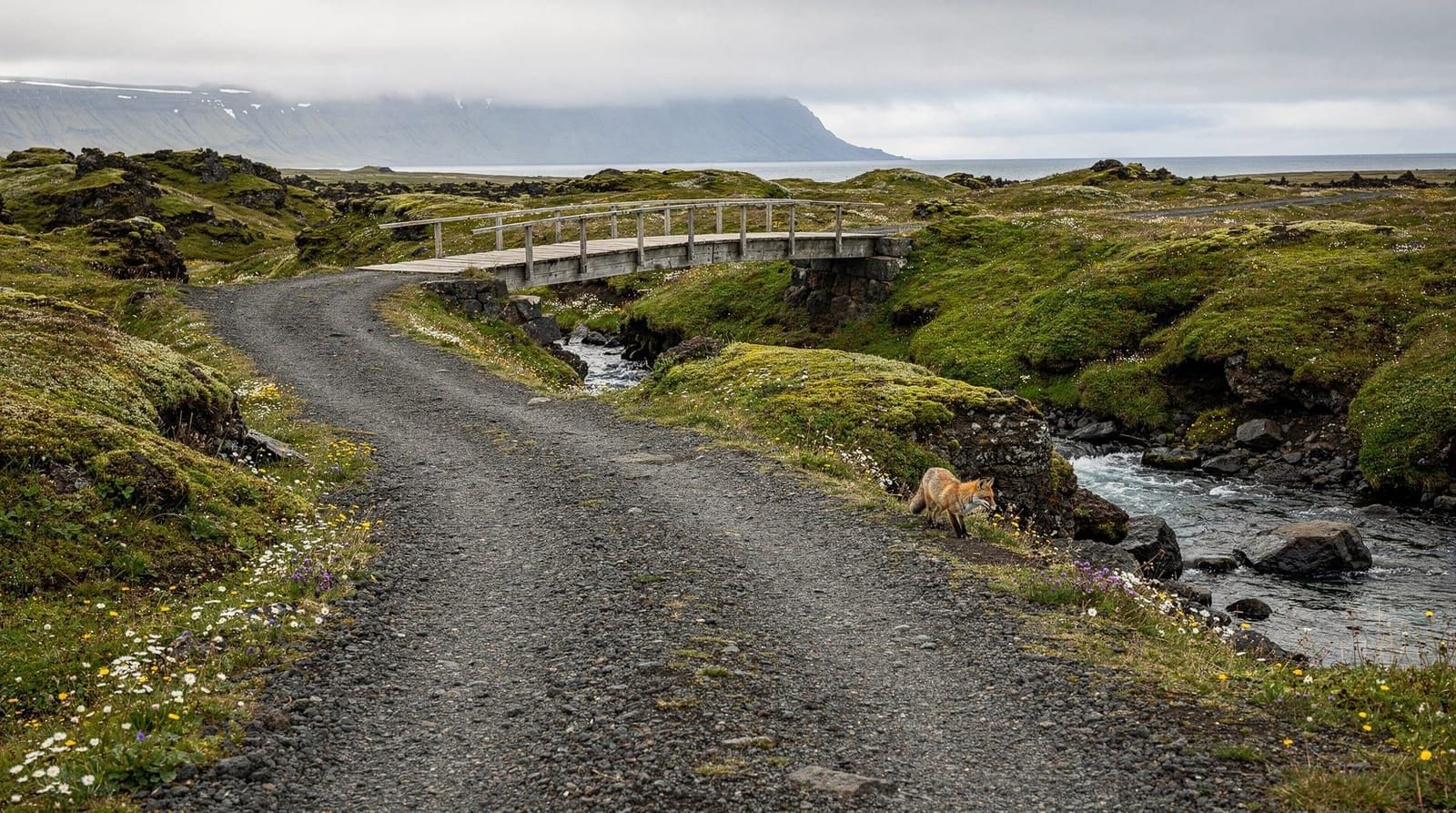
The moss-covered lava fields that cover much of Iceland — iconic in photographs, the result of centuries of slow colonisation by Racomitrium and other species — are severely damaged by foot traffic off established paths. The moss compresses under pressure, root systems break, and the surface desiccates. At popular sites, visitor numbers have created visible braided erosion paths around single-file trails where people walked slightly off-path.
Specific places where off-trail damage is acute:
- Landmannalaugar and the rhyolite highlands
- Þórsmörk valley vegetation
- Geothermal areas around Lake Mývatn
- Jökulsárlón glacier lagoon foreshore
- The rim areas around Kerið crater
The Icelandic Environment Agency (Umhverfisstofnun) publishes current damage maps and trail closures. Areas under active revegetation are fenced and signposted — respect these even if there is no physical barrier.
Off-road vehicle driving
Driving off the road surface in Iceland is illegal outside designated off-road areas and has been since 1999. The law exists because vehicular off-road driving is catastrophically damaging — tracks through the highland moss can remain visible for 50+ years.
The enforcement of this law has been inconsistent, but penalties are real and can include significant fines. More to the point: the damage is severe and permanent on a human timescale.
F-roads are the designated rough-terrain routes through the highlands. Everything else is road surface. “4WD access” does not mean off-road access.
Campsite behaviour
Illegal camping — setting up tents outside designated campsites — has been a significant issue in the period of rapid tourism growth. Iceland’s camping culture has rules that differ from some free-camping traditions elsewhere:
- Designated campsites: Tent camping on private land without permission is prohibited
- “Responsible camping” law (2015): Camping outside designated sites in many popular areas is explicitly illegal
- Leave No Trace principles apply: No campfires outside designated fire areas, all waste packed out
The Iceland Camping Card (campingcard.is) provides unlimited camping at 50+ official campsites — a structure that channels campers toward designated and managed sites rather than dispersed wild camping.
For campsite-specific rules at popular destinations, see the campervan Iceland guide.
Overtourism hotspots and alternatives
Several locations have seen visitor numbers that damage the physical site or significantly degrade the experience quality. Being honest about this helps visitors make different choices:
Geysir-Haukadalur: Strokkur erupts every 5–10 minutes and is the most-visited natural site in Iceland. The area around the geyser field is managed with boardwalks, but pressure on the parking, facilities, and surrounding paths is intense in July. Visiting before 9am or after 7pm reduces the impact and improves the experience.
Seljalandsfoss: The path behind the waterfall (when open) is the specific draw. In summer, the car park fills and queues form. The path is narrow. A late evening visit (10pm+ in summer) is a completely different experience.
Reynisfjara black beach: Sneaker waves are a genuine hazard here and have caused visitor deaths. The wave danger has not reduced the visitor numbers. Stand well back from the water regardless of how calm it appears — rogue waves arrive without warning.
Diamond Beach: Sitting on or moving icebergs is dangerous and prohibited. Some visitors climb onto stranded ice chunks for photographs — the ice is unstable and the water is lethal.
Genuine alternatives to the most-crowded sites:
- Instead of Geysir: Hveravellir in the highlands (accessible June–September) or the Krísuvík geothermal area on the Reykjanes Peninsula
- Instead of Seljalandsfoss: Skógafoss (equally impressive, different character, some months less crowded), or lesser-visited falls like Gljúfrafoss just 200m from Seljalandsfoss
- Instead of Reynisfjara: Dyrhólaey headland has better views and no sneaker wave risk
Puffin watching — the critical notes
The Atlantic puffin is classified as vulnerable — its global population has declined significantly due to food availability changes linked to climate change. Iceland holds one of the world’s largest puffin breeding populations.
Responsible puffin watching means:
- Not approaching active burrows at nesting sites (stress to nesting adults can cause nest abandonment)
- Not entering fenced areas even when puffins are visible inside them
- Keeping a minimum distance — most respectable tour operators use 5–10 metres as a guideline
The Látrabjarg cliffs and Vestmannaeyjar are the two main colonies. Local rangers at Látrabjarg ask visitors not to get closer than 3 metres to any bird.
Whale watching ethics
Iceland continues to permit commercial whale hunting for minke and fin whales, which is a source of ongoing controversy. Tour operators that actively support whale watching research — particularly IceWhale members — are distinct from whale watching operators that have no particular environmental programme.
Several operators in Húsavík use carbon-neutral vessels or offset emissions. The Húsavík Whale Museum supports research. These are specific, verifiable claims that differ from generic “eco” labelling.
Carbon footprint of Iceland travel
Iceland is a long-haul flight from North America and a medium-haul flight from Europe. The carbon cost of getting there is real and not offset by taking shorter showers on arrival.
Honest carbon management means acknowledging the flight emissions and either reducing them through longer stays (fewer round trips for the same time in Iceland), offsetting through credible schemes (Gold Standard or Verra certified), or reducing air travel in other parts of your travel pattern.
Within Iceland, the country runs primarily on renewable energy (geothermal and hydroelectric) — electricity and geothermal heating have near-zero emissions. Electric vehicle adoption is growing, and the rental fleet includes a significant proportion of hybrid and electric options. For a self-drive trip, an electric or hybrid rental meaningfully reduces in-country emissions.
Practical green travel tips
- Choose longer stays: One 10-day trip rather than two 5-day trips reduces the flight emissions for the same Iceland experience.
- Travel in shoulder season: Reduces pressure on peak-crowded sites and provides better economic distribution to communities beyond the main tourist circuit.
- Use official campsites: The Iceland Camping Card structures camping toward designated sites where waste and water management are proper.
- Stay on trails: More consequential than any product purchase or certification.
- Support local food: Icelandic lamb, skyr, and seafood have substantially lower food miles than imported alternatives.
- Bring a reusable water bottle: Iceland’s tap water is drinkable directly everywhere in the country — buying bottled water is unnecessary and plastic-wasteful.
Certification and genuine operators
The Vakinn quality and sustainability label (run by the Icelandic Tourist Board) has a specific sustainable tier that operators must qualify for through audited practices. It is not a comprehensive guarantee, but it is a starting filter.
The Earthcheck certification has been adopted by some larger Icelandic operators and provides third-party verification.
Be sceptical of operators that use “eco” or “green” as unverified marketing terms without specifying what this means in practice.
The Fagradalsfjall eruption and geotourism ethics
The volcanic eruptions beginning at Fagradalsfjall in March 2021, and the subsequent eruptions on the Reykjanes Peninsula through 2023–2024, raised specific geotourism ethics questions. Tens of thousands of people hiked to view active lava flows — an extraordinary natural event, but one that strained infrastructure and raised safety concerns.
Key ethical dimensions:
- Emergency service strain: Several visitors required rescue during the eruption period. The Icelandic Association for Search and Rescue (ICE-SAR) is volunteer-staffed and rescues in eruption zones are hazardous for responders.
- Infrastructure damage: The unmarked paths created by thousands of visitors caused significant erosion on the approach routes to eruption sites.
- Gas hazard: Volcanic fissure eruptions release SO2 and CO2 at concentrations that can be immediately dangerous in enclosed ground-level areas. Several visitors ignored gas hazard warnings.
The lessons for volcano tourism: check current status on vedur.is before visiting any active eruption site, stay on designated paths, and do not approach within restricted zones. The Fagradalsfjall eruption guide covers safety specifics.
Tour operator environmental responsibility
Iceland has specific third-party sustainability certifications for tour operators:
Vakinn Sustainable Tourism: The Icelandic Tourist Board’s sustainability label. Operators must meet audited criteria including waste management, energy use, community relations, and environmental practices. The bronze, silver, and gold tier structure indicates depth of commitment.
B Corp certification: Several Icelandic operators have achieved B Corporation status — the international certification that assesses social and environmental performance.
IceWhale membership: The whale watching operator association that promotes responsible practices, including minimum approach distances, research contributions, and carbon-neutral vessel operations.
When comparing tours, specifically ask operators:
- “What specific actions do you take to reduce environmental impact?”
- “Are you Vakinn certified, and at what tier?”
- “How do you manage waste and water use on tours?”
Generic “we love nature” marketing language without specifics is not meaningful. Specific operational commitments are.
Icelandic food and sustainable choices
Iceland’s food system has its own sustainability profile:
Lamb: Icelandic lamb is free-range by default — sheep spend the summer grazing mountain pastures. The carbon footprint is significantly lower than intensive livestock farming. Choosing Icelandic lamb over imported beef is the most sustainable meat choice in Iceland.
Fish: Iceland’s fisheries are generally well-managed under quota systems. The Marine Stewardship Council certifies several Icelandic fisheries. Atlantic cod, capelin, and Arctic char are typically well-managed.
Dairy: Icelandic dairy (skyr, butter, cream) is produced domestically. Skyr has been made in Iceland since the settlement period and is nutritionally dense relative to its packaging volume.
Greenhouses: Iceland’s geothermal energy powers large greenhouse operations. Year-round tomato, cucumber, and pepper production makes local vegetables available that would not otherwise grow here.
Avoid: Whale meat (minke and fin whales hunted commercially — eating it directly funds continuation of the hunt). Iceland is one of only three countries that continues commercial whale hunting; the industry is sustained partly by tourist curiosity. Responsible whale watching operators specifically counsel against purchasing whale products.
Reykjavik’s waste infrastructure
Reykjavík has relatively good waste infrastructure for tourists:
- Recycling bins (glass, plastic, paper, metal) at most guesthouses and hotels
- Public recycling at main tourist sites
- Composting at some larger facilities
The complication: Iceland’s recycling infrastructure is less developed than Scandinavian mainland standards. Some materials collected in recycling bins are ultimately sent to energy recovery rather than reprocessed, depending on market conditions. The practical priority is: reduce consumption first, recycle second.
Plastic water bottles are the highest-impact unnecessary waste item. Iceland’s tap water is drinkable everywhere — bringing and refilling a reusable bottle eliminates this entirely.
The 1% for the Planet and similar schemes
Several Icelandic tourism businesses contribute to environmental funds through 1% for the Planet membership or equivalent. When choosing accommodation or tour operators, checking for this membership provides a verifiable baseline of environmental commitment.
The Náttúruvernd ríkisins (Environment Agency of Iceland) runs the official protected area and conservation programme. Contributions are possible directly and represent concrete local conservation funding.
Practical sustainable travel resources
Specific tools and resources for planning a lower-impact Iceland trip:
safetravel.is: Iceland’s national safety information site. Registering travel plans before any hiking or remote driving is a free, practical step that reduces the rescue burden if something goes wrong.
road.is: Real-time road conditions updated by the Icelandic Road and Coastal Administration. Essential for responsible driving — knowing which roads are closed or hazardous before you encounter them.
vedur.is: The Icelandic Met Office. Weather forecasts, aurora forecasts, and volcanic hazard assessments. The volcanic activity alert system gives advance warning of eruption events.
vakinn.is: The Icelandic Tourist Board’s quality and sustainability label directory. Search for certified operators before booking.
nattura.is: The Environment Agency of Iceland’s site, with information on protected areas, nature reserve regulations, and current environmental alerts.
icewhale.is: The IceWhale whale watching operators association, with information on responsible whale watching standards.
The Responsible Tourism Pledge
Iceland’s tourism authority promotes a visitor pledge called Pledge to Iceland (icelandresponsibly.is), which covers:
- Driving only on designated roads
- Staying on marked paths
- Camping only in designated sites
- Leaving no trace
- Being prepared for conditions
- Reporting problems to the relevant authorities
The pledge is not legally binding and compliance is self-reported. Its value is as a communication of the specific behaviours Iceland’s environment and society need from visitors. Reviewing it before a trip is a 5-minute exercise that directly addresses the most common environmentally damaging visitor behaviours.
The relationship between overtourism and sustainable travel
A significant challenge in Icelandic sustainable tourism is the concentration effect: 80% of visitors pass through 20% of the sites, specifically the south coast Ring Road circuit between Reykjavík and Jökulsárlón. This concentration creates overtourism pressure at specific locations while leaving most of Iceland genuinely empty.
Distributing visitor time more evenly across Iceland is structurally the most effective sustainability intervention. Spending time in the Westfjords, the East Fjords, or north Iceland contributes economically to communities outside the over-trafficked south coast corridor and directly reduces pressure on the most-stressed sites.
This is not about sacrificing experience — it is about recognising that the less-visited parts of Iceland are genuinely worthwhile and often more distinctive than their more famous equivalents.
Frequently asked questions about sustainable travel in Iceland
Is Iceland an overtouristed destination?
Some specific sites — Geysir, Seljalandsfoss, Reynisfjara, Jökulsárlón — see visitor numbers that cause environmental stress and degrade the visitor experience. Iceland as a whole has vast areas of completely uncrowded landscape. The issue is concentrated at a handful of sites on the main tourist circuit.
Is it safe to drink tap water in Iceland?
Yes. Iceland’s tap water comes from glacial and spring sources and is consistently safe to drink directly from the tap everywhere in the country. Buying bottled water is unnecessary.
Is whale watching compatible with sustainable travel?
Whale watching from ethical operators — particularly those who support research or use carbon-neutral vessels — is generally considered compatible with sustainable travel. It provides economic incentives for whale protection as an alternative to whale hunting. The operators’ actual practices vary significantly; check specifically before booking.
What is the most damaging thing visitors do in Iceland?
Off-trail walking on fragile moss and vegetation, and off-road vehicle driving, cause the most severe and lasting environmental damage. Both are prohibited and enforced, but both continue to occur.
Are guided tours more sustainable than self-driving?
It depends more on the specific operator than on the format. A well-run guided tour concentrates emissions and impact into fewer vehicles and typically follows established, low-impact routes with a knowledgeable guide reinforcing good behaviour. A self-drive trip gives you full control over your own choices — staying on trails, choosing certified accommodation, avoiding off-road shortcuts — but that control cuts both ways if those choices aren’t made carefully. Checking an operator’s Vakinn tier or IceWhale membership is more informative than assuming guided automatically means greener.
How can I choose a genuinely sustainable whale watching operator?
Look for IceWhale membership, stated minimum approach distances (5–10 metres is the respectable standard), and specific claims about carbon-neutral or emissions-reduced vessels rather than generic “eco-friendly” language. Operators that fund or participate in whale research are a further positive signal.
Húsavík carbon-neutral whale watching aboard a traditional oak boatSustainable accommodation choices
Beyond operator certifications for tours, accommodation is worth the same scrutiny. Look for guesthouses and hotels that state specific practices — geothermal heating (near-universal in Iceland and low-impact by default), water-saving fixtures, local sourcing for breakfast and restaurant ingredients, and genuine waste-sorting facilities rather than a single bin labelled “recycling.”
Smaller, locally owned guesthouses tend to keep more of their revenue within the community than large international hotel chains, which supports the broader goal of distributing tourism’s economic benefit beyond the handful of companies that dominate the busiest corridors. This isn’t a strict rule — some larger properties have genuinely strong sustainability programmes — but it’s a reasonable starting heuristic when comparing otherwise similar options.
Farm stays, in particular, often combine a lower environmental footprint with a more direct connection to Icelandic rural life, and many participate in agritourism schemes that put visitor spending directly into small-scale sheep and dairy operations rather than a larger corporate structure.
Photography and drone use responsibly
Photography is one of the main reasons people visit Iceland, and it’s also a common source of off-trail damage — the pursuit of an unobstructed angle is exactly what leads people to step off boardwalks and marked paths at sites like Kerið crater or Jökulsárlón. The honest rule is that no photograph is worth years of moss recovery; if the shot requires stepping off the path, it isn’t the shot to take.
Drone use has its own specific restrictions in Iceland. Flying is prohibited in and around national parks (including Þingvellir and Vatnajökull National Park) without a specific permit, and prohibited entirely near airports, over crowds, and in any area where wildlife — particularly nesting birds — could be disturbed. Puffin colonies at Látrabjarg and similar sites are especially sensitive to drone noise during breeding season. Check Icelandic Transport Authority (Samgöngustofa) rules before bringing a drone, and always defer to posted signage at specific sites over general assumptions.
How much difference an individual visitor actually makes
It’s fair to ask whether one visitor’s choices meaningfully matter given the scale of Iceland’s tourism numbers. The honest answer is nuanced: any single footprint off a trail is a small thing, but the cumulative effect of hundreds of thousands of visitors making the same small choice is precisely how sites like the rim of Kerið crater or the approaches to popular waterfalls have visibly eroded over the past decade.
Individual behaviour doesn’t solve systemic overtourism pressure on its own — that requires policy, infrastructure investment, and visitor distribution across the country. But individual behaviour is the one lever every visitor actually controls, and it costs nothing to exercise well: stay on the path, use the designated campsite, ask the specific certification question before booking. These are not symbolic gestures; they are the actual mechanisms by which Iceland’s most visited sites either continue to degrade or hold steady.
Top experiences
Best-rated activities across GetYourGuide and Viator.

Airport Transfer: Keflavik Airport to Reykjavik Center in Iceland
- Viator

From Reykjavik: Snaefellsness Peninsula small group day tour
- Viator

Ice Cave and Glacier Walk into Blue Glacier Canyon
- Viator

Small-Group South Coast & Glacier Hike Tour from Reykjavik
- Viator

Sólheimajökull Ice Climbing and Glacier Walk
- Viator

From Reykjavik: Katla Ice Cave and South Coast Day Tour
- Viator