Avoiding crowds in Iceland — timing, tactics, and alternatives
Reykjavik: From Reykjavik Golden Circle full day guided trip
How do you avoid crowds in Iceland?
Arrive at popular sites before 9:00 AM or after 18:00. Visit in May, September, or October instead of July–August. Drive past overcrowded car parks and come back in two hours. Use lesser-known sites with equivalent quality. A car lets you leave when coach groups arrive — use that advantage.
The crowd problem in Iceland
Iceland had approximately 500,000 visitors per year before 2010. By 2019, that number exceeded 2 million — a fourfold increase in a decade, concentrated almost entirely in July and August, on a circuit of 20–30 popular sites.
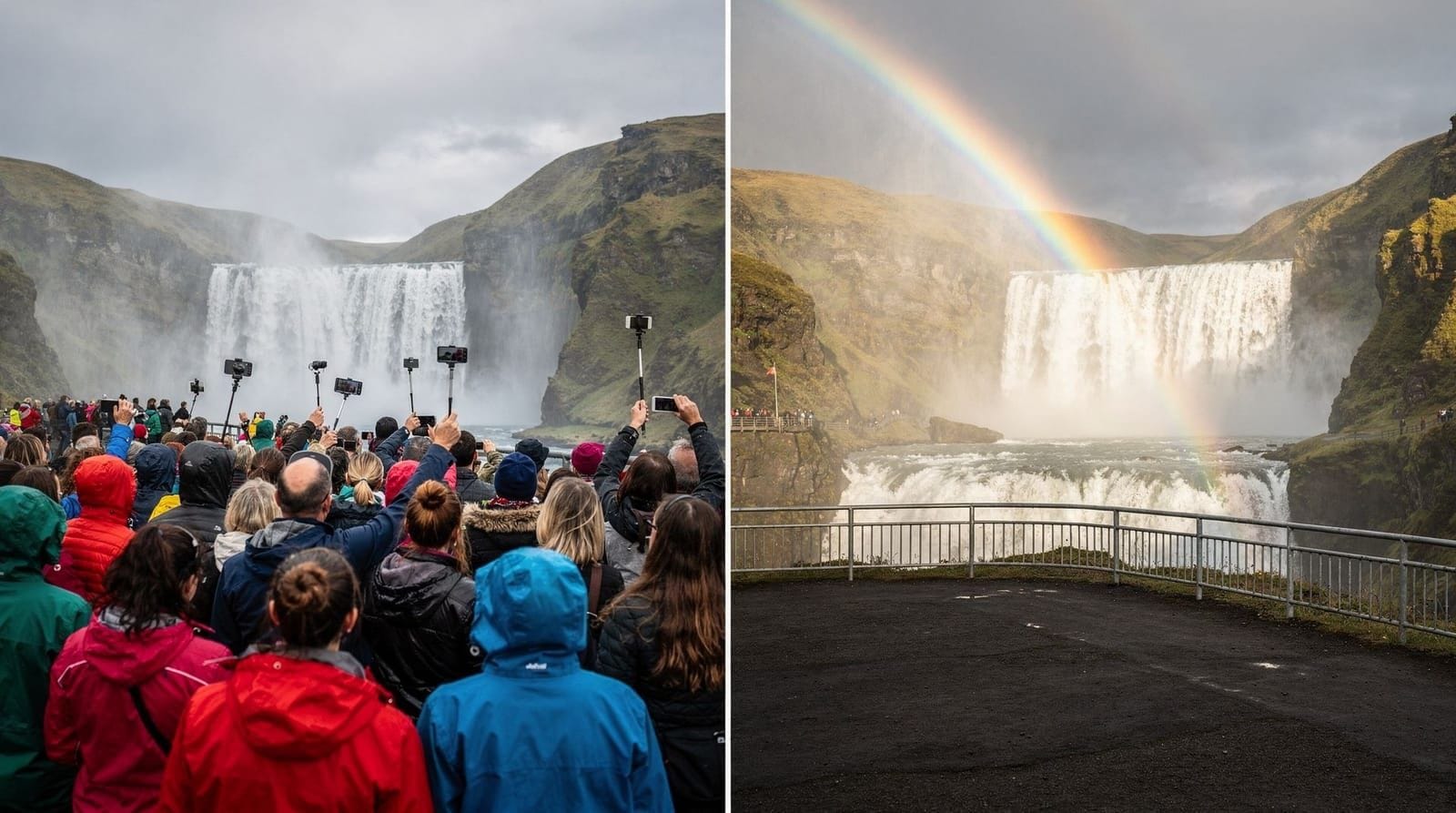
The infrastructure has not kept pace. Reynisfjara beach has one car park. Seljalandsfoss has one main viewpoint path. Geysir has one eruption zone. The physical capacity of these sites is finite. When 400 coach passengers and 200 individual cars arrive between 10 AM and 2 PM, the experience becomes crowd management, not nature.
The good news: tactical timing and modest flexibility can transform the experience. Iceland at 7 AM in September is almost unrecognisably different from Iceland at noon in August.
| Peak crowd window | 10:00–16:00 daily, July–August worst overall |
| Best arrival times | Before 9:00 AM or after 17:00 at any major site |
| Best months | May, September, October — see shoulder season |
| Best tactic | Leave a crowded car park and return in 2 hours |
| Cost | Free — timing changes nothing about ticket prices |
The fundamental tactic: get up early
Iceland’s accommodation and tour infrastructure is oriented around comfortable 9–10 AM departures. Coach tours leave Reykjavik at 9:00. Guided tours arrive at Seljalandsfoss at 11:00. Independent drivers sleep until 9:00 and arrive at Reynisfjara at 12:00.
If you leave your guesthouse at 6:30 AM, you are at major sites before any coach tour arrives. In summer, sunrise is before 4 AM — there is no darkness, no comfort argument for sleeping in.
Specific timing targets:
- Seljalandsfoss: Before 9:00 AM
- Skógafoss: Before 9:00 AM; the morning light from the east hits the waterfall directly
- Reynisfjara: Before 8:30 AM
- Geysir: Before 10:00 AM, or after 17:00 when day tours have departed
- Gullfoss: Before 10:00 AM or after 17:00
- Jökulsárlón: Before 9:00 AM or after 17:00 for boat tour quiet
- Kirkjufell: Midweek before 9:00 AM
Seasonal tactics
Swap July–August for May, September, or October
July and August account for roughly 40% of Iceland’s annual visitors. September is the single best trade-off month: northern lights are returning (from mid-September), F-roads are still open, crowds are noticeably down from August, temperatures are manageable (6–12°C), and autumn colours on the hillsides are spectacular.
May is the most underrated month. Snowmelt makes waterfalls run at maximum power. Bird life is returning. Tourist numbers are significantly below summer. Prices are lower. The only downside: some F-roads are still closed.
October has dramatic weather and atmosphere. Some F-roads close mid-month. Northern lights are reliable on clear nights. Far fewer visitors.
See Iceland in shoulder season for more detail.
Avoid school holidays
Northern European school holidays (especially German, French, Dutch, and Scandinavian summer holidays, typically mid-July through mid-August) correlate directly with Iceland’s peak crowd periods. The two weeks around the UK and Irish school summer holidays are similarly busy.
Christmas week and Easter week are secondary peaks — much smaller than summer, but worth noting.
Specific site tactics
Seljalandsfoss
The problem: The path behind the waterfall and the main viewpoint are exceptionally crowded 10 AM–4 PM in summer.
The fix: Arrive before 9:00 AM or after 6:00 PM. The waterfall is lit until midnight in summer — late evening photography is excellent.
Alternative viewpoint: Gljúfrabúi, a slot canyon waterfall 200m north of Seljalandsfoss, is accessed by wading through ankle-deep water into a cave. It has a fraction of the visitors of Seljalandsfoss and is equally dramatic. See Seljalandsfoss guide.
Jökulsárlón glacier lagoon
The problem: The car park fills completely by 11 AM in peak summer. The boat tour queue stretches long at midday.
The fix: Arrive by 8:30 AM for boat tours. The lagoon itself is beautiful at any time, but early morning light is typically the best for photography.
Alternative: Diamond Beach, the black sand beach on the ocean side of the lagoon bridge, typically has fewer people than the lagoon itself, and the icebergs that wash up there are in some ways more accessible and dramatic.
Geysir area
The problem: Strokkur erupts every 5–10 minutes, which means standing in a crowd for up to 10 minutes between eruptions.
The fix: The best position for Strokkur photography is actually from slightly to the side rather than front-on. If you arrive early (before 9:00 AM), the crowd is thin enough that you can easily reach the front position. After 14:00 and before the evening tours arrive is also reasonable. Eruptions happen regardless of whether you are in the prime position — step back from the main crowd and enjoy it from 20m further away with a better angle.
Reynisfjara black sand beach
The problem: The beach and its basalt columns are genuinely dangerous — sneaker waves have killed tourists here. Crowds make safety awareness worse, not better.
The fix: Arrive before 8:30 AM or after 17:00. The beach is accessible 24 hours — in summer you have full daylight at 6 AM with very few people.
Safety regardless of crowd timing: Stay at least 30 metres from the water’s edge. Never turn your back on the ocean. The waves here are not manageable — people have been swept to their deaths. See is Iceland safe.
The photography angle on avoiding crowds
For photographers, crowd avoidance has an additional dimension: clean shots. The most photographed places in Iceland are genuinely difficult to photograph without other visitors in frame during peak periods.
Specific photography timing by site:
Kirkjufell and its waterfall (Kirkjufellsfoss): The postcard angle has 15 people standing in it between 10 AM and 4 PM on summer weekends. At 5:30 AM on a weekday in September, you may be the only person. See Kirkjufell photography guide.
Jökulsárlón: The boat tours begin at 10 AM. Before 9 AM, the lagoon surface is still, the icebergs are lit by low dawn light, and few people are present. The combination of calm water and pink early light is exceptional.
Seljalandsfoss: The path behind the waterfall has a steady stream of visitors from 9 AM to 7 PM in summer. The waterfal’s west-facing orientation means late evening light (7–10 PM in summer) is golden. Evening at Seljalandsfoss is dramatically less crowded than midday.
See best photo spots in Iceland and Iceland photography guide.
The Ring Road’s hidden advantage for avoiding crowds
The Ring Road (Route 1) circuit is popular, but the way most people drive it — getting on at Reykjavik, heading southeast, doing the highlights — means traffic concentrates on certain stretches.
The stretch from Reykjavik to Jökulsárlón (approximately 380 km) sees the most traffic. East Iceland and North Iceland see significantly less. By the time you are driving from Höfn to Egilsstaðir, you may go 30 minutes between passing another vehicle.
Crowd distribution on the Ring Road:
- Reykjavik to Vik: high traffic, June–August
- Vik to Jökulsárlón: moderate to high traffic
- Jökulsárlón to Höfn: moderate
- Höfn to Egilsstaðir (East Iceland fjords): low
- Egilsstaðir to Akureyri (North): low to moderate
- Akureyri to Mývatn: moderate (day trips from Akureyri add traffic)
- Mývatn to Húsavík: low
- The return leg (North Iceland west): low
Going slowly through East and North Iceland while rushing the south coast is usually a mistake. The south coast deserves time, but East and North Iceland reward exactly as much time if you give it.
Use your car’s superpower: leave and come back
Coach tours operate on fixed schedules. If you are self-driving and arrive at a waterfall to find 30 coaches in the car park, you can leave. Drive to the next site. Come back in two hours. The coaches will have moved on.
Most people do not do this because they feel obligated to tick the box. Untick it. The waterfall will still be there.
Go clockwise on the Ring Road
Most tour operators and many self-drive visitors go counter-clockwise (south coast first). Going clockwise (north coast first, south coast last) means you are moving opposite to the main traffic of guided tours and many self-drivers.
In practical terms, this means you arrive at East Iceland before the south coast traffic reaches it, and you approach the south coast in early autumn when the summer peak has subsided. The Ring Road is not directional — there is no wrong way.
Lesser-known alternatives to crowd magnets
| Crowded site | Quiet alternative | Why it works |
|---|---|---|
| Blue Lagoon | Sky Lagoon / Secret Lagoon at Flúðir | Both offer geothermal water with far fewer visitors |
| Reynisfjara | Djúpalónssandur (Snæfellsnes) | Black pebble beach, shipwreck ruins, almost no coaches |
| Seljalandsfoss | Gljúfrabúi cave waterfall | 200m away, requires minor wading, almost no one |
| Golden Circle | Diamond Circle (North Iceland) | Same geological drama, fraction of the visitors |
| Westman Islands ferry (summer) | Visit in September or by small aircraft | Half the summer crowd |
| Kirkjufell on weekend | Same mountain on Tuesday at 8 AM | Entirely different experience |
Book specific time slots
The Blue Lagoon, Sky Lagoon, and some glacier hike operators use timed entry. Booking the first slot of the day (7:00 or 8:00 AM) gives you the quietest conditions regardless of season.
Golden Circle full day guided trip — small-group option availableManaging crowds at specific seasonal experiences
Northern lights crowd management
Northern lights season (September–March) does not have the same daytime crowd issues as summer sightseeing, but tour group concentration at specific viewing spots is a factor.
The main northern lights viewing areas near Reykjavik (Þingvellir, the Reykjanes coast, Heiðmörk nature reserve) attract large numbers on nights when the forecast is good (Kp index 3+). The further you drive from Reykjavik, the more dispersed the crowd.
Best approach for northern lights: Drive to genuinely dark areas rather than joining the standard tour group spots near the capital. Þórufoss waterfall (45 minutes from Reykjavik), the shores near Hvalfjörður, and the Borgarfjörður area offer dark skies without the concentrated tour group traffic. See where to see northern lights.
Puffin watching
Puffin season is mid-May to mid-August. At prime puffin spots (Vestmannaeyjar, Látrabjarg, Dyrhólaey), timing matters.
Látrabjarg on the Westfjords is actually one of the best puffin spots with the fewest visitors. The drive deters day-trippers. If you are already in the Westfjords, prioritise it.
Dyrhólaey (near Vík) closes to all visitors mid-June to mid-July during the most sensitive nesting period. Plan accordingly. See puffin watching in Iceland.
Whale watching
From Reykjavik, peak season whale watching (June–August) has large vessel tours departing multiple times per day. These are not particularly crowded on the boats themselves (capacity 50–80 people). The crowd issue is more about the experience quality — multiple tour boats in the same area can affect whale behaviour.
For a better whale watching experience with fewer boats and higher sighting rates, go to Húsavík. The boats are smaller, the guides more specialised, and humpback whale encounters are far more common. See whale watching in Húsavík.
The Reykjavik day-trip crowd pattern
Reykjavik-based visitors, tour buses, and day-trip operators all tend to arrive at sites in a predictable window: 10:00–16:00. This is when:
- Seljalandsfoss, Skógafoss, and Reynisfjara receive the bulk of their traffic
- Geysir has the largest crowds (multiple coach tours overlap)
- The Golden Circle car parks fill
The evening relaxes significantly after 17:00, especially after tour buses return to Reykjavik for their included dinners. The window between 17:00 and 21:00 (in summer — full daylight to midnight) is often the best for visiting South Coast sites from Reykjavik as a day trip.
If you are staying along the Ring Road rather than commuting from Reykjavik, you have the additional advantage of being at sites when the day-trip traffic has not yet arrived in the morning, and after it has left in the evening.
Practical accommodation choices to beat crowds
Where you stay affects your crowd exposure more than most visitors realise.
Stay on the Ring Road rather than Reykjavik: Visitors who commute from Reykjavik to South Iceland arrive with everyone else. Staying in Vík means you wake up at the South Coast — you can walk to Reynisfjara at 7:00 AM from your guesthouse.
Farm stays: Iceland has a large network of farm guesthouses (bændasetur), many with no other accommodation within 30 km. These are often quieter, cheaper than branded hotels, and in genuinely remote settings. Look for them on guesthouses.is and booking.com with “farm” in the search.
Book small guesthouses over large hotels: Small guesthouses (8–15 rooms) are typically run by local owners, are quieter, and often in better locations for early-morning access to nearby sites. Large hotel complexes near popular attractions are the most expensive and busy options.
Crowd patterns by day of the week
Weekday vs weekend patterns matter more than most visitors assume, particularly around Reykjavík:
Friday and Saturday: domestic Icelandic visitors join the international crowd at Golden Circle and South Coast sites, adding to the volume. Reykjavík restaurants and bars are busiest; day-trip car parks fill earliest.
Sunday: still busy with international visitors but noticeably fewer domestic day-trippers than Saturday.
Tuesday to Thursday: consistently the quietest weekdays at major sites, a pattern also true for Kirkjufell, Jökulsárlón, and Reynisfjara. If your itinerary has flexibility, shift the busiest single stops (Golden Circle, Kirkjufell) to a midweek day.
Cruise ship days: check the Reykjavík and Akureyri port schedules if visiting in summer — a single large cruise ship can add 2,000–4,000 passengers to day-trip circuits on a given day. Cruiseiceland.com and similar sites publish arrival schedules that let you avoid the busiest days at ports like Akureyri.
Public holidays: Icelandic public holidays (Sjómannadagurinn in early June, Verslunarmannahelgi the first weekend of August) bring domestic travel spikes on top of the usual international crowds. Verslunarmannahelgi in particular fills campsites and rural accommodation across the south and west; avoid booking a first visit to Iceland around this specific weekend if flexibility allows.
Local festivals: smaller town festivals (Þjóðhátíð in the Westman Islands, various Akureyri and Húsavík summer events) can fill an entire region’s accommodation for a weekend with almost no notice to visitors unfamiliar with the local calendar. A quick check of each region’s festival calendar before booking avoids an unpleasant surprise of fully booked guesthouses in an otherwise quiet area.
The weather variable
Bad weather in Iceland sends everyone inside. If there is a stormy morning — driving rain, low cloud, high winds — the car parks at popular attractions are empty. Many people change their plans.
This is your opportunity. Many of Iceland’s dramatic landscapes are enhanced by dramatic weather. Gullfoss in a rain squall with spray mixing with the mist. Reynisfjara in a gale with Atlantic waves crashing 10m high. Þingvellir in fog. These conditions are less comfortable than sunshine but photographically more dramatic and personally more memorable.
Check forecasts and plan accordingly: on a beautiful sunny day, the tourist sites are at capacity. On a stormy day, you may have them nearly to yourself.
Frequently asked questions about avoiding crowds in Iceland
Is Iceland worth visiting in July despite the crowds?
Yes, if you are flexible about timing within each day. Iceland in July with an early start is excellent. Iceland in July if you sleep until 9 AM and follow the standard coach tour schedule is a crowd-management exercise.
Are there any genuinely uncrowded major attractions in Iceland?
The Westfjords, East Iceland fjords, and most of North Iceland (except the Mývatn area in peak season) remain genuinely uncrowded even in summer. These require more time and a willingness to be off the main circuit.
Does going in winter help with crowds?
Significantly. January–March sees a fraction of summer visitors. The trade-offs are short days, some road closures, and the inability to access F-roads or some remote areas. The major sites (Jökulsárlón, Seljalandsfoss, Geysir) are open year-round and are much quieter in winter.
Can I park near popular sites in summer?
At the most popular sites (Seljalandsfoss, Jökulsárlón, Reynisfjara), parking fills by 10 AM in peak July–August. Arrive early or accept a longer walk from overflow parking. Some sites have introduced parking fees to manage demand.
How do I know if a site will be crowded when I arrive?
Check the weather — bad weather reduces crowds. Check the time — anything between 10 AM and 3 PM is peak. Check if it is a Saturday or Sunday (weekends are busier). Follow coach tour itineraries to know when to expect arrival waves at each site.
Applying this to an itinerary, not just individual stops
Crowd avoidance works best as an itinerary design principle, not a list of one-off tricks. If you’re building a Ring Road itinerary from scratch, sequence early starts on the days with the busiest single sites (south coast, Golden Circle) and allow slower mornings on days with naturally quieter driving (East and North Iceland). Basing a night in Vík rather than commuting from Reykjavík for the south coast, for instance, buys you the 7:00 AM window at Reynisfjara for free — no earlier alarm than a standard day trip would require anyway.
The same logic applies to shorter trips. A 48 hours in Reykjavík itinerary that front-loads the Golden Circle at first light and saves the city centre for the afternoon avoids the worst of both crowd windows in a single compact trip.
Most visitors don’t actually follow this discipline — the default pattern is a leisurely 09:00 start that lands squarely in the peak crowd window at every stop. The early-departure habit described throughout this guide is the single variable that separates a genuinely memorable South Coast morning from a crowd-management exercise indistinguishable from a busy theme park queue.