Whale watching in Húsavík — a diary
| Where | Húsavík, north Iceland, ~90km from Akureyri |
| Season | May–October, peak late June–August |
| Cost | Tours typically ISK 12,000–15,000/person |
| Time needed | 2–3 hours on the water |
| Sightings rate | Operators quote 95%+ for seeing at least one whale |
Húsavík has a specific claim
Húsavík calls itself the whale watching capital of Europe, and the claim is defensible. The town of about 2,300 people on the north coast of Iceland sits at the mouth of Skjálfandi Bay, a sheltered inlet that concentrates the zooplankton and small fish that feed large baleen whales. In summer, humpback whales are reliable visitors. Minke whales are present throughout the season. Blue whales appear in June and July in good years. The season runs May through October, with the peak for diversity from late June through August.
I visited in late September — shoulder season — when the tourist volume had dropped but the whales were still present and the landscape had shifted to the autumnal tones of north Iceland. The birch along the hillsides above town had turned a dusty gold. The sea was grey-green. The mornings smelled of cold salt and old fish nets, which is not unpleasant once you adjust.
The boat question
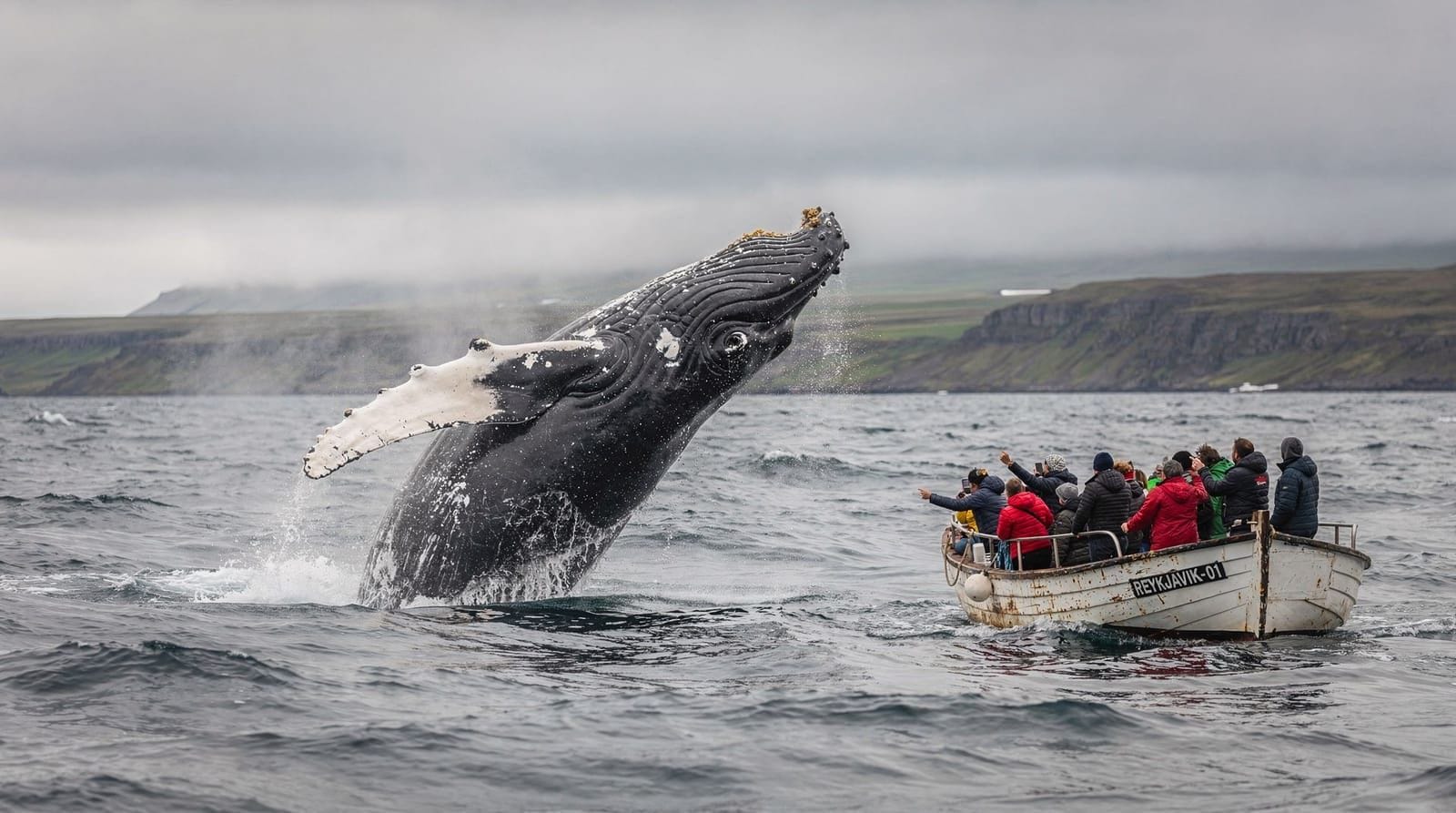
Húsavík has multiple operators and the competition is active. The main ones are North Sailing, Gentle Giants, and Salka Whale Watching. All operate from the same small harbour. The boats range from traditional oak Icelandic fishing vessels — the type that are aesthetically beautiful and not optimised for stability — to larger steel vessels with enclosed lower decks and rib-style speedboats.
I booked with North Sailing’s traditional oak schooner, the Ópal. This was a decision made with my heart rather than my stomach, and in late September conditions with a 2-metre swell, I paid for it. The traditional boats sit lower, have no stabilisers, and move with the sea rather than against it. If you are at all susceptible to motion sickness, book a larger modern vessel or the speedboat instead.
The speedboat (2-hour express) covers more sea faster but the ride is rough. For wildlife quality, the 3-hour traditional boat tours have more time on the water and can follow whales at leisure rather than rushing back to meet a schedule. The naturalist guides on the traditional boats also tend to be more thorough — there is time for proper explanation rather than rapid-fire commentary between bursts of speed.
The original whale watching tour from Húsavík is one of the best-rated wildlife experiences in Iceland; the 3-hour trip on a traditional oak vessel is the classic option if sea conditions allow.
What happened on our tour
We left the harbour at 10 a.m. The sky was overcast, the air 8°C, the sea green-grey with white-capped waves. There were 14 of us plus a skipper and a naturalist guide. The guide spoke in English and Icelandic and maintained a running commentary on the bay ecology, the whale species we might encounter, and the history of whaling in this region (Iceland resumed commercial whaling in 2006; North Sailing and other operators take an explicit anti-whaling position and the guides do not shy from the subject).
The first whale appeared about 25 minutes out: a minke, 7-8 metres long, surfacing twice and then gone. Quick, unspectacular in the way that small cetaceans can be. A few people looked slightly disappointed.
Twenty minutes later, the guide pointed port side and something surfaced that was categorically not small. A humpback, probably 14 metres, blowing a column of water-vapour that was visible before we saw the whale itself. It surfaced three times in sequence — that distinctive small dorsal fin, the broad back rolling forward — and then disappeared for about four minutes.
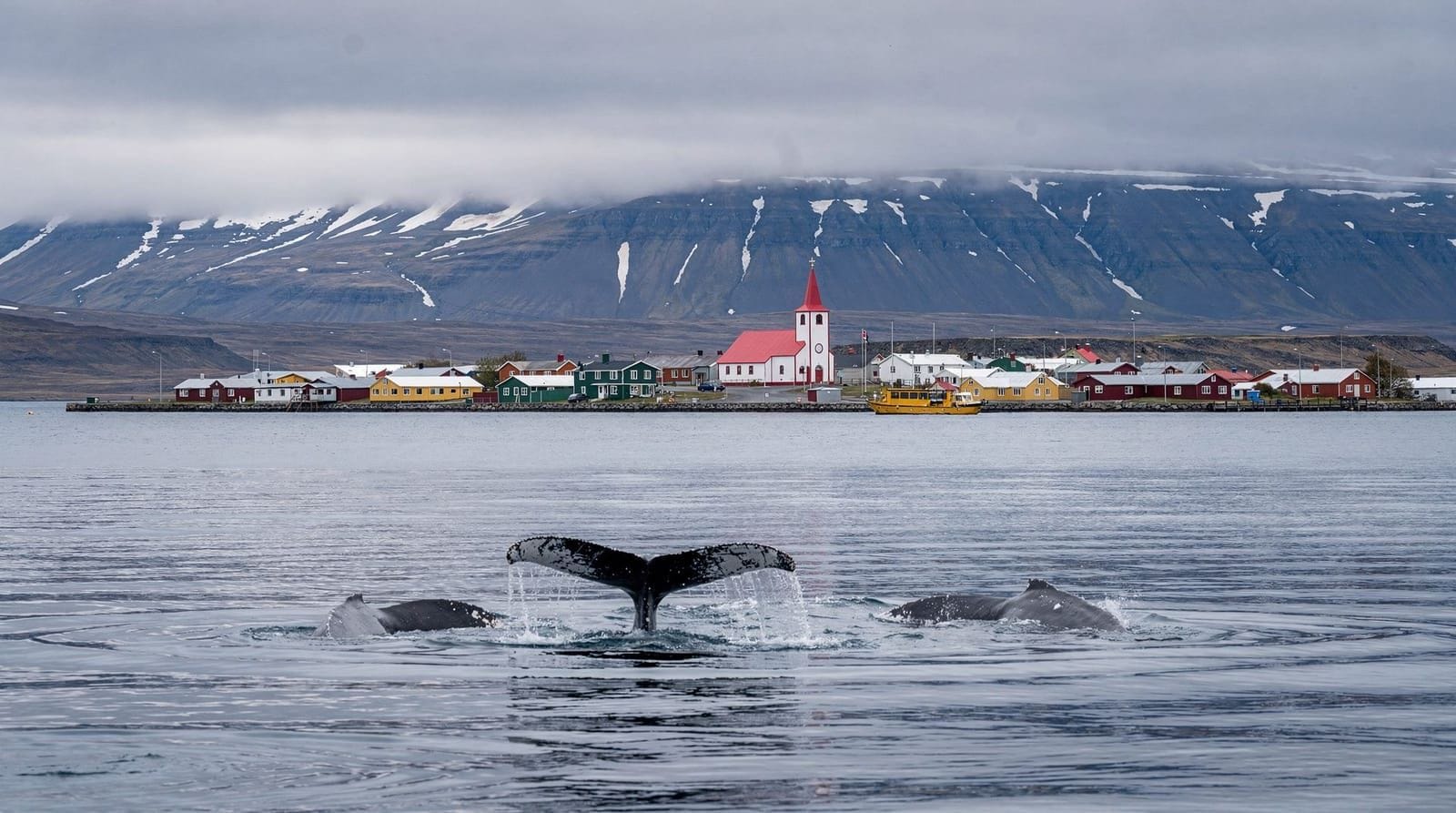
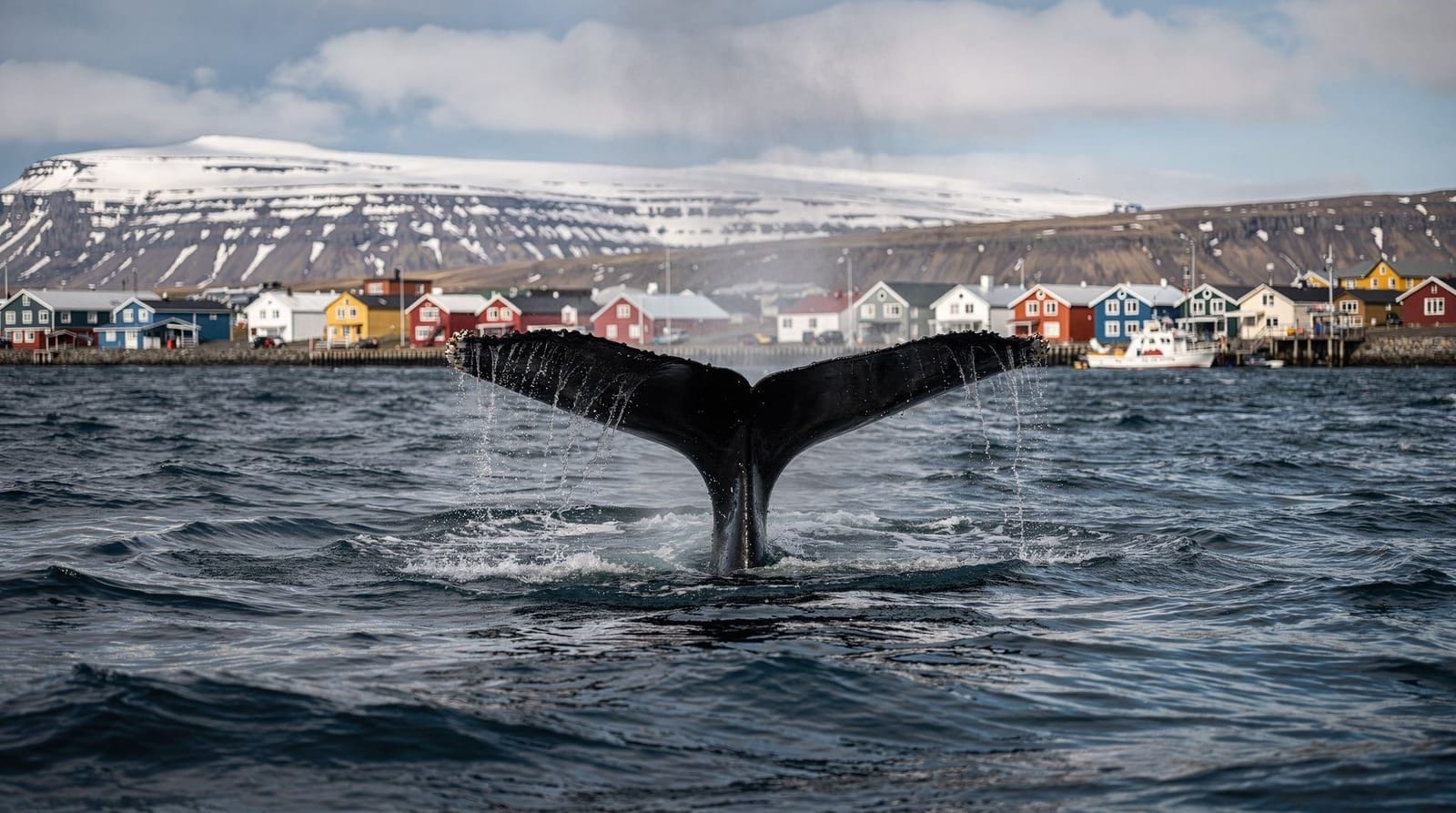
When it surfaced again it was off the starboard bow, close enough that several of us had to take a step back from the rail. The skipper had held position while the whale circled. On the third surfacing, it raised its flukes — the classic humpback tail-up dive that means a long deep dive is coming — and as it did, a second whale surfaced alongside. We had found a pair.
They stayed in the area for about 40 minutes. In that time we saw probably 15-20 surface sequences, two full fluke displays, and one moment where one of the whales surfaced within about 30 metres of the boat — close enough to smell the blow, which is warm and slightly fishy and not unpleasant.
The honesty section
Three people on the boat were seasick. Seasickness is real and not amusing when it is happening to you. I was not sick but the motion was constant and during the slow periods between whale sightings I understood why people found it hard. The naturalist guide distributed ginger biscuits and pointed people toward the back of the boat, which moves less. If you are going on a traditional vessel in any kind of sea, take medication preventively — the standard advice to take it 30-60 minutes before boarding is correct.
The second honest point: you are not guaranteed a good sighting. The operators all advertise high success rates (North Sailing quotes over 95% for seeing at least one whale), but there is a spectrum from a brief minke dorsal fin at 200 metres to what we saw. September is the end of the season and success rates are slightly lower than July-August. North Sailing offers a free re-booking if you see nothing or only distant views; the policy is posted clearly.
The third honest point: the photos you take will mostly be disappointing. Phone cameras cannot capture what happens on the water. A fast camera with a long lens can, but most of us are not carrying that. The experience is in the eye, not in the archive.
Clothing for the boat
This deserves its own section because I have seen people misery-frozen on whale watching boats from inadequate preparation. In September, sea temperature is around 8-10°C. Wind on the water, even in calm conditions, adds effective cold. The boats provide blankets and sometimes overalls; these are supplementary, not sufficient.
Wear: a thermal base layer, a mid-layer fleece, a windproof and waterproof outer jacket, and waterproof trousers. Hat that covers your ears. Waterproof gloves — your hands will be on the rail for long periods. Non-slip-soled shoes. If you are cold on the boat, the sighting is still the same but your capacity to enjoy it is significantly reduced.
The guide on our boat told us that the single most common complaint they receive is from underdressed passengers rather than poor sightings. Iceland in late summer is not the Caribbean. The sea temperature at Skjálfandi Bay in June is around 7°C; in August, around 10°C. Dress for it.
The combined whale watching and puffin tour from Húsavík adds seabird viewing to the whale watching; in late summer the puffins are still present in Skjálfandi Bay before their September departure.
Timing: when to go for the best experience
June and July offer the best diversity — blue whales have been recorded in Skjálfandi Bay in June and early July when cold nutrient-rich water is upwelling near the bay mouth. Humpbacks are reliable June through September. Minkes are present throughout the season. Dolphins (white-beaked) appear in summer.
Whale watching by month
| Month | Species likely | Crowds | Notes |
|---|---|---|---|
| May | Minke, early humpbacks | Low | Season just opening |
| June–July | Humpback, minke, occasional blue whale | High | Best diversity, book ahead |
| August | Humpback, minke | High | Puffins still present |
| September | Humpback, minke | Moderate | Good balance of sightings and space |
| October | Minke, fewer humpbacks | Low | Season closing, colder conditions |
The whale watching guide for Iceland has a full seasonal breakdown by species. For Húsavík specifically, the guide to whale watching in Húsavík includes a current comparison of operators with pricing, which changes each season.
My honest assessment after September: it delivered. The humpback pair at close range was among the best wildlife encounters I have had. But if I were planning specifically to maximise the chance of exceptional sightings, I would go in July rather than September.
Húsavík beyond the harbour
Húsavík is genuinely worth an overnight rather than just a stop for the boat tour. The Húsavík Whale Museum (on the main street) is among the best in Europe for cetacean biology; the skeleton of a blue whale hangs from the ceiling of a converted warehouse. Entry is around 2,000 ISK. The exhibition covers the evolution of cetaceans, the history of whaling globally and in Iceland, and the current conservation picture.
The town has a small but working port, a yellow-painted Lutheran church that is the most photographed building in north Iceland, and a few restaurants. Gamli Baukur, on the harbour, does a solid fish of the day and a lamb burger that was better than it had any right to be. The fish chowder in particular — thick, creamy, with local haddock and mussels — is one of the better bowls I have eaten in north Iceland.
Accommodation ranges from small guesthouses at around 18,000-25,000 ISK per room to the Fosshotel Húsavík at the higher end. Book ahead in peak season; the town is small and beds are limited.
The Diamond Circle connection
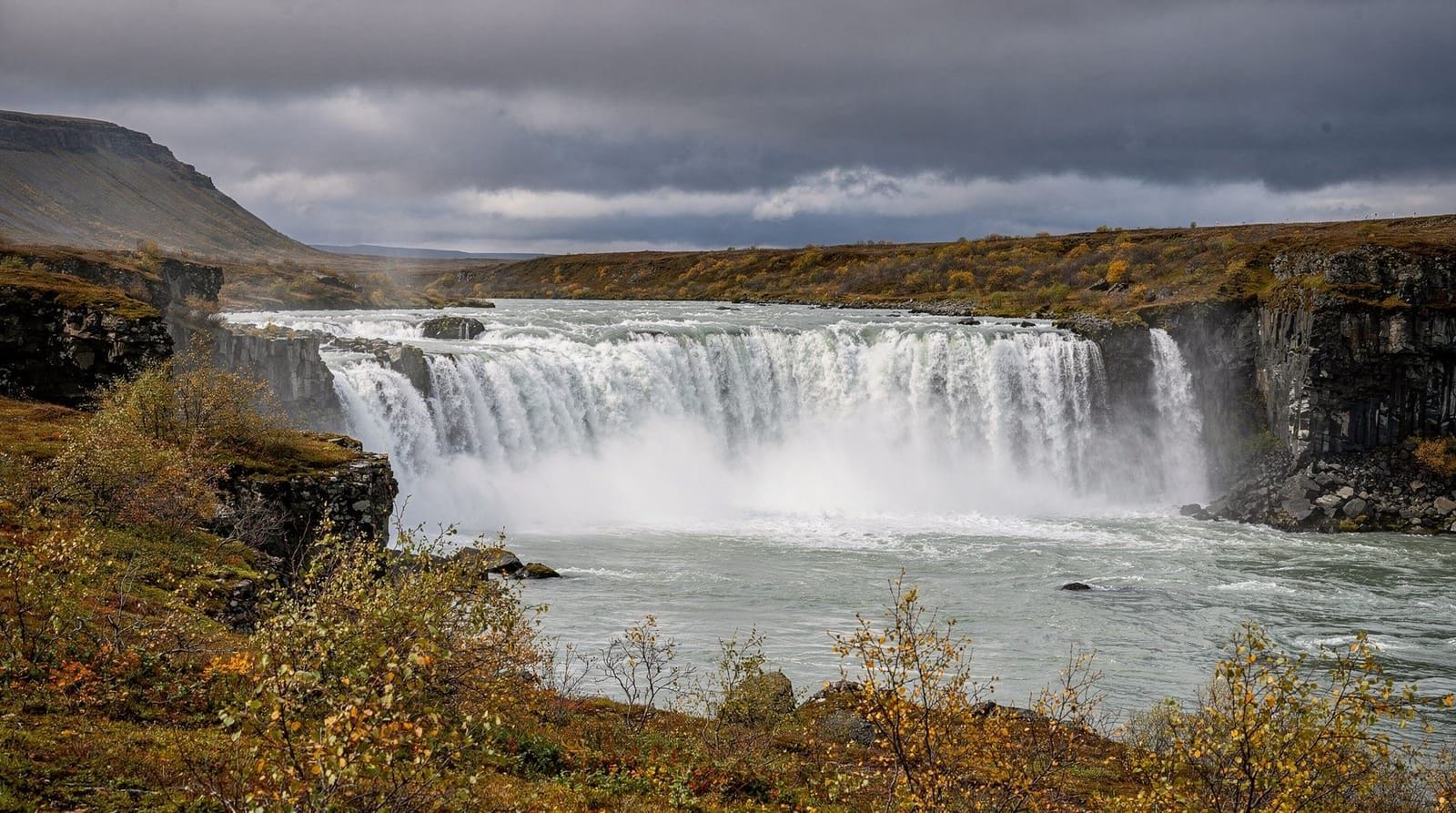
From Húsavík it is straightforward to loop the Diamond Circle — the north Iceland equivalent of the Golden Circle, connecting Húsavík with Lake Mývatn, Dettifoss, and Ásbyrgi canyon. This is one of the best single-day driving routes in Iceland: you start with whales in the morning, reach Dettifoss — Europe’s most powerful waterfall — by early afternoon, and end at Ásbyrgi’s horseshoe canyon in the late afternoon. The distances are manageable (roughly 230 kilometres for the full loop) and the road quality on the main route is good.
The north Iceland 4-day itinerary covers this in detail. If you are based in Akureyri — the main city in north Iceland, about 90 kilometres west of Húsavík — you can do the Diamond Circle as a day trip and return to Akureyri for the evening, which gives you a wider range of accommodation and restaurant options.
The whale watching guide has timing recommendations and a comparison of the main operators with current pricing, which changes seasonally.
FAQ
Is Húsavík better than Reykjavík for whale watching?
For sighting quality and diversity, yes — Skjálfandi Bay’s sheltered waters concentrate whales more reliably than the waters off Reykjavík, and Húsavík’s operators quote higher success rates. Reykjavík is more convenient if you’re not travelling to north Iceland, but Húsavík is worth the detour if whale watching is a priority.
What should I wear on a Húsavík whale watching boat?
Full layering regardless of season: a thermal base layer, a fleece mid-layer, a windproof and waterproof outer shell, waterproof trousers, a hat covering your ears, waterproof gloves, and non-slip shoes. Boats provide blankets and sometimes overalls, but these supplement rather than replace proper clothing.
Which boat type should I choose if I get seasick easily?
Choose a larger modern vessel with an enclosed lower deck, or the rib-style speedboat, over the traditional oak schooners — the older boats sit lower and roll more with the swell, which is atmospheric but genuinely rough in anything above calm conditions. Take motion sickness medication 30–60 minutes before boarding regardless of which vessel you pick.