Is Iceland's overtourism problem real? An honest assessment
The numbers, first
Iceland received approximately 2.1 million foreign visitors in 2023. Iceland’s total resident population is around 380,000. That ratio — more than five visitors for every resident — is among the highest in Europe. For comparison, France (the world’s most visited country) receives about one visitor per resident per year.
The question of whether this constitutes an “overtourism problem” depends on where you are and when. The answer is not uniform across the island.
| Visitor-to-resident ratio | ~5.5 visitors per resident (2023) |
| Worst crowding | South coast, Golden Circle, Reykjavik — July/August |
| Least crowded | Westfjords, north Iceland, east coast, highlands |
| Best fix | Shoulder season (May, Sept–Oct) + spreading nights along the Ring Road |
| Genuine environmental risk | Trail erosion, off-road driving damage |
Where overcrowding is genuinely a problem
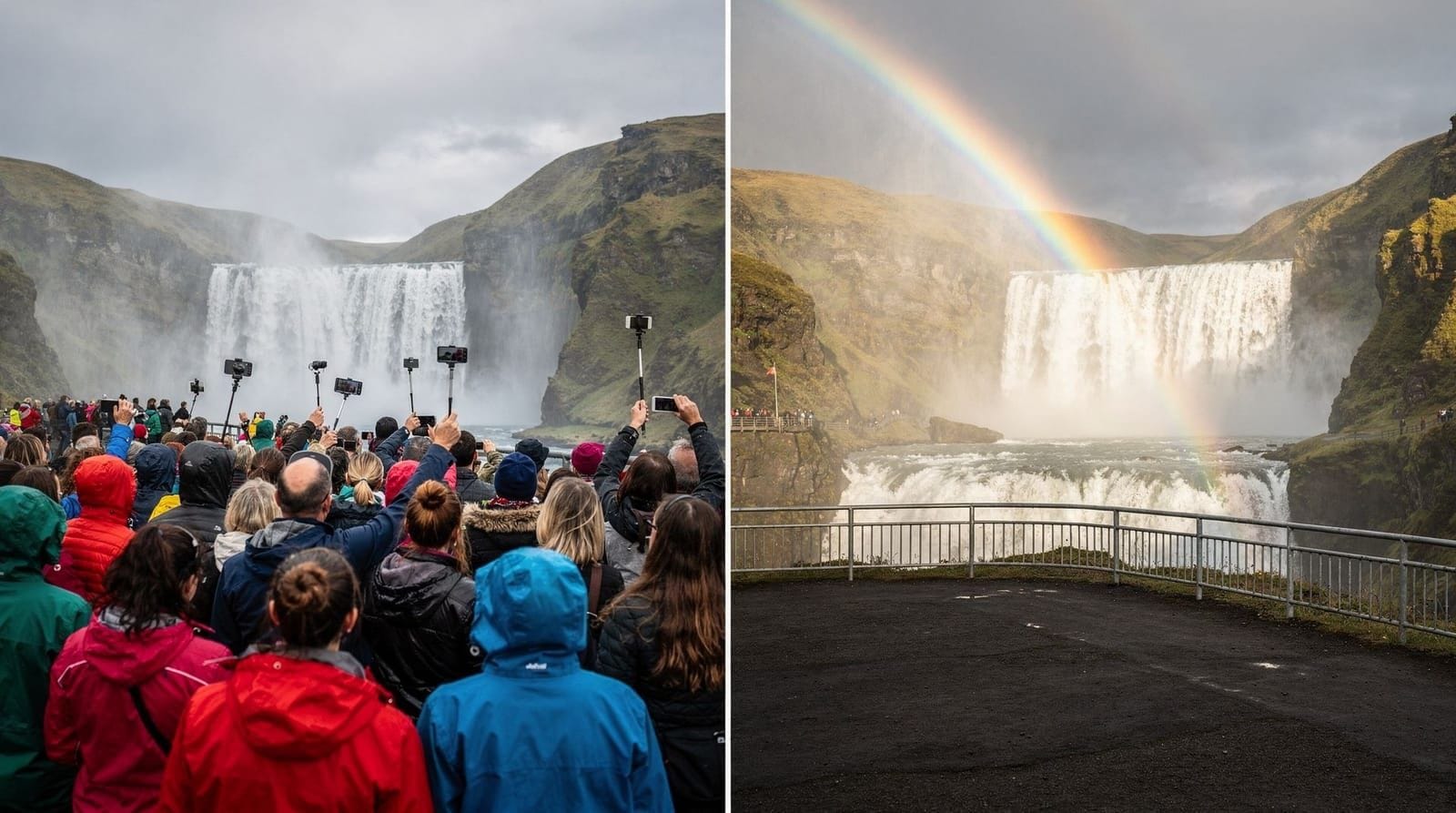
Seljalandsfoss and Skógafoss in July–August: These two waterfalls on the south coast are within 30 kilometres of each other on Route 1. In peak summer, Seljalandsfoss car parks are full by 9 am. The path behind the falls — which is the specific thing that makes Seljalandsfoss distinctive — has queues. You are walking with dozens of people in a space designed for perhaps ten. The sensory experience is fine; the photographic experience without crowds in frame requires either arriving before 7 am or accepting that you’ll be editing people out for an hour.
Skógafoss has similar dynamics. The staircase to the viewing ridge above the falls has a queue in July. The base of the falls is crowded from 10 am to 5 pm.
Jökulsárlón glacier lagoon: The main viewpoint and car park are heavily trafficked in summer. The amphibious boat tour queue can exceed an hour without pre-booking. Diamond Beach is crowded from 9 am onward on clear days. These are real constraints on the experience.
The Blue Lagoon: This is a managed experience where capacity is controlled by reservation. The “overcrowding” here is different — it’s not overcrowding exactly, it’s a commercialised visitor experience where the infrastructure and pricing reflect the volume. If you book early, the entry experience is structured and bearable. The problem isn’t the number of people; it’s whether you enjoy the product the Blue Lagoon has become.
Reykjavik in July: Laugavegur shopping street is genuinely very crowded in peak season. Accommodation prices are at their highest. The restaurant queues are real. None of this constitutes an environmental problem — it’s a city with too many tourists in summer, which describes dozens of European cities.
Where it isn’t the problem it’s portrayed as
The Westfjords: The 7,000 residents and perhaps 100,000–150,000 annual visitors means the Westfjords remains genuinely uncrowded. You will, on a July Tuesday, have Dynjandi waterfall to yourself for significant stretches.
North Iceland: Akureyri and the north coast region receive a fraction of south Iceland’s visitors. The Diamond Circle route (Ásbyrgi, Dettifoss, Húsavík) in September has maybe a third of the people at the equivalent south coast sites.
The highlands: The interior is self-limiting by its road requirements and remoteness. Overcrowding is not a problem when a trip requires a purpose-built 4x4.
Most of the east coast: Between Höfn and Egilsstaðir, the ring road runs through dramatic scenery with very little tourist infrastructure and modest visitor numbers.
Shoulder season everywhere: The April–May and September–October windows have maybe 30–40% of peak summer visitor volumes at the main sites. Shoulder season is the most practical response to overcrowding concerns.
The environmental picture
The environmental concerns about Iceland’s tourism are more nuanced than crowd-at-waterfall photography.
Genuine problems:
- Trail erosion: Popular hiking trails, particularly those into the highlands (Laugavegur, Fimmvörðuháls), show significant erosion from high footfall. The trail management organisations have introduced reservation systems for the Laugavegur trek specifically to limit daily users.
- Off-road driving: Despite laws prohibiting off-road driving in Iceland (one of the strictest prohibitions in Europe), GPS-assisted tourists and tour vehicles occasionally drive on fragile volcanic soil. The damage takes decades to reverse.
- Fragile geological features: Some lava formations in the Reykjanes Peninsula and around Mývatn show damage from people climbing on them despite signage.
Less significant problems than often claimed:
- Carbon footprint of flights: Real, but present for any international travel destination. Iceland’s own electricity grid is nearly 100% renewable.
- Waste: Iceland has robust waste management and recycling, and most tourists visit serviced sites.
The responsible travel question
The discussion about “responsible tourism” in Iceland sometimes tips into performative territory — where the guilty feeling of being part of a crowd becomes the point rather than actual behaviour change.
What actually makes a difference:
- Timing: Travel in May, October, or November rather than July or August. The financial impact on local businesses (who depend on summer revenue) is spread more evenly and you have a better experience.
- Where you sleep: Choosing smaller guesthouses and farms over large hotel chains keeps money in local hands.
- Route: The ring road is the correct backbone of any Iceland trip. Distributing your nights along it rather than doing day trips from Reykjavik supports businesses in less-visited regions.
- Behaviour at sites: Don’t leave the marked paths, don’t fly drones in restricted areas, don’t touch lava formations or geothermal crusts. These aren’t complex ethical positions; they’re just reading the signage.
The sustainable travel guide has more specifics on low-impact travel choices. The avoiding crowds guide gives practical timing and route alternatives.
The honest conclusion
Yes, Iceland’s overtourism is real in specific places at specific times. Seljalandsfoss in July at 11 am is genuinely unpleasant from a crowd perspective. The transformation of the Blue Lagoon into a luxury resort product over the past decade reflects and amplifies the pressure of mass tourism on a single site.
But “Iceland is overtouristed” as a blanket statement misrepresents what’s actually happening. The island is large, and most of it is empty. The ring road can absorb visitor numbers that overwhelm the south coast pinch points. The Westfjords, the highlands, north Iceland, and the east coast all remain places where you can go for an entire day without seeing another tourist.
The solution is not to avoid Iceland. The solution is to visit at the right time, move beyond the south coast, and distribute your spending across the regions that need it rather than concentrating at sites that are already strained.
Three-day tours of the Westfjords from Reykjavik are one of the more responsible ways to visit Iceland’s most remote region — the economics support local businesses and guides in an area that sees a fraction of south coast visitor numbers.What Iceland’s tourism industry itself says
Iceland’s government and tourism bodies have been unusually candid about the problem. Visit Iceland’s own published research in recent years has focused on “tourist distribution” rather than volume limits — the idea that the problem isn’t the total number of visitors but their concentration in a narrow geography and season.
The government has raised landing fees at Keflavík Airport, increased parking fees at some key sites, and introduced mandatory booking at the Laugavegur trail. These are incremental measures. The more significant intervention is the Inspired by Iceland programme’s marketing campaigns specifically promoting non-south-coast regions — a rare case of a national tourism body actively trying to divert its own visitors.
Whether this works is unclear. The viral imagery of Iceland — Jökulsárlón, the Blue Lagoon, Kirkjufell — is self-perpetuating across Instagram and TikTok in ways that no campaign can easily redirect. The avoiding crowds guide looks specifically at how individual itinerary choices contribute to or mitigate the concentration problem.
The comparison point
For context: Dubrovnik in Croatia receives 1.5–2 million visitors per year in a walled medieval city of 1,500 residents. The Lofoten Islands in Norway receive around 500,000 visitors in a similarly remote, scenic, and fragile island chain. Santorini in Greece receives 2 million visitors on an island of 15,000 residents.
Iceland’s visitor-to-resident ratio is high, but the island’s physical size is also large — 103,000 square kilometres, roughly the same as South Korea. The problem is distribution, not absolute numbers. The south coast and Reykjavik together receive the vast majority of visitors; the north, east, and Westfjords receive a fraction.
That asymmetry is the real story. North Iceland has comparable or superior natural attractions to the south coast, receives roughly 15% of south coast visitor volumes, and has significant underdeveloped accommodation and tourism infrastructure. Directing tourism capital and visitor flows northward is the long-term structural answer — not telling people to stay home.
The traveller’s role
One of the more useless responses to the overtourism debate is self-congratulatory abstention — choosing not to visit Iceland as a statement, or visiting but feeling guilty about it the entire time. Neither changes anything material, and the second produces a worse experience without any benefit to Iceland.
What actually matters is choice at the margin. Not whether you go, but how you go:
When: May and October are genuinely low-pressure months at key sites. April is quieter still (though some highland routes aren’t open). These months offer better-than-average weather stability, fewer crowds, and accommodation at 60–70% of peak season rates.
Where you sleep: Accommodation in smaller towns along the ring road — Hvolsvöllur, Kirkjubæjarklaustur, Vopnafjörður, Reyðarfjörður — directly funds businesses in regions that see fewer visitors. Spending nights in Reykjavik while day-tripping to the south coast concentrates economic benefit in the capital.
How you move: Self-driving the ring road distributes your economic footprint more broadly than doing everything as a Reykjavik day tour. Stopping at a local guesthouse café rather than at a large chain along Route 1 routes money to individuals rather than corporations.
These are not dramatic sacrifices. They often produce better experiences — quieter, more personal, better value — than the maximally convenient and crowded alternatives.
Crowd levels by region and season, roughly
A more useful way to think about “is Iceland overtouristed” than a single yes/no answer is region against month.
| Region | Peak (Jun–Aug) | Shoulder (May, Sep–Oct) | Winter (Nov–Mar) |
|---|---|---|---|
| South coast / Golden Circle | Very crowded | Moderate | Light, weather-dependent |
| Reykjavik | Very crowded | Moderate | Quiet, except New Year |
| North Iceland | Moderate | Light | Very light |
| Westfjords | Light | Very light | Mostly closed roads |
| Highlands | Light (self-limiting by roads) | Closing/closed | Closed |
| East coast | Light | Very light | Light |
The pattern is consistent: the crowding problem is a south-coast-in-summer problem, not an Iceland problem. The avoiding crowds guide breaks this down site by site with specific timing recommendations.
One further nuance worth stating plainly: even within a “crowded” region and season, arrival time changes the experience more than most visitors expect. The gap between a 7 am and a 10 am arrival at Seljalandsfoss in July is the difference between a handful of other visitors and a genuinely packed car park. The overtourism problem, in practice, is often a scheduling problem as much as a volume problem — and scheduling is the one variable entirely within a traveller’s control.
Iceland is not ruined. Some specific corners of it are being managed imperfectly. The rest of it is extraordinary and waiting.