Caving in an Icelandic lava tunnel — Raufarhólshellir guide
Reykjavik: From Reykjavik Raufarholshellir lava tunnel by bus
Duration: 3 hours
What is lava tube caving in Iceland like?
Lava tubes are tunnels formed when the surface of a lava flow cooled and solidified while molten rock continued flowing inside, eventually draining and leaving hollow tubes. Raufarhólshellir near Reykjavík is Iceland's most accessible lava tube — over 1,300 metres long, with dramatic lava formations, ice stalagmites in winter, and guided tours year-round.
Raufarhólshellir is the easiest genuine underground experience near Reykjavík — no ice-cave-season lottery, no long transfer, just a warm layer and sturdy shoes. Here’s what to expect, what it costs, and how it stacks up against Iceland’s other underground options.
| Where | Route 39, about 35–40 min from Reykjavík |
| Cost | around €72 per person |
| Time needed | 3–4 hours including transfer, 1–1.5hrs inside |
| Best for | Year-round schedule flexibility, families |
| Wear | Warm layers, boots with ankle support |
How lava tubes form
Iceland’s volcanic landscape is riddled with lava tubes — tunnels formed by a specific process during volcanic eruptions. When lava flows across the surface, the outer edges cool and solidify quickly. Inside, molten rock continues flowing. Eventually, the eruption pauses or the flow direction changes, and the interior lava drains away, leaving behind a hollow tube in the solidified exterior rock.
The tubes can stretch for kilometres; they’re found across Iceland wherever significant lava eruptions have occurred. They’re darkest, most impressive geology: vaulted roofs of black basalt, walls textured with frozen lava ripples, floor littered with breakdown blocks from sections that have partially collapsed over millennia.
Raufarhólshellir (the “Lava Tunnel”) near Reykjavík is Iceland’s most visited lava tube, formed by a lava eruption in the Bláfjöll area approximately 5,200 years ago. At 1,360 metres, it’s substantial — not the longest in Iceland but the most accessible. The operator, The Lava Tunnel, has developed a proper visitor facility at the entrance without compromising the geological integrity of the tunnel interior.
What’s inside Raufarhólshellir
The tunnel is roughly 10–12 metres wide and 8–12 metres high in most sections, tapering toward the far end where the lava flow eventually diminished. The lighting system installed by the operator is subtle — LED strips placed at ground level illuminate sections without overwhelming the natural rock with artificial colour. It’s tastefully done.
Rock formations: The tunnel walls and ceiling preserve the texture of the original lava flow — ripple marks, lava stalactites (drips of cooling lava that solidified mid-drop), and the boundaries between different eruption pulses where lava flowed at different temperatures. The formations are black and brown basalt, occasionally reddish where iron oxidised in the cooling process.
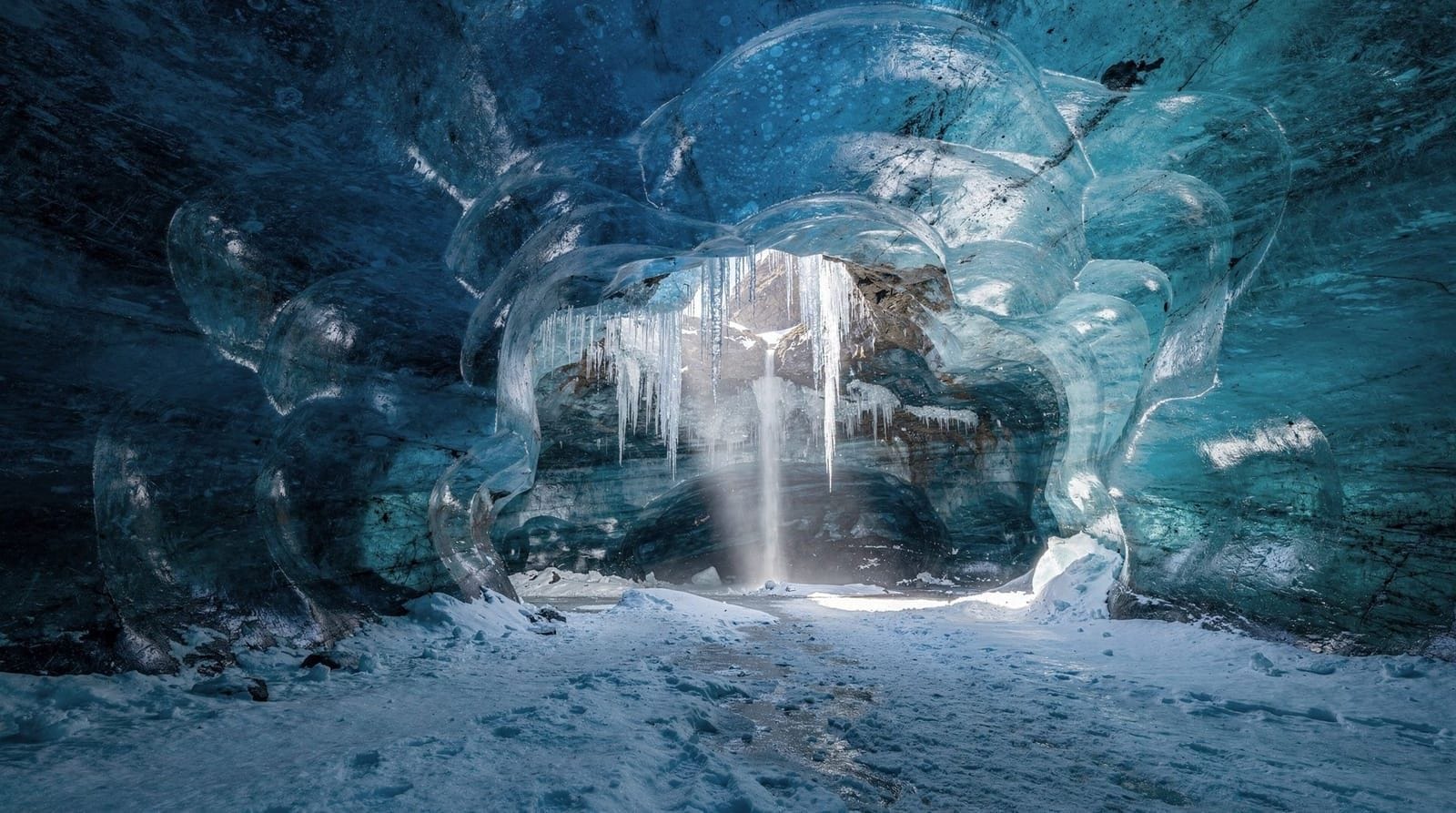
Winter ice formations: In the colder months (roughly November–April), meltwater seeping through the tunnel ceiling freezes on the floor and walls, creating ice stalagmites and frost formations that contrast with the black rock. These are temporary and change each winter. Photos of Raufarhólshellir in winter — with blue-white ice against black lava — are among the more striking images of Icelandic geology.
The extreme section: At the far end of the standard tour route, the tunnel narrows and becomes more physically demanding — lower ceiling, more uneven floor, requiring crouching and careful footwork. This section is clearly labelled and optional; the main tour is complete without it. Those who do it get a more visceral sense of the original tube dimensions.
Raufarhólshellir lava tunnel underground expedition (self-drive)
Getting to Raufarhólshellir
Self-driving: Route 39 from Reykjavík, approximately 35–40 minutes. The entrance is clearly signed and has a purpose-built visitor building with toilets and a small café. Parking is free. This is the most flexible option — you combine it with nearby attractions (Kerið crater, the Secret Lagoon, Hveragerði) on the same day.
By bus from Reykjavík: Operators run regular transfers from central Reykjavík pickup points. Practical for visitors without cars. Total time including transfer is 3–3.5 hours.
Nearby combination options: Raufarhólshellir is conveniently positioned between Reykjavík and the Golden Circle route. A combined day visiting Þingvellir or Geysir and including the lava tunnel is practical.
Raufarhólshellir lava tunnel tour by bus from Reykjavík
The tour experience
Tours depart on the hour and half-hour during peak season, less frequently in winter. Your guide provides a helmet with headlamp (the tunnel has installed lighting, but a personal headlamp is useful for the extreme section). Warm waterproof clothing is advised — the 4°C temperature inside requires a proper mid-layer even in summer.
The guided narration covers the geology, formation process, age of the lava, and specific features along the route. It’s educational content delivered at a pace that allows for photography — your guide will stop at the most photogenic sections.
The walk in and out covers about 2 km total (1 km each way). The floor is uneven volcanic rock — wear boots or shoes with ankle support. Crampons are provided in winter if the ice floor sections require them.
Duration inside: 1 to 1.5 hours depending on group pace and engagement with the guide’s narration.
Ice cave vs. lava tunnel — what to choose
Both offer underground Iceland experiences, but the comparison stops there:
Raufarhólshellir:
- Black volcanic rock, year-round
- 35 minutes from Reykjavík
- From €72 per person
- No seasonal constraints
- Cultural and geological context: Icelandic volcanic history
Vatnajökull ice caves:
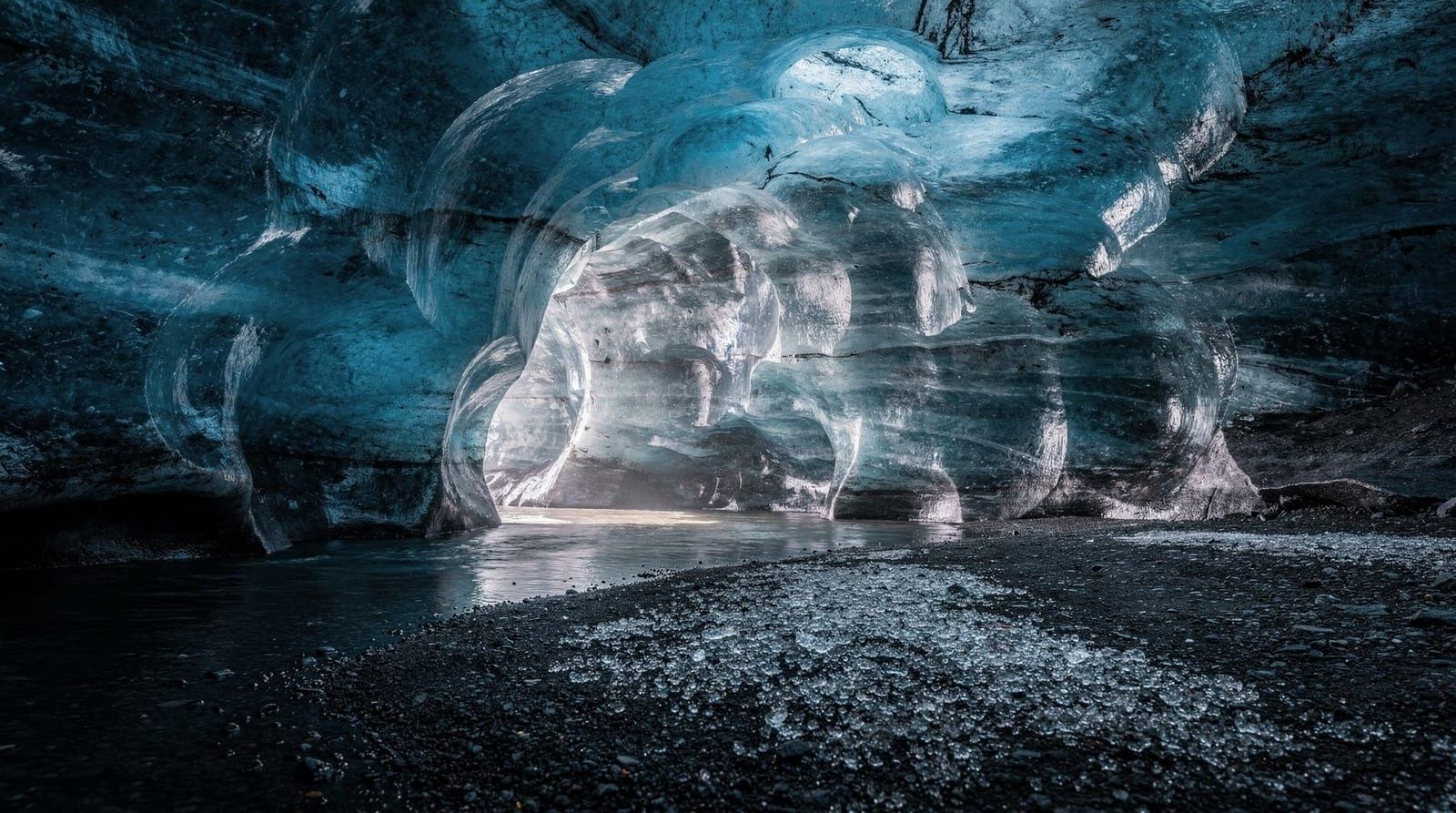
- Blue/white glacial ice, November–March only
- 5 hours from Reykjavík
- From €100 per person
- Weather-dependent cancellation risk
- Visually more dramatic in the canonical Iceland photography sense
Katla geothermal caves:
- Dark ash ice, year-round
- 2 hours from Reykjavík
- From €80 per person
- More accessible than Vatnajökull
For visitors on a tight itinerary who are based in Reykjavík, Raufarhólshellir is the most efficient underground experience — close, well-run, genuinely impressive, and available in any season. For those who specifically want the famous blue ice cave look, it’s Vatnajökull in winter.
Iceland’s lava geology — context for the tunnel
Raufarhólshellir formed during a lava eruption approximately 5,200 years ago, originating from the Bláfjöll area about 30 km east of Reykjavík. The lava flowed toward the sea in a long tube system, eventually cooling from the outside in. The tube preserved by this cooling process is what you walk through today.
Iceland’s position on the Mid-Atlantic Ridge means that volcanic activity is ongoing and distributed across the island. The Reykjanes Peninsula — visible from the tunnel area — has experienced eruptions every few years since 2021. The lava fields you cross on the approach road to Raufarhólshellir were formed by eruptions of similar type to the ones occurring on the Reykjanes Peninsula now.
Understanding the scale helps contextualise the tunnel. The lava flow that created Raufarhólshellir covered roughly 80 square kilometres before cooling. The tube was just one component — a drainage channel within a larger flow. The visible geology around the tunnel entrance shows multiple overlapping lava flow edges, each representing a slightly different eruption pulse.
Basalt mineralogy: The walls of Raufarhólshellir are olivine basalt — the primary composition of Icelandic volcanic rock. The dark colouring comes from iron and magnesium compounds. The occasional reddish or brown patches represent areas where iron oxidised differently during cooling, essentially rusting at geological temperatures.
Lava stalactites: Drips of cooling lava that solidified mid-fall are visible on the ceiling in some sections. These are distinct from cave stalactites (which form from mineral-laden water over thousands of years) — lava stalactites formed in hours during the original eruption.
The visitor experience in detail
The Lava Tunnel operator (which operates under the name “The Lava Tunnel — Raufarholshellir”) has managed the site since 2012. The visitor building at the entrance includes changing facilities, toilets, a small exhibition, and a café. The operation is well-run — guides are knowledgeable, English-language tours are the most frequent, and the group sizes are managed to avoid congestion inside.
Booking: Online booking is strongly recommended for summer. Tours depart hourly in peak season and every 2 hours in winter. The 45-minute drive from Reykjavík, combined with the 1.5 hour tour, makes for a 4-hour half-day activity.
What to wear: The tunnel is 4–6°C inside year-round. Warm layers are essential regardless of outside temperature. If you arrive in summer clothes, the operator has rental gear (warm jackets) available at cost. Sturdy shoes with ankle support are important — the floor is uneven volcanic rock throughout.
Headlamp: Provided as part of the helmet. Your phone torch is supplementary — don’t rely on it as primary lighting. The installed tunnel lighting is atmospheric but not bright.
The “extreme” section: At the far end, the tunnel narrows into a section requiring crouching, careful stepping, and some physical commitment. It’s not genuinely dangerous but adds a more physical dimension to the tour. Approximately 30% of tour participants attempt this section; the guide makes it optional and ensures those who skip it can wait comfortably.
Víðgelmir — the alternative for serious cavers
For those wanting a more significant lava tube experience, Víðgelmir in western Iceland is worth knowing about. Located near Húsafell (about 2 hours from Reykjavík, same direction as Langjökull), Víðgelmir is one of the world’s largest lava tubes by volume — roughly 1,585 metres accessible, with chambers reaching 16 metres high.
The operator runs tours with proper caving headlamps and a more expedition-style feel than the family-accessible Raufarhólshellir experience. If you’re already visiting Langjökull for Into the Glacier or snowmobiling, Víðgelmir is a logical same-day addition.
Visiting with children
Raufarhólshellir is one of the better activity options for families with children in Iceland. The tunnel walk is not physically demanding, the geological storytelling is accessible to older children, and the cave atmosphere (dramatic but not frightening) appeals to a wide age range. Minimum age typically 5–6 years, depending on operator requirements for headlamp helmets.
The visitor building at the entrance has toilets, which is practical with young children. The cold (4°C) means dressing appropriately matters more than in many outdoor activities.
The lava tunnel and Iceland’s recent volcanic activity
Raufarhólshellir formed approximately 5,200 years ago — in geological time, recent, but well before any human settlement of Iceland. The eruption that created it was part of a long volcanic history of the Reykjanes Peninsula, the same volcanic system that has been erupting near Grindavík since 2021.
The 2021–2024 Reykjanes eruptions are related to the same underlying plumbing that generated the Raufarhólshellir lava flow, though different eruption centres. The connection is instructive: standing in a 5,200-year-old tunnel formed by the same volcanic forces now producing lava on the surface 30 km away gives a direct geological continuity to the landscape.
Iceland’s volcanic system is cyclic. The Reykjanes Peninsula was quiet for approximately 800 years between its last eruption (medieval period) and 2021. Before that, there were several centuries of activity similar to what’s occurring now. The current eruption series is consistent with this cycle — not unusual, not particularly dangerous to the capital (which is more than 40 km away), but a real expression of Iceland’s ongoing geological youth.
Combining Raufarhólshellir with other half-day activities
The lava tunnel’s location on Route 39, roughly 35 km from Reykjavík, puts it adjacent to several other worthwhile stops:
Kerið crater (Route 35, Grímsnes area): A volcanic explosion crater filled with turquoise-blue water, about 40 km from Raufarhólshellir. A walkable rim path circles the 55-metre-deep crater in about 15 minutes. One of Iceland’s most visually striking small stops — 800 ISK (€5) entrance fee. From Raufarhólshellir, head north on Route 39 to Route 35 toward Selfoss.
Hveragerði: A geothermal town 30 km south-west of Raufarhólshellir on Route 1. The town centre has geothermal vents and hot springs directly in the urban area — steaming ground and boiling pools visible from the main street. The Ölkelda (natural carbonated spring) is drinkable and unusual. Hveragerði is also the starting point for the Reykjadalur hot spring hike.
Golden Circle route: Raufarhólshellir lies between Reykjavík and the Golden Circle. Adding it to a Golden Circle day adds 1.5–2 hours but keeps the geography sensible — drive out via Route 39 (through the tunnel), continue to Þingvellir, Geysir, and Gullfoss, then return via Route 1.
Frequently asked questions about Icelandic lava tunnel caving
Are there other lava tubes in Iceland besides Raufarhólshellir?
Yes — Iceland has many lava tubes, including Víðgelmir in western Iceland (one of the world’s largest lava tubes by volume) and Surtshellir in the highlands. Víðgelmir offers guided tours with a somewhat different experience — it’s less developed and larger. Raufarhólshellir remains the most accessible from Reykjavík.
What should I wear inside a lava tunnel?
Warm layers (wool or fleece mid-layer minimum), waterproof or windproof outer layer, and sturdy boots with grip — the uneven volcanic floor requires ankle support. Gloves are useful in winter. Helmet with headlamp is provided by the operator.
Can I take photos inside?
Yes. Tripods are not ideal on the uneven floor, but a monopod helps. The installed lighting is reasonably photogenic on a wide-angle lens. In winter with ice formations, macro and close-up photography is worth attempting.
How many people are in a tour group?
Standard groups run up to 20 people. Peak summer sees frequent back-to-back departures. For a quieter experience, book early morning or late afternoon slots. Private tours are available for smaller groups at a premium.
Is the lava tunnel bat-free?
Iceland has no native land mammals except the Arctic fox — no bats. The tunnel contains no wildlife of significance. Small cold-adapted invertebrates exist in the cave ecosystem but are not visible to casual visitors.
Does Raufarhólshellir ever flood?
The tunnel is designed to handle meltwater drainage, and modern management monitors water levels. Temporary closures during extreme melt conditions have occurred. The operator communicates closures in advance when foreseeable.
Booking self-drive vs. joining a bus tour
If you already have a rental car, the self-drive option is almost always the better value — you control the schedule, can combine the visit with Hveragerði or Kerið crater on the same loop, and pay only for the tour itself. See driving in Iceland if this is your first time on Icelandic roads; Route 39 is paved and straightforward year-round, so no 4x4 is required for this particular trip (for the broader question of what vehicle you actually need elsewhere, see 2WD vs 4x4 Iceland). Without a car, the bus transfer bundles pickup and drop-off from central Reykjavík, which is worth the premium if you’re not renting for the rest of your trip — check public transport in Iceland for how that fits a car-free itinerary.
Is it worth it compared to skipping underground Iceland altogether?
Some visitors on a short Reykjavík stopover wonder if an underground detour is worth the half-day. For most first-timers, yes: nowhere else in Iceland lets you touch 5,000-year-old lava rock at close range with this little planning risk. If your schedule is genuinely tight, prioritise it over a second waterfall stop on the Golden Circle — waterfalls repeat themselves visually across the island, lava tunnels don’t.
Top experiences
Bookable activities with verified prices and instant confirmation on GetYourGuide.
Top experiences
Best-rated activities across GetYourGuide and Viator.

Ice Cave by Katla Volcano Super Jeep Tour from Vik
- Viator

Sólheimajökull Glacier Hike – Adventure in a Small Group
- Viator

Ice Cave Tour from Vík
- Viator

Blue Ice Discovery – Guided Glacier Hike from Skaftafell
- Viator

Glacier Hike from Skaftafell - Extra Small Group
- Viator

East Glacial River – Grade 4 Rafting with Drysuits, North Iceland
- Viator