Public transport in Iceland — buses, schedules, and limitations
Reykjavik: Small group Golden Circle day trip
Can you get around Iceland by public transport?
Reykjavik city has a functional bus network. For the Ring Road and tourist sites, summer bus services exist but are limited, infrequent, and often require overnight stops in small towns. Most travellers rent a car. If you're committed to bus travel, plan around Strætó's long-distance routes (51, 52, 55) and accept slower, more rigid itineraries.
The honest starting point
Iceland has no passenger railway. The country’s public transport system is built around Strætó, a national bus company that covers Reykjavik city and intercity routes. For tourists, the honest assessment is: public transport works well in Reykjavik but is a significant constraint outside it. Most popular tourist sites are either inaccessible by bus, served only in summer, or reachable only by bus tours rather than scheduled services.
That said, a car-free Iceland trip is possible if you plan carefully, travel slowly, and accept that your itinerary will be bus-schedule-dependent rather than spontaneous.
| Where it works well | Reykjavik city, KEF airport transfers, Laugavegur/Fimmvörðuháls trekking |
| Where it’s limiting | Ring Road, Westfjords, East Iceland, most scenic car parks |
| Cost | City fare around 590 ISK; intercity segments 3,500–12,000 ISK |
| Frequency | City: frequent; intercity: often 1–2 buses per day, summer-only on many routes |
| Best alternative | Guided day tours from Reykjavik, or a rental car for full flexibility |
Reykjavik city buses (Strætó)
Reykjavik’s city bus network (operated by Strætó) is solid for a city of its size. Routes cover most residential areas and connect central Reykjavik with suburbs including Kópavogur, Garðabær, and Hafnarfjörður.
How it works:
- Flat fare: 590 ISK per single journey (2026 rate) — pay on board with card or cash (driver gives no change for cash; use a contactless card)
- Transfers within 75 minutes are free with the Strætó app
- The app (free) shows real-time arrivals and lets you buy tickets in advance
Key city routes:
- Route 1 and 2 cover the main city centre corridor
- Route 6 serves the domestic airport (Reykjavik Airport)
- Route 55 goes to Keflavik Airport (intercity — different pricing)
For most central Reykjavik attractions — Hallgrímskirkja, Harpa, the Old Harbour, Laugavegur shopping street — walking is often faster than the bus. The city is compact.
Intercity buses: what Strætó covers
Strætó operates several long-distance routes that are relevant for tourists:
Route 51 (Reykjavik–Borgarnes–Akranes): useful for reaching the West Iceland region. Runs daily.
Route 52 (Reykjavik–Borgarnes–Ólafsvík–Snæfellsnes): seasonal summer service reaching the Snæfellsnes Peninsula. Frequency is limited (1–2 trips per day). No service from November to May.
Route 55 (Reykjavik–Keflavik Airport): daily service, roughly hourly. The cheapest airport connection. See getting from Keflavik airport.
Route 57 (Reykjavik–Selfoss–Vík): reaches the South Coast as far as Vík. Seasonal summer service. Stops at Selfoss and Hvolsvöllur. Does NOT stop at Seljalandsfoss or Skógafoss (those require a separate walk or taxi from the highway).
Route 74/75 (Akureyri area): local service in north Iceland.
The critical limitation: most scenic stops along the Ring Road (Seljalandsfoss car park, Jökulsárlón, Reynisfjara beach) are not Strætó stops. Buses pass on Road 1 but do not pull in.
The Sterna and Reykjavik Excursions scheduled tours
During summer (roughly May–September), Reykjavik Excursions and Sterna operate scheduled bus routes marketed partly at independent travellers. These are tour buses with fixed stops, not on-demand transport.
- Reykjavik Excursions “Excursion Passports”: bundled bus passes for the Golden Circle, South Coast, etc. Useful for day-trip structure.
- Highland buses (F35 Kjölur, F26 Sprengisandur routes): Reykjavik Excursions and Trex operate highland bus routes in summer for trekkers on Laugavegur and Fimmvörðuháls. These serve Landmannalaugar and Þórsmörk. Book weeks in advance.
Prices for scheduled highland buses: 7,000–12,000 ISK per segment. Not cheap, but the only non-private way to reach these trailheads without your own 4WD.
The Flybus network and airport transfers
Reykjavik Excursions’ Flybus is the most-used intercity bus for tourists. It connects KEF Airport to the BSÍ Terminal (Reykjavik) and to hotels, meeting every scheduled flight. Price: around 3,500–4,500 ISK one way. See the full breakdown in getting from Keflavik airport.
Can you do the Ring Road by public bus?
Technically yes. Practically, it’s difficult. Strætó Route 51 covers the west; there is no continuous scheduled bus service completing the full Ring Road. You would need:
- Multiple operators and connections
- Overnight stays in towns where buses stop rather than where you want to be
- A very slow pace (minimum 2–3 weeks for a full loop)
- Willingness to miss many attractions that are not on bus routes
For determined bus travellers, the best approach is to combine scheduled Strætó routes with hitchhiking (common and generally safe in Iceland) or rental of a bike for stretches. Iceland’s Ring Road hitchhiking culture is well-established, particularly in summer.
Getting around without a car: practical strategies
If you’re committed to travelling without a car:
- Base in Reykjavik and take day tours. Most Golden Circle, South Coast, whale watching, and northern lights tours run as organised day trips from Reykjavik. You pay more per activity but avoid car hire entirely. Best day trips from Reykjavik lists the options.
-
Use the Flybus + highland buses for trekking. If your goal is the Laugavegur trek or Fimmvörðuháls, the highland buses serve Landmannalaugar and Þórsmörk directly. You need no car — just book buses and accommodation huts well in advance.
-
Fly domestically. Eagle Air and Air Iceland Connect serve Akureyri, Egilsstaðir, Vestmannaeyjar, and other regional airports. Combined with city taxis or local car hire in each hub, this can substitute for Ring Road driving. See domestic flights Iceland.
-
Cycle the Ring Road. A growing community of cyclists completes the Ring Road in 3–5 weeks. The roads are paved, facilities exist at regular intervals, and the experience is singular. Not a budget option once gear is factored in, but car-free.
Bus passes and travel cards
Strætó city pass: available via the app. A 24-hour pass costs around 1,700 ISK; unlimited for city buses.
Senior and youth discounts: Strætó offers discounted fares for under-18s and over-67s with valid ID.
Camping Card combined packages: some operators sell combined camping card and bus pass packages for independent travellers aiming at a low-cost Ring Road experience.
Apps and planning tools
- Strætó app (iOS/Android): real-time city bus tracking, ticket purchase, route planning. Essential for Reykjavik buses.
- straeto.is: the official schedule website with intercity route information
- Reykjavik Excursions website: for Flybus and highland summer bus bookings
Frequently asked questions about public transport in Iceland
Is there a train in Iceland?
No. Iceland has no passenger rail network and no current plans to build one. The country’s geology (volcanic rock, terrain complexity) and small population make rail infrastructure economically unviable.
Can I get to the Blue Lagoon by public bus?
Yes, via the Reykjavik Excursions Flybus direct service (KEF–Blue Lagoon connection) or by taking the Strætó Route 55 to Grindavík and transferring. Direct transfer packages from Reykjavik to the Blue Lagoon are also available. See Blue Lagoon guide for logistics.
How do I pay for Reykjavik city buses?
Contactless card payment on board, or the Strætó app for pre-purchased tickets. Cash is technically accepted but the driver gives no change — exact change or app is strongly recommended.
Are there buses to Jökulsárlón glacier lagoon?
No scheduled Strætó stop at the lagoon. Organised tours from Reykjavik cover it. Jökulsárlón day trip guide lists the main options.
Can tourists use the Strætó app outside Iceland?
Yes — it works on any iOS or Android device and is the standard way to buy city bus tickets. Download it before you arrive.
How reliable are Iceland’s intercity buses?
More reliable than their infrequency suggests. Strætó maintains schedules seriously. Delays occur in winter due to weather. The main issue for tourists is not reliability but frequency — one or two buses per day on most intercity routes.
Is hitchhiking a viable option in Iceland?
For summer travel, yes — hitchhiking is culturally accepted and commonly practiced along the Ring Road and major tourist routes. It is slower and less predictable than renting a car but works for travellers with time flexibility. It is significantly harder in winter due to lower traffic volumes.
Public transport in Reykjavik in detail
Reykjavik’s city bus network is more useful than casual visitors assume. The Strætó system covers the full Greater Reykjavik area (Reykjavik, Kópavogur, Garðabær, Hafnarfjörður, Mosfellsbær) with around 30 routes.
Key routes for tourists:
- Route 1: Runs east-west along the main city corridor, connecting Hlemmur bus terminal with Laugardalur and the domestic airport area
- Route 2: Parallel to Route 1 through slightly different streets
- Route 6: Connects the domestic airport (Reykjavik Airport, RKV) to Hlemmur
- Route 11: Reaches the Laugardalur pools and campsite
- Route 55: Not a city route — this is the intercity connection to Keflavik Airport
Hlemmur bus terminal is the central hub — most routes pass through here. Located on Lækjargata at the east end of Laugavegur shopping street.
BSÍ bus terminal is Reykjavik’s intercity coach terminal. From here, Flybus, Reykjavik Excursions coaches, and Strætó intercity services depart. It is a 20-minute walk from the city centre.
Using the Strætó app
The Strætó app is genuinely useful and free to download. It offers:
- Real-time bus tracking (you can see exactly where buses are)
- Journey planning (input your start and destination)
- In-app ticket purchase (cheaper and faster than paying on board)
- Automatic transfer registration (connections within 75 minutes are free)
Download it before you land and add a payment card. This removes any friction for city bus use.
What visitors miss: scenic bus routes
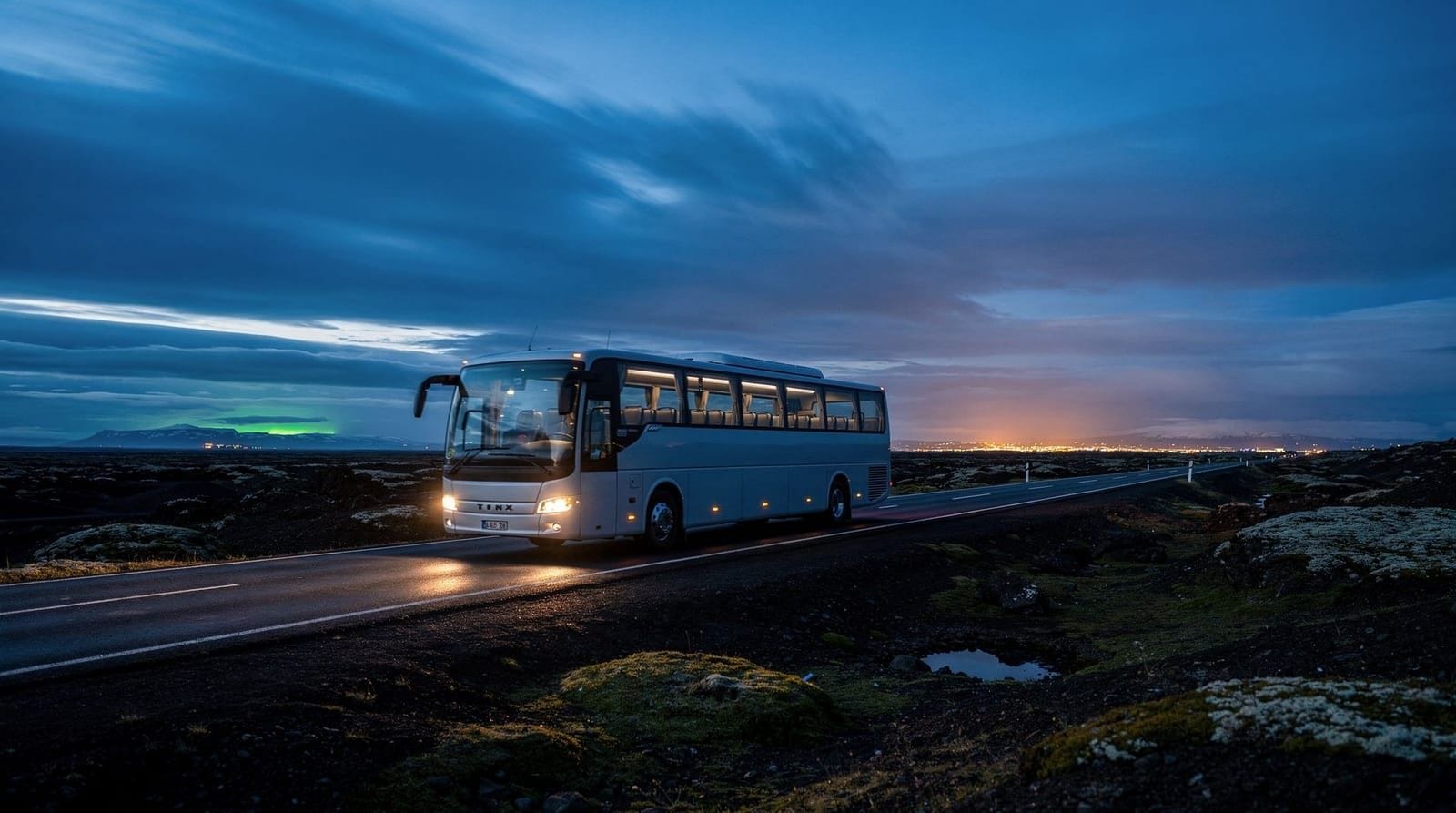
One underrated use of Strætó is the Route 55 ride itself. The 45-minute drive between KEF and Reykjavik crosses the Reykjanes lava fields — a stark, otherworldly landscape of mossy lava rock, geothermal vents, and the occasional eruption scar. First-time visitors staring out the bus window on this route often arrive in Reykjavik already impressed before they’ve seen anything on their actual itinerary.
Similarly, Strætó Route 57 through the South Coast towards Vík passes near several viewpoints. While the bus doesn’t stop at Seljalandsfoss or Skógafoss car parks, the bus journey itself through the Hvolsvöllur flatlands with glacier views is genuine scenery.
Organised shared transport as an alternative
For travellers who want structured transport without renting a car, Iceland’s tour operator network offers scheduled day-tour buses that function similarly to public transport for specific destinations:
Gray Line, Reykjavik Excursions, Arctic Adventures, Tröll Expeditions all operate scheduled round-trip buses from Reykjavik to Golden Circle, South Coast, Snæfellsnes, and other major routes. These run daily in summer and depart from BSÍ or central Reykjavik pickup points.
The key difference from renting a car: you go on the bus’s schedule, stop for fixed durations, and return when the bus returns. The upside: no driving, no navigation, someone else handles logistics, and there’s usually a guide on board with commentary. The cost per person is higher than a car rental split between 3–4 people, but cheaper than a solo car rental.
For a first Iceland visit focused on the main sites, a sequence of day tours from a Reykjavik base is a legitimate and well-functioning alternative to car hire. See best day trips from Reykjavik for what’s available.
Walking and cycling in Reykjavik
Reykjavik’s compact city centre is very walkable. From the main tourist hostel district near Laugavegur to Hallgrímskirkja, the Old Harbour, and Harpa, most sights are within a 20-minute walk of each other.
The city also has dedicated cycling infrastructure on main routes. Rental bikes are available at several city locations. For summer visitors who want to reach the suburban areas (Laugardalur, Öskjuhlíð) without a bus, cycling is practical.
City bikes work well for exploring Reykjavik’s neighbourhood streets and seafront promenade. They are not suitable for Ring Road travel or leaving the city, but for a 2–3 day Reykjavik stay, bikes combined with the occasional city bus cover everything a tourist needs without a car.
Accessibility: public transport for travellers with mobility needs
Iceland’s accessibility provision on public transport is inconsistent. Points to know:
- Strætó’s newer low-floor buses are wheelchair accessible; older fleet is not. Routes vary in accessibility provision.
- Flybus coaches and shared shuttle transfers typically accommodate folding wheelchairs in the hold.
- KEF airport is modern and fully accessible.
- Reykjavik city centre, while walkable, has some cobblestoned areas around the old town that are difficult for wheelchairs.
- Ring Road attractions vary enormously in accessibility — Geysir and Gullfoss have paved accessible paths; many hiking trails and volcanic features do not.
For detailed accessibility planning in Iceland, safetravel.is and the Tourist Information Office in Reykjavik can provide current information.
Luggage and logistics on intercity buses
A practical detail rarely covered in general transport guides: most Strætó intercity coaches and the Reykjavik Excursions/Sterna summer services have a limited underfloor luggage hold, typically one standard suitcase and one carry-on per passenger. Travellers arriving with hiking gear, camping equipment, or multiple bags for a longer trip should check the specific vehicle’s capacity when booking, particularly for the highland trekking buses to Landmannalaugar and Þórsmörk, where trekking poles, large packs, and wet-weather gear all compete for the same limited hold space. Arriving early to secure a good luggage slot is standard practice among regular users of these routes.
Bus frequency and when to use it: a realistic assessment
The fundamental constraint of Iceland’s public transport is not quality — Strætó is well-run and punctual — but frequency. Most intercity routes run once or twice per day. This means:
If you plan to use Route 57 to reach Vík, you’re tied to departure times. Arriving at Seljalandsfoss requires a bus, then a walk (the car park is not a scheduled stop), then catching the next bus — possibly an hour or more later. The experience of “seeing Iceland by bus” involves significantly more waiting than a car traveller experiences.
For travellers who genuinely embrace slow travel — spending a full day at one location, building itineraries around bus schedules, moving every 2–3 days rather than daily — Iceland by bus is deeply satisfying. You interact with the landscape differently when you’re not rushing to reach the next viewpoint before the tour bus.
For travellers trying to replicate a car-paced itinerary on buses: it won’t work. The practical ceiling for bus-based Iceland travel is roughly half the sites in twice the time.
Planning resources for car-free Iceland travel
- straeto.is: Full intercity and city bus schedule information
- Reykjavik Excursions (re.is): Flybus, highland buses, scheduled tours
- Trex.is: Highland bus services to Þórsmörk, Landmannalaugar
- r/VisitingIceland on Reddit: Current reports from travellers who’ve done car-free trips. Invaluable for up-to-date practicalities.
- Lonely Planet Iceland and similar travel books: useful for bus route appendices, though schedules change annually
The official Strætó app is updated in real time and is the most reliable source for current schedules. Download it before travel.
Car-free Iceland: a realistic assessment
The question every planning guide eventually addresses: can you do Iceland without a car?
Short answer: In Reykjavik and on specific organised routes (Laugavegur trek, Golden Circle day tour), yes. For exploring Iceland independently outside these contexts: it’s difficult, limiting, and often more expensive per-activity than simply renting a car.
The comparison that matters: a compact 2WD rental car for 10 days costs around 100,000–150,000 ISK. Over 10 days, the guided day tours needed to cover the same sights (South Coast, Golden Circle, Snæfellsnes, northern lights) total approximately 80,000–120,000 ISK per person. For two people, that’s 160,000–240,000 ISK in tour costs — more than the car, plus you’re constrained to tour schedules and can’t linger where you want.
The economic argument for car-free travel in Iceland is weakest when you have a travel partner to split car costs. It’s strongest for solo travellers on a short Reykjavik-based trip.
There is also a time-cost dimension that pure price comparisons miss. A rental car lets you leave when you choose and adjust your route on the fly if weather or road conditions change; day tours run to a fixed schedule regardless of how you’re feeling that morning or whether an unplanned stop looks tempting. For travellers who value spontaneity as much as budget, this is often the deciding factor even when the numbers are close.
Car-free Iceland genuinely works for:
- A 3–5 day Reykjavik urban trip with 2–3 day tours
- The Laugavegur or Fimmvörðuháls trekking route (highland buses + huts)
- Visitors with significant time flexibility who enjoy slow travel by bus and hitchhiking
- Travellers who have a specific reason not to drive (medical, preference, licence type)
Car-free Iceland is limiting for:
- Anyone wanting to explore beyond the main tour routes
- Families with children who want flexible timing
- Photography-focused travellers who need to be at specific locations at specific light times
- Anyone wanting to visit the Westfjords, East Fjords, or North Iceland independently
For the specific case of Reykjavik city travel without a car, the Strætó bus system is entirely adequate and using public transport in Reykjavik works well. For everything outside Reykjavik, read renting a car in Iceland to understand the full costs and what you actually gain.
A middle path: transfers plus day tours
Travellers who want to avoid driving entirely but find pure Strætó travel too rigid often land on a hybrid: a scheduled airport transfer at each end of the trip, combined with organised day tours for the main sights, and city buses or walking for everything in Reykjavik itself.
Keflavik Airport to Reykjavik bus transferThis hybrid approach costs more overall than a rental car split between two or more people, but it removes every driving decision from the trip — no navigating unfamiliar roundabouts, no winter tyre concerns, no parking logistics. For a solo traveller or a couple prioritising a stress-free first visit over cost efficiency, it is a genuinely reasonable way to see Iceland’s highlights without ever touching a steering wheel.
Top experiences
Best-rated activities across GetYourGuide and Viator.

Reykjavik: From airport to adventure private Reykjanes peninsula tour
- GetYourGuide
Reykjavik: Kef bus transfer to from Reykjavik shuttle
- GetYourGuide
Reykjavik: Keflavik airport transfer to Reykjavik
- GetYourGuide
Reykjavik: Kef private transfer to from Reykjavik
- GetYourGuide
Reykjavik: Keflavik airport to Reykjavik bus transfer
- GetYourGuide
Reykjavik: Private transfer to from kef airport
- GetYourGuide