Renting a car in Iceland — complete 2026 guide
What do I need to rent a car in Iceland?
A valid driving licence from your home country, a credit card in the driver's name for the deposit, and you must be at least 20 years old (some companies require 23 for 4WD vehicles). Book in advance — cars sell out fast in summer.
Why renting a car is the default way to see Iceland
Iceland has very limited public transport outside Reykjavik. Buses on the Hringvegur (Ring Road) run only in summer, schedules are sparse, and most of the landscapes people come to see — the South Coast, the Snæfellsnes Peninsula, the Westfjords — are not reachable without a vehicle. Renting a car gives you the freedom to stop at any waterfall or viewpoint on your own timetable, and it is often cheaper than stringing together day tours.
The core decision is what type of car to rent. For summer travel on paved roads, a small 2WD is fine. For highland F-roads or winter driving, a proper 4WD is required by law on some routes. Read the 2WD vs 4x4 Iceland guide before booking.
| Cost | Around 8,000–10,000 ISK/day for a compact 2WD in shoulder season; higher in July–August |
| Minimum age | 20 for standard cars, 23 for 4WD/campervans (varies by operator) |
| Deposit | 80,000–300,000 ISK on a credit card in the driver’s name |
| Booking window | 8–12 weeks ahead for July–August; more flexible in shoulder/winter |
| Extras to budget for | Gravel protection (SAAP/GP), child seats, winter tyres (included Nov–Apr) |
Age and licence requirements
Most Icelandic rental companies set the minimum age at 20 years for small 2WD cars, rising to 23 years for larger 4WD or campervan categories. Some budget operators require 25 for premium vehicles. Drivers over 70 may face restrictions with a handful of companies — worth checking in advance.
Your home-country driving licence is accepted. EU, UK, US, Canadian, Australian and most other national licences are valid without an international driving permit. Iceland has not signed the Vienna Convention in a way that requires the IDP, but if your licence is not in Latin characters (Arabic, Chinese, Korean script), bring an IDP or a certified translation.
You need a credit card — not a debit card — in the primary driver’s name to cover the security deposit. Deposits typically run from 80,000 ISK to 300,000 ISK depending on vehicle type and insurance level.
Booking: when and where
Iceland’s rental market is highly seasonal. In June and July, the cheapest small cars disappear weeks or months ahead. The same Yaris-class car that costs around 8,000–10,000 ISK per day in shoulder season can exceed 20,000 ISK per day in peak summer if booked late.
Where to book:
- Booking.com Cars / RentalCars.com / Discovercars.com — aggregators that compare multiple local operators; good for price shopping
- Hertz, Europcar, Avis — international chains at KEF airport; reliable but often pricier than local operators
- Local companies (SADcars, Lagoon Car Rental, Go Car Rental, Northbound) — frequently 20–40% cheaper than chains for identical vehicle classes
- Avoid booking at the counter on arrival — walk-up prices at KEF airport are significantly higher than online rates
Book the car before flights and accommodation, not after. In August, cars genuinely run out.
Picking up at Keflavik airport (KEF)
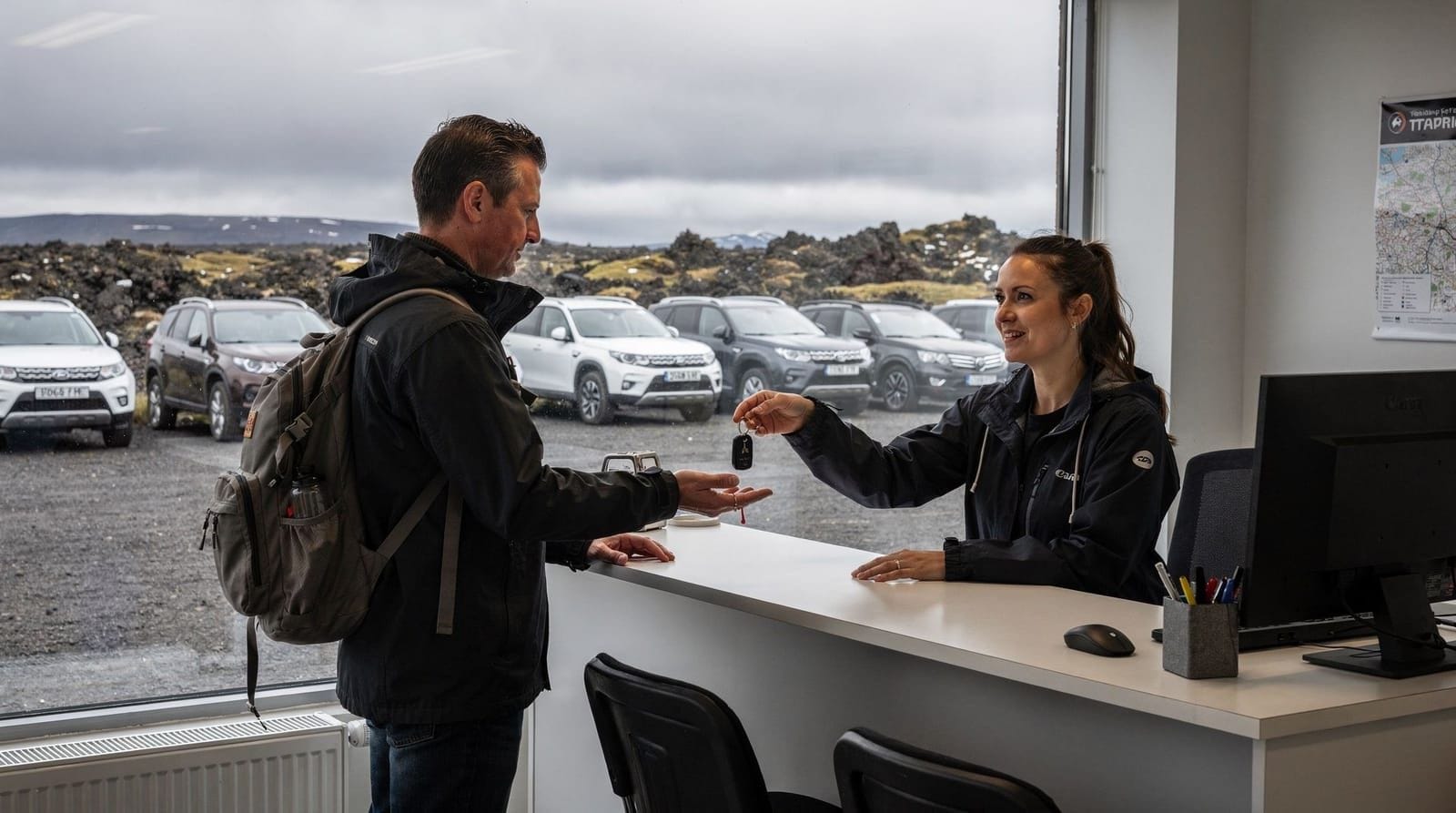
Most rental desks are not inside KEF terminal — they operate off-airport lots connected by shuttle bus. When you land, collect luggage, then look for the rental company’s shuttle stop outside arrivals. The shuttle ride takes 5–15 minutes. Factor this into your schedule, especially if you have a connecting plan or Blue Lagoon booking.
International chains (Hertz, Europcar, Budget) have counters inside or directly adjacent to the terminal. Off-airport operators compensate with lower prices.
Documents to have ready at pickup:
- Driving licence
- Credit card (in driver’s name)
- Booking confirmation
- Passport or national ID
The desk agent will try to upsell insurance at pickup. Know what cover you already have before you arrive. The car rental insurance guide covers every category in detail.
Gravel protection (SAAP/GP) — the Iceland-specific extra
Standard CDW/collision waiver does not cover gravel and sandstorm damage, which is a real risk on Iceland’s roads. Flying gravel chips windscreens and strips paint — it’s not hypothetical. SAAP (Sand and Ash Protection) or GP (Gravel Protection) is a separate add-on costing 700–2,500 ISK per day depending on the company.
If you’re driving any highland F-road, the coastal road near Vík, or the South Coast in windy conditions, this cover is worth having. Some aggregator sites bundle it in. Check what is and isn’t covered before you decline it.
What type of car for your trip
A compact 2WD (Yaris, Corsa) is sufficient for:
- Ring Road in summer
- Golden Circle, South Coast, Snæfellsnes Peninsula
- All paved roads year-round
A 4WD (high-clearance) is required for:
- All F-roads (legally required; police fine is 50,000 ISK+)
- Landmannalaugar, Kerlingarfjöll, Askja
- Highland interior in general
For the 4WD vs 2WD decision in full detail, see the 2WD vs 4x4 Iceland guide. If you want the flexibility of sleeping in the vehicle, the campervan vs car comparison will help you decide.
Fuel and costs on the road
Iceland runs on regular unleaded (95 RON) and diesel. Fuel prices in 2026 hover around 265–295 ISK per litre for petrol. A full tank in a compact car costs roughly 8,000–10,000 ISK. The Ring Road is approximately 1,332 km; budget for three to four full tanks over a full loop.
Petrol stations (N1, Orkan, ÓB, Costco near Reykjavik) are generally well-spaced on the Ring Road, but gaps exist in the East Fjords and the Westfjords. Never let the tank drop below half in remote areas. For comprehensive station info, see fuel and gas stations in Iceland.
Driving rules to know before you go
- Drive on the right side
- Speed limits: 50 km/h in town, 80 km/h on gravel/unpaved, 90 km/h on sealed rural roads
- Headlights on at all times, day or night — it’s the law
- Seatbelts mandatory for all occupants
- No off-road driving — leaving designated roads carries heavy fines and causes irreversible damage to Iceland’s fragile moss and lava fields
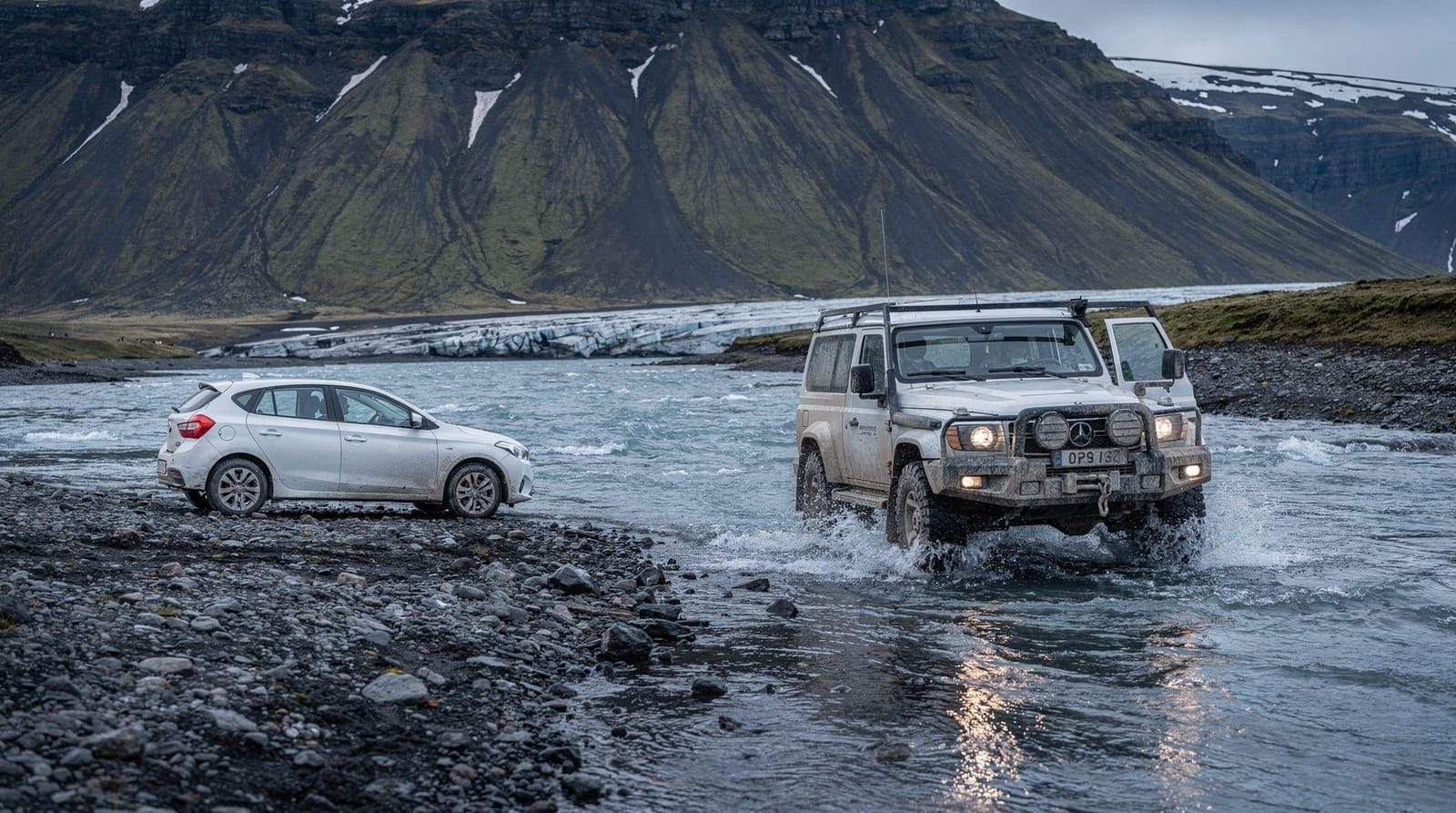
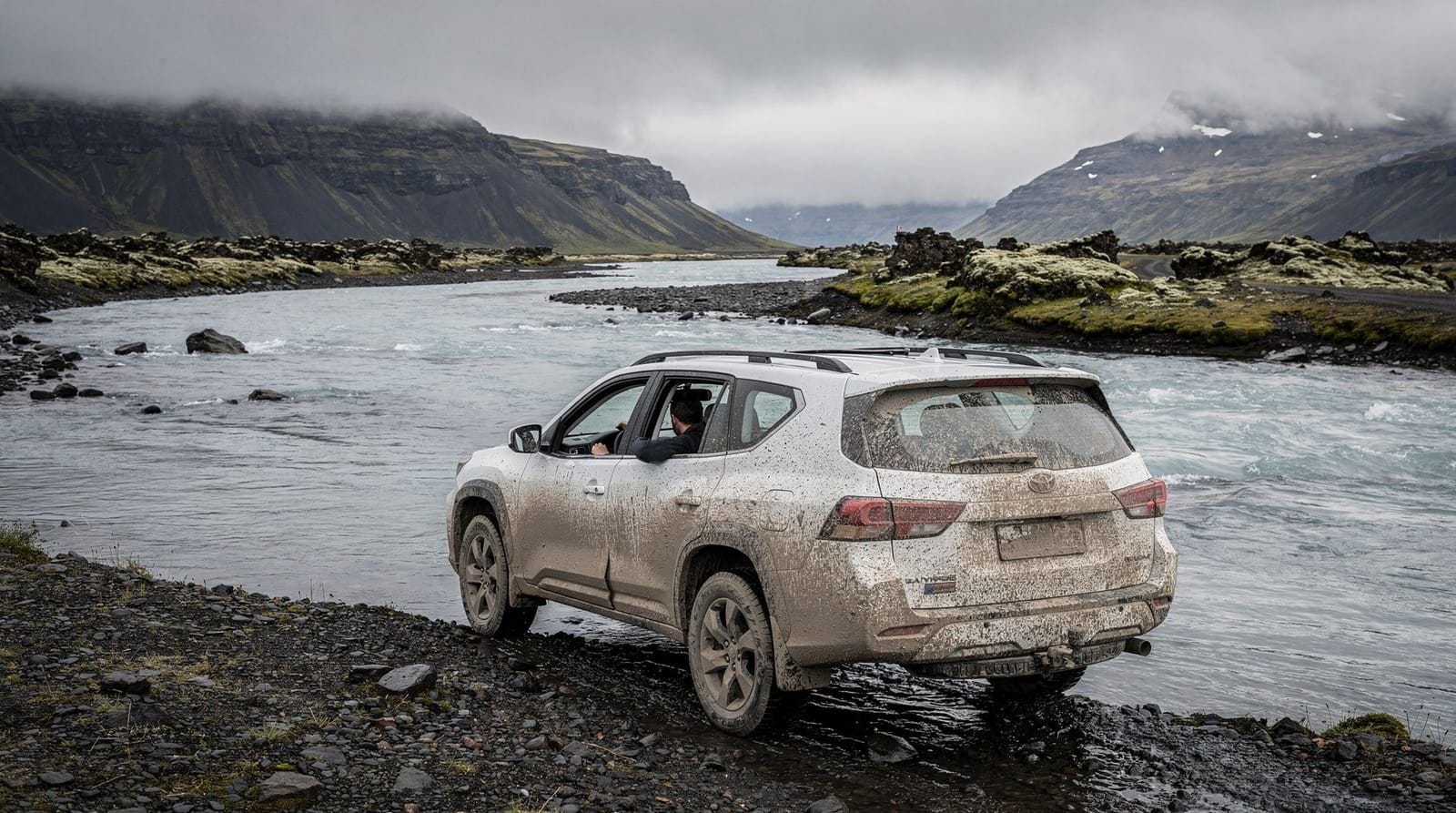
- River crossings on F-roads require a 4WD; even then, assess water depth carefully
- For full winter and road condition guidance, see driving in Iceland
Returning the car
Most companies require a full-to-full fuel policy — fill up before returning. Reykjavik city petrol stations include N1 on Grensásvegur and ÓB near the city centre. KEF airport area has an Orkan station near the ring road junction.
Inspect the car with a company rep at return. Take photos before and after your rental. If damage disputes arise, your timestamped photos are the only documentation you control.
Common mistakes to avoid
Underestimating distances. Iceland looks small on a map. Driving from Reykjavik to Jökulsárlón is 375 km one way, around 4–5 hours without stops. Stops are the whole point — plan conservatively.
Booking a 2WD and wanting to drive F-roads. F-road access is not a grey area — rental companies can void your entire insurance coverage if you take a 2WD on an F-road, and the rescue bill for a stuck vehicle starts at 200,000+ ISK.
Ignoring weather. Road conditions change hourly. Check road.is and safetravel.is before every long drive. See the Iceland road conditions guide for the full picture.
Not checking if the car has winter tyres. Between November and April, the law requires winter tyres. Most rental cars automatically have them in winter, but confirm with the operator.
Frequently asked questions about renting a car in Iceland
Can I use a debit card to rent a car in Iceland?
Most rental companies require a credit card for the security deposit. A few operators accept debit cards with a larger cash deposit (up to 400,000 ISK held). Check with your specific company before assuming this is possible.
Do I need an international driving permit for Iceland?
No — for most nationalities. Your home-country licence in Latin characters is sufficient. If your licence uses non-Latin script, bring an IDP or a certified English translation.
What is the minimum age to rent a car in Iceland?
Most companies allow rental from age 20 for standard cars, 23 for 4WD and larger vehicles. Young driver surcharges (around 1,500–2,500 ISK per day) apply for drivers under 25 with many companies.
Is it cheaper to rent at the airport or in Reykjavik city?
Off-airport lots near KEF are often cheaper than city pick-up desks. In-terminal chains (Hertz, Avis) at KEF charge a premium for the convenience. Booking through an aggregator and picking up at an off-airport shuttle stop often saves 10–20%.
What happens if I break down?
Most rental companies include 24/7 roadside assistance. Save the company’s emergency number on your phone before you leave the lot. Iceland’s roads are remote — help can take time to arrive. For serious emergencies, 112 is the general emergency number, and safetravel.is tracks your trip if you register it.
Are child seats available from rental companies?
Yes, virtually all companies offer child seats and booster seats as an add-on, usually 800–1,500 ISK per day. Book in advance during summer — they can sell out.
Can I drive into the highlands with a rental car?
Only with a 4WD. Most rental contracts explicitly exclude F-road access for 2WD vehicles, and some contracts require prior written permission for certain highland routes even with a 4WD. Read your contract. The F-roads Iceland guide covers restrictions in detail.
Is fuel included in car rental prices?
No. You will pay for all fuel consumed. The standard policy is full-to-full: pick up a full tank, return full. Prepaid fuel options exist but are rarely good value.
Seasonal considerations for car rental
Summer (June–August)
Peak season brings the highest prices and tightest availability. Book 8–12 weeks ahead for July–August. The advantage: roads are at their most accessible, daylight is essentially continuous (midnight sun in June–early July), and campsite networks are fully open. A 2WD handles all paved routes.
Downsides: tourist volume is high at popular sites (Skógafoss, Seljalandsfoss, Blue Lagoon), and spontaneous overnight decisions are harder without advance accommodation bookings. The Ring Road between Vík and Höfn sees heavy lorry and campervan traffic in summer — maintain good following distance on narrow sections.
Shoulder season (May, September–October)
Car hire prices drop 20–35% in shoulder season. Availability is less stressed. Weather in May can surprise with lingering snow at elevation; September offers the first autumn colours and first aurora windows (from mid-August onwards). The landscape photography in September is arguably better than in July — low-angle golden light, frost on morning grass, post-harvest fields.
F-road access: opening and closing dates vary by year and depend on snowpack. The Icelandic Road and Coastal Administration (Vegagerðin) publishes real-time F-road status at vegasja.vegagerdin.is. The highland F-roads typically open in late June and close again in late September or October.
Winter (November–April)
Car hire prices are lowest in January–February. This is also Iceland’s most challenging driving season, requiring genuine winter experience and a 4WD in most cases for safe off-ring-road driving. Ice, compacted snow, reduced daylight (4–5 hours in December), and unpredictable mountain pass closures are all real factors.
Benefits: aurora season is prime, tourist numbers are a fraction of summer’s, and the landscape covered in snow is genuinely beautiful. Some rental companies restrict certain vehicle classes or routes in winter — read the contract. Never drive on a closed road (stickers at junctions indicate closures; road.is shows current status).
Understanding rental car categories
Icelandic operators use slightly different category names than EU standards. Roughly:
Group A (Economy): Yaris, Corsa, Peugeot 108-class. 2WD, 5-door, 50–75 hp. Sufficient for Ring Road, Golden Circle, South Coast in summer. Cheapest fuel consumption.
Group B/C (Compact/Intermediate): VW Golf, Toyota Auris-class. Slightly more luggage space. Still 2WD.
Group D (Compact SUV 2WD): Hyundai Tucson without 4WD, Dacia Duster 2WD. Higher clearance than a hatchback but no 4WD. A common upsell that charges SUV prices without genuine 4WD capability.
Group E/F (4WD SUV): Dacia Duster 4WD, Ford Kuga, Hyundai Tucson 4WD. Sufficient for most highland routes, confirmed by your operator for specific F-roads.
Group G/H (Large 4WD): Toyota Land Cruiser, Ford Ranger. Required for demanding river crossings and the most challenging F-roads. Highest daily rate.
When comparing quotes, always confirm which group you’re booking — the same category letter can mean different things at different operators.
What to photograph and document at pickup
Before you drive away from the lot:
- Walk around the entire car and check for existing damage — dents, scratches, chips, cracks
- Photograph every side of the car, plus the roof if accessible
- Photograph inside the windscreen for existing chips (very common on used Iceland fleet vehicles)
- Check tyres — Iceland’s rental cars are heavily used; ask about tyre condition if you’re heading into remote areas
- Confirm the fuel level on the contract matches what’s in the tank (most contracts state “full” but verify)
- Get a signed condition report noting any existing damage before signing for the vehicle
The condition report is your only protection against being billed for damage that was there before you arrived. Don’t skip this step.
Driving etiquette and road behaviour in Iceland
Iceland’s roads have their own informal conventions. Following them improves safety and avoids conflicts:
Passing places on single-track roads: The Westfjords, Snæfellsnes Peninsula, and some highland roads use single-track roads with periodic passing bays. The convention is that the vehicle closer to a passing bay pulls in to let oncoming traffic pass. If you’re unsure who should give way, look for the white diamond road signs indicating right of way.
Reversing off bridges: Iceland has many single-lane bridges (einbreið brú). Etiquette: if you’re closer to the bridge, you have priority. If the other driver has already started crossing, wait. Don’t start a game of chicken on a narrow bridge over a glacial river.
Hazard lights on slow vehicles: Campervans and touring vehicles sometimes use hazard lights when stopping suddenly for roadside photography. This is technically illegal in motion but occurs. Keep appropriate following distance.
Animal crossings: Sheep freely graze and wander across roads throughout Iceland, especially in rural areas and the Westfjords. Icelanders drive with this expectation built in. Slow down for any animal on or near the road. Hitting a sheep is a serious incident — you’re liable for the animal’s value, which can be substantial, and the animal often runs into the road unexpectedly.
Headlights: On at all times, including sunny summer days. It’s the law, and road visibility inspections target this.
GPS and navigation in Iceland
Iceland’s road naming system is simple: F-roads are highland tracks, roads are numbered 1–980ish, with 1 being the Ring Road. Google Maps handles Iceland well with current offline download. OpenStreetMap/Maps.me is a solid free offline alternative.
Specific GPS items to know:
- Some rental cars have Icelandic-specific GPS units with F-road status and real-time road condition data — useful for highland driving
- Google Maps accurately reflects Ring Road paved/unpaved status in most areas
- For current road conditions and closures: road.is (the official government road condition site)
- For safety registration on remote drives: safetravel.is (register your itinerary and expected return time — Icelandic Search and Rescue checks these if you don’t return on schedule)
What to pack in your rental car
Beyond personal gear, keep these items accessible in the car:
- Warm layer and waterproofs — even in July, weather can turn rapidly
- Emergency reflective vest — legally required in some countries; in Iceland it’s sensible
- First aid kit — rental cars sometimes have one; supplement it
- Phone charger (12V car adapter) — essential for navigation
- Portable battery pack — for long days away from power
- Small amount of ISK cash — for automated pay systems that don’t accept some cards
- Physical road map backup — for remote areas where GPS signal or phone battery fails
For complete packing guidance, see what to pack for Iceland.
Excess mileage and daily driving limits
Most Icelandic rental agreements include unlimited mileage as standard, which suits the Ring Road and most touring itineraries well. A small number of budget operators cap daily mileage on their cheapest rates, particularly for very short rentals of one or two days — check this specifically if you’re planning a long single-day drive, such as a round trip from Reykjavik to Jökulsárlón and back (750+ km in a day). Confirm unlimited mileage is included before booking if your itinerary involves more driving than a typical week-long Ring Road loop.
Comparing car rental to campervan rental
Renting a campervan instead of a car-plus-hotel combination is a common alternative, particularly for budget-conscious or flexible-schedule travellers. A campervan folds accommodation and transport into one cost, removes the need to book guesthouses ahead in a tight market, and lets you change your route on a whim. The trade-off is a higher daily rental rate than an equivalent car, generally worse fuel economy, and more limited manoeuvrability on some narrower roads and in city parking. For a full breakdown of when each option makes more financial and practical sense, see campervan vs car.
Icelandic road signs
A few signs specific to Iceland that international drivers may not recognise:
- White diamond on blue background: You have right of way
- F + road number (F35, F208): F-road ahead — 4WD required, no 2WD
- Einbreið brú: Single-lane bridge ahead
- Lokað (with red X or barrier): Road closed
- Blind hæð: Blind rise ahead — blind crests are common on rural roads, often very sharp; reduce speed significantly
One-way rentals and dropping off in a different city
Not every trip ends where it started. If you’re flying out of Akureyri after a Ring Road loop, or want to drop the car in Reykjavik after starting in Keflavik, one-way rentals are available from most larger operators, though not all local companies offer them. Expect a one-way fee, typically 15,000–40,000 ISK depending on distance and vehicle class, and reduced vehicle choice compared to standard round-trip bookings. Book one-way rentals earlier than a standard round trip — availability at the drop-off location is the limiting factor, especially for 4WD categories in shoulder season when highland-bound travellers are competing for the same vehicles.
What Icelandic rental staff actually recommend
Talking to rental desk staff across several operators reveals a consistent set of informal advice that doesn’t always make it into official terms and conditions. Most agents will privately suggest taking gravel protection even on a short South Coast trip, since the claims volume from windscreen chips is disproportionately high relative to the add-on’s daily cost. Several also note that renters who decline the pre-rental walkaround inspection are the ones most likely to dispute a damage charge later — the five minutes spent documenting the car’s condition at pickup consistently saves arguments at return. On vehicle choice, more than one operator has noted that customers who book a 2WD compact car for a June–August Ring Road trip rarely regret it, while those upgrading to 4WD “just in case” for a paved-road-only itinerary often feel they overpaid.
Top experiences
Best-rated activities across GetYourGuide and Viator.
Reykjavik: From airport to adventure private Reykjanes peninsula tour
- GetYourGuide
Reykjavik: Kef bus transfer to from Reykjavik shuttle
- GetYourGuide
Reykjavik: Keflavik airport transfer to Reykjavik
- GetYourGuide
Reykjavik: Kef private transfer to from Reykjavik
- GetYourGuide
Reykjavik: Keflavik airport to Reykjavik bus transfer
- GetYourGuide
Reykjavik: Private transfer to from kef airport
- GetYourGuide