What to pack for Iceland — the realistic gear list
What is the most important thing to pack for Iceland?
A waterproof outer layer (jacket and trousers) and waterproof hiking boots with ankle support. Iceland's weather changes within the hour — you will encounter rain, wind, cold, and potentially sun on the same day, even in July. Nothing else matters as much as staying dry and warm.
Packing wrong for Iceland means either freezing at a waterfall in a cotton hoodie or hauling a suitcase of gear you never touch. This guide gives the realistic list — what actually matters (a genuine waterproof shell and real hiking boots), what’s seasonal, and what you can safely leave at home. Pair it with Iceland weather explained to understand why layering matters so much here.
| Must-have | genuine waterproof hardshell jacket + waterproof hiking boots |
| Luggage | 40–50L backpack or medium wheeled case — most guesthouses have narrow corridors |
| Laundry | most guesthouses offer it — pack 3–4 days of clothes, not 10 |
| Buy locally if needed | 66°North and Cintamani in Reykjavík, at a price premium |
| Season-specific | winter and northern lights hunting need extra insulation beyond the base list |
The fundamental principle: layers
Iceland’s weather is layered — not simply “cold” or “warm.” You will move between a warm car, an exposed coastal cliff, a heated café, and a windy glacier all on the same day. The layering system works:
- Base layer: Moisture-wicking material (merino wool or synthetic). Keeps sweat away from your skin.
- Mid layer: Insulating layer (fleece or down jacket). Traps body heat.
- Outer layer: Waterproof and windproof shell (hardshell jacket and trousers). Blocks rain and wind.
You adjust by removing or adding layers. This beats packing a single “warm coat” that is either too hot or too cold.
Clothing: the non-negotiables
Outer shell: the most important item
A waterproof, breathable hardshell jacket with a hood. Not a soft-shell (water-resistant is not the same as waterproof). Not a cotton anorak. A proper hardshell — Gore-Tex or equivalent — that keeps rain out completely in sustained downpour.
Waterproof trousers or over-trousers: essential if you plan to hike, walk waterfalls, or spend time outdoors in rain. A pair of lightweight waterproof trousers weighs very little and changes everything when it rains sideways.
Footwear
Waterproof hiking boots with ankle support. This is the single most important footwear choice for Iceland. The terrain at most attractions involves uneven volcanic rock, mud, soft ground, and wet grass. Trail runners without waterproofing will soak through at the first muddy path.
Requirements:
- Waterproof (Gore-Tex or similar)
- Ankle height (helps on uneven terrain)
- Stiff enough for uneven ground but not mountaineering-stiff
- Already broken in — new stiff boots on day 1 of a 10-day trip is a bad idea
A pair of compact town shoes or trainers for Reykjavik evenings if you care about not walking cobblestones in heavy hiking boots.
Warm wool socks: Two to three pairs. Merino wool manages moisture better than cotton and stays warm when wet.
Mid layers
- Fleece jacket or midlayer: For cool evenings and as insulation under your shell.
- Down jacket or synthetic puffer: Valuable in winter, useful in shoulder season, optional in summer but worth bringing for cold evenings at guesthouses.
- Thermal leggings (base layer bottoms): For winter and spring. Merino wool is warmer per weight than polyester for cold conditions.
Base layers
- Merino wool base layer top: Two is ideal for a week-plus trip (one washing overnight). Merino resists odour effectively — you can wear it several days between washes.
- Merino wool base layer bottoms: Useful for cool evenings and cold mornings.
- Everyday clothing: T-shirts, casual trousers or jeans for guesthouses and Reykjavik. Three to four days’ worth. Guesthouses and most Airbnbs have laundry facilities.
Accessories
- Woollen hat / beanie: Worn more days than not, including July at elevation.
- Lightweight gloves: Thin liner gloves for cool days; warmer gloves for winter.
- Neck gaiter / buff: Invaluable. Keeps wind off your neck on cliffs and glacier walks.
- Sunglasses: Surprisingly important. Iceland has bright summers, and snow reflection in winter can be intense.
Footwear quick reference by season
Summer (June–August): Waterproof hiking boots for outdoors, light shoes for Reykjavik. Sandals are rarely practical given the terrain.
Autumn (September–October): Same as summer, plus warmer socks and mid-layers.
Winter (November–March): Waterproof boots with insulation or very warm socks. Consider microspikes (shoe-grip attachments) for icy paths — sold widely in Iceland if you do not bring them.
Spring (April–May): Waterproof boots mandatory. Snow possible at elevation, wet conditions everywhere.
| Season | Key extra items | Avg. daytime temp |
|---|---|---|
| Summer (Jun–Aug) | Light midlayer, sunglasses, swimsuit | 10–15°C |
| Autumn (Sep–Oct) | Warmer mid-layer, insulated gloves | 5–10°C |
| Winter (Nov–Mar) | Insulated boots, microspikes, hand warmers | -1–4°C, colder with wind |
| Spring (Apr–May) | Waterproof boots, layered mid-layers | 3–8°C |
For a deeper dive into why conditions shift so fast, see Iceland weather explained and, if you’re travelling in the cold months specifically, Iceland in winter.
Electronics and photography gear
- Phone charger + universal adapter (if non-EU): Iceland uses Type F (Schuko) plugs, 230V / 50Hz.
- Power bank (10,000–20,000 mAh): For all-day outdoor days, northern lights hunts at night, or glacier hikes.
- Camera: Iceland rewards any level of camera. Your phone camera is fine for most situations. A tripod is very useful for northern lights and waterfall long-exposures. See Iceland photography guide.
- Memory cards and backup storage: Bring more storage than you think you need. You will take more photos than expected.
- Car charger/USB adapter: Useful for charging devices while driving between stops.
Driving and road trip essentials
If you are renting a car (which most visitors do), carry:
- Physical road atlas or downloaded offline maps: GPS signal drops in highlands and some remote areas.
- Backup snacks and water: Some highland stretches have no services for 100+ km.
- Ice scraper and small snow brush: Hire companies often provide these, but confirm.
- High-visibility vest: Mandatory in some countries; useful for roadside stops in Iceland.
- First-aid kit: Basic one from a pharmacy. Cuts from lava rock happen.
Packing for the hot springs experience
Iceland’s geothermal pools are a major activity. Whether visiting the Blue Lagoon, Sky Lagoon, Secret Lagoon, or wild pools, specific items help:
Swimsuit: Mandatory. A decent one that you do not mind getting silica-stained at the Blue Lagoon. Bikini or swimsuit for women; swimsuit or shorts for men.
Waterproof sandals / flip-flops: For changing rooms at Blue Lagoon, Sky Lagoon, and community pools. Not mandatory but comfortable.
Waterproof bag: For carrying wet swimsuit and towel from pool to car or guesthouse. A dry bag or zip-lock bag works.
Anti-tangle hair tie: The Blue Lagoon’s silica water tangles long hair badly. Tie it up or braid it before entering.
Contact lens case: The Blue Lagoon recommends removing contact lenses before entering — the mineral-rich water can cause irritation or damage. Bring your case and solution if you wear contacts.
For wild hot springs (Reykjadalur, Landmannalaugar, others): Old swimsuit that can get muddy. Water shoes for the walk. The hike to the hot river at Reykjadalur is a 45-minute walk each way — add appropriate hiking footwear.
Toiletries and health
- Lip balm with SPF: Wind chapping is a problem. Iceland’s cleaner air can give a false sense of security about sun exposure.
- Sunscreen (SPF 30+): Needed in summer, especially during midnight sun periods when UV exposure is longer.
- Hand cream: Iceland’s air can be very dry.
- Reusable water bottle: Iceland tap water is excellent. You never need to buy bottled water.
- Prescription medications: Pharmacies (apótek) in Reykjavik are well-stocked, but do not rely on finding specific medications in smaller towns.
Travel insurance documentation: Print or store policy number, emergency contact, and claim reporting details offline on your phone. See travel insurance for Iceland.
Documents and admin
- Passport (with at least 3 months’ validity beyond departure)
- ETIAS confirmation (if required for your nationality — see ETIAS for Iceland)
- Driving licence (printed copy + digital)
- Car rental confirmation
- Accommodation confirmations (downloaded offline)
- Travel insurance documents
- Emergency contacts (downloaded or written)
What NOT to pack
- Cheap waterproof jackets: A €20 rain jacket will fail within hours. Iceland’s horizontal rain penetrates water-resistant jackets that are not fully waterproof.
- Cotton as a base layer: Cotton holds moisture against your skin and causes rapid heat loss when wet. The outdoor community says “cotton kills” — this applies in Iceland.
- Heavy luggage: Many Ring Road guesthouses have narrow corridors and small rooms. A 40–50L backpack or a medium wheeled case is enough for two weeks.
- Multiple pairs of shoes: One good hiking boot + one pair of town shoes is enough.
- Beach gear: There are black sand beaches, but the water is 8–12°C in summer and swimming is generally not safe or pleasant. A swimsuit for hot springs is worth it though — the Blue Lagoon, Sky Lagoon, and geothermal pools are a major part of the Iceland experience.
- Umbrella: Wind makes umbrellas useless and occasionally dangerous. A good hood is far more practical.
Packing for winter Iceland
Winter Iceland (November–March) requires a more deliberate approach to layering. Key additions beyond the summer list:
Insulated waterproof boots: Your regular hiking boots may not have enough insulation for sustained cold (–5 to –15°C with wind) on a glacier or northern lights hunt. Consider boots with 200g Thinsulate or equivalent insulation if you will spend hours outside in cold conditions.
Microspikes or Yaktrax: Icy paths around Reykjavik, at waterfalls, and on access paths to viewpoints become treacherous in winter. Microspikes (lightweight metal grips that fit over boots) are inexpensive and sold at outdoor shops in Reykjavik if you forget. They prevent falls on ice far better than boot tread alone.
Warmer mid-layer: A heavyweight fleece or down jacket rated to –10°C or below. For northern lights watching, you may stand outside for 1–2 hours at temperatures of –5 to –10°C with wind. A thin puffer is not enough.
Hand warmers (chemical): Small single-use chemical hand warmers are useful for extended northern lights nights or ice cave visits. Carry a few packs.
Thermal hat covering ears: A thin fashion beanie is not adequate in Icelandic winter wind. A proper insulated hat covering the ears is essential.
Neck gaiter or balaclava: For the coldest days and northern lights hunting.
What to wear for the northern lights
Northern lights hunting in Iceland means standing outside at night for potentially 1–3 hours in temperatures of –5 to –15°C in winter and 0 to 8°C in autumn. Your standard hiking layers are not enough for this — you are stationary, not generating warmth through movement.
Northern lights packing additions:
- Heavily insulated jacket (down rated to –10°C or warmer synthetic equivalent)
- Insulated waterproof trousers or heavyweight fleece trousers under waterproof shell
- Insulated gloves (not the thin liner gloves used for glacier hiking — your hands will be still)
- Fleece-lined hat covering ears or balaclava
- Thermal base layers (both top and bottom)
- Insulated footwear — your summer hiking boots may not be warm enough for standing outside for 2 hours at –5°C
- Hand warmers (chemical single-use warmers for your jacket pockets)
- Blanket for sitting on or wrapping around yourself if you plan to lie on your back watching the sky
Many people discover on their first Iceland trip that their “warm” outdoor gear is adequate for active hiking but insufficient for passive waiting. Northern lights photography in winter requires significantly more insulation than any other Iceland activity.
See northern lights photography tips.
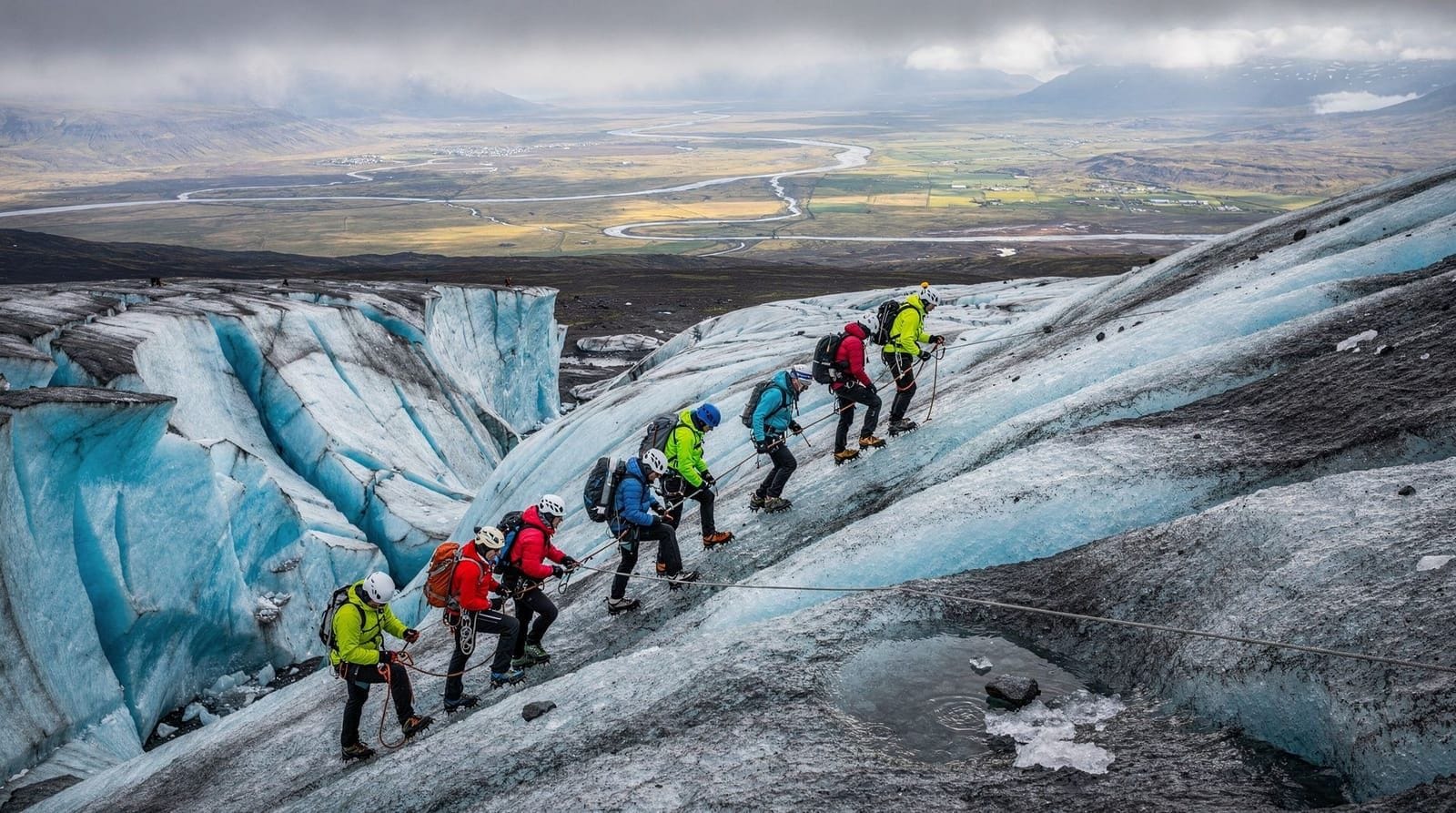
Packing for glacier hiking
If you have booked a glacier hike on Sólheimajökull or any Vatnajökull outlet glacier, the tour operator provides:
- Crampons (fitted to your boots on the day)
- Ice axe
- Harness (for some tours)
- Safety briefing
You need to bring:
- Waterproof hiking boots (the operator will tell you the minimum ankle height)
- Waterproof trousers (essential — glacier walks involve snow, ice, and water)
- Warm mid-layer (it is cold on the glacier regardless of season)
- Gloves (waterproof preferred — you may grip ice and snow)
- Sunglasses (glacier glare is intense in sunny conditions)
Do not book a glacier hike in trainers or regular shoes — operators will turn you away.
Camping equipment for Iceland
Iceland’s campsite network (tjaldsæti) is extensive. If you plan to camp:
Tent requirements:
- Rated to at least –5°C
- Double-walled with a full vestibule (Icelandic rain comes sideways)
- Freestanding (some campsite ground is rocky and hard to stake)
Sleeping bag: At minimum rated to 0°C comfort for summer camping; –5 to –10°C for autumn
Sleeping mat: Insulated mat (R-value 4+) for ground camping. Iceland’s ground is cold even in August.
Camp stove: MSR, Jetboil, or equivalent. Bring enough gas for your trip — availability in small towns is not guaranteed.
Water filter: Drinking from rivers is generally safe in Iceland (away from agricultural areas and geothermal zones) but a Sawyer Squeeze or Lifestraw adds peace of mind in remote areas.
Wind-rated tent stakes: Standard tent stakes bend or pull out in Icelandic gusts. Bring at least a few heavy-duty stakes designed for sandy or rocky ground, and know how to guy out your tent properly — a poorly staked tent in a strong overnight wind is a genuinely miserable, and occasionally unsafe, experience.
Rubbish bags and a trowel: Iceland’s leave-no-trace expectations are taken seriously, and not all campsites have full facilities. Bring what you need to pack out rubbish and manage waste responsibly, particularly in the highlands where facilities are minimal or absent.
Packing list: summer trip (7–10 days)
Clothing:
- 1 hardshell waterproof jacket with hood
- 1 pair waterproof trousers
- 1 fleece or softshell midlayer
- 1 light down or synthetic puffer (evening use)
- 2 merino wool base layer tops
- 1 pair thermal leggings (optional in summer)
- 3–4 T-shirts / casual tops
- 2 pairs casual trousers or jeans
- Waterproof hiking boots (worn on travel days)
- Casual town shoes
- 3 pairs of wool hiking socks + 2 pairs casual socks
- 1 merino beanie
- Lightweight gloves
- Neck gaiter
- Sunglasses
- Swimsuit (for hot springs)
Electronics and admin:
- Phone, charger, universal adapter
- Power bank
- Camera + accessories (optional)
- Offline maps downloaded
Frequently asked questions about packing for Iceland
Can I buy gear in Iceland if I forget something?
Yes. Reykjavik has well-stocked outdoor shops (66°North is an Icelandic brand with excellent products; Cintamani is another). Prices are high. Keflavik Airport sells basics. It is cheaper to bring gear from home, but you will not be stranded without a beanie.
Do I need crampons or microspikes?
For summer hiking and the Ring Road: no. For winter glacier access: your tour operator provides crampons. Microspikes (lightweight grip attachments for shoes) are useful for icy paths in winter and early spring and are sold cheaply at outdoor shops in Iceland.
Can I wear jeans in Iceland?
For town and guesthouse use: yes. For outdoor activities: not ideal. Denim is heavy, dries slowly, and is cold when wet. Lightweight walking trousers or trekking pants are more practical.
How many days of clothes should I pack?
Most guesthouses offer laundry for a small fee. Merino wool base layers can be worn multiple days between washes. For a 10-day trip, 3–4 sets of everyday clothes plus dedicated hiking layers is sufficient.
What should I wear for the Blue Lagoon?
You are provided a robe and towel at the Blue Lagoon. Bring a swimsuit and secure flip-flops or waterproof sandals for the changing rooms. Everything else is provided. The lagoon water is mineral-rich and can damage some fabrics, so bring an older swimsuit rather than a new one.
How cold is Iceland in July?
Average temperatures in Reykjavik in July are 10–15°C during the day, dropping to 8–10°C at night. At elevation and in wind, it feels colder. You will want a midlayer most days and your shell jacket anytime it rains or the wind picks up.
Is there a dress code for restaurants in Reykjavik?
Not strictly. Smart casual is appropriate for most places. No restaurant requires formal dress. Icelanders generally dress practically.
Packing differently for a road trip vs. a Reykjavík-only stay
Not every Iceland trip needs the full Ring Road packing list. If you are staying entirely in Reykjavík and doing day tours from the city, you can travel noticeably lighter:
Reykjavík-based trip: prioritise one good waterproof shell, waterproof boots or shoes, warm layers for evenings, and a swimsuit for wild hot springs or the Blue Lagoon. Skip camping gear, a full first-aid kit, and offline maps beyond what your phone already covers with a data plan.
Self-drive Ring Road trip: add the driving essentials (ice scraper, high-visibility vest, basic first-aid kit, backup snacks and water), pack for a wider range of conditions since weather varies more region to region, and bring slightly more clothing since laundry access is less predictable outside Reykjavík and Akureyri.
Multi-activity adventure trip (glacier hiking, ice caving, snowmobiling): pack activity-specific items in addition to the base list — see the glacier hiking and northern lights sections above — and check with each tour operator directly about what’s provided versus what you need to bring, since this varies by company.
Matching your packing list to your actual itinerary, rather than packing for every possible activity “just in case,” is the difference between a manageable bag and an overloaded suitcase you regret hauling around Iceland’s guesthouses. If your plans are still taking shape, read is Iceland safe alongside this list — several of the packing decisions here (insurance documents, first-aid basics, appropriate footwear) are as much about safety as comfort.