2WD vs 4x4 in Iceland — which do you actually need?
Do I need a 4x4 to drive in Iceland?
For summer Ring Road and paved road driving, a 2WD is fine and saves you money. A 4WD is legally required on all F-roads (highland interior) and strongly advisable for winter driving outside the Ring Road. Never take a 2WD on an F-road — it voids insurance and risks rescue bills of 200,000+ ISK.
The honest answer first
The tourism industry and many rental companies nudge visitors towards 4WD vehicles because the margins are higher. The truth is more nuanced: most Iceland trips do not require a 4WD, and paying for one you don’t need wastes 5,000–15,000 ISK per day.
The answer depends on exactly where you’re going, when you’re going, and whether those plans might change. This guide gives you a clear framework. If you’re weighing this against renting a campervan instead, see campervan vs car — the drivetrain question applies to both.
| Need 4WD for | F-roads, winter routes off the Ring Road, Landmannalaugar/Askja/Þórsmörk |
| 2WD is fine for | Ring Road, Golden Circle, South Coast, Snæfellsnes in summer |
| Cost gap | Around 10,000–25,000 ISK/day more for a compact 4WD |
| Booking | Book 4WD well ahead for summer — they sell out before 2WD stock |
| Legal note | 2WD on an F-road voids insurance completely |
When a 2WD is completely adequate
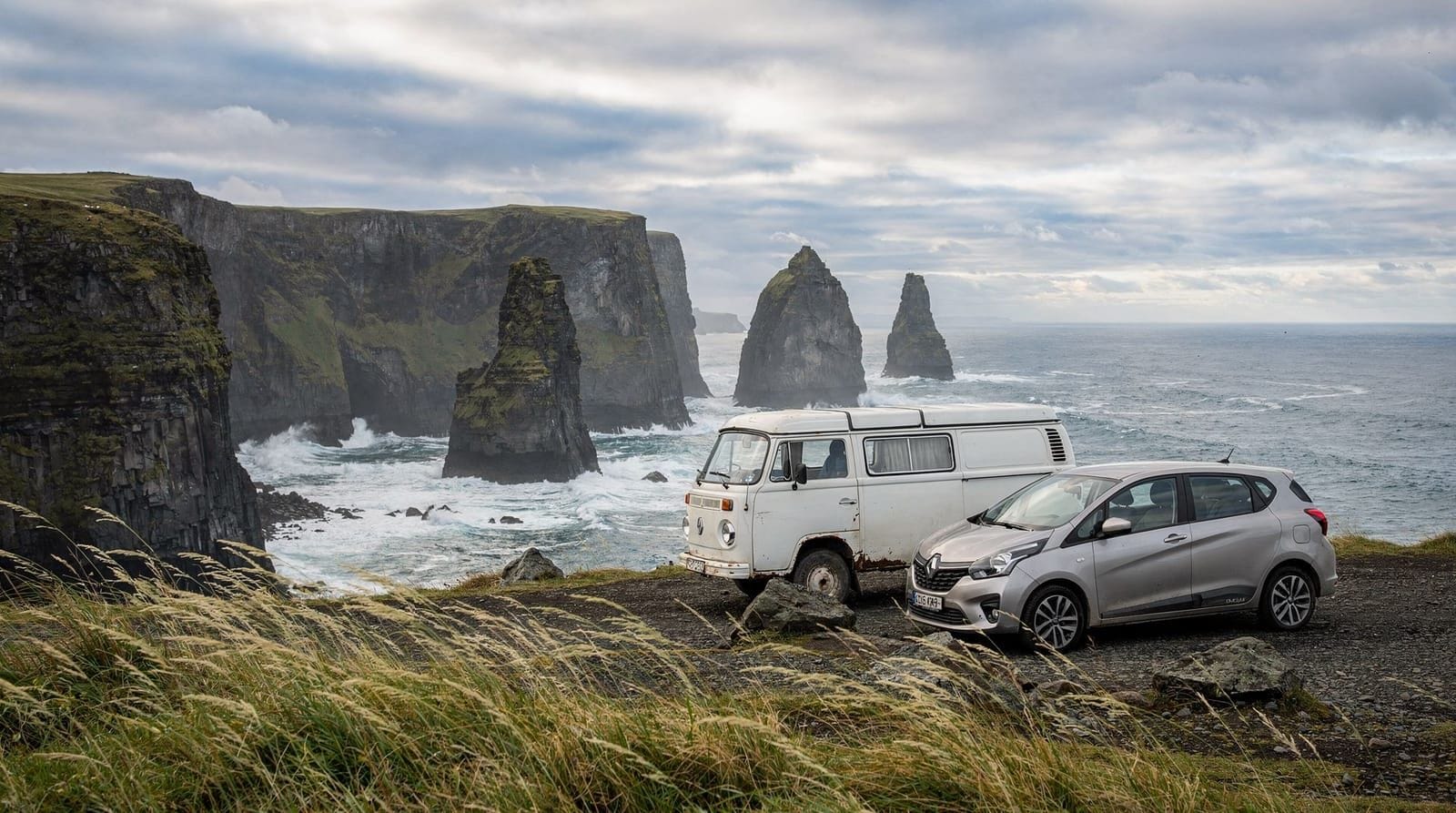
A standard front-wheel or rear-wheel drive car — a Yaris, Polo, Micra, or similar — handles everything on this list without issue:
- Ring Road (Hringvegur) in summer: fully paved and maintained
- Golden Circle (Þingvellir, Geysir, Gullfoss): all paved
- South Coast (Seljalandsfoss, Skógafoss, Vík, Reynisfjara, Jökulsárlón, Diamond Beach): all paved Road 1 with paved spur roads
- Snæfellsnes Peninsula: mostly paved
- North Iceland (Akureyri, Goðafoss, Húsavík, Dettifoss via Road 1): accessible in a 2WD
- Westfjords in summer on main roads: 2WD handles the paved sections, though unpaved gravel roads benefit from higher clearance
- Reykjavik city driving: 2WD is perfectly suited
If your trip fits the above — Ring Road loop in June, July, August or September, plus popular attractions — save the money and take a 2WD.
When you need a 4WD
F-roads (mandatory by law)
F-roads are Iceland’s highland interior tracks, designated with an “F” prefix (F35, F208, F26, etc.). They require:
- High ground clearance
- 4WD engagement (not just AWD — active differential lock matters for deep river crossings)
- River crossing capability in some cases
Taking a 2WD on an F-road is illegal in Iceland and will void your rental insurance completely. If you get stuck or damaged, the rescue cost — which you bear entirely — starts at 200,000 ISK and can reach 600,000 ISK or more. The fines are additional. This is not a technicality; it is enforced.
Popular F-road destinations:
- Landmannalaugar (F208/F225): requires 4WD and river crossing ability
- Kerlingarfjöll (F35 Kjölur): Kjölur is not technically an F-road but benefits from a 4WD; some spur roads to Kerlingarfjöll require it
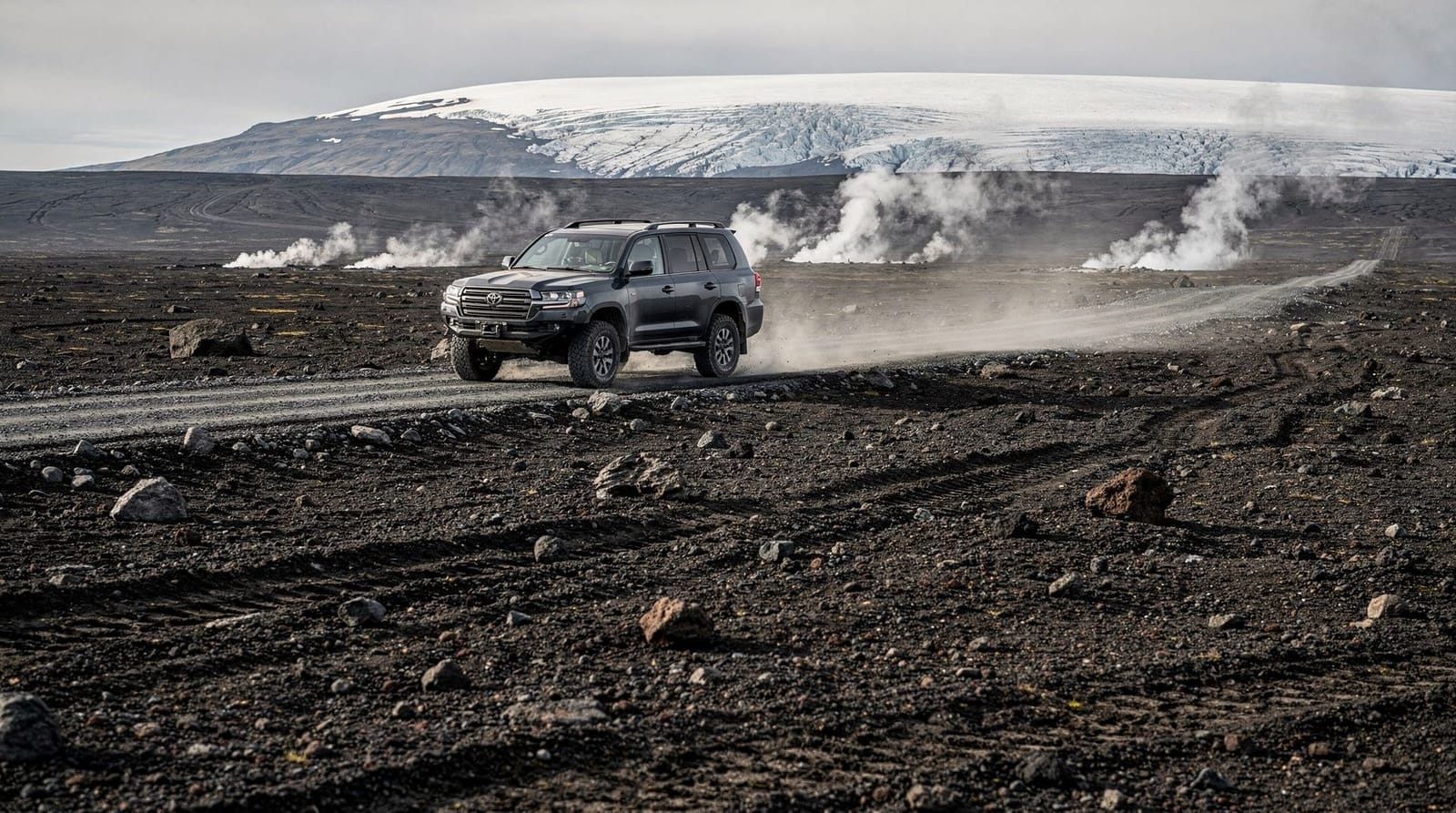
- Askja (F88): mandatory 4WD, river crossings
- Þórsmörk (F249): river crossing, 4WD required
For the full F-road picture, see F-roads Iceland.
Winter driving (November–April)
Iceland’s winter roads can throw any vehicle into trouble, but the risk gap between 2WD and 4WD widens substantially. Conditions include:
- Ice-covered Ring Road sections, especially in the north and east
- Snow drifts closing mountain passes
- Compacted snow on secondary roads
- Sudden blizzard whiteouts
A 4WD with winter tyres (mandatory by law November–April, provided by rental companies automatically in winter) handles these conditions meaningfully better than a 2WD. That said, 4WD does not improve braking on ice — it only helps with traction during acceleration and cornering. Drive accordingly.
For routes outside the Ring Road in winter — including some South Coast roads after heavy snowfall — a 4WD provides genuine safety margin. See Iceland in winter driving for the full guide.
Cost difference
Small 2WD in summer: 8,000–18,000 ISK per day (booked in advance)
Compact 4WD (Dacia Duster, Ford Kuga equivalent): 18,000–35,000 ISK per day in summer
Large 4WD/SUV (Land Cruiser class): 35,000–70,000 ISK per day
Over 10 days, the difference between a 2WD and a mid-range 4WD can be 100,000–200,000 ISK. On a summer Ring Road trip with no F-road plans, that’s a significant unnecessary expense.
Insurance: the part rental desks gloss over
The daily rate is only half the cost picture. Iceland’s gravel roads, sudden gusts, and unpredictable weather mean car rental insurance in Iceland is not the usual box-ticking exercise it is elsewhere — gravel protection (GP) and sand/ash protection (SAAP) are genuinely relevant add-ons here, on both 2WD and 4WD bookings. A cheaper 2WD with no gravel cover can end up costing more in an excess payment than a slightly pricier 4WD with fuller cover, if a stone chip cracks the windscreen. Read the insurance guide before comparing headline daily rates between vehicle classes.
If you’re still deciding whether to rent at all, self-drive vs guided tour covers the broader trade-off — for F-road destinations specifically, many visitors choose a guided super-jeep precisely to avoid the 2WD/4WD decision entirely.
What “4WD” means in the rental context
Rental companies use several terms:
- 4WD / 4x4: Full four-wheel drive with transfer case, suitable for F-roads. This is what you need for highlands.
- AWD (All-Wheel Drive): Automatic torque distribution across axles, standard on many modern SUVs. Better than 2WD in slippery conditions but not designed for deep river crossings or serious off-road use.
- SUV with AWD: Common upsell. Higher clearance and AWD, suitable for winter driving — but not legally adequate for all F-roads.
When booking for F-roads, confirm with the operator that the specific vehicle is rated for highland use and that your rental contract permits it. Ask explicitly: “Is this vehicle approved for F-roads under my insurance?” Get the answer in writing.
Manual vs automatic, and other rental details that affect the decision
The 2WD-vs-4WD question often gets bundled with other rental choices that matter almost as much:
Transmission: Iceland’s rental fleet skews manual for economy 2WD cars, automatic for most 4WD/SUV categories. If you can’t drive manual, your 2WD options narrow and the effective price gap to 4WD shrinks — factor this in before assuming 2WD is automatically cheaper for your specific trip.
Excess/deductible: A 2WD with a high excess (e.g. 250,000 ISK) and no gravel protection can expose you to nearly as much financial risk as a 4WD with full cover, if a stone chip or gravel spray damages the windscreen or paintwork. Compare total risk exposure, not just the daily rate, when weighing vehicle classes.
Fuel type: Diesel 4WDs are common in the mid-range and Land Cruiser classes and often cost less per km on longer trips despite a higher daily rate. For a Ring Road trip covering 1,500+ km, this can meaningfully offset the extra 4WD cost.
Age of driver and licence requirements: some 4WD and all Land Cruiser-class vehicles require drivers over 23–25 with at least 2–3 years’ licence history — check this before assuming you can simply upgrade at booking. Younger drivers on a budget often find the 2WD decision made for them by these age restrictions rather than by route planning.
What about the Westfjords?
The Westfjords are accessible in a 2WD on the main roads (paved or compacted gravel). Many spur roads into fjords and to remote attractions are unpaved but drivable in a 2WD at lower speeds. A 4WD gives more confidence on steep, loose-gravel descents — particularly in wet conditions — but is not mandatory.
In winter, the Westfjords’ mountain passes are challenging and sometimes closed. A 4WD with winter experience is strongly advisable if travelling here outside summer.
The plateau: when it’s genuinely a toss-up
If you’re on the Ring Road in September — late season, some highland passes may already have snow, and occasional shoulder roads get icy — a compact 4WD might give you real peace of mind beyond just money savings. The same logic applies to October and May.
For a pure summer trip (June–August) with no F-road plans: 2WD, no question. For F-roads any time of year: 4WD, no compromise. For winter Ring Road: 4WD is strongly advisable, not mandatory.
Frequently asked questions about 2WD vs 4x4 in Iceland
Can I drive the Ring Road in a 2WD car?
Yes. The full Ring Road is paved (Road 1) and maintained year-round. A 2WD is entirely adequate for the Ring Road in summer. In winter, the Ring Road is passable in 2WD with winter tyres, but a 4WD provides more confidence on icy sections.
What happens if I take a 2WD on an F-road?
You void your rental insurance, expose yourself to the full cost of any rescue (starting at 200,000 ISK), and may face a police fine. Rental companies check GPS logs in some cases. The risk is not theoretical — tourists get stuck on F-roads every year.
Is a Dacia Duster enough for Iceland F-roads?
Some operators approve Dacia Dusters for certain F-roads. Others don’t. The vehicle has 4WD capability but limited ground clearance compared to a Land Cruiser. Always confirm F-road approval in writing with your specific rental company for your specific vehicle and intended route.
Do I need a 4WD for the Golden Circle?
No. All Golden Circle stops (Þingvellir, Geysir/Strokkur, Gullfoss) are on paved roads fully accessible by 2WD.
Is 4WD worth it just for safety, even on paved roads?
In summer on paved roads, the safety benefit of 4WD over a modern 2WD with winter tyres is marginal. The bigger factors are tyre condition, driver behaviour, and weather awareness. A 2WD driven carefully is safer than a 4WD driven recklessly.
What about AWD vs true 4WD for Iceland?
AWD improves traction on slippery paved roads and light gravel. True 4WD with a transfer case and differential lock is what you need for river crossings and serious F-roads. Know which one your rental car has.
Can I upgrade from 2WD to 4WD at the rental desk?
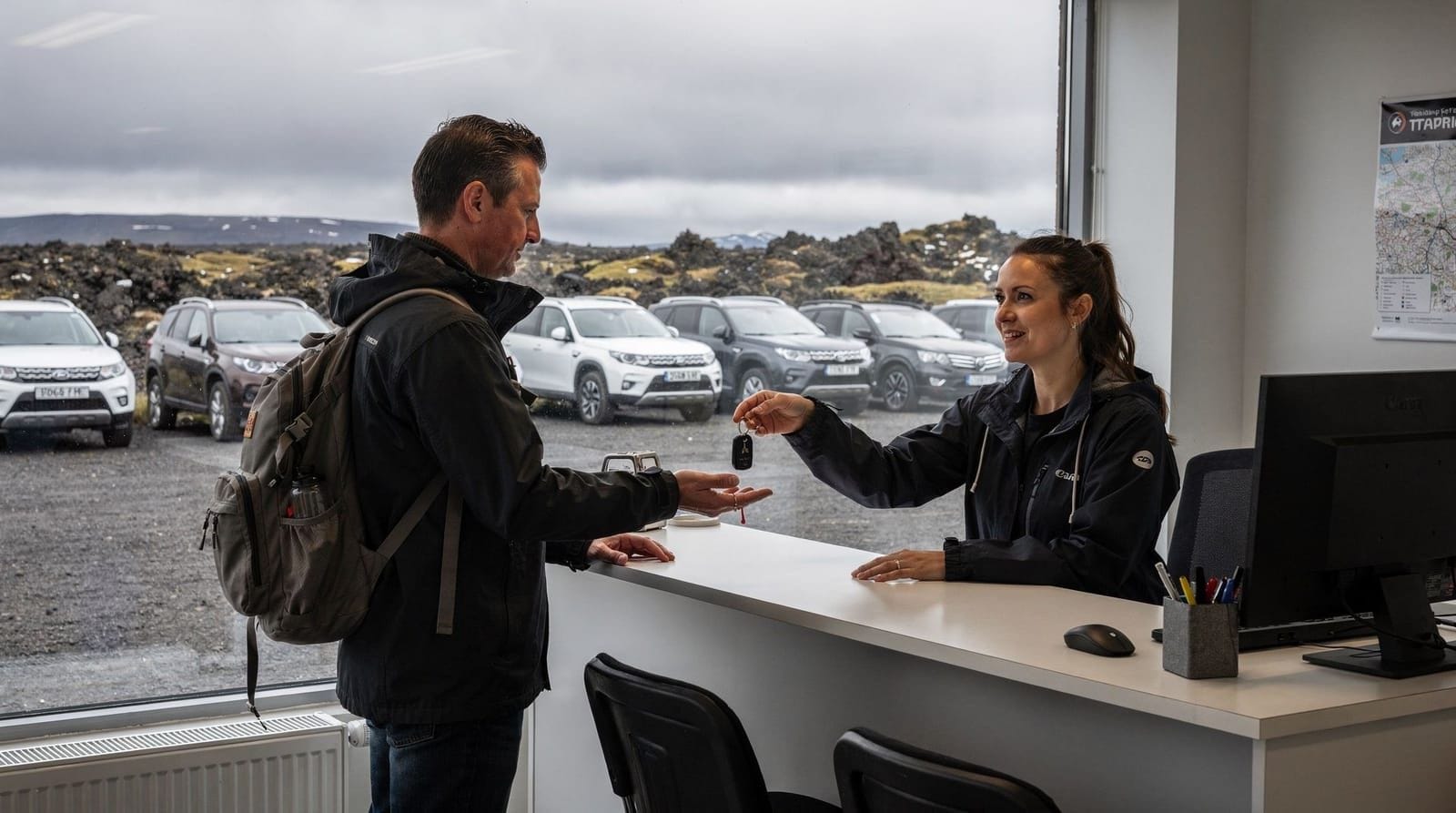
Sometimes, if vehicles are available. But in peak summer, 4WD vehicles sell out before 2WD ones. If your plans require 4WD, book it in advance — don’t rely on upgrading at the counter.
Real cost comparison: 2WD vs 4WD over 10 days
To make the decision concrete, here’s what the numbers look like for a summer Ring Road trip with no F-road plans:
| Vehicle type | Daily rate (summer) | 10-day total |
|---|---|---|
| Economy 2WD (Yaris/Polo) | 8,000–14,000 ISK | 80,000–140,000 ISK |
| Compact SUV 4WD | 20,000–35,000 ISK | 200,000–350,000 ISK |
| Land Cruiser class | 40,000–65,000 ISK | 400,000–650,000 ISK |
For two travellers on a Ring Road summer trip with no F-roads planned, the difference between a 2WD and a compact 4WD can be 120,000–210,000 ISK (roughly 800–1,400 EUR per couple). That money pays for multiple nights of accommodation, all the Blue Lagoon entries, or several guided glacier hikes.
The common itineraries: what they actually need
Golden Circle only
Þingvellir, Geysir, Gullfoss: all paved roads. 2WD, no question.
South Coast (Reykjavik–Vík–Jökulsárlón)
All paved Road 1, all paved spur roads to attractions. 2WD handles it completely. Jökulsárlón is on Road 1.
Snæfellsnes Peninsula
Main roads are paved. A couple of access roads to remote beaches (Djúpalónssandur, Breiðavík) are unpaved gravel but manageable in 2WD at reduced speed. 2WD is fine for standard Snæfellsnes itineraries.
Diamond Circle (North: Dettifoss, Ásbyrgi, Húsavík)
Road 862 (west bank of Dettifoss) is paved. Road 864 (east bank) is unpaved gravel — manageable in 2WD but slightly rougher. 2WD is adequate for the main Diamond Circle route.
Westfjords
Main roads are a mix of paved and unpaved. No F-roads in the official sense. A 2WD handles the main Westfjords circuit in summer. Some more remote fjord tracks benefit from higher clearance — a compact SUV is reassuring here, though not strictly required. In wet conditions, steep unpaved sections get muddy. A higher-clearance 2WD (like a small SUV with standard 2WD) gives more margin than a Yaris.
Landmannalaugar, Kerlingarfjöll, Askja
4WD mandatory. No argument. The F-roads to these destinations involve river crossings and rough highland tracks that no 2WD should attempt. See F-roads Iceland for the specific requirements of each route.
Tyre quality matters as much as drive train
Iceland’s rental cars see heavy use. A new 2WD with good tyres performs better in wet conditions than an older 4WD with worn tread. When picking up your car:
- Check tyre depth visually — significant tread wear is a safety issue
- In winter, confirm winter tyres are fitted (required by law November–April)
- Look for tyre age markings on the sidewall — tyres over 7 years old regardless of tread are deteriorated
If you receive a car with obviously poor tyres, ask for a different vehicle or a tyre inspection before accepting.
Decision summary
Take a 2WD if: Summer Ring Road (Jun–Sep), Golden Circle, South Coast, Snæfellsnes, standard Diamond Circle or Westfjords routes on main roads.
Take a 4WD if: Any F-road including Landmannalaugar/Kerlingarfjöll/Askja, serious Westfjords remote tracks, winter driving outside the Ring Road, or you simply want the extra reassurance on an ambitious shoulder-season itinerary.
Don’t let the rental desk decide for you. The upsell pressure is real, the financial stakes are significant, and the decision framework is simple once you know your actual route.
High-clearance 2WD: the middle ground
A category worth understanding: many rental operators offer compact SUVs with all-wheel drive but NOT full 4WD transfer case systems — vehicles like the Hyundai Tucson 2WD, Nissan Qashqai, and some Ford Kuga trims. These vehicles have:
- Higher ground clearance than a hatchback (150–200 mm vs 120–150 mm)
- Two-wheel drive (usually front-wheel drive, sometimes automatically engaging AWD in slip conditions)
- Standard road tyres (winter tyres in season)
These are often marketed as “SUV” which confuses matters. They’re not Highland-capable 4WDs, but they’re better than a Yaris on loose gravel or muddy guesthouse access tracks. If your itinerary is Ring Road plus Snæfellsnes with a few unpaved car park accesses, this middle category is often the optimal choice — more capable than a hatchback, cheaper than a genuine 4WD.
The trap: operators sometimes price these at near-4WD rates without making clear they won’t take F-roads. Ask directly if you need F-road access.
River crossings: the 4WD litmus test
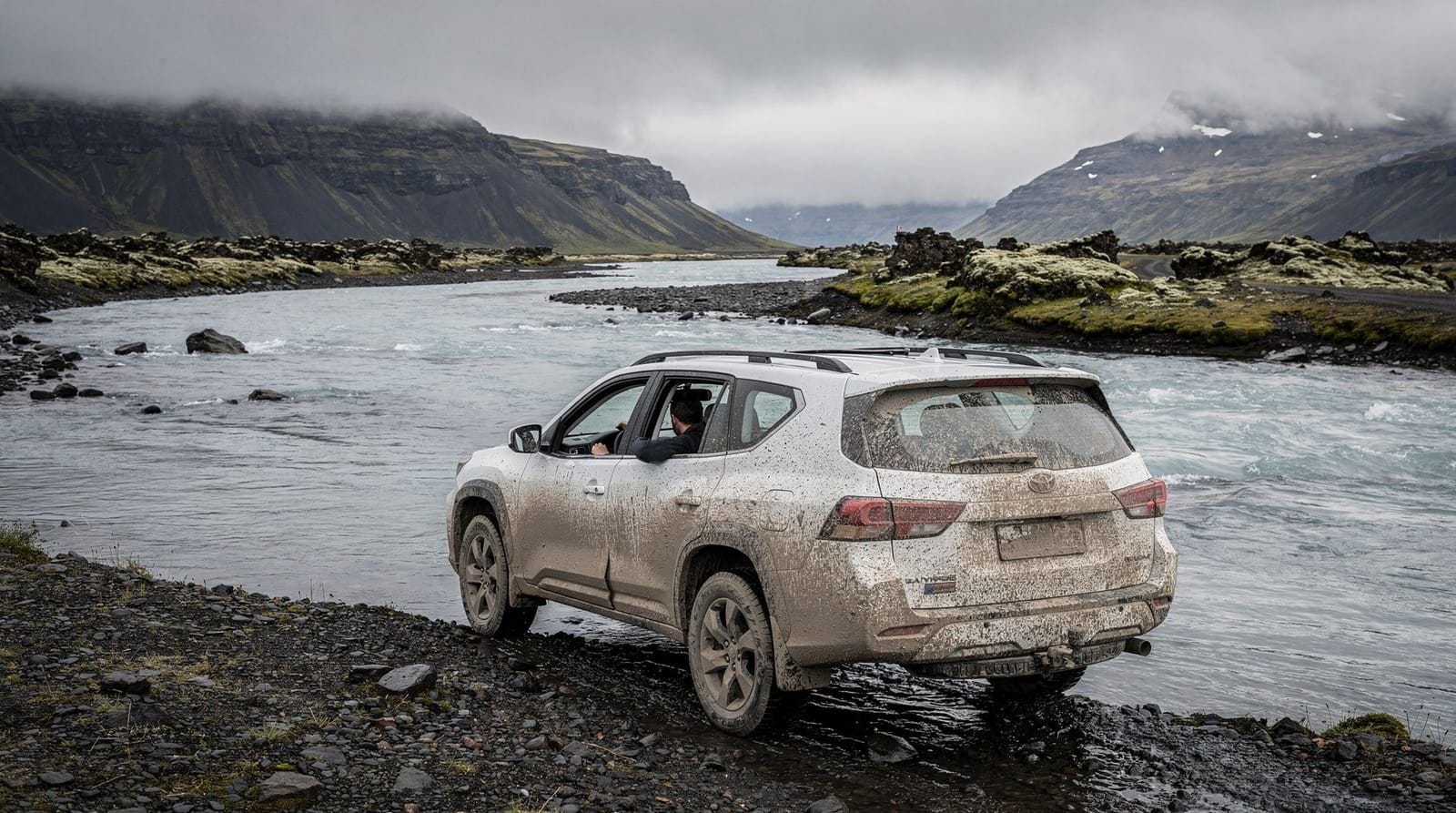
Iceland’s highland F-roads require river crossings. This is the clearest differentiator between genuine 4WD capability and marketing claims:
- A 2WD compact car: engine floods and stalls at 15–20 cm of moving water
- An AWD sedan: similar limitation
- A Dacia Duster or similar compact 4WD: can ford up to ~35 cm of calm water with care
- A Land Cruiser Prado/200-class: rated to 70+ cm with snorkel, can handle serious crossings
River crossings are not uniformly deep. The standard Iceland approach:
- Stop before the ford
- Walk across (or observe another vehicle crossing) to assess depth and current
- Choose the widest, shallowest point
- Cross at a diagonal to reduce head-on current resistance
- Don’t stop midway
- If in doubt, wait or turn back
Getting a vehicle water-damaged in a river crossing without F-road permission voids your insurance entirely. Even with F-road permission, most rental contracts explicitly exclude damage from fording water above a specified depth (usually 30–50 cm). Know the limit of your specific vehicle before approaching a ford.
Traction control and the Iceland driving context
Modern 2WD vehicles with traction control (which is virtually all cars built since 2010) handle slippery conditions significantly better than older 2WDs. Electronic traction control intervenes to prevent wheel spin, effectively giving the driver more useful traction on ice or loose gravel than raw horsepower would suggest.
In practice: a 2026 Toyota Yaris with traction control and winter tyres on an icy Ring Road section is considerably more tractable than a 1995 Toyota Land Cruiser on all-season tyres. The physical 4WD system matters most for sustained traction in deep snow, river crossings, and steep gravel — not for occasional grip events on paved roads.
Iceland’s rental fleet is modern. Don’t assume a new-spec 2WD car is a liability on slippery roads — it’s engineered better than your assumptions about 2WD suggest.
What happens if you encounter an unexpected F-road sign
If you’re on a route and suddenly see an F-road sign:
- Stop immediately — going past the sign constitutes entering an F-road
- Check road.is or your rental contract for your vehicle’s F-road status
- If your vehicle is not authorised: turn around. No scenic view or shortcut is worth 200,000+ ISK in uninsured rescue costs and potential legal liability
- If your vehicle is authorised: proceed carefully, engage 4WD, and treat the surface conditions with appropriate caution
Some routes have gradual transitions from paved to gravel to F-road without dramatic signage changes. The F designation and the sign are the legal markers — once you see that F, the rules change.
For the full guide to Iceland’s F-road network, distances, and requirements: F-roads Iceland. For up-to-date road status before you set out, check Iceland road conditions — it’s the single most useful bookmark for any self-drive trip, 2WD or 4WD.
Top experiences
Best-rated activities across GetYourGuide and Viator.
Reykjavik: From airport to adventure private Reykjanes peninsula tour
- GetYourGuide
Reykjavik: Kef bus transfer to from Reykjavik shuttle
- GetYourGuide
Reykjavik: Keflavik airport transfer to Reykjavik
- GetYourGuide
Reykjavik: Kef private transfer to from Reykjavik
- GetYourGuide
Reykjavik: Keflavik airport to Reykjavik bus transfer
- GetYourGuide
Reykjavik: Private transfer to from kef airport
- GetYourGuide