Midnight sun magic: what it's really like, and how to not waste it
What you think it will be vs what it actually is
Before the trip, I imagined the midnight sun as a dramatic moment — a sun that hovers perfectly at the horizon at exactly midnight, golden and theatrical, while you stand there with a glass of wine and a camera.
The reality is stranger and more pervasive than that. In Reykjavik around the June solstice, the sun doesn’t set at all. It gets low — dropping to about 2–3 degrees above the horizon around 1 am — and then rises again without ever properly disappearing. The sky never gets darker than a deep blue twilight. For someone whose body uses darkness as a sleep cue, this is biologically disorienting.
I arrived in Reykjavik on June 18th — three days before the solstice — with blackout curtains in my suitcase and a deliberately blank evening schedule, open to whatever the light suggested. A week later I left having slept badly, driven more kilometres after 11 pm than before it, and taken roughly 900 photographs with the word “golden” in the filename.
| Where | Reykjavik, Snæfellsnes, statewide from late May |
| Season | Late May to mid-July, peak around June 21 |
| Best hours for empty sites | 11 pm–5 am |
| Cost impact | Apartment with blackout blinds, around ISK 21,000/night in the 101 area |
| Trade-off | No northern lights visible during this window |
The first night: adjustment
The apartment I’d rented in the 101 area (a studio near Hlemmur bus terminal, around ISK 21,000/€130 per night) had adequate blackout blinds. I fell asleep easily at 11 pm.
I woke at 3 am, looked out the window, and saw full afternoon light. Not sunrise colours — full, flat, daylight. The street outside was quiet but lit as if it were 2 pm in April. This is the disorientation that nobody warns you about clearly enough: the midnight sun isn’t just about the sunset hour; it means uninterrupted light for 24 hours, which your brain has no framework for.
I lay awake for an hour and then went for a walk. Laugavegur at 3:30 am in June is deserted of tourists but not of Icelandic night workers. I walked to the old harbour, where a single fishing trawler was coming in. The water was mirror-flat and reflected the low sun from the northeast. Three people were photographing from the quay. Nobody spoke. It lasted 20 minutes and I went back to sleep feeling that the trip had already delivered something unexpected.
The light in practice
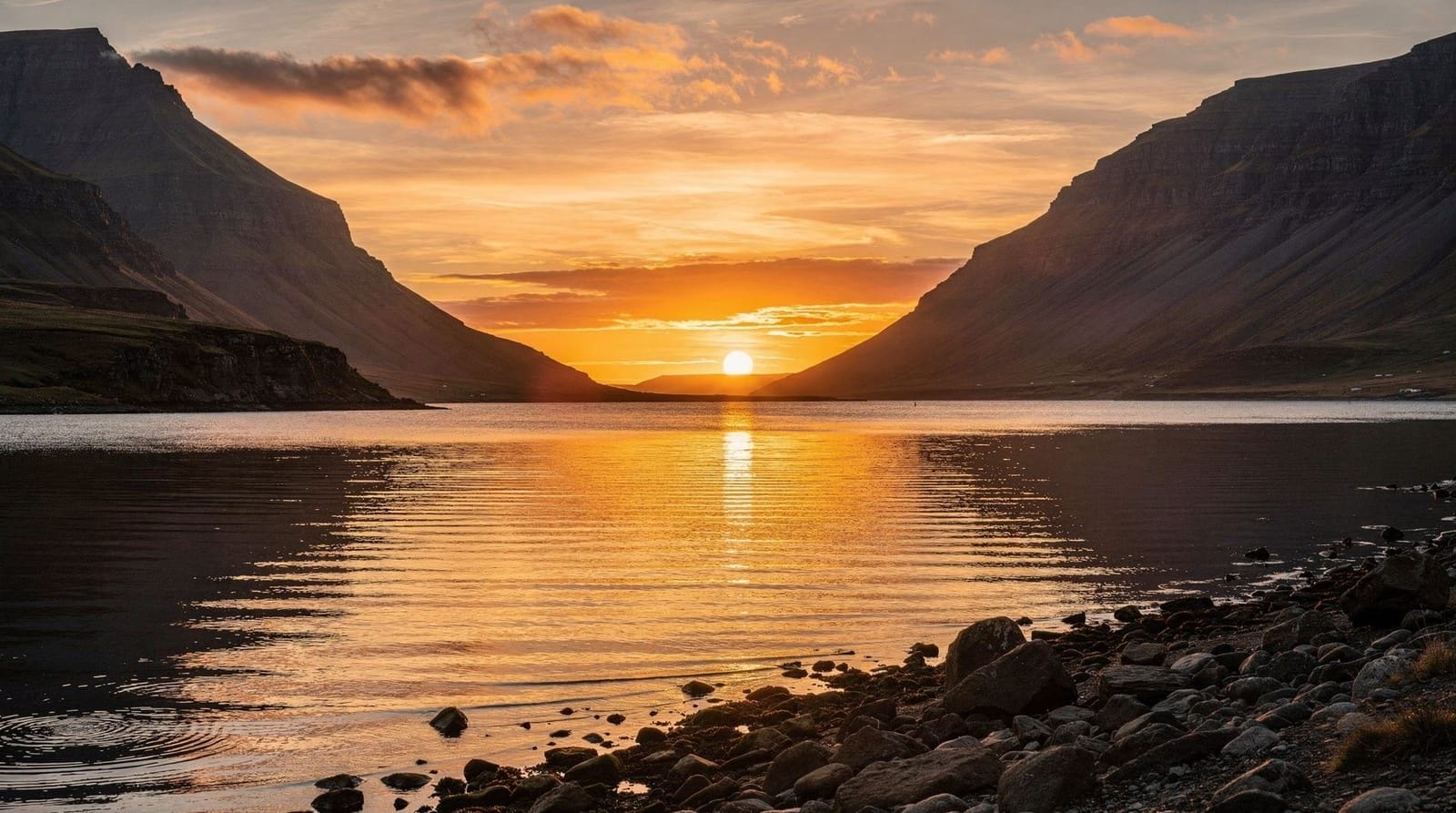
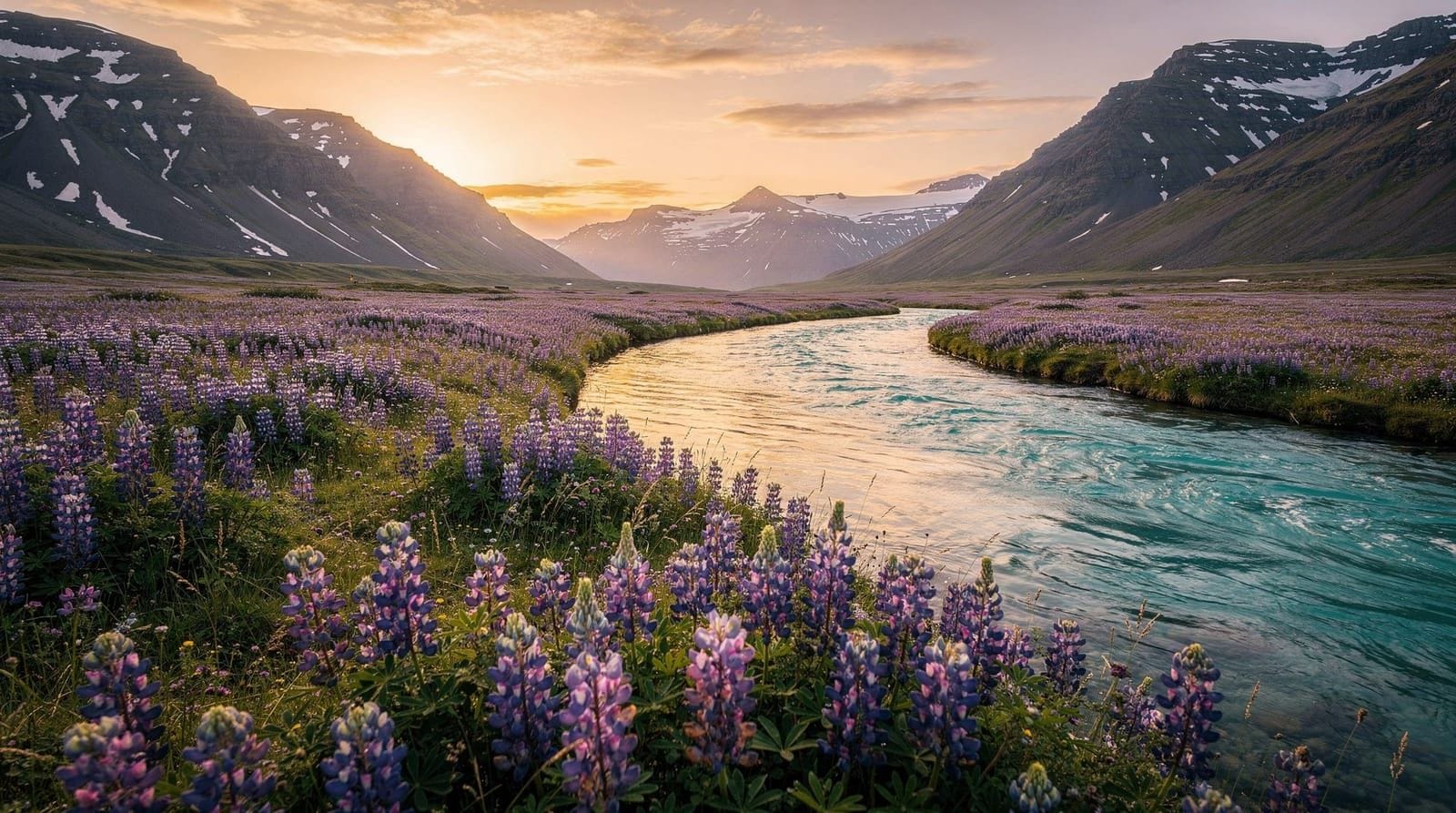
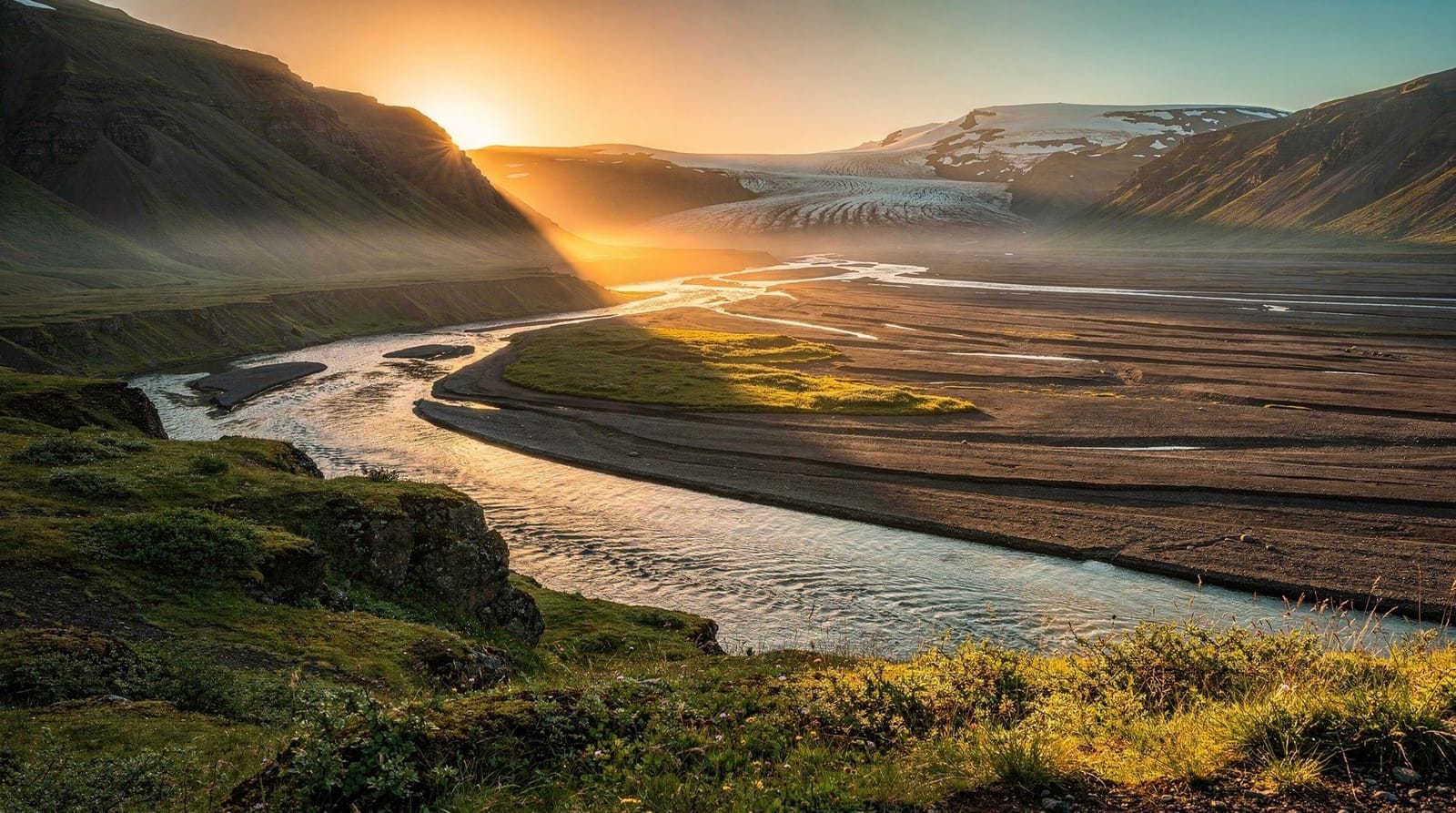
The midnight sun produces a specific quality of light that photographers describe as “permanent golden hour.” This is technically accurate and practically significant.
From roughly 10 pm to 3 am, the sun moves along the northern horizon at a low angle. This produces side-lighting on any north-facing subject — mountains, waterfalls, cliffs — that doesn’t occur during midday. Shadows are long and soft. Colours are warmer. The blue hour that precedes sunrise and follows sunset, when the sky is deep blue and contrast is even, is compressed into a very brief window (about 30 minutes around 1 am on the solstice) rather than the hour-long window it offers in temperate latitudes.
Practically: if you want to photograph Kirkjufell mountain on Snæfellsnes at midnight with the sun coming from the north over the sea, you can. If you want to hike Reykjadalur at 11 pm in daylight, you can. If you want to drive toward Þingvellir at midnight and see the rift valley lit by sun that hasn’t set, you can.
None of these things are possible at any other time of year.
The drive to Snæfellsnes at midnight
On the third night, I drove to Snæfellsnes. I left Reykjavik at 10:30 pm, drove north on Route 1 and then west on Route 54. I arrived at Kirkjufell around midnight.
There were five other cars in the small car park. The mountain, lit from behind and slightly to the right by the low sun, cast a long shadow across the waterfall in front of it. The light was gold and raking and the sky was a gradient from orange at the horizon to a medium blue overhead. I set up a tripod and shot for an hour. Around 1 am, the sky shifted briefly into blue hour, the warmth dropping out of the light and the mountain face going into the kind of cool shadow that reads as pre-dawn in photographs.
Then the sun came back round. It had gone from my view behind a small headland to the north, and now it reappeared to the east, and the whole light cycle started again.
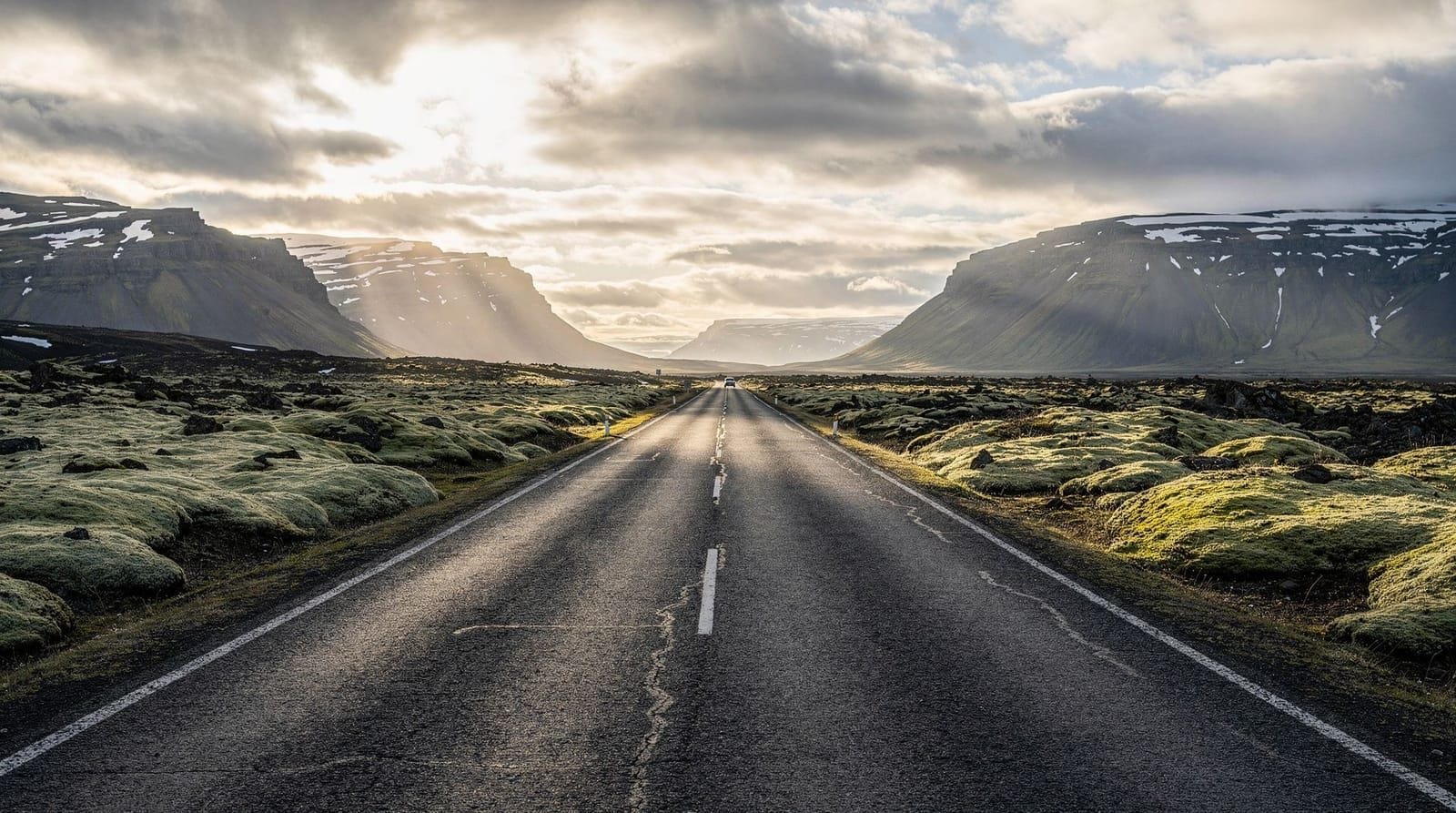
I drove back to Reykjavik at 3 am. The road was empty. I drove slowly and ate almonds and listened to a podcast in the full daylight.
What to actually do with the midnight sun
Adjust your schedule aggressively: Do the main sightseeing from 8 pm to 2 am. Sleep from 3 am to 10 am (use blackout curtains; they’re not optional). The major sites you want to see without crowds — Jökulsárlón, Skógafoss, Kirkjufell — are empty from 11 pm to 6 am. This is the practical advantage of the midnight sun that most itineraries don’t capitalise on.
The solstice specifically (June 21): This is when the sun is lowest at its “nadir” (the lowest point it reaches, around 1 am), and when the light is most dramatic. It’s also when Iceland’s solstice festivals occur — Jónsmessa is a traditional midsummer celebration. Some communities hold bonfires. Not a major tourist event but pleasant if you encounter it.
Whale watching at midnight: I booked an 11 pm whale watching departure from Reykjavik harbour. In full daylight on a calm sea, with humpback whales visible against a golden horizon — this is one of the specific experiences that only exists in Iceland in June.
Akureyri also runs midnight sun whale watching specifically timed for the late-night light. The combination of whale encounters and the sun sitting on the horizon at 1 am is one of Iceland’s most unusual wildlife experiences.The practical limit: The midnight sun is interesting for two or three days. By day five, the disrupted sleep catches up with you and the novelty is replaced by an increasingly desperate need for darkness. Bring blackout curtains and melatonin. Both are required rather than optional.
The social and biological consequences
Sleep quality in Iceland in June is genuinely poor unless you’re well prepared. I slept an average of 5.5 hours per night, waking each morning with a sense that I’d gone to bed in the wrong time zone. This is not a serious health concern for a week-long trip, but it accumulates.
I met a couple from Japan at the Reykjavik harbour who had been in Iceland for three weeks in June. By the third week, they told me, they had genuinely lost track of what time it was and were eating “lunch” at 10 pm and “dinner” at 3 am. This was not entirely a complaint. Iceland in June warps time pleasantly if you surrender to it.
The crowd paradox
June is peak tourist season in Iceland. The midnight sun is part of what makes it peak — the light and the extended day are a draw, and the country receives its highest visitor volumes between late June and August. All the concerns about crowded sites at Seljalandsfoss, Skógafoss, Jökulsárlón, and the Golden Circle apply fully in June.
The midnight sun solves part of this problem. Sites that are genuinely overcrowded between 10 am and 5 pm are accessible in entirely different conditions from 11 pm to 5 am. This is not a theoretical workaround — it’s how a significant number of experienced Iceland visitors actually operate in summer: sleep until noon, drive in the afternoon, photograph from 10 pm to 2 am.
The practical challenge: accommodation check-in and check-out times are not designed for this schedule. Checking in at 3 am because you’ve been shooting waterfalls is possible at some self-catering properties. It’s awkward at hotels with front desk hours. Plan your accommodation with this in mind if you intend to run a reversed schedule.
The solstice experience
The exact solstice (June 21, or the 20th in some years) is worth trying to reach a viewpoint for, regardless of photography ambitions. At midnight on the solstice in Reykjavik, the sun is approximately 2 degrees above the horizon to the north-northwest. It does not set. The sky is the colour of very early morning — a pale turquoise gradient fading to deeper blue overhead.
I sat on the harbour wall near the Sun Voyager sculpture (Sólfar) at 11:55 pm on June 21st. There were perhaps 40 other people doing the same thing. Nobody spoke much. The sun touched the horizon at approximately 12:50 am (at its lowest point) and then — visibly, if you watched continuously — began to rise again. This is the moment that’s actually difficult to communicate: the sun does not set. It rises continuously. Time loses its anchoring event.
For context on what else the summer season offers, the Iceland in summer guide covers June through August broadly. The midnight sun spots guide has specific viewpoints around Iceland where the geometry works best for midnight sun photography.
The honest downsides
The midnight sun has a side effect on the northern lights: they’re invisible. You cannot see the aurora when it never gets dark enough. June visitors who also want the aurora will need to return in a different season. You cannot have both.
The midnight sun guide explains the season’s dates and duration. The Iceland in summer guide covers the peak season broadly. For photography, the best photo spots guide maps locations where midnight sun angles hit most dramatically.
How the light changes month by month
The “midnight sun” label gets applied loosely, but the actual experience shifts noticeably across the roughly two-month window.
| Period | Sun at lowest point | Practical effect | Crowd level |
|---|---|---|---|
| Late May | Low but sets briefly | Very long twilight, not full midnight sun yet | Building toward peak |
| Mid-June to early July | Sun barely dips, doesn’t fully set | True midnight sun, 24-hour light | Peak season, most crowded |
| Mid-July | Low again, brief true dark returns | Last week or two of the effect | Still very busy |
| August onward | Proper darkness returns | Northern lights become possible again | Declining |
If your goal is specifically the “sun never sets” experience rather than just long daylight, aim for the ten days either side of June 21 — outside that window you get spectacular long evenings but a genuine, if brief, sunset.
Where the effect is strongest
Not every part of Iceland experiences the midnight sun identically. Latitude and terrain both matter.
Reykjavik: The sun dips to around 2–3 degrees above the horizon — technically it can briefly disappear behind terrain even when astronomically still “up,” which is why some Reykjavik nights feel darker than the pure statistics suggest.
North Iceland (Akureyri, Húsavík): Being further north, the effect is slightly more pronounced and the sun sits marginally higher at its lowest point. Whale watching at midnight from Húsavík, in particular, benefits from the extra light angle over the water.
Snæfellsnes: No latitude advantage over Reykjavik, but the west-facing coastline and Kirkjufell’s isolated silhouette make it one of the most photographed midnight sun locations regardless.
Go in June if you want the light. Come back in February for the dark.