Saving money on car rental in Iceland — 12 practical strategies
How do I get the cheapest car rental in Iceland?
Book through aggregators (Discovercars.com, RentalCars.com) at least 6–8 weeks before summer travel. Choose local operators over international chains. Take a 2WD if you don't need F-roads. Split costs between as many people as possible. Avoid optional upgrades at the desk.
Why car rental costs so much in Iceland — and where the savings are
Iceland’s car rental market is concentrated among a handful of players on a small island with a short high season. Demand spikes from June through August; supply of vehicles is finite. Combined with Iceland-specific insurance requirements and the high cost of operating in a remote environment, rental prices are structurally higher than in mainland Europe.
That said, the gap between an informed booking and an uninformed one can be 50–100% of the total cost. The strategies below are specific and actionable.
| Biggest lever | Booking 6–10 weeks ahead for summer travel |
| Cheapest operator type | Local Icelandic operators (SADcars, Go Car, Lagoon) vs. international chains |
| Vehicle to avoid overpaying for | 4x4 for a summer Ring Road trip on paved roads |
| Typical saving from timing + operator choice | around 30–50% vs. a last-minute chain booking |
| Season for cheapest rates | November–April (but winter driving conditions apply) |
Strategy 1: Book 6–10 weeks ahead (minimum)
The single biggest price driver is lead time. In Iceland’s summer market (June–August), booking 2–3 weeks before travel often means paying double what a 2-month-advance booking would have cost — or finding nothing available at all.
For July and August, book at least 8–10 weeks ahead. For May, September, and shoulder months, 4–6 weeks is usually adequate. For January–March, last-minute bookings are often possible at low prices.
Strategy 2: Use an aggregator, not a brand website
International chains (Hertz, Avis, Europcar, Budget) have recognition and convenience but charge a premium. Iceland has active local operators — SADcars, Lagoon Car Rental, Go Car Rental, Northbound, Geysir Car Rental — that often price 20–40% below chains for comparable vehicles.
Aggregator sites to use:
- Discovercars.com: includes many Iceland-specific operators, transparent about what’s included
- RentalCars.com: wider international operator base
- Booking.com Cars: useful comparison tool
Always check what is and isn’t included in the quoted price (CDW, SAAP, mileage) before comparing final costs.
Strategy 3: Don’t upgrade to 4WD unless you actually need it
This is the most common upsell in Iceland’s rental market — operators push 4WD, the marketing pushes 4WD, and visitors arrive thinking they need it. For summer Ring Road travel on paved roads: you don’t.
The price difference between a compact 2WD and a compact 4WD is typically 8,000–15,000 ISK per day in summer. On a 10-day trip, that is 80,000–150,000 ISK.
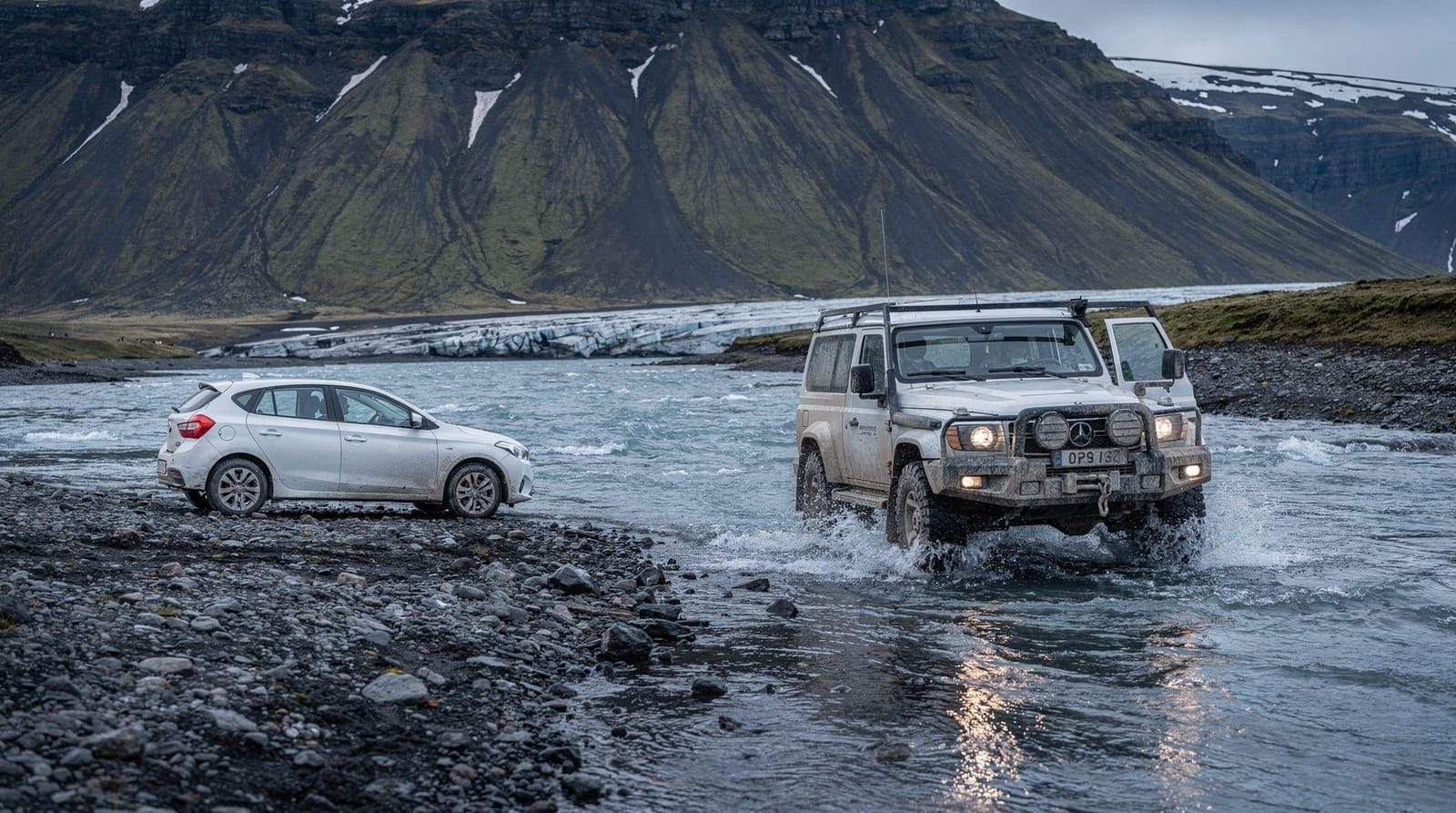
You need a 4WD only if: you’re driving F-roads (legally required), driving in winter outside the Ring Road, or specifically targeting remote highland routes. See 2WD vs 4x4 Iceland for the full decision guide.
Strategy 4: Maximise people per car
The rental cost is per vehicle, not per person. The most effective cost reduction is simply having more people share the cost:
- 2 people in a car: 6,000–10,000 ISK per person per day (base rate only)
- 4 people in the same car: 3,000–5,000 ISK per person per day
A group of four splitting a compact 2WD for 10 days pays roughly 30,000–50,000 ISK each in car hire. A solo traveller in the same car pays 100,000–150,000 ISK.
If you’re solo or as a couple, consider whether your travel dates overlap with anyone you know visiting Iceland, or whether a short-term group can be formed (Reddit’s r/VisitingIceland often has travellers looking for car-share arrangements).
Strategy 5: Pick up at an off-airport lot, not in-terminal
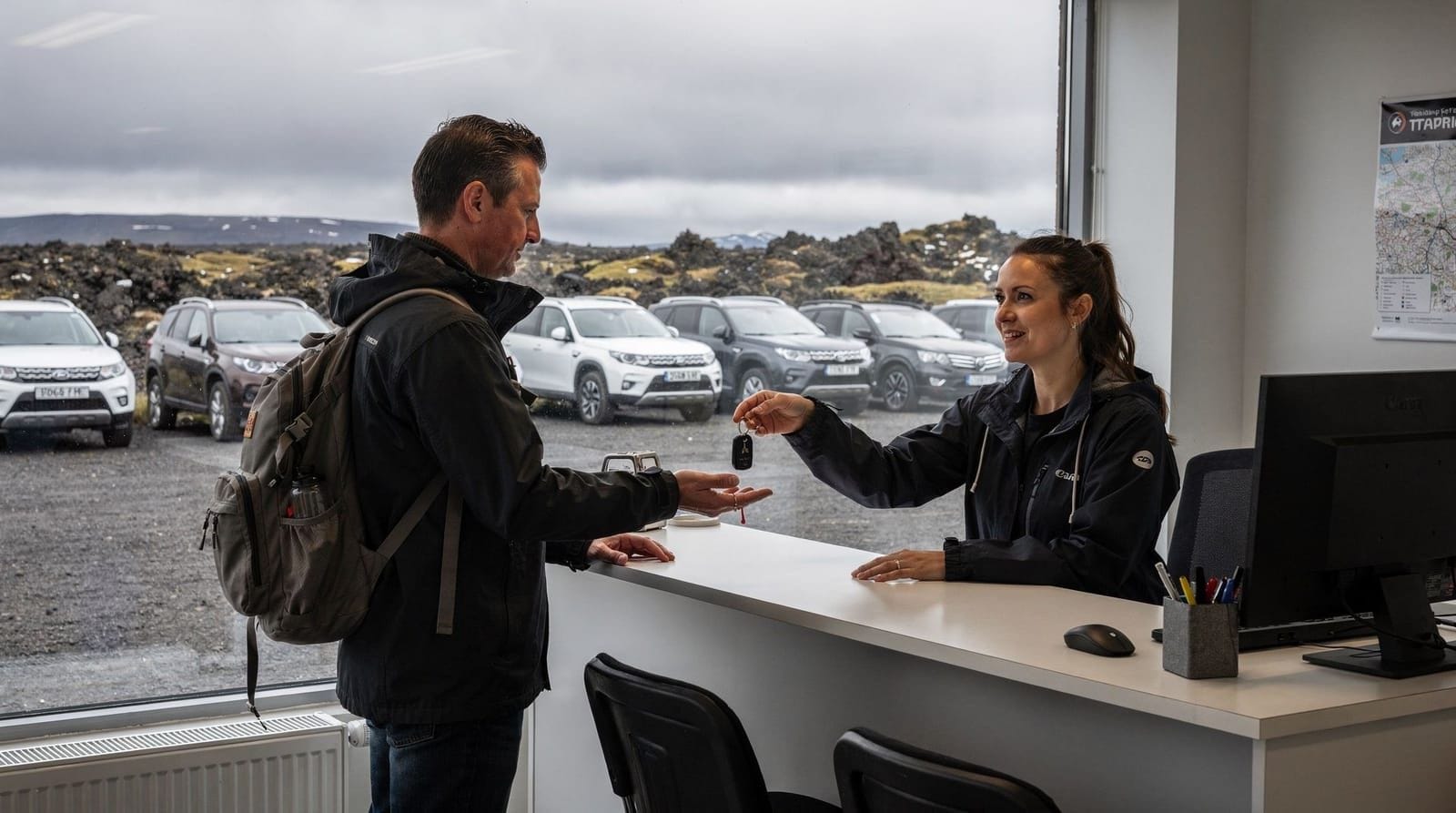
Rental counters inside KEF terminal (Hertz, Avis, Budget) charge a premium for their location. Off-airport lots — connected by shuttle bus, 10–15 minutes from the terminal — are cheaper because they’re outside the airport concession fee structure.
Most local Icelandic operators (SADcars, Lagoon, etc.) operate from off-airport lots. The shuttle is straightforward; the savings are real. Factor in the 20–30 minute transit time when planning your arrival schedule.
Strategy 6: Understand what insurance is actually necessary (don’t buy twice)
Iceland’s rental insurance landscape is complex enough that people regularly pay for overlapping cover. The key principle: buy what you actually need, don’t buy duplicates.
- CDW (basic collision waiver): Usually included in the base rental price. If not, add it.
- SCDW (zero excess): Worthwhile if the excess is high and you want peace of mind.
- SAAP (gravel/sand protection): Essential for Ring Road travel. Cannot be substituted by credit card cover (most credit cards exclude gravel damage). Cost 700–2,500 ISK/day.
- Windscreen: Ask if it’s included in SAAP. If not, add it separately for Ring Road trips.
- Credit card cover: Verify before relying on it. Most cards explicitly exclude gravel damage in Iceland. Call your card company.
Do not buy both credit card-covered CDW AND the rental company’s SCDW for the same risk — that’s doubling up. Full explanation: car rental insurance Iceland.
Strategy 7: Return the car with a full tank
Standard policy is full-to-full. The rental company will charge fuel at their pumps — typically 50–80 ISK/litre above local pump prices — if you return with less than a full tank. Fill up at an ÓB, Orkan, or Costco station before returning. Reykjavik stations are conveniently located near the KEF access road.
Never buy the prepaid fuel option — you pay for a full tank upfront and don’t get a refund for unused fuel. It’s almost always worse value.
Strategy 8: Avoid automatic transmission if not needed
Automatic transmission vehicles in Iceland cost more than manual (stick shift). If you can drive manual, the price difference (typically 2,000–5,000 ISK per day at smaller operators) adds up over a 10-day trip. Many European visitors drive manual already; this applies mainly to North American travellers where automatics are standard.
Strategy 9: Travel in shoulder season
Car hire prices in Iceland follow the same summer/winter dynamic as accommodation:
- July–August: peak prices
- June, September: 10–25% cheaper
- May, October: 20–40% cheaper
- November–April: 30–50% cheaper (but winter driving restrictions and conditions)
A Ring Road trip in late September or early October can save 100,000–200,000 ISK on car hire alone versus July, while offering near-identical landscapes (often with early snow on peaks for drama) and better aurora conditions. See Iceland in autumn.
Strategy 10: Watch for weekly rate discounts
Most operators offer a discount for 7+ day rentals — typically 10–15% below the equivalent daily rate multiplied by seven. For Ring Road trips of exactly 7 or 10 days, the weekly rate structure can save 10,000–20,000 ISK. Always ask or check the calculator on the operator’s site.
Strategy 11: Don’t rent GPS if you have a smartphone
Rental companies charge 500–1,500 ISK per day for GPS units. A smartphone with Google Maps or Maps.me (offline download) does the same job. Download the Iceland offline map before arrival and you don’t need mobile data on the road. The one exception: some 4WD vehicles in the highlands benefit from the operator’s proprietary highland-specific maps that show track conditions, but these are niche.
Strategy 12: Read the contract before signing
Icelandic rental contracts have real gotchas. Common ones:
- Penalty for returning the car late (even by 1 hour) — typically 2,000–5,000 ISK
- Minimum rental period requirements at certain rates
- Mileage limits on some economy rates (common with daily flat-rate deals)
- Geographic restrictions (some contracts exclude F-roads or specific highland routes — verify before driving them)
Five minutes reading the contract before signing can prevent significant unexpected charges at return.
What savings look like in practice
Example comparison: two people, 10-day summer Ring Road trip
| Booking approach | Car hire cost (both) |
|---|---|
| Last-minute at KEF Hertz counter, full 4WD | 350,000–450,000 ISK |
| Advance booking, local operator, compact 2WD | 140,000–180,000 ISK |
The difference — around 200,000 ISK — is approximately 1,300 EUR per couple on just the car hire component.
Frequently asked questions about saving on car rental in Iceland
Which is cheapest: Hertz, Avis, or local operators in Iceland?
Local Icelandic operators (SADcars, Lagoon, Go Car, Northbound) are consistently cheaper than international chains for comparable vehicles, typically by 20–40%. Find them through aggregators like Discovercars.com.
Is it worth using Discover Cars or RentalCars in Iceland?
Yes — aggregators pool inventory from multiple operators and make price comparison transparent. The coverage in Iceland is good. Check that the listed inclusions (CDW, mileage limit) make the comparison fair.
Should I book from home or from Iceland?
From home, in advance. Prices booked from home online are almost always lower than walk-up prices at the airport counter.
What happens if I return the car with a chip in the windscreen without SAAP?
You pay full repair cost — typically 50,000–180,000 ISK depending on vehicle and chip size. SAAP covers this. This is why SAAP is consistently recommended for Ring Road trips.
Can I get a car rental refund if I return early?
Most operators charge for the booked duration regardless of early return. Some offer partial refunds with advance notice. Check the specific policy in your contract before booking.
Should I decline currency conversion when paying at the rental counter?
Yes. If offered the choice to pay in your home currency (“dynamic currency conversion”) versus ISK, always choose ISK. DCC rates are typically 3–8% worse than the exchange rate your own card issuer applies, and this applies at both pickup deposits and final settlement.
Is it cheaper to book the whole trip (car, activities, accommodation) as one package?
Not usually for the car specifically. Bundled Iceland packages from some agencies fold in guided activities at a markup that often exceeds booking the car and any day tours separately through aggregators. The one exception is genuine multi-day guided small-group tours, which are priced as a full package rather than a bundled discount — see self-drive vs guided tour for that comparison.
Does the size of the car actually change fuel cost much?
Somewhat, but less than most people expect. A compact 2WD averages roughly 6L/100km on the Ring Road; a mid-size 4WD SUV closer to 8–9L/100km. Over 1,322 km, that difference is around 25,000–40,000 ISK in fuel — real money, but usually smaller than the daily rental price gap between the two vehicle classes. Vehicle size decisions should be driven mainly by rental rate and passenger comfort, with fuel as a secondary factor.
Operator comparison: local vs international chains
This is the highest-leverage saving available beyond booking timing. The same class of car from a local Icelandic operator routinely runs 15,000–25,000 ISK per day cheaper than the equivalent from Hertz or Avis in July.
Why local operators are cheaper:
- No global franchise fees
- Off-airport lots avoid airport concession charges
- Smaller overhead
- Less brand premium
Why some travellers choose chains:
- Loyalty programme points
- Known cancellation and complaint processes
- In-terminal location at KEF for convenience
- Consistent global standards
Reputable local Iceland operators:
SADcars: One of Iceland’s oldest and largest local operators. Wide vehicle selection, off-airport, consistent reviews.
Lagoon Car Rental: Mid-sized local operator. Good 4WD selection. Named after proximity to the Blue Lagoon area in a clever piece of marketing.
Go Car Rental: Transparent pricing, aggregator-listed, popular for budget bookings.
Northbound: Focused on eco-conscious travellers. Fully electric vehicle options (limited range — best for Reykjavik and short trips, not Ring Road).
Geysir Car Rental: Budget-focused with reasonable reviews.
One-way rental options
If you’re flying into KEF and out from Akureyri (or vice versa), a one-way rental avoids the dead driving time of returning to your start point. One-way fees vary:
- KEF to Akureyri Airport: 15,000–35,000 ISK drop fee depending on operator
- KEF to Egilsstaðir: 25,000–45,000 ISK drop fee
Whether this is worth it depends on how much you value not redriving the same road. On a 10-day Ring Road, the full loop is part of the experience and one-way fees are unnecessary. On a 5-day focused trip combining flight with driving, a one-way may justify the fee.
Electric vehicles in Iceland: the savings picture
Electric vehicles are slowly entering Iceland’s rental fleet. Operators like Northbound offer Teslas and other EVs. EV rental pricing is not necessarily cheaper than petrol — operators charge a premium for newer technology.
Charging infrastructure: Iceland’s charging network has improved significantly in Reykjavik and along the Ring Road. Key charging hubs exist in Reykjavik, Selfoss, Vík, Höfn, Egilsstaðir, Akureyri, and Akranes. Gaps exist in the Westfjords and between Kirkjubæjarklaustur and Höfn.
Range anxiety: A Tesla Model 3 Long Range has approximately 500 km of range (reduced in cold weather). The Ring Road’s 1,332 km requires several charging stops. The charging infrastructure on the main Ring Road is adequate for careful planning but offers little margin for unplanned detours.
Cost: Charging a 75 kWh battery at an Icelandic fast charger costs approximately 3,500–5,000 ISK per session (3–5 sessions for the Ring Road loop). Compare to 25,000–30,000 ISK for petrol in a compact ICE car. The fuel saving on a 10-day trip is roughly 20,000–25,000 ISK — partially offsetting any EV rental premium.
For carbon-conscious travellers willing to plan charging stops carefully, an EV is viable for the Ring Road in summer. Winter range reduction and charging availability in remote areas make it less practical outside summer.
The insurance calculation: what actually minimises total cost
A common trap: choosing the cheapest base rental price and then buying all the extra insurance at the desk, ending up paying more total than a slightly pricier package deal would have been.
Run the full calculation:
- Base daily rate
- SCDW (zero excess add-on)
- SAAP (gravel/sand protection)
- Windscreen cover (if not in SAAP)
- Any other add-ons you need
Some operators offer an “All Inclusive” package that bundles CDW, SCDW, SAAP, and tyre protection for a fixed daily premium. If the components would cost as much individually, the bundle is reasonable. Compare the bundled package to the itemised cost and choose whichever is lower.
Aggregators like Discovercars.com often bundle SAAP into their “full cover” tier — check whether this is true cover or a separate purchase. Read the inclusions box carefully before finalising.
The complete insurance explainer: car rental insurance Iceland.
The rental period length sweet spot
One day: Expensive per day, no weekly discount. Only book this if your schedule is genuinely that tight.
3–4 days: Useful for the Golden Circle + South Coast combined without a full Ring Road.
7 days: The magic number for many operators. Weekly rate kicks in at most companies, reducing the effective daily rate by 10–15%. Allows a solid Ring Road half-loop (Reykjavik to Akureyri or vice versa) plus time in the capital.
10–14 days: Full Ring Road plus regional extensions. Daily rate at weekly-rate equivalent or better. The most common Ring Road booking.
For a first Iceland trip, 10 days is the sweet spot: enough to complete the Ring Road without rushing, with 1–2 days of buffer.
Self-drive vs day tours: the car hire cost in context
Some travellers wonder if forgoing car hire and taking day tours instead saves money. The comparison:
Day tours from Reykjavik for 7 days:
- Golden Circle: 9,000–14,000 ISK
- South Coast: 12,000–18,000 ISK
- Snaefellsnes: 12,000–18,000 ISK
- Northern Lights: 8,000–12,000 ISK
- Glacier hike: 12,000–18,000 ISK
- Whale watching: 12,000–16,000 ISK
- 7 nights Reykjavik accommodation: 120,000–200,000 ISK
- Total for two people: approximately 350,000–580,000 ISK
7-day Ring Road self-drive for two people:
- Car hire (2WD + insurance): 100,000–150,000 ISK
- Fuel: 20,000–25,000 ISK
- Accommodation mix: 120,000–180,000 ISK
- Food (mixed): 50,000–75,000 ISK
- Activities (glacier hike + secret lagoon): 30,000–40,000 ISK
- Total for two people: approximately 320,000–470,000 ISK
Self-drive is cheaper and shows you significantly more of Iceland. The day tour option makes sense for: very short trips (3–4 days in Reykjavik only), solo travellers for whom car hire is expensive per-person, or travellers who specifically don’t want to drive in unfamiliar conditions.
Cars vs mini-campervans for the budget category
For budget-conscious solo travellers or couples comparing:
- Economy car (Yaris) + hostels: Cheapest per day, requires separate accommodation booking every night
- Mini-campervan: Higher per-day cost, eliminates accommodation cost, more flexibility
For 7 days: a mini-campervan at 22,000 ISK/day (camping 7 nights at 2,000 ISK/person) = 168,000 ISK for vehicle + 28,000 ISK for two people’s camping = 196,000 ISK total.
Economy car at 10,000 ISK/day + hostel dorms at 6,500 ISK/person x7 nights = 70,000 + 91,000 = 161,000 ISK for two people.
The car+hostel option is marginally cheaper for 7 days. At 10 days, the calculation gets closer. At 14 days, the campervan wins.
For full details: campervan vs car Iceland.
Payment method and currency savings
Two overlooked savings sit in how you pay rather than what you book.
Currency: Always pay in ISK, not your home currency, when the card terminal offers “dynamic currency conversion” (DCC) at pickup or return. DCC exchange rates are typically 3–8% worse than your card issuer’s own rate. Decline the conversion and let your bank handle the exchange.
Credit card type: Some travel-focused credit cards (check your specific card’s benefits) include complimentary rental car excess/collision cover for international rentals, which can reduce or eliminate the need for SCDW. Verify this in writing from your card issuer before relying on it — many cards explicitly exclude gravel and Iceland-specific risks even when they cover standard CDW elsewhere.
Booking currency lock: Aggregators sometimes show a lower headline price in USD than the equivalent EUR or ISK booking due to exchange rate timing. If your card charges foreign transaction fees, calculate the total in your home currency before assuming the cheapest-looking listing is actually cheapest.
Membership and loyalty angles worth checking
A few membership-based discounts apply specifically to Iceland rentals and are easy to miss:
- Airline credit cards and travel portals sometimes list Iceland-specific operators with a percentage discount or bonus points multiplier — check your card’s travel portal before booking directly.
- Annual travel membership programmes (some banks, some airlines) occasionally include a flat discount code for Discovercars.com or RentalCars.com bookings.
- Coupon codes from Icelandic tourism newsletters — SADcars and other local operators occasionally distribute first-booking discount codes through their own mailing lists, which is worth signing up for a few weeks before your trip if you have that lead time anyway for the booking-timing strategy above.
None of these substitute for the fundamentals (book early, choose a local operator, right-size the vehicle) — they are marginal savings on top of those decisions, not a replacement for them.
Late season and last-minute discounts
Rental companies sometimes offer discounted rates in the final days before a booking period to fill remaining inventory. These are visible on aggregator sites as “last minute” deals or through direct operator flash sales. To access:
- Check Discovercars.com within 2 weeks of your travel date for current inventory
- Follow Iceland rental operators on social media — some post flash sales
- Call operators directly and ask about available inventory and any flexible pricing
This strategy only works if your travel dates are genuinely flexible and you’re comfortable with vehicle type uncertainty. Not recommended for summer peak or travellers with fixed itineraries.