Campervan vs hotel in Iceland: costs, comfort, and trade-offs
Is a campervan or hotel better value in Iceland?
For 2 people in summer, a campervan at campsites costs approximately ISK 32,000–39,000/day total (vehicle + camping). A small rental car plus mid-range guesthouses costs ISK 37,000–45,000/day. Campervanning is cheaper for 2+ people staying at campsites, but comfort and privacy are significantly lower. For winter or solo travel, hotels win clearly.
| Cheapest for 2 people | Car + tent camping |
| Most comfortable | Guesthouse or hotel |
| Best all-round for couples | Campervan (summer only) |
| Solo travellers | Hotels/guesthouses usually win on cost per person |
| Winter travel | Guesthouses; most campsites close Nov–Mar |
Setting up a fair comparison
“Campervan vs hotel” in Iceland is really three separate questions:
- Which costs less?
- Which is more comfortable?
- Which gives a better Iceland experience?
The answers depend heavily on group size, season, and travel style. A couple camping in July has a completely different equation from a solo traveler in November. This guide works through the specifics.
Cost comparison: same 10-night Ring Road trip
Option A: 2-berth campervan + campsites
| Item | ISK | EUR |
|---|---|---|
| Campervan rental (2-berth, summer) | 280,000–350,000 | 1,900–2,400 |
| Insurance (CDW + SAAP + GPSB) | 40,000–70,000 | 270–475 |
| Campsites (10 nights × 2 people × ISK 2,000) | 40,000 | 270 |
| Fuel (extra vs car, ~40% more consumption) | 42,000–52,000 | 285–355 |
| Total (2 people) | 402,000–512,000 | 2,725–3,500 |
| Per person | 201,000–256,000 | 1,362–1,750 |
Option B: Small rental car + mid-range guesthouses
| Item | ISK | EUR |
|---|---|---|
| Small 4x4 rental (10 days) | 150,000–250,000 | 1,020–1,700 |
| Insurance | 40,000–70,000 | 270–475 |
| Fuel | 30,000–40,000 | 205–270 |
| Mid-range guesthouses (10 nights × ISK 28,000) | 280,000 | 1,900 |
| Total (2 people) | 500,000–640,000 | 3,395–4,345 |
| Per person | 250,000–320,000 | 1,700–2,175 |
Option C: Small rental car + campsites (tent)
| Item | ISK | EUR |
|---|---|---|
| Small car rental | 120,000–200,000 | 815–1,360 |
| Insurance | 30,000–60,000 | 205–410 |
| Fuel | 25,000–35,000 | 170–240 |
| Camping (10 nights × 2 people × ISK 2,000) | 40,000 | 270 |
| Total (2 people) | 215,000–335,000 | 1,460–2,280 |
| Per person | 107,000–167,000 | 730–1,140 |
Verdict on cost: Campervan is cheaper than hotels but significantly more expensive than car + tent. If budget is the primary driver, rent a car and bring a tent. If the convenience of a built-in bed without tent setup matters, a campervan is the midpoint option.
Comfort comparison
Sleeping
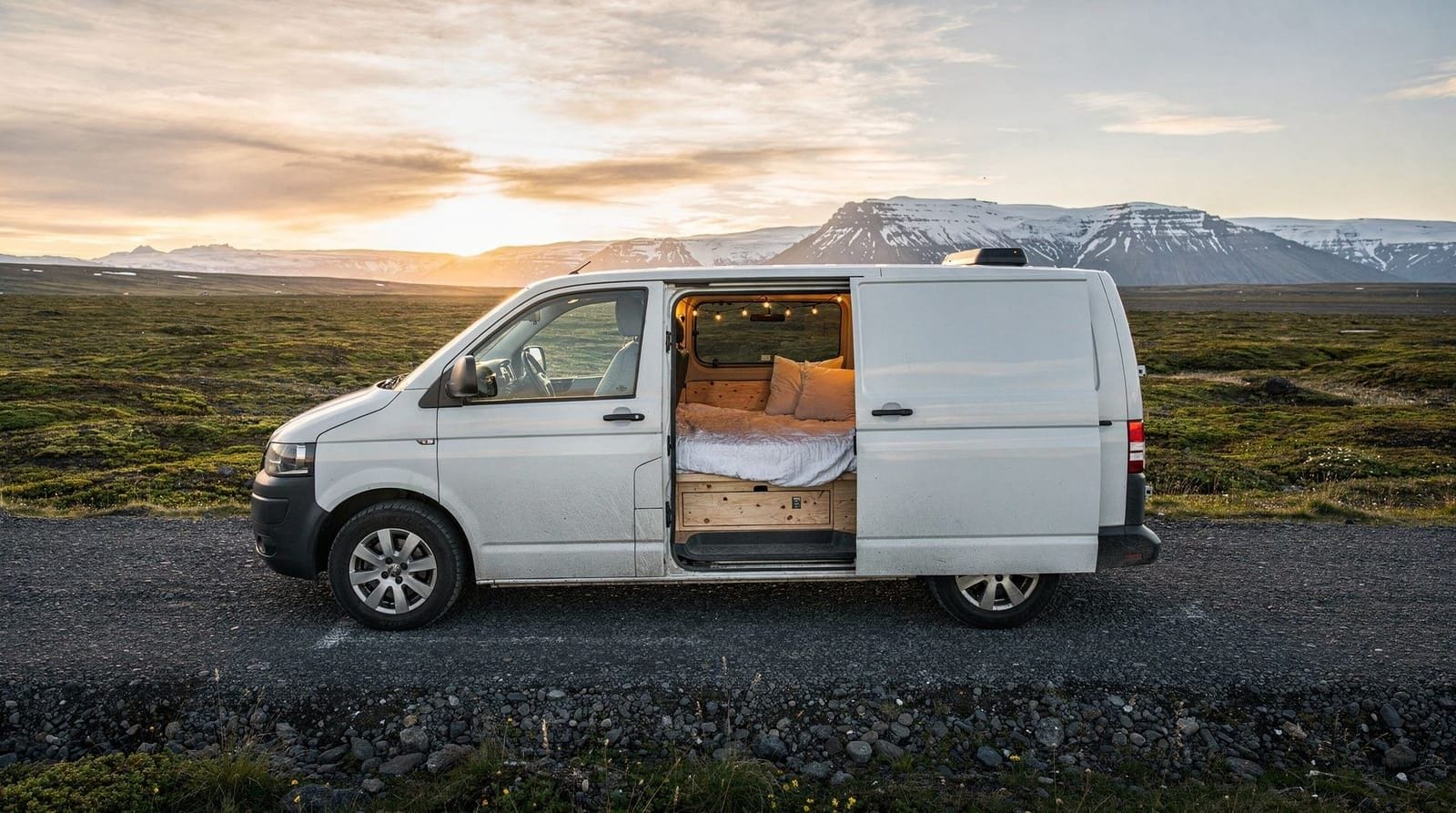
Campervan: A 2-berth campervan bed is typically 1.2–1.4 m wide and 1.8–1.9 m long. For two average-sized adults this is close quarters. Many designs require removing the rear seat cushions and rearranging to create the sleeping surface — a 5-minute process but one you do every night. Temperature in the campervan at night: varies from 8°C (October) to 18°C (July) depending on insulation quality and external temperature.
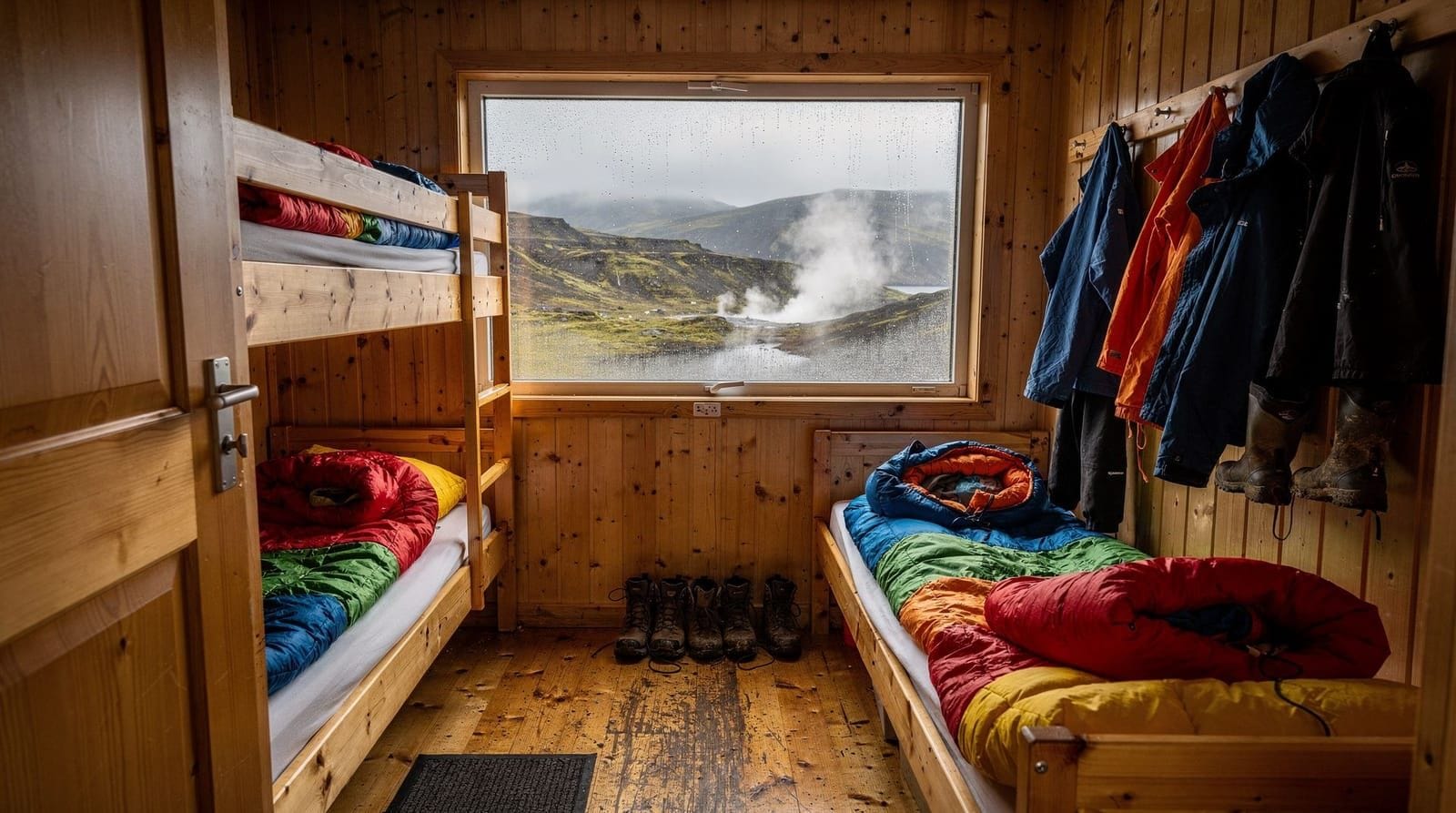
Guesthouse: Private room with a real bed. En suite bathroom in most mid-range options. Temperature controlled. You arrive, drop your bag, and sleep. The Ring Road guesthouse standard has improved significantly in recent years; ISK 20,000–35,000/night for a double gets you clean, basic accommodation with breakfast included at many places.
Hotel (quality tier): Iceland has several Fosshotel and Icelandair Hotel properties along the Ring Road offering 3-star standards with private bathroom, decent mattress, and sometimes restaurant access. ISK 30,000–55,000/night.
Bathroom and showering
Campervan: Small campervans (2-berth) usually have no onboard toilet or shower. You use campsite facilities — warm showers ISK 200–500 extra. Campsite showers on the Ring Road range from adequate (Skógar, Mývatn) to basic (some East Fjords sites). You shower when you camp, not whenever you need to.
Guesthouse/hotel: Private or shared bathroom at the property. Shower whenever you want, as long as you want.
Cooking
Campervan: Most campervans have a 2-ring gas hob and small fridge. You can cook proper meals — pasta, eggs, fried fish, whatever you buy at Bónus or Krónan. This is one of the campervan’s genuine lifestyle advantages: coffee before sunrise, hot soup at a glacier viewpoint, flexible eating schedule.
Guesthouse: You eat at the guesthouse restaurant (often overpriced) or drive to the nearest town. This is the main cost disadvantage of guesthouse-based travel — eating out in Iceland is expensive (ISK 2,500–5,500/person for a main course at a basic restaurant). A campervan that allows self-catering saves ISK 3,000–6,000/day for two people.
Flexibility comparison
Campervan: No check-in or check-out constraints. If you want to spend an extra day at Mývatn, you move your campervan to a different pitch. No need to book everything 3 months ahead. The campsite network along the Ring Road is dense enough that you can usually decide where to stop each afternoon and find a spot.
Caveat: In July–August, popular campsites (Skógar near Skógafoss, Vík, Þórsmörk) fill by afternoon. Some accept advance booking; others are first-come-first-served. Having a backup campsite 20–30 km further is standard planning.
Guesthouse/hotel: You must book in advance for summer. Flexibility to change plans is limited by cancellation policies (most are 24–72 hours notice for full refund). If you decide to stay an extra night at Jökulsárlón, you need to check availability and rebook the following nights. This is manageable with flexible bookings but adds planning overhead.
Who campervanning suits
- Couples or small groups (2–3 people) where the per-person cost advantage is clear
- Travelers who value spontaneity over comfort
- People who enjoy cooking and the “camping lifestyle”
- Summer-only travel (May–September)
- Budget travelers who want more than a tent but less than hotel costs
Who hotels/guesthouses suit
- Solo travelers (cost per person is similar or better than campervan)
- Winter travelers (most campsites close November–March)
- Anyone who values a proper bed, private bathroom, and temperature control
- Travelers with children under 10 (sleeping logistics in a campervan with young children are challenging)
- Those who have physical limitations that make ground-level sleeping difficult
The “campervan for Iceland” myth
Travel forums frequently describe campervanning as Iceland’s default best option. This oversimplifies. The cases where campervanning is clearly superior:
- Two adults, 10+ days, summer, comfortable with camping logistics
- Travelers who want to cook their own food and avoid restaurant costs
- People who want maximum flexibility and don’t need comfort
The cases where it is clearly not superior:
- Solo traveler — pay the same vehicle cost for one person
- Winter trip — most sites closed, heating requirements increase costs
- Travelers who prioritize sleep quality, warmth, and private bathrooms
- Short trips (5–7 days) where setup/breakdown overhead is proportionally larger
The hidden costs of each option
Campervan hidden costs:
- Campsite showers: ISK 200–500 per shower at most Ring Road sites — 2 people × 10 nights = ISK 4,000–10,000 extra
- Campsite electricity hookup: ISK 700–1,500 per night if needed — adds ISK 7,000–15,000 for 10 nights
- Higher fuel consumption: Campervans use 40–60% more fuel than small cars — extra ISK 12,000–20,000 for 10 days of Ring Road driving
- Gas canisters: Budget ISK 3,000–5,000 for cooking gas over a 10-day trip
- Camp kitchen washing up supplies: ISK 1,500
- Total hidden additions: ISK 27,500–51,500 on top of the headline vehicle and camping cost
Hotel hidden costs:
- Parking fees: Reykjavik city centre parking, Þingvellir, Geysir: ISK 500–1,000 per stop, perhaps ISK 5,000–8,000 total
- Breakfast: Many “guesthouse” quotes show room-only rates. Breakfast often ISK 2,500–4,000/person if not included
- Restaurant meals: 3 restaurant meals/day × 10 days × ISK 4,500/person average = ISK 135,000/person. Self-catering even partially (breakfast and lunch from a supermarket) cuts this by 50–60%
- Laundry: Hotels generally have self-service laundry (ISK 1,000–1,500/load). Campervans use the same facility at campsites
The hidden cost of eating out completely in hotels is the biggest underestimated expense for hotel-based travel in Iceland.
How accommodation quality varies along the Ring Road
South Coast: Good quality guesthouses at Skógar (Hótel Skógafoss), Vík (Hótel Kría, Black Beach Suites), and Kirkjubæjarklaustur. Most are updated and comfortable. Prices ISK 25,000–50,000/night for a double in summer.
East Fjords: Smaller and more rustic options. The Egilsstaðir Guesthouse is the main mid-range option in the hub town. Several farmstays (gistihús) along the fjords offer simple but authentic accommodation at ISK 15,000–25,000/night.
Akureyri: Full urban hotel range. Icelandair Hótel Akureyri, Hótel KEA. More choice than anywhere outside Reykjavik. Prices comparable to Reykjavik but availability slightly better.
Mývatn: Hótel Gígur is the main lakeside option (ISK 35,000–55,000/night in summer). Smaller guesthouses at Skútustaðir and near the nature baths. Book Mývatn accommodation 6–8 weeks ahead in summer — it’s the most limited quality accommodation segment on the Ring Road.
Group size economics
The campervan vs hotel calculation changes dramatically with group size:
Solo traveler:
- Campervan: Full vehicle cost for one person. ISK 25,000–40,000/day for a 2-berth van is expensive per capita
- Single hotel room: ISK 12,000–20,000/night at a budget guesthouse, often slightly less than the campervan
- Verdict: Hotels are usually cheaper for solo travelers
Couple (2 people):
- Campervan: Vehicle cost split two ways. Marginal advantage over hotel if camping most nights
- Double hotel room: ISK 20,000–35,000/night mid-range
- Verdict: Campervan cheaper if camping, close to equal at mid-range hotels
3 people:
- Campervan: 3-berth campervans exist but are heavier, more expensive, and less efficient. 2-berth + tent alongside is the practical option
- Triple hotel room: Hard to find in rural Iceland; usually two double rooms required
- Verdict: Car + tent wins for 3-person groups on budget; 2 hotel rooms is expensive
4 people:
- 4-berth campervan: Significantly more expensive vehicle (ISK 40,000–70,000/day)
- Two rooms: ISK 40,000–70,000/night at mid-range guesthouses
- Verdict: Campsite fees are the deciding factor — 4 people × ISK 2,000 = ISK 8,000/night vs two rooms saves significantly
Sustainability comparison
Iceland’s tourism growth (from 500,000 visitors/year in 2010 to 2.3 million in 2023) has put significant strain on campsite infrastructure, especially at popular South Coast and Snæfellsnes sites.
Campervan impact: Concentrated campsite use in peak season creates waste management and sanitation challenges. Iceland introduced stricter free-camping rules precisely because campervan waste was damaging sensitive sites. Using designated campsites is legal and environmentally appropriate.
Hotel impact: Guesthouse construction and operation generates a different impact pattern — longer-term building investment but less acute site damage. Local guesthouses (family-run farmstays) directly support Iceland’s rural economy in a way that large hotel chains don’t.
Both options: Iceland charges a tourism tax per visitor (included in accommodation fees at registered properties). Some campsites in remote areas don’t collect this; staying at regulated sites ensures your contribution reaches the national park and infrastructure maintenance funds.
What travellers actually say about each option
Based on recurring feedback from Ring Road travelers:
Campervan positives most cited:
- Waking up in remote locations with no other people
- Coffee at the edge of a glacier while everyone else is still driving
- Arriving at Jökulsárlón at 05:00 in complete solitude
- The cooking savings over 10 days being significant
- No check-in/check-out stress changing daily plans
Campervan negatives most cited:
- Sleep quality on narrow, hard beds — “we were tired from day 4”
- Shower access frustration (queue at campsite, forgetting to budget shower coins)
- Condensation in the van overnight making everything slightly damp
- Gas running out 40 km from the nearest station
- The complexity of a breakdown in a remote area
Hotel/guesthouse positives most cited:
- Proper sleep in a proper bed — “we arrived rested every day”
- The surprise quality of some Ring Road farmstays
- Hot breakfast included eliminating morning meal logistics
- Local guesthouse owners who gave better recommendations than any guidebook
Hotel/guesthouse negatives most cited:
- Arrival-time constraints (check-in 14:00–17:00, checkout 11:00) limiting flexibility
- Booking everything in advance reducing spontaneity
- Restaurant food quality varying wildly and being expensive
- Some guesthouses being 20–30 minutes off the Ring Road, adding driving
Neither list is universally applicable — individual experience depends on group size, the specific vehicles and properties chosen, and personal tolerance for roughing it. But the campervan sleep-quality complaint is consistent enough to be a real planning factor.
Quick decision guide by trip type
| Trip type | Recommended option |
|---|---|
| 10+ day Ring Road, couple, summer | Campervan |
| 5–7 day South Coast trip | Rental car + guesthouses |
| Solo traveller, any season | Rental car + hostel/guesthouse |
| Family with children under 10 | Rental car + guesthouses or farm stays |
| Winter northern lights trip | Rental car + guesthouses |
| Budget-maximising group of 2 | Rental car + tent camping |
How this compares to just renting a car and booking a guesthouse
If the campervan logistics above feel like more than you want to manage, a straightforward rental car paired with guesthouses booked along your Ring Road route remains the simplest option for most first-time visitors. It requires more advance booking but removes the daily campsite-finding, grey-water, and gas-refill logistics entirely. See Iceland self-drive guide for the full self-drive picture, and 2WD vs 4x4 Iceland if you’re deciding on a vehicle class independent of the campervan question.
Tent camping vs campervan: the third option
The most budget-efficient choice — a rental car (not campervan) plus a tent — is worth considering for travelers comfortable with camping:
Cost advantage: A small car at ISK 12,000–15,000/day plus ISK 2,000/person campsite fees is dramatically cheaper than any campervan.
Comfort: A quality tent (MSR Hubba Hubba NX, Big Agnes) on a campsite with warm showers is arguably more comfortable than a cramped 2-berth campervan van conversion. You have a standing height space to change in, more airflow, and a proper sleeping pad/bag system suited to your body.
Flexibility: A tent fits in any campsite, including walk-in sites accessible from car parks at Þórsmörk or Landmannalaugar.
Weather: Iceland rain is horizontal and persistent. A quality 3-season or 4-season tent handles it well; a poorly ventilated campervan gets condensation issues. Neither option is perfectly comfortable in heavy rain.
The tent option is recommended for travelers who have backpacking experience and value cost savings over convenience. It is the choice of many experienced Iceland visitors who have done the Ring Road before.
Frequently asked questions about campervan vs hotel in Iceland
Is a campervan worth it for one week in Iceland?
Borderline. Seven nights of campsite fees and vehicle rental at the high end will be close to mid-range guesthouses once you factor in the comfort differential. Many travelers find 7–8 days of campervan travel tiring by the end. Ten days or more is where campervanning’s advantages compound.
Can I park and sleep anywhere in Iceland in a campervan?
No. Iceland’s free camping rules apply only to uncultivated land far from farmland, settlements, and roads. Almost all accessible areas near tourist routes are private or protected. Using designated campsites is effectively required for overnight stays near the Ring Road.
Are campervans good for families with kids?
2-berth campervans: no. 4-berth motorhomes: workable for children over 6–7 with the right vehicle. The main issue for young children is the lack of a proper toilet and the difficulty of settling children in a moving sleeping environment. A car-and-guesthouse combination is significantly easier with children under 10.
Do guesthouses provide towels and linens in Iceland?
Yes. All registered guesthouses and hotels in Iceland provide linens, towels, and pillows as standard. This is one advantage over tent camping. Some basic hostels have linen hire fees (ISK 700–1,500) rather than inclusion — check when booking. Campervans should include bedding (sleeping bag-style duvets or separate sheets) — verify with your rental company at collection.
Which is better for northern lights viewing?
Campervan has a slight edge because you can drive to a dark spot and sleep there. But aurora viewing from a guesthouse location — stepping outside when the forecast improves at 23:00 — is equally effective and warmer. The campervan advantage is marginal for aurora specifically.
Can I cook meat in the campervan safely?
Yes, with ventilation. Keep a window or vent open while cooking any protein on the gas hob to prevent steam and smell buildup. Iceland lamb and fish are excellent cooked in the campervan — the local quality makes self-cooking a genuine pleasure rather than a budget necessity.
Do campervans have electricity?
Most have a leisure battery (80–120 Ah) for lighting and device charging. Campsites with electricity hookups allow you to run the fridge and heating continuously. Without hookup, the battery typically lasts 8–12 hours for basic use.
Is a rental car plus guesthouses easier for a first Iceland trip than a campervan?
Generally yes. A car and pre-booked guesthouses remove the daily logistics of finding a campsite, managing grey water, and refilling gas, which matters most for first-time visitors still learning Iceland’s roads and weather. Experienced Iceland travellers on a second or third trip are often more comfortable with the campervan trade-offs.