Blue Lagoon vs Sky Lagoon: which should you visit?
Blue Lagoon: Admission with drink towel mask
Should I visit the Blue Lagoon or Sky Lagoon in Iceland?
Blue Lagoon is more remote, more iconic, and more expensive (from €135 with transfers). Sky Lagoon is 7 km from Reykjavik, cheaper (from €60 direct), and focuses on an indoor/outdoor ritual experience. Blue Lagoon suits travelers passing through Keflavik; Sky Lagoon suits those based in Reykjavik.
| Blue Lagoon | ~€100+ from Reykjavík, 50km, iconic milky water |
| Sky Lagoon | From ~€60 direct, 7km, ocean-view ritual experience |
| Best for airport days | Blue Lagoon |
| Best for city-based visitors | Sky Lagoon |
| Booking | Mandatory for both, especially in summer |
Two very different experiences
Blue Lagoon and Sky Lagoon are both geothermal spas in Iceland, but the visitor experience is substantially different. Understanding those differences makes the choice straightforward for most visitors — they are not interchangeable.
Blue Lagoon: the basics
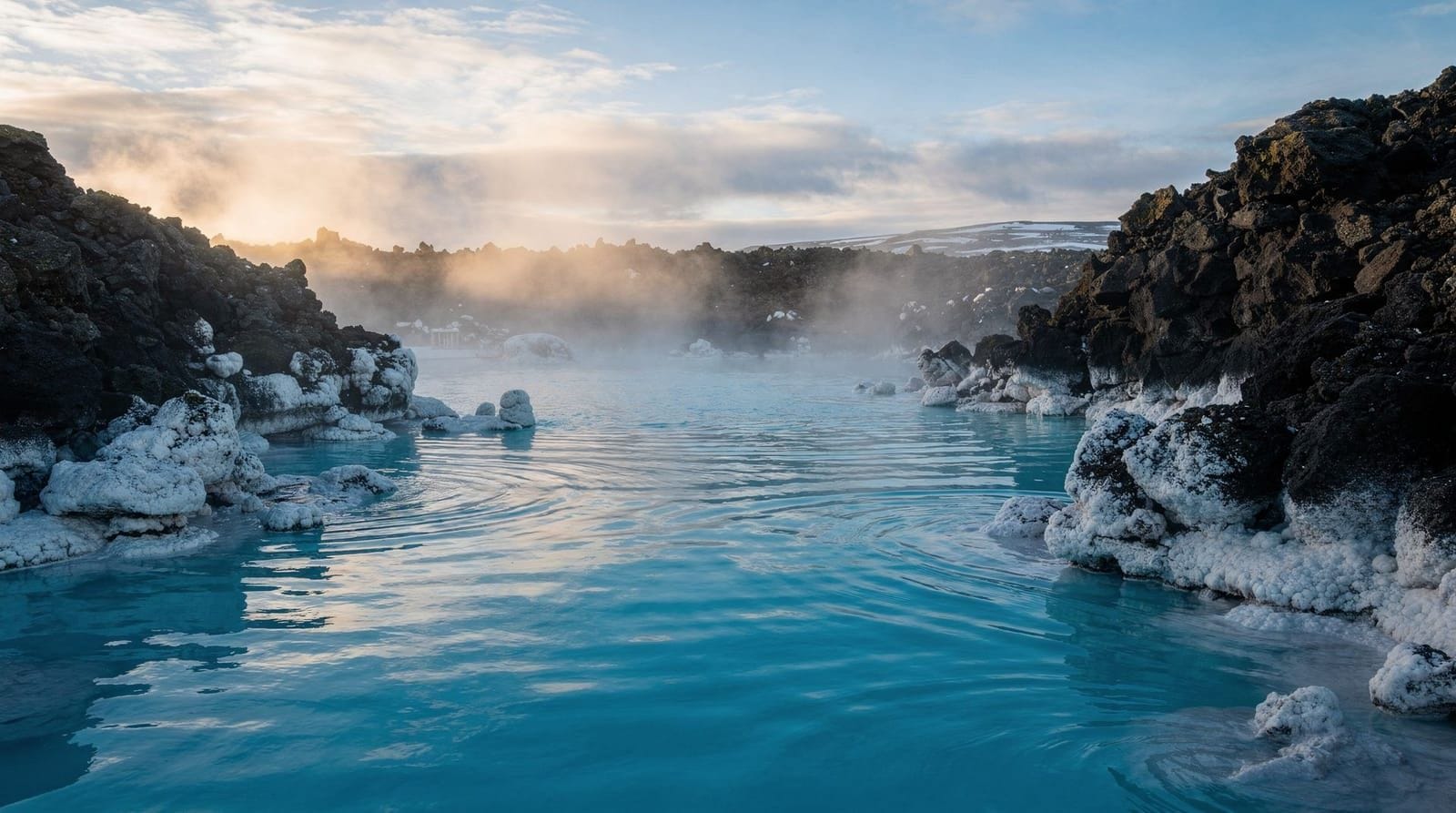
The Blue Lagoon is located in the Reykjanes Peninsula lava field, 46 km from Reykjavik and 22 km from Keflavik Airport. The water — a byproduct of the Svartsengi geothermal power plant — is rich in silica and algae, giving it the characteristic milky blue-white colour. Temperature is maintained at 37–39°C.
Scale: The outdoor lagoon covers approximately 9,000 square metres with depth ranging from 0.3 to 1.4 m. In peak season it holds several hundred visitors at a time. The complex includes several indoor and outdoor pools, steam rooms, and a lava cave sauna.
Admission options:
- Comfort (entry, towel, 1 drink, silica mask): from ISK 10,000–12,000 (€68–82) direct, or from ~€145 with transfers through operators
- Premium (adds bath robe, 2 drinks, algae mask): ISK 15,000–18,000+ (€100–120+)
- Retreat (access to exclusive pools, in-water massage available): ISK 30,000+ (€205+)
Note on recent Grindavík volcanic activity: The Blue Lagoon has temporarily closed twice since 2023 due to nearby eruptions. As of mid-2026 it is operating normally, but check current status at bluelagoon.com before booking.
Sky Lagoon: the basics
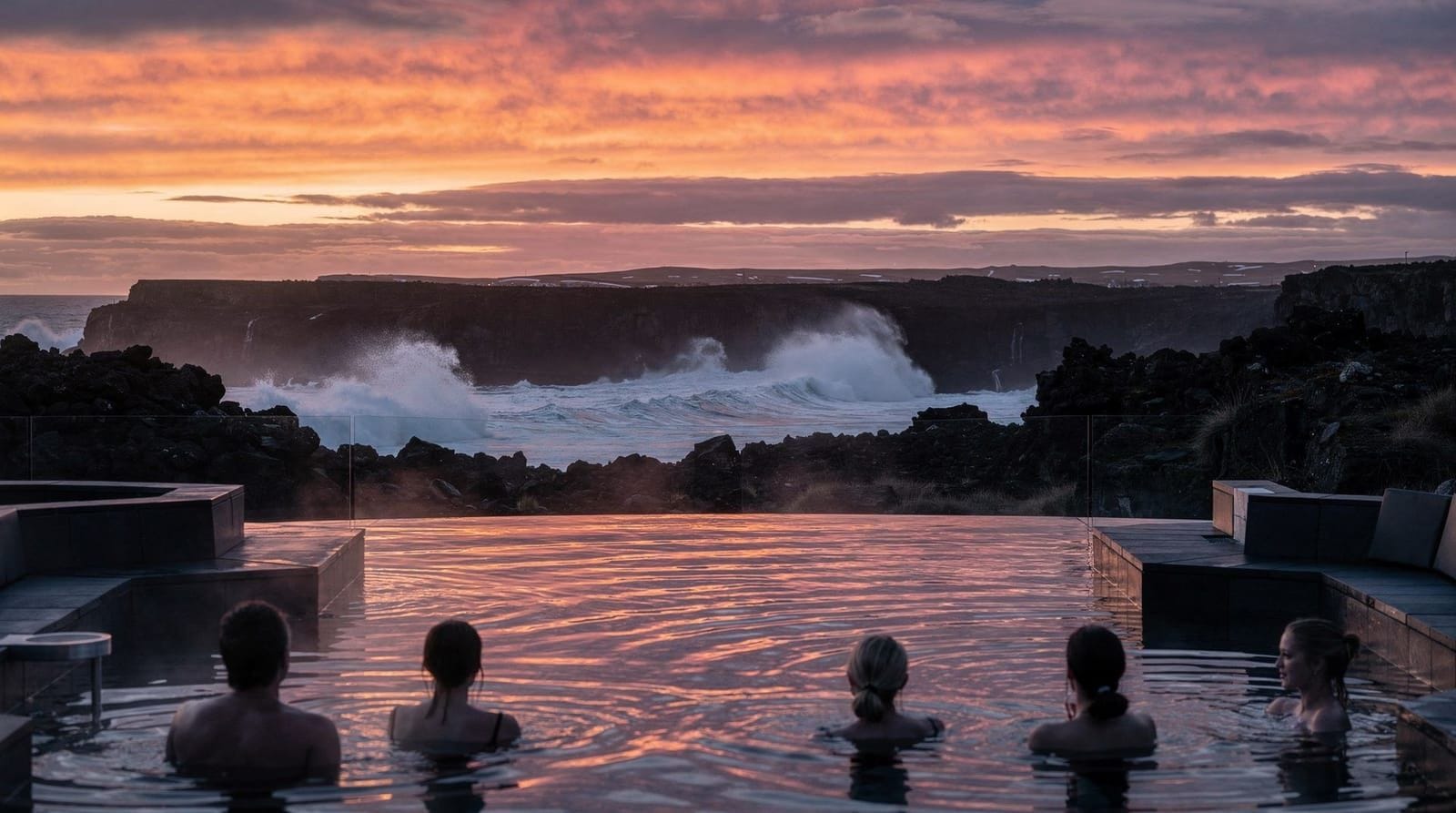
The Sky Lagoon opened in 2021 in Kársnes, Kópavogur — approximately 7 km from central Reykjavik. The water is geothermal, temperature 38–40°C, with an infinity edge that faces the open Atlantic Ocean.
Scale: The main pool holds fewer people than Blue Lagoon — roughly 150–200 at capacity. The design emphasises the ocean panorama, particularly in winter when the contrast between warm pool water and cold sea air creates dramatic steam.
The 7-step ritual: Sky Lagoon’s signature offering is the Skjól ritual — a guided sequence through cold pool, sauna, cold mist, steam room, warm scrub, and finally back to the main lagoon. This is included in the Sér pass (ISK 12,900–15,900 / €88–108) and optional add-on for the Pure pass.
Admission options:
- Pure (entry only, no ritual): ISK 9,990–10,990 (€68–75)
- Sér (entry + Skjól ritual + towel + robe): ISK 12,900–15,900 (€88–108)
Direct comparison
Location and accessibility
Blue Lagoon: 46 km from Reykjavik. Requires a car, transfer bus, or taxi. Works well as an arrival/departure stop (between Keflavik Airport and Reykjavik) — this is actually its best use case.
Sky Lagoon: 7 km from Reykjavik city centre. Direct bus service (Sky Lagoon shuttle from Harpa concert hall) costs ~ISK 1,200 (€8) each way. Easy to reach without a car.
Winner for Reykjavik-based visitors: Sky Lagoon by a wide margin. Getting to the Blue Lagoon from Reykjavik adds 1.5–2 hours of travel each way.
Price
Blue Lagoon Comfort: ISK 10,000–12,000 entry only; add transfers and it jumps to €145–240/person.
Sky Lagoon Sér: ISK 12,900–15,900 including the ritual, robe, and towel.
At comparable service levels (entry + towel + add-ons), Sky Lagoon is meaningfully cheaper, especially if you don’t need transfers.
Winner: Sky Lagoon on price, particularly for self-driving visitors.
The water
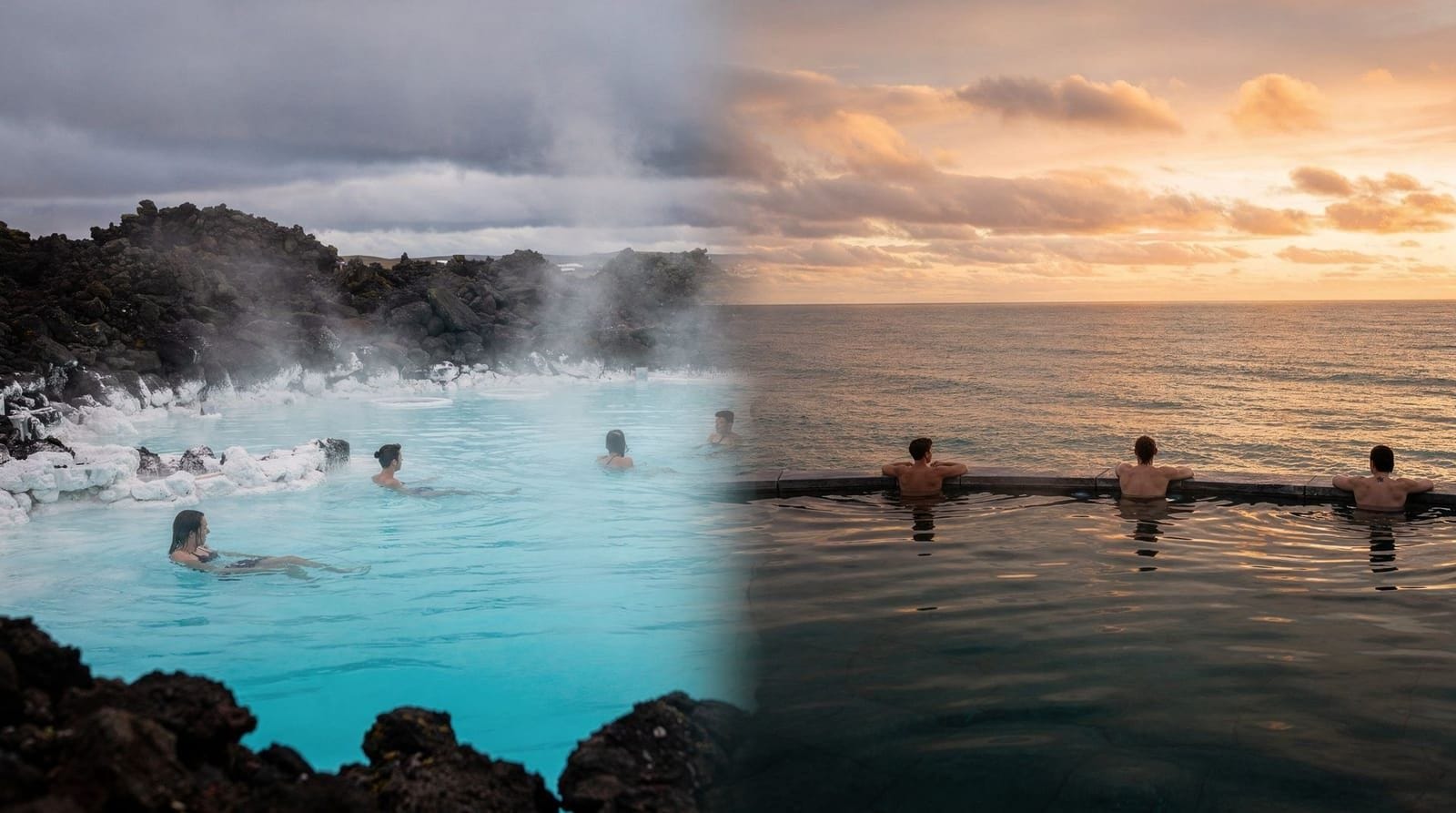
Blue Lagoon: Milky blue-white from silica. Genuinely unusual colour that photographs exceptionally well. The silica content creates a slippery smooth feel on skin. Mineral content (silica, algae, minerals) gives it a slightly different texture from regular geothermal water.
Sky Lagoon: Clear blue-green, standard geothermal mineral content. The water looks similar to other geothermal pools. Not as photogenically distinctive as Blue Lagoon.
Winner on “iconic photo”: Blue Lagoon.
The view
Blue Lagoon: Surrounded by the Reykjanes lava field. Atmospheric but enclosed — you’re in a bowl of lava. Minimal long-distance views.
Sky Lagoon: Infinity-edge pool facing the open Atlantic. On clear days you see the ocean horizon; on stormy days the contrast between warm water and crashing waves is dramatic. Sunset from Sky Lagoon (west-facing) is spectacular from October–April when the sun sets over the water.
Winner on view: Sky Lagoon.
Crowds
Blue Lagoon: Receives approximately 1.5 million visitors per year, making it Iceland’s most-visited paid attraction. Even with timed entry slots it can feel busy. The milky blue water means you can’t see people more than 2 m away, which reduces the crowd feel slightly.
Sky Lagoon: Smaller capacity means lower total crowding. Evening visits (18:00–21:00) are quieter. Weekday mornings are the least busy time at both facilities.
Winner on crowd levels: Sky Lagoon, particularly mid-week evenings.
The ritual experience
Blue Lagoon: Includes a lava sauna, steam rooms, cold plunge areas, and various add-on treatments (massages, in-water mud treatments). More extensive facilities but less structured as a “journey.”
Sky Lagoon: The Skjól ritual is a defined 7-stage experience with guides helping you through each step. For visitors who like structured wellness experiences, this is more rewarding than the Blue Lagoon’s self-directed format.
Winner for structured wellness experience: Sky Lagoon.
When to go to each
Blue Lagoon is the better choice if:
- You are stopping en route between Keflavik Airport and Reykjavik on arrival or departure day
- You specifically want the iconic blue-white water photographs
- You are doing a Reykjanes Peninsula day trip and can incorporate it
- You want the Retreat experience (no equivalent at Sky Lagoon)
Sky Lagoon is the better choice if:
- You are staying in Reykjavik and don’t want to deal with transport logistics
- You want better value (same experience, lower price without transfer costs)
- The ocean view matters to you
- You want the structured Skjól ritual
- You are visiting in winter when the contrast between steam and cold air at the ocean edge is dramatic
The booking experience: what to expect at each
Blue Lagoon booking process
Blue Lagoon requires advance online booking through bluelagoon.com. Entry is by timed slot — you choose an arrival window (08:00, 10:00, 12:00, etc.) and must arrive within that 30-minute window. There is no free entry; walk-ups are turned away if capacity is reached.
In summer (June–August), popular slots fill 4–6 weeks ahead. For arrival or departure day visits (the highest-demand scenario), book 6–8 weeks ahead. The booking system shows availability in real time; if your preferred slot is sold out, check cancellations 24–48 hours before your target date.
The booking includes your entry time and the facilities level (Comfort/Premium/Retreat). Upgrades cannot be applied at the door — decide in advance.
Sky Lagoon booking process
Sky Lagoon books via skylagoon.com. Also requires advance booking, particularly in summer. Timing windows are similar to Blue Lagoon. Sky Lagoon typically has more availability at short notice (1–2 weeks ahead) because it has lower total visitor capacity and less international marketing than Blue Lagoon.
The experience on arrival: practical details
Blue Lagoon arrival experience
The complex is large — reception, changing rooms, lockers, multiple pools, and several bar/dining options inside. On arrival:
- Check in at reception and receive your electronic wristband (payment for in-water drinks and face mask applications is charged against this)
- Pick up towel and amenity kit based on your ticket level
- Change in the large changing rooms (separated by gender; large, well-maintained)
- Enter the lagoon through foot baths and shower areas
- The milky blue water is immediately visible from the entry point
The lagoon has several zones: main pool, lava cave sauna, steam rooms, skin care area, and an outdoor bar-in-water where you can order drinks without leaving the pool. The face mask (silica) is available from dispenser stations around the lagoon — apply, wait 10–15 minutes, rinse.
Sky Lagoon arrival experience
Sky Lagoon’s arrival is more streamlined because the facility is smaller. The changing rooms are elegant — less industrial than Blue Lagoon’s. The main pool is immediately visible through glass panels from the changing area.
The Skjól ritual, if booked, is led by a staff member who guides your group through each stage:
- Lagoon (warm): Start in the main geothermal pool
- Cold plunge: 5°C cold pool, typically 30–60 seconds
- Sauna: Dry heat sauna overlooking the ocean through full-length glass
- Cold mist: A cold fog chamber
- Steam room: Warm and humid
- Sky scrub: Exfoliating scrub applied in the steam room
- Return to lagoon: The warm pool feels significantly more pleasant after the cold stages
The cold plunge is genuinely cold. Staff encourage participants but don’t force anyone. First-timers often find this the most memorable part of the visit.
Value assessment: what you actually get
The marketing for both facilities emphasises luxury. The honest picture:
Blue Lagoon Comfort: You get entry, a towel, one drink, and one silica face mask. The lagoon itself is large and atmospheric. The in-water drink experience (ordering from an in-water bar) is a genuine novelty. The face mask ritual is a gimmick that takes 15 minutes and leaves skin feeling silky for about 2 hours. The overall experience lasts 2.5–3 hours for most visitors.
At €145+ with transfers, you are paying for the iconic experience — the colour, the photography, and the story. The physical wellness benefit is marginal compared to, say, a hot tub at a local swimming pool.
Sky Lagoon Sér (with ritual): At €88–108 direct, significantly more affordable. The Skjól ritual is the more genuinely wellness-oriented experience — the cold-warm cycling is a legitimate thermal therapy with documented physiological benefits (increased circulation, muscle relaxation). The ocean view is the main sensory advantage over Blue Lagoon.
For visitors who genuinely care about thermal wellness benefits (not just photo opportunities), Sky Lagoon delivers more substance per euro. For visitors who want the iconic image, Blue Lagoon is irreplaceable.
Geothermal alternatives worth knowing about
Both Blue Lagoon and Sky Lagoon dominate the marketing, but Iceland has other options worth considering:
Laugarvatn Fontana: On the Golden Circle route. Smaller, cheaper (ISK 4,200–5,200), naturally occurring geothermal pools on a lake shore. Less photogenic than either major spa but significantly less crowded.
Mývatn Nature Baths: North Iceland equivalent of Blue Lagoon, with similar milky water, lower prices (ISK 4,500–7,500), and dramatically fewer visitors. The most comparable experience to Blue Lagoon at lower cost and crowd level. If you are doing the Ring Road, this should be on your itinerary. Full details in our Mývatn Nature Baths guide.
Secret Lagoon (Gamla Laugin): Near Flúðir on the Golden Circle. An outdoor geothermal swimming pool in use since 1891. ISK 3,200–3,900. No marble changing rooms or branded towels — just hot water, a geothermal field with active springs bubbling nearby, and far fewer visitors than either major spa. See our Secret Lagoon guide.
Timing your visit: how to avoid peak crowds
Both facilities use timed entry slots to manage capacity, but crowds still vary significantly within slots.
Blue Lagoon quietest times:
- Opening slots (08:00) are consistently less crowded than midday
- Closing slots (18:00–20:00) are often the least busy, especially in winter
- Weekdays are significantly quieter than weekends
- June is busier than May or September despite being the same season
The milky white water at Blue Lagoon is an advantage here — visibility into the water is low, making a 400-person lagoon feel less crowded than a clear-water pool with the same numbers.
Sky Lagoon quietest times:
- Mid-week evenings (Tuesday–Thursday, 17:00–20:00) are the least busy
- The facility is smaller, so even quiet times can feel moderately busy on summer weekends
- Winter is significantly quieter than summer; December–February weekday mornings can have very few other visitors
Accessibility at both facilities
Blue Lagoon: Designated accessible parking close to the main entrance. Changing rooms have accessible facilities. The lagoon has steps into the water and a slope entry — not wheelable, but accessible for visitors who can descend steps. Wheelchairs available for loan to access the changing and pool entrance areas. The Retreat spa has better accessibility infrastructure than the Comfort level.
Sky Lagoon: Accessible changing rooms and toilet facilities. The main pool has step entry only — no zero-step entry. For visitors with significant mobility limitations, the step configuration (4–5 steps down into the pool) is the main barrier. Contact Sky Lagoon directly before booking to confirm current accessibility provisions.
Neither facility has fully inclusive access for all disability types. Visitors with specific needs should contact them directly before purchasing tickets.
Dining at both facilities
Blue Lagoon: The in-water bar serves drinks (included in Comfort and above). The Lava Restaurant at Blue Lagoon is a full-service restaurant overlooking the lagoon — ISK 4,500–8,500 (€31–58) for a main course, with a fixed menu. The MOSS Restaurant (Retreat level) is a Michelin-quality experience at premium prices. Quality is generally high; prices are very high.
Sky Lagoon: The Smakk Bar serves Icelandic-inspired small plates and drinks — smaller in concept than Lava Restaurant but well-reviewed for quality. Soup, cured fish, skyr desserts. ISK 1,500–3,000 (€10–20) for small plates. The Ocean Bar at the pool edge serves drinks.
For both facilities: budget separately for dining. Neither includes food in the standard ticket price.
Seasonal differences worth knowing
Summer (June–August): Both facilities are at their busiest. Blue Lagoon’s timed-entry slots fill 4–6 weeks ahead; Sky Lagoon usually has availability 1–2 weeks out. The midnight sun means there’s no dramatic steam-versus-darkness contrast at either — the visual spectacle is muted compared to winter.
Winter (November–March): This is arguably when both facilities are at their best photographically — steam rises more dramatically against cold air, and Sky Lagoon’s ocean-facing sunset (visible October–April) becomes a genuine highlight rather than a bonus. Availability is better than summer at both, though the Christmas–New Year window spikes demand again.
Shoulder months (April–May, September–October): The quietest and often the best-value time to visit either. Fewer crowds, milder Blue Lagoon queues at the swim-up bar, and Sky Lagoon evening slots that feel genuinely uncrowded.
Which itinerary slot each one fits
If you’re arriving or departing via Keflavík Airport, the Blue Lagoon is the natural choice since the detour is minimal and the transfer is happening regardless. If you’re based in Reykjavík for city nights, Sky Lagoon fits an evening slot without eating into a full day of sightseeing. Travellers doing the Golden Circle or Reykjanes Peninsula can combine either with those routes, though the Blue Lagoon sits geographically closer to the Reykjanes loop. For budget-conscious travellers who’d rather skip both flagships, the Secret Lagoon and best geothermal pools guide map out cheaper genuine alternatives.
Frequently asked questions about Blue Lagoon vs Sky Lagoon
Can I visit both on a trip?
Yes, but most visitors find one geothermal spa sufficient per trip. If you are particularly interested in wellness experiences or specifically comparing them, do Sky Lagoon early in the trip and Blue Lagoon as a departure-day activity. Both require 3–4 hours.
Do I need to book in advance?
Yes for both, especially in summer. Both operate timed entry and capacity limits. Blue Lagoon booking windows of 1–3 months in advance are normal for peak season. Sky Lagoon can usually be booked 2–4 weeks ahead.
Is the Blue Lagoon overhyped?
See our detailed is the Blue Lagoon worth it assessment. Short answer: at Comfort-level pricing with transfers, it is expensive relative to the experience. Visiting on arrival/departure day (when the transfer is unavoidable anyway) dramatically improves the value proposition.
Are children allowed at both?
Blue Lagoon: minimum age 2 years; ages 2–13 free with a paying adult. Sky Lagoon: minimum age 12 in the main pool (with adult), 12+ for the ritual.
Is the Blue Lagoon water clean?
Yes. The water circulates completely every 40 hours. The milky colour is caused by silica and algae, not pollution. Both facilities test water quality continuously.
Can I bring a waterproof camera into the lagoons?
Yes at both. Waterproof cameras, underwater housings, and GoPro-type action cameras are permitted. Standard cameras without waterproof protection should be kept at the changing room locker — spray and steam damage them quickly. Blue Lagoon’s milky water creates interesting reflective photography opportunities; Sky Lagoon’s infinity edge offers dramatic ocean-frame compositions from the pool.
Which lagoon is better for photography?
Blue Lagoon for the white water contrast and the surreal colour. Sky Lagoon for sunset ocean shots and winter steam-over-sea photography. They serve different photographic purposes.
Which is better if I only have one day in Reykjavík before flying home?
Sky Lagoon, since it’s a 10–15 minute taxi from the city and doesn’t consume travel time you might want for last-minute sightseeing or shopping. Save the Blue Lagoon for the actual departure day when you’re heading to Keflavík anyway.
Top experiences
Bookable activities with verified prices and instant confirmation on GetYourGuide.