New Year in Reykjavík — the bonfire, the fireworks, and the full chaos
Why Reykjavík on New Year’s Eve
Most people arrive in Iceland for the northern lights or the summer midnight sun. New Year’s Eve is a different category of reason and it requires a direct explanation: Reykjavík’s New Year is genuinely unusual, to a degree that justifies a trip specifically for it.
The key element is the fireworks. Iceland does not have a professional, municipally organised fireworks display. What it has instead is a tradition of private citizens buying and setting off professional-grade fireworks throughout the night, from approximately 10 p.m. through to 2 a.m. The scale is extraordinary. The entire city becomes a launch site. You are not watching fireworks from behind a barrier; you are inside them.
This is simultaneously more impressive and more dangerous than a managed display. Fireworks are set off from rooftops, from the middle of the road, from the harbour, from hillsides. Shells fired at low angles pass overhead. The noise is constant and total. The smoke accumulates in the valley around the city centre.
I have seen similar traditions in other countries but none at this intensity. The comparison that comes closest is a city-wide street celebration where every participant has professional-grade pyrotechnics. The closest European equivalent might be certain festivals in the Balkans, but even those have a more organised structure. Reykjavík on December 31st is pure individual expression, scaled up to 130,000 people.
| Where | Reykjavik city centre and neighbourhood bonfire sites |
| Cost | Free to watch; 30–50% premium on accommodation |
| Time needed | Full evening, roughly 9 pm–2 am |
| Booking | Restaurants and bars weeks ahead; hotels months ahead |
| Best viewpoints | Öskjuhlíð, Skólavörðuhæð, Seltjarnarnes |
The bonfire tradition
Before the fireworks, the evening follows a different pattern. Neighbourhood bonfire associations (Brenna) build large bonfires across the city throughout December, using donated materials — old furniture, pallets, collected from the neighbourhood over several weeks. On New Year’s Eve, these are lit at around 9 or 10 p.m. The tradition is specifically Icelandic — the bonfires mark the transition between the old year and the new, and people gather around them in their neighbourhoods.
The Hljómskálagarðurinn park in the centre has one of the main city bonfires. Klambratún park, Ásfjall hill, and various neighbourhood sites have others. These are not ticketed or formally organized; you simply go and stand near the bonfire with several hundred of your neighbours. People bring children, hot drinks, and the particular Icelandic composure that comes from living at 64° north and having no illusions about the weather.
The bonfire gatherings are the better half of the evening for atmosphere. The fireworks spectacle that follows is impressive but also overwhelming; the bonfires are communal in a way that is warmer (literally and metaphorically). Standing around a 5-metre bonfire in the Reykjavík cold, watching the fire reflect on everyone’s faces, hearing the wood pop and crackle, is a better “Icelandic New Year” experience than the fireworks proper.
The bonfires also serve a practical function: they are the meeting points. Icelanders find their friends at the local bonfire before midnight, and the social cohesion of the event comes from this neighbourhood structure.
The midnight view: where to stand
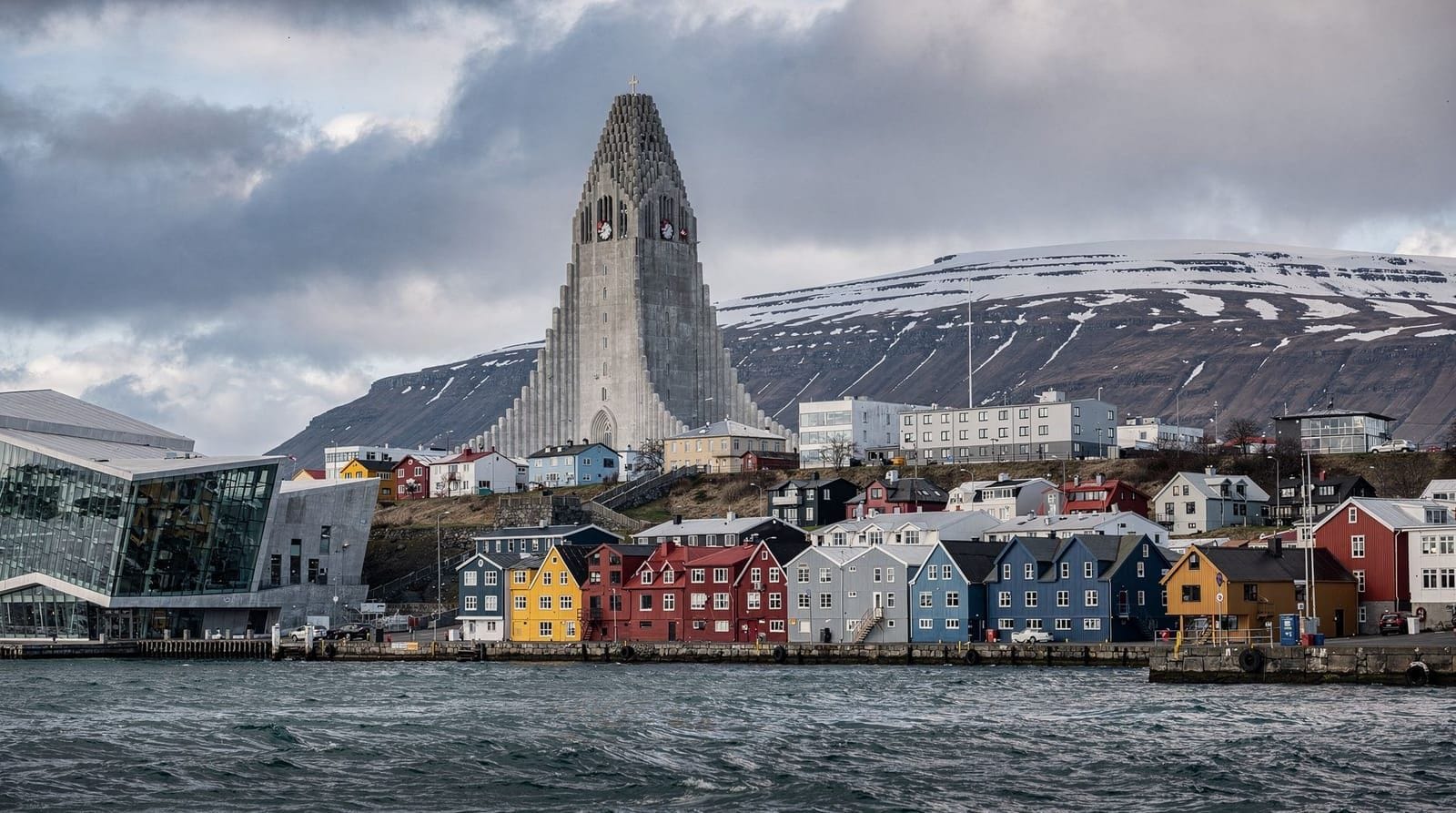
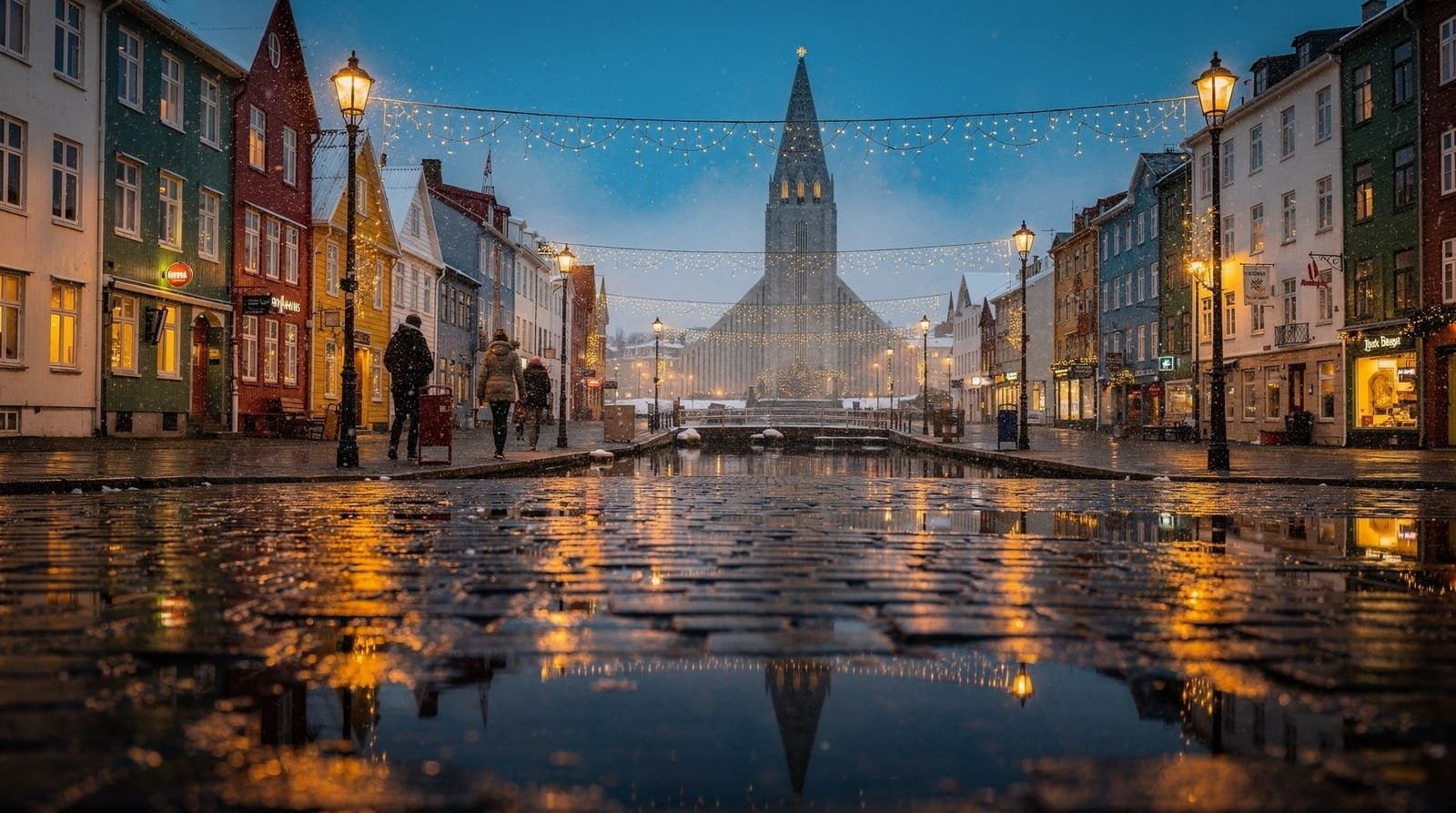
The best elevated positions for midnight are the hill above Hallgrímskirkja church (Skólavörðuhæð), the Öskjuhlíð hill near the Perlan building, and the Seltjarnarnes peninsula to the west of the city. All three give panoramic views over the fireworks. The Hallgrímskirkja position is most accessible and most crowded; Öskjuhlíð is less crowded and has the advantage of the Perlan dome reflecting and launching its own displays nearby.
The harbour area (the Old Harbour and the Harpa concert hall waterfront) offers reflections of the fireworks in the water, which is visually excellent. The Harpa building itself, with its glass honeycomb facade, reflects fireworks from multiple angles at once. Wind direction on the night determines whether smoke is a problem; a southerly wind pushes smoke north and clears your view, while a northerly pushes it back into the city centre.
Dress for serious cold and wind. December 31st in Reykjavík averages around -2°C to 3°C with wind chill that can bring the effective temperature to -10°C or colder. Insulated waterproof trousers, multiple layers, hand warmers, and a balaclava if you have one. This is not dressed-up New Year’s Eve weather; it is winter survival gear. I wore everything I had packed for a week of Iceland in winter and was still cold by 1 a.m.
The logistics before midnight
New Year’s Eve in Reykjavík follows a specific rhythm. Icelanders eat the traditional New Year’s dinner with family (smoked lamb, often, or ptarmigan) in the early evening. At 10 p.m. the Icelandic national broadcaster RÚV shows a comedy programme (Áramótaskaupið) that every Icelander watches and that requires understanding Icelandic cultural references to find funny. You will not understand it but you will be aware that everyone around you is thinking about it — it is referenced constantly in conversation on New Year’s Eve.
After the television programme, people go out. This means bars, house parties, and the street. The main restaurant and bar area around Laugavegur and Bankastræti fills from about 11 p.m. Bars require reservation for New Year’s Eve; if you arrive hoping to walk in, the answer will be no. Book weeks in advance. The Kaldi bar, Kaffibarinn, and Skúli Craft Bar are among the places that fill earliest.
If you are staying in Reykjavík for New Year’s specifically, accommodation in the centre books out months ahead. December in Iceland is low-tourist-season by most metrics, but New Year’s Eve is an exception. The stopover options and boutique hotels near the city centre are your best bet; budget places book first. Expect to pay 30-50% more than standard December rates for New Year’s Eve night.
If you want to understand Reykjavík’s layout, history, and neighbourhood structure before the New Year’s Eve chaos, a walking tour earlier in your stay is a useful orientation — you will navigate the bonfire sites and midnight viewpoints more confidently.
The Icelandic winter week around New Year’s
The days around New Year’s Eve in Reykjavík are among the darkest in Iceland — sunrise around 11:30 a.m., sunset around 3:30 p.m. This gives around 4 hours of daylight, most of it low-angled and golden. The quality of the winter light at midday on a clear day in late December is exceptional — everything is illuminated at a low angle for hours rather than the brief transition period in more southerly latitudes.
If you are spending a week around New Year’s, the days either side are good for day trips. The south coast in winter has Seljalandsfoss and Skógafoss with ice formations at their bases and almost no crowds. The Golden Circle in winter has Þingvellir with ice on the Öxará river and Gullfoss with snow along the canyon edges.
Northern lights viewing around New Year’s: the aurora is active in December and January, and Reykjavík in winter darkness (before the fireworks and after) provides enough darkness for sightings. The best time to see northern lights guide covers the conditions; December 31st itself is the worst night of the year for aurora viewing due to the fireworks, but December 28-30 and January 1-3 can be excellent.
The northern lights on New Year’s Eve
People ask whether northern lights are visible on New Year’s Eve. The honest answer: sometimes. The aurora requires darkness and clear sky. Reykjavík on New Year’s Eve after midnight is the least dark it will be all winter — the fireworks create a continuous artificial glow that outcompetes all but the strongest aurora. If the sky is clear and you get away from the city centre (Seltjarnarnes is far enough west to reduce the light pollution), a strong aurora can be visible above the city lights.
In my experience, New Year’s Eve is not the moment to optimise for northern lights. The fireworks and the social atmosphere are the event; the aurora is a potential bonus. For northern lights planning, the darker weeks of January and February, away from the Reykjavík glow, are better. The northern lights tours guide covers the organised options from the city.
The Christmas and New Year in Iceland guide covers the full December holiday season, including the 13 Icelandic Yule Lads tradition, which begins December 12th and delivers a different character to each of the 13 days leading to Christmas — each Yule Lad has a specific mischievous trait drawn from folklore.
The morning after
January 1st in Reykjavík is one of the quieter days of the year. Most things are closed; the city sleeps late. The streets have an impressive quantity of spent firework casings and paper. The bakeries that open do a lively trade — Brauð and Co. on Frakkastígur and Sandholt on Laugavegur both open on New Year’s morning and the queues form quickly.
This is a good day to drive south if you have a car — the south coast in January is often windy and grey but completely uncrowded. Seljalandsfoss and Skógafoss with ice forming at their bases and no other visitors is a significantly different experience from July. The drive on Route 1 in January morning light, with the mountains to the north and the sea to the south, is one of the quietly good things about Iceland in the depth of winter.
If you are flying home, note that Keflavík Airport on January 1st has full security queues from 7 a.m. and the mood is uniformly exhausted. Arrive early.
Was it worth coming specifically for New Year’s?
Yes, without qualification. The Reykjavík New Year’s Eve experience is genuinely not replicable elsewhere. The bonfire tradition, the civilian fireworks spectacle, the specific atmosphere of a small city going collectively enormous — it has a character that is distinctly Icelandic and that is impossible to adequately describe. You have to be inside it.
Choosing a viewpoint: the trade-offs
Not all vantage points give the same night. Here’s how the main options compare.
| Viewpoint | Crowd level | View quality | Smoke risk |
|---|---|---|---|
| Skólavörðuhæð (Hallgrímskirkja hill) | Very crowded | Panoramic, central | Moderate |
| Öskjuhlíð (near Perlan) | Moderate | Panoramic, Perlan reflections | Lower, more open |
| Seltjarnarnes peninsula | Light | Wide but more distant | Depends on wind |
| Old Harbour / Harpa waterfront | Moderate | Water reflections | Moderate |
Wind direction on the night is the wildcard that no viewpoint fully escapes — check the forecast that afternoon and be ready to shift plans if smoke is blowing into your chosen spot.
Safety notes worth taking seriously
The scale of civilian fireworks means this isn’t a passive spectator event in the way a professional display is. A few things worth knowing before you go: wear closed shoes, avoid standing directly beneath launch trajectories near residential streets, and keep young children close — the noise level alone can be startling for anyone unprepared for it. Eye protection (even sunglasses) is a reasonable precaution if you plan to be at ground level in a residential neighbourhood rather than an elevated viewpoint. Officially organised viewpoints away from launch sites, like Öskjuhlíð, are the more comfortable option if the intensity of being “inside” the fireworks sounds overwhelming rather than exciting.
Come warm and come with no plans for January 1st.