Iceland with a toddler: what worked, what didn't, what we'd do differently
Why we went with a 22-month-old
The honest answer: we had flights booked before our son Nico was born and he arrived before we’d used them. The practical answer: Iceland is one of the more accessible international destinations for small children, once you understand which version of Iceland to do with them.
We went for eight days in early March 2024, focused on the south coast between Reykjavik and Jökulsárlón. No highlands (inaccessible in March), no extreme hikes, no whale watching (we decided the cold and motion were too unpredictable for a toddler). The plan was waterfalls, geothermal pools, sea views, and short walks with a pushchair or carrier.
Here is what actually happened.
| Where | South coast, Reykjavik to Jökulsárlón |
| Trip length | 8 days |
| Max driving per day | 4–5 hours, not more |
| Accommodation | Self-catering apartments, around 18,000–28,000 ISK/night |
| Best season for toddlers | May–June (light, milder, fewer wind days than March) |
The things that worked
Waterfalls: Nico loved every waterfall we visited without qualification. Seljalandsfoss especially — the spray and noise were apparently the correct combination of exciting and overwhelming. He stood pointing at Skógafoss for 10 minutes without moving, which is unprecedented attention span. Iceland’s waterfalls are accessible for small children: most have flat paths from car parks to good viewing positions.
The hot pool: We took Nico to the Secret Lagoon in Flúðir. The water temperature is around 38°C — slightly warm for a toddler, but we kept him in the shallower entry sections and he was delighted. Entry for children under 14 is free; adult admission is ISK 3,500. We stayed about 45 minutes, which was long enough. The Secret Lagoon’s informal atmosphere (no luxury infrastructure, no crowds) worked better for us with a toddler than the Blue Lagoon would have.
Short car drives: Iceland’s south coast is relatively compact. We never drove more than 90 minutes without a stop, which Nico’s threshold required. The route from Reykjavik to Vík has waterfalls roughly every 30–40 minutes of driving, which conveniently aligned with his attention span.
Supermarket picnics: We ate in the car with Bónus groceries approximately five times. Nico ate bread and cheese and skyr with no complaints. This saved roughly €30–40 per meal compared to restaurant dining with an unpredictable small person, and avoided situations where he decided to melt down at 5:30 pm in a restaurant in Vík.
The rental car: We rented a Toyota RAV4 with a proper seat runner that fit our car seat without modification. Check this before arriving — Icelandic rental companies generally have modern fleets but it’s worth confirming ISOFIX compatibility when booking.
The things that didn’t work
Long driving days: We tried to do the ring road section from Vík to Jökulsárlón in one day. It’s about 280 km with stops, and with Nico’s nap schedule, feeding stops, and a couple of unexpected long stops for interesting roadside things, it took 9 hours. This was too much. The following day, he refused to get in the car seat for 25 minutes. We learned: cap driving days at 4–5 hours maximum with a toddler.
Evening activities: Two nights we’d booked a northern lights tour for after his bedtime, planning to let him sleep in the carrier. This worked once (he slept through the entire drive and northern lights viewing). The second night he absolutely refused to sleep and spent the aurora tour crying, which made the experience somewhat limited for everyone including the other tour participants.
Black sand beaches: Reynisfjara was our one genuine safety concern. The sneaker wave warning signs are serious. With a toddler who can move quickly and unpredictably toward anything interesting, keeping him safely away from the water on a wave-prone beach required continuous two-adult supervision and was exhausting. We kept the visit to 20 minutes and stayed well above the wave zone.
Wind: March in Iceland regularly produces 50–70 km/h gusts. A 22-month-old in a carrier in 60 km/h wind is fine but extremely unhappy. A 22-month-old being held at a viewpoint in 60 km/h wind is a genuine safety concern. We cancelled one planned stop near Dyrholaey because the exposed promontory viewpoint had gusts we weren’t comfortable navigating with him.
Accommodation
We chose self-catering apartments over hotel rooms. A room with a kitchen allows you to cook toddler food at toddler times, store breast milk or formula, and do a small load of laundry midweek. We found apartments through Airbnb and Booking.com ranging from ISK 18,000–28,000 per night (€113–175) — comparable to hotel rooms but with significantly better functionality for a family.
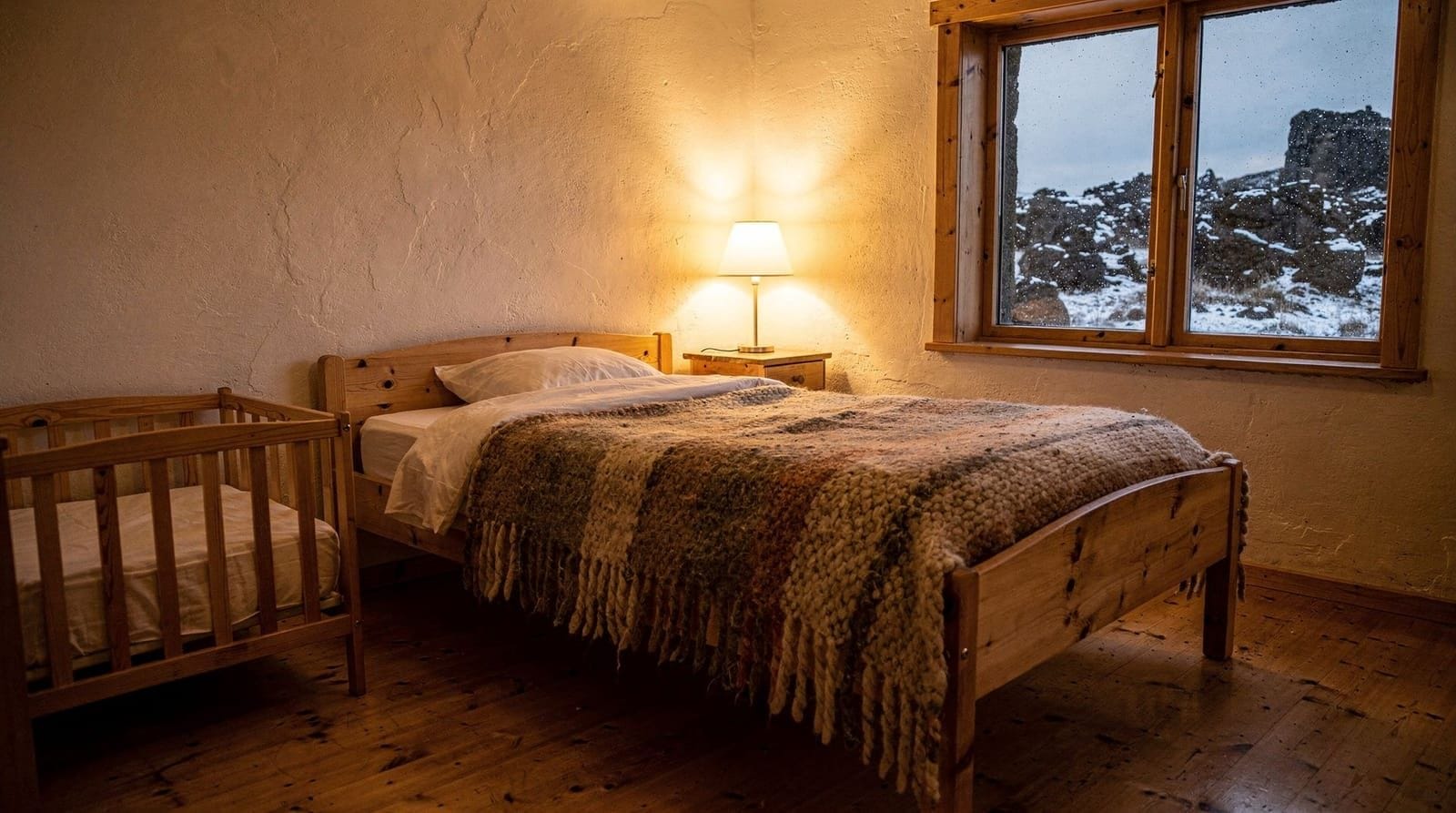
All the properties we used had travel cots available (called “ferðarúm” in Icelandic). Book these in advance — not all properties have them.
The one night we stayed in a standard hotel room (no kitchen, no travel cot booked in advance) was our worst night. We improvised a sleeping arrangement from couch cushions and experienced the particular pleasure of a toddler awake at 3 am in a single room with nowhere to retreat.
Food for a picky 22-month-old
Skyr was the revelation. Nico ate skyr at every meal of every day in Iceland with enthusiasm that exceeded his enthusiasm for anything except the waterfalls. The Bónus 150g cups (ISK 160–200 each) became breakfast, afternoon snack, and emergency dessert. Bring more skyr than you think you need.
Icelandic bread (rye flatbread, “flatkaka”) was accepted. Icelandic cheese was accepted. Dried fish snacks from petrol station grab-bags were not accepted and will not be discussed further.
Restaurant meals: we had four proper restaurant meals. Two were easy (Nico ate fish soup with a spoon, was cooperative, slept in the carrier). Two were difficult. The restaurant at Hótel Vík with its nice views was one of the difficult ones: he decided 10 minutes in that he wanted to be held the entire time, ruling out us eating with two hands. We rotated eating and holding. It worked, in the way that parenting in public “works.”
What we’d do differently
Keep the itinerary shorter and slower. We were ambitious and did more driving than was sensible for a toddler. Eight days felt right as a total duration, but I’d reduce the driving ambition by about 30% — fewer total kilometres, more time at each stop.
Travel in May or June rather than March. Warmer and lighter evenings mean more flexibility with outdoor time. March offered the possibility of northern lights (we saw them once, faintly) but the cold and short days made some of the outdoor experiences harder.
Bring: a lightweight travel carrier for short walks (we used an Ergobaby Omni, excellent), a portable white noise machine for naptime in the car, and snacks that are not identical to snacks from home (novelty has leverage over a toddler).
Iceland is actually quite good for toddlers in terms of infrastructure — nappy changing facilities in most petrol stations, cafés that are accustomed to families, car park distances that aren’t enormous. The waterfalls require no expertise to visit. The Iceland with kids guide has a broader overview for different ages.
Specific practical notes for travelling with a toddler
Car seat at the rental desk: Specify your car seat type (Group 1/2/3 or weight class) and the required ISOFIX anchors when booking. Icelandic rental companies generally have modern cars, but confirming compatibility before you arrive prevents a frustrating 45-minute delay at the rental counter while they find a compatible vehicle. Some companies offer car seat rental for ISK 2,000–3,000/week, which removes the need to bring your own on the plane.
Food storage in the car: Most rental cars don’t have refrigerators. A small cooler bag with an ice block from a Bónus supermarket kept Nico’s dairy food adequately cold for 6–8 hours. Restocking ice every morning at a petrol station or supermarket became part of the daily routine.
Nappy disposal: Petrol stations in Iceland have large outdoor bins. Do not leave nappies at viewpoints, car parks, or nature sites — this is explicitly prohibited in Iceland’s outdoor access legislation and visually obvious when it happens. Sealed bag in the car, bin at the next petrol station.
Emergency supplies: We carried a first aid kit, children’s paracetamol (Þristur/Tylenol equivalent available at Lyf og heilsa pharmacy in any medium-sized town), rehydration sachets, and a digital thermometer. We needed the paracetamol once when Nico developed an ear infection near Höfn. The Neyðarlínan (emergency number 112) and the Heilsugæslan (primary health service) both have English speakers; the primary health clinic in Höfn saw us within 90 minutes.
Pushchair vs carrier: We had both. The pushchair (a travel-compact model) was useful in Reykjavik on flat pavements and in car parks. For anything approaching a trail, it was useless — Icelandic gravel paths are not pushchair-compatible. The carrier (soft-structured, front and back carry) was essential for the actual Iceland experiences. Pack a carrier regardless of whether you usually use a pushchair at home.
Swimming pools as a lifesaver: The public geothermal pools aren’t just for adults. Laugardalslaug in Reykjavik has a shallow paddling pool (temperature around 34°C) specifically for small children. Nico spent 40 minutes in it on a rainy Monday. Entry for children under 6 is free at most Icelandic pools. We used the pool routine as an afternoon reset on difficult days.
For more family logistics, the Iceland with kids guide covers ages from baby to teenager. The Iceland with a baby guide has infant-specific detail. The family Iceland itinerary structures a week around family-accessible activities.
The indoor backup plan for bad-weather days
We built in one flexible indoor day, and it was worth it. On our windiest afternoon, we skipped the outdoor plan entirely and went to Perlan in Reykjavik — the dome building above the city with an indoor ice cave exhibition and a planetarium show. Nico was fascinated by the ice cave’s cold air and lights; the planetarium show was too long and too dark for him at 22 months, and we left halfway through without regret. Budget an hour there rather than the full two.
Perlan’s Wonders of Iceland ticket covers the ice cave and exhibitions — a solid wet-weather fallback with a toddler when the outdoor plan isn’t safe.How the itinerary would change by age
Our south-coast, slow-paced approach was specifically calibrated for a 22-month-old. It wouldn’t be the right shape for every age.
| Age | What changes | Best regions |
|---|---|---|
| Under 12 months | Shorter days, more feeding/nap stops, avoid highland roads | South coast, Reykjavik |
| 1–3 years (our trip) | Cap driving at 4–5 hrs, skip black sand beach risk zones, pools as reset | South coast, Golden Circle |
| 4–7 years | Can handle Ring Road pacing, short easy hikes, glacier walks with guides | Ring Road, Snæfellsnes |
| 8+ years | Highlands, longer hikes, whale watching becomes realistic | Full ring road, Westfjords |
The family Iceland itinerary is built around the 4–7 age range; adjust the driving distances down if your children are younger, as we learned the hard way on the Vík–Jökulsárlón day.
We came back with a toddler who says “waterfall” with genuine feeling and a plan to return when he’s old enough to hike.