Scuba diving Silfra — what divers need to know
Reykjavik: Diving Silfra day tour
Can I scuba dive in Silfra without a drysuit certification?
Most operators require only an Open Water certification (or equivalent) plus drysuit experience or willingness to do a brief drysuit orientation before the dive. You do not need a separate drysuit certification card in most cases, though some operators prefer it. Confirm requirements when booking.
Silfra for divers — why it’s different
Most iconic dive sites derive their status from marine biodiversity — coral systems, pelagic species, shipwrecks. Silfra’s status derives from geology and water physics alone, and this makes it unusual in the world of recognised diving destinations.
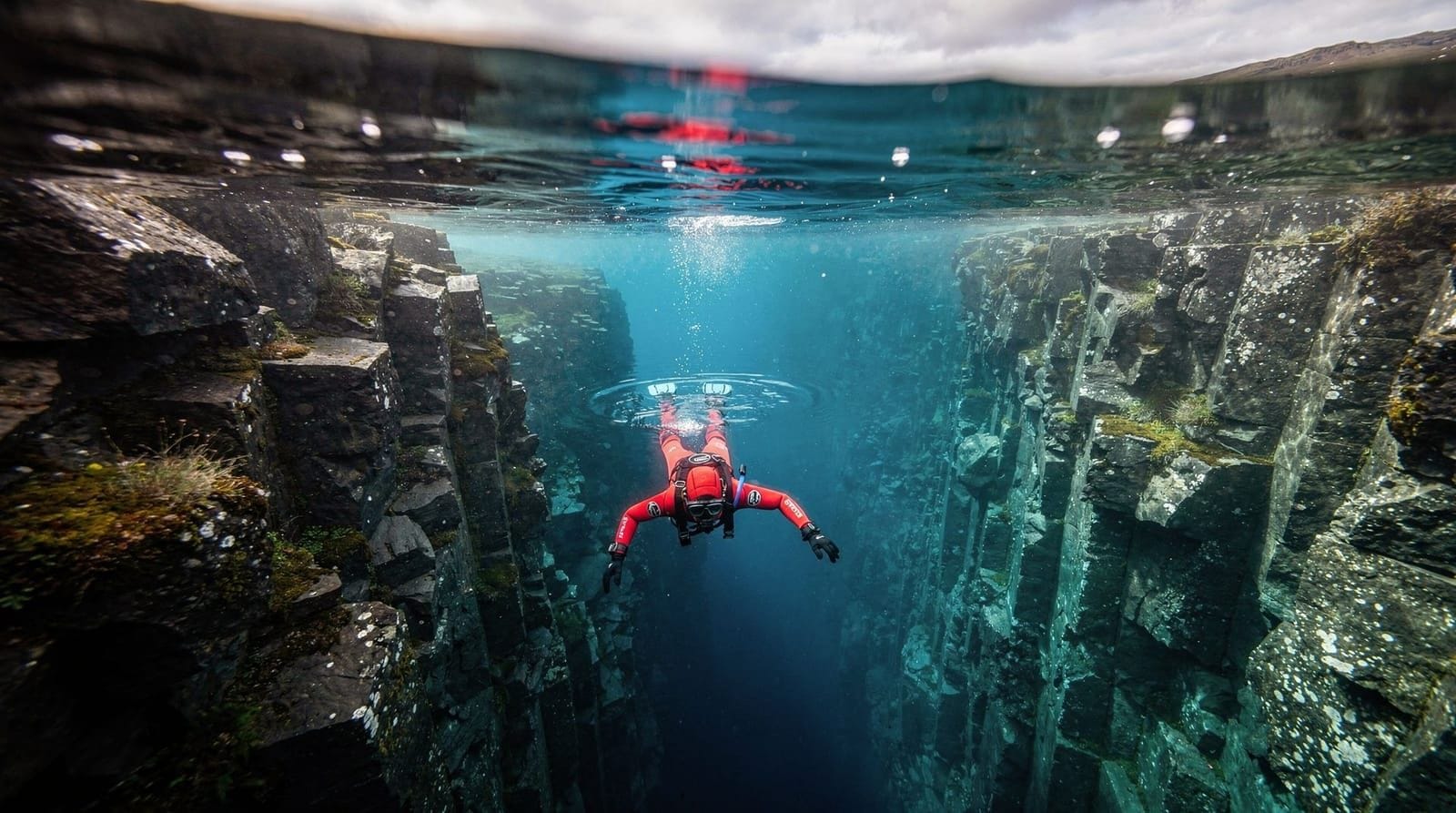
The fissure sits in Þingvellir National Park, directly on the diverging boundary between the North American and Eurasian tectonic plates. Divers enter where the surface snorkeling section begins and can descend into the narrowing fissure below — the same gap that separates two continental plates, negotiable from the inside. The water is glacial meltwater, filtered for decades through lava rock to a clarity that exceeds most Caribbean sites.
For experienced divers seeking something genuinely unusual, Silfra delivers consistently. For those primarily interested in fish and reef life, it will be disappointing.
| Where | Þingvellir National Park, ~50 min from Reykjavík |
| Certification needed | Open Water (or equivalent) plus drysuit orientation |
| Water temperature | 2–4°C year-round |
| Time on-site | around 3.5–4.5 hours including gear-up and orientation |
| Best time | Year-round — conditions barely change by season |
The dive itself
The entry is a short ladder descent from the concrete platform at the Silfra parking area. You enter into Silfra Hall — the wide, shallow entry section about 4–8 metres deep, covered in vivid green silkweed algae. The visibility is immediately apparent: you can see 50–80 metres horizontally from the entry point.
As you drift through Silfra Hall (there’s a very slight current in some sections, almost imperceptible), the fissure deepens and you can descend toward Silfra Cathedral — a wider section where the depth reaches 22–25 metres at the base. The walls of the fissure are the North American plate to your left and the Eurasian plate to your right; the gap at depth narrows to less than a metre in places.
Light quality at depth is exceptional. The turquoise-to-blue colour gradient from surface to 20 metres is one of those underwater visuals that no amount of description captures accurately. Divers routinely report it as the most distinctive colour they’ve experienced underwater.
The dive ends at Silfra Lagoon, where you surface and exit via a ramp. Guides typically collect divers here if the exit process requires assistance in the drysuit.
Diving Silfra day tour (from Þingvellir or Reykjavík)
Cold water reality
The most significant challenge at Silfra is the 2–4°C water temperature. This is colder than recreational diving in most destinations and requires a well-sealed drysuit. The difference between drysuit and wetsuit is absolute: a drysuit keeps you completely dry (air layer inside provides insulation), while a wetsuit relies on a thin water layer for insulation that provides meaningless protection at these temperatures.
For drysuit-experienced divers: Silfra is comfortable and relatively straightforward. Buoyancy control in a drysuit differs slightly from a wetsuit (you adjust air in the suit as well as the BCD), but experienced drysuit divers adapt quickly.
For open-water divers without drysuit experience: Operators provide an on-site orientation, typically 20–30 minutes of shallow-water practice in the lagoon before the main dive. This is usually sufficient for confident open-water divers. If you’ve never dived cold water, the cold shock during initial submersion — your face in 3°C water — requires a moment of mental adjustment.
Air consumption: Cold increases air consumption, and drysuit management (adding/releasing air to maintain buoyancy) adds complexity. Conservative gas planning is essential; Silfra isn’t the dive to push no-decompression limits.
Equipment provided vs. your own kit
Operators provide:
- Drysuit (various sizes; confirm availability for non-standard body types)
- Undersuit (thermal insulation layer)
- Tanks and weights
- Regulators (cold-water specific — important, as standard regulators can free-flow at 2–4°C)
- Hood and gloves
Most operators allow:
- Personal BCD (if cold-water appropriate)
- Personal dive computer
- Personal camera (housing required)
Operators typically do not allow:
- Standard regulators designed for tropical temperatures (freeze risk)
- Personal tanks
Getting a drysuit orientation
If you don’t have drysuit experience, contact your operator before booking to confirm they offer orientation. Reputable Silfra dive operators (DIVE.IS, Arctic Adventures Dive, Scuba Iceland) all provide this. A brief orientation covers:
- Drysuit donning and sealing procedure
- Inflation and deflation valves
- Buoyancy control with the drysuit vs. BCD
- Emergency procedures (primarily: if the suit floods, surface immediately via BCD)
The orientation typically happens in Silfra Lagoon (shallow, calm water) before the main dive. Most open-water divers with good buoyancy skills find drysuit adaptation straightforward in these conditions.
Silfra fissure diving with optional pickup from Reykjavík
Planning around Þingvellir
Þingvellir is approximately 45 km north-east of Reykjavík on Route 36 — roughly 50 minutes’ drive. It’s the first stop on the standard Golden Circle day trip, making it easy to combine diving with a broader sightseeing day. However, a full Silfra dive takes half a day minimum (equipment setup, orientation, dive, change), so combining it with a full Golden Circle is rushed.
Most serious dive trips to Silfra are self-contained: drive to Þingvellir, dive, have lunch in the national park area, and return to Reykjavík. This takes about 5–6 hours total.
Silfra dive logistics
Parking: Pay at the Þingvellir parking machines (750 ISK / approximately €5 per car). The Silfra dive entry point is a short walk from the main Silfra parking area.
What to bring: Swimwear (worn under the drysuit), a change of dry clothes, towel, warm drink in a thermos (appreciated after the dive), and any personal dive equipment (computer, mask if preferred).
What operators provide: All necessary equipment (see above). Hot drinks are sometimes provided post-dive; check when booking.
Duration on-site: 3.5–4.5 hours typically, including gear-up, orientation (if needed), briefing, dive, exit, and changing.
How diving compares to snorkeling
For certified divers, the diving experience is definitively superior. The reasons:
-
Depth access: You see the Cathedral section from below rather than looking down. The narrowing of the fissure at depth, with the two tectonic plates visible on each side, is the defining image of Silfra.
-
Colour gradient: The blue transition from surface turquoise to deep blue as you descend is not visible from the surface.
-
Spatial awareness: Floating neutrally buoyant in the 3D space of the fissure, surrounded by 100-metre visibility, is a sensory experience that snorkeling can’t replicate.
-
More time: Diving gives more time in the water to process the environment.
Snorkeling is worth doing if you’re not certified — the surface visual is still extraordinary. But don’t turn down a diving opportunity at Silfra based on budget or convenience if you’re a certified diver.
The geology you’re diving through
Understanding what Silfra actually is makes the dive more meaningful. The fissure sits directly on the Mid-Atlantic Ridge — the divergent boundary where the North American tectonic plate is separating from the Eurasian plate. Iceland sits atop the ridge because the ridge here intersects a volcanic hot spot, producing the continuous eruptions that built and maintain the island.
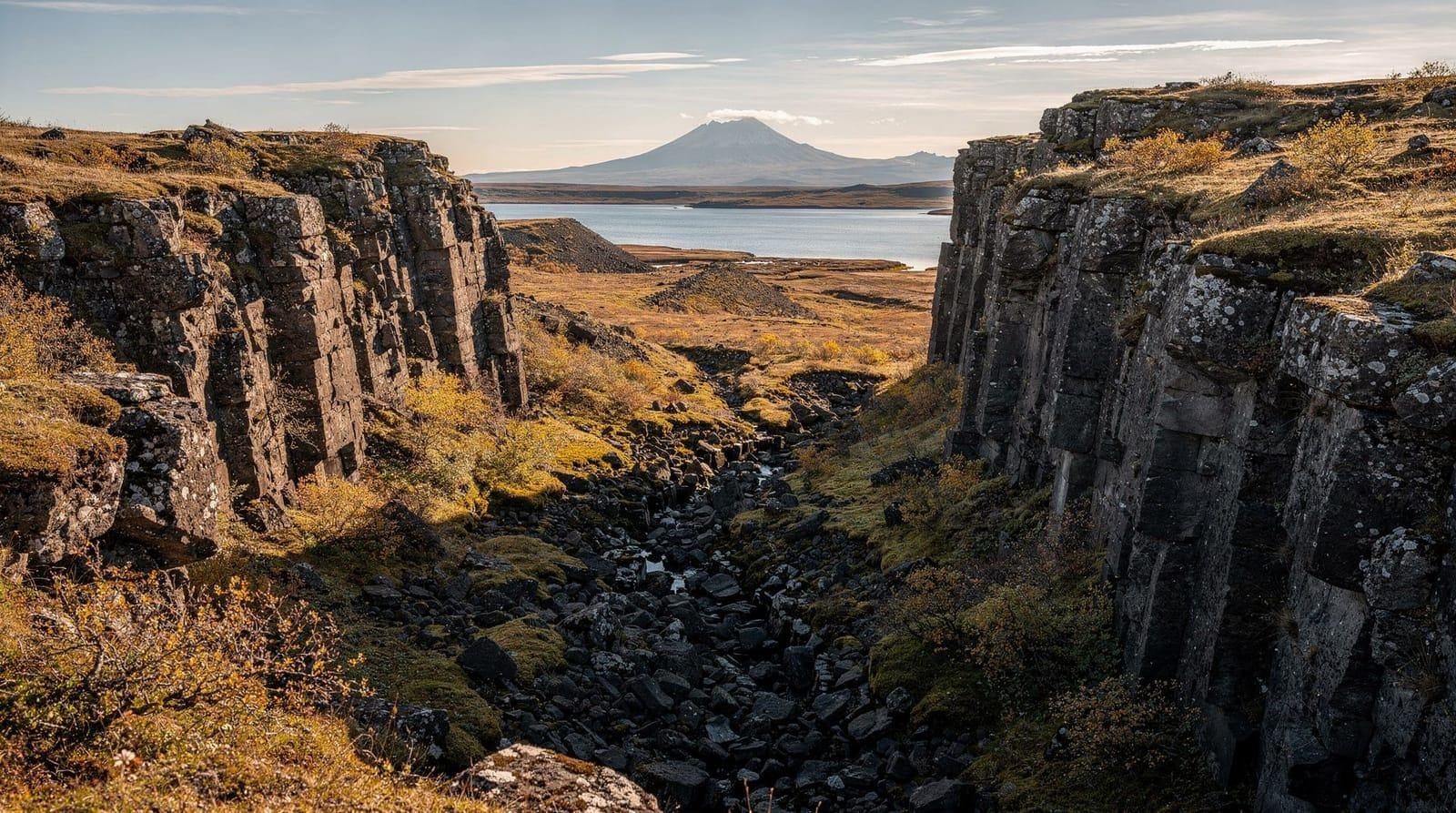
Þingvellir’s entire landscape is shaped by this divergence. The lake (Þingvallavatn) fills a graben — a valley that has sunk as the plates pull apart. The lava walls visible on either side of the national park mark the outer limits of the rift zone. Silfra is one point where you can physically touch both plates from the water.
The water itself is meltwater from Langjökull glacier, roughly 50 km to the north-east. It seeps through the porous lava rock of the highlands over an estimated 30–100 years, filtering to extraordinary purity in the process. The flow rate into Silfra is roughly constant — there is a very slight current moving from Silfra Hall toward the Lagoon, perceptible as a gentle push at around 0.5–1 km/h.
The lava rock that forms the fissure walls is basalt — the same material as most of Iceland’s volcanic rock. In some sections of the dive, you can see the structure of individual lava flows, identifying boundaries where one eruption ended and the next began. The algae (drowned cat-tail algae, Tolypella nidifica) that covers sections of the floor is cold-adapted and unique to glacial water environments.
Dive sites comparison: why Silfra ranks globally
Silfra consistently appears in international dive media “top 10” lists. Understanding why requires comparing it to more mainstream acclaimed dive sites:
Versus tropical sites (Great Barrier Reef, Maldives): Far less biodiversity — no fish, no coral, no pelagic species. The attraction is purely geological and optical. Silfra wins on water clarity (100+ metres vs. 30–50 metres at most tropical sites) and geological uniqueness.
Versus other cold-water sites (Norwegian fjords, British Columbia): Norway’s fjords have better marine life diversity and dramatic underwater topography but lower visibility. British Columbia’s Emerald Sea is exceptional for kelp forest diving. Silfra’s visibility and the tectonic context are unmatched.
Versus other freshwater sites: Cenote diving in Mexico’s Yucatán has comparable clarity in some caves and more complex geometry. Both are extraordinary freshwater diving environments. Silfra is simpler in structure but unique in geological context.
The consistent ranking comes down to the combination of: extreme clarity, unique setting, accessible depth, and the literal-but-true claim of diving between continents.
Photography specifics for Silfra diving
If you’re bringing a camera, specific considerations apply:
Housing: Your camera requires a waterproof housing rated to at least 30 metres (exceeding the actual maximum depth for safety margin). Housings for Sony, Canon, Nikon, GoPro, and Olympus TG series cameras all work. The Olympus Tough series (built-in waterproofing to 15 metres, housing extends this) is popular for its compact size.
Wide angle: The single most important lens choice. A 16mm (full-frame) or 10–16mm (APS-C) captures the fissure walls and the sense of space. Standard kit lenses at minimum focal length are adequate but miss some of the grandeur.
White balance: Auto white balance works poorly in blue-dominated underwater environments. Setting white balance manually to around 6000–7000K provides more accurate colour. Alternatively, shoot RAW and correct in post.
The silkweed section: The vivid green algae in Silfra Hall photographs best with a slight upward angle — backlighting from above creates contrast between the green algae and the blue water column. Overexposed shots of this section are common; bracket your exposure.
Light levels: Despite the clarity, light levels drop significantly below 10 metres. At 20 metres, you’ll need ISO 400–800 even at f/2.8. Strobes are permitted but rarely necessary in Silfra — the ambient light is sufficient for most photography.
Iceland’s other dive sites — context for Silfra
Silfra is far and away Iceland’s most famous dive site, but it’s worth knowing the broader context for divers who want to explore more:
Þingvallavatn lake: The lake that Silfra drains into is also dived. Visibility isn’t as extreme as Silfra itself, but the lake has species of interest — particularly the Þingvallavatn charr, a unique landlocked subspecies of Arctic charr. Several dive sites around the lake’s margins offer different experiences.
Strytan hydrothermal chimney (north Iceland): In Eyjafjörður near Akureyri, a hydrothermal chimney rises 55 metres from the seabed to about 15 metres from the surface. Unlike most hydrothermal vents (deep sea), this one is diveable in the recreational depth range. Water temperature at the vent is higher than the surrounding fjord. A niche but legitimate dive site for those visiting north Iceland.
Reykjanes Peninsula marine sites: Several sites near Reykjanes offer dives in the Atlantic — kelp forests, echinoderms, and cold-water fish species. Visibility is good on calm days. The cold North Atlantic water (4–10°C year-round) requires drysuit capability. Less visited by tourist divers than Silfra due to the need for ocean experience.
For most visiting divers: Silfra is the reason to dive in Iceland, and it stands on its own merits without needing other sites to justify the trip. A dedicated dive trip to Iceland built around 2–3 days of Silfra diving (morning and afternoon sessions on separate days) is how serious divers approach it.
Post-dive recovery and logistics
After Silfra diving, your body has been stressed by cold exposure regardless of how comfortable you felt in the water. Practical considerations:
Warm up properly: Change out of the drysuit and into dry, warm clothes immediately after exiting. Don’t attempt to squeeze another activity before warming up fully — your core temperature has dropped even in a well-fitted drysuit.
Hydration: Cold water diving is dehydrating. Drink warm fluids (the thermos you brought) before driving or continuing the day.
No flying for 12–18 hours after diving: Standard diving guidelines for nitrogen offgassing apply to Silfra despite it being freshwater diving (the decompression physics are the same). If flying out of Iceland the same evening as your Silfra dive, schedule the dive in the morning with an afternoon flight.
Muscle soreness: First-time drysuit divers often experience unusual muscle soreness the following day from maintaining buoyancy with an unfamiliar suit and the continuous slight tension of the unfamiliar posture. This is normal and resolves in a day.
The Blue Lagoon after Silfra: Some visitors plan to visit the Blue Lagoon after Silfra on the way back to Reykjavík — the warm geothermal water after the cold dive is a compelling sequence. The Blue Lagoon is accessible from Route 41 on the way back from Þingvellir. However, this is a long day (Silfra + Blue Lagoon + Reykjavík is 6–7 hours). The warm water contrast is pleasant but the body may appreciate rest more than a crowded lagoon.
Booking logistics and what actually costs what
A dedicated Silfra dive typically runs ISK 45,000–65,000 per person for the dive itself (equipment, guide, permit fee), not including transport from Reykjavík if you need it. Operators who offer pickup add a transfer fee or bundle it into a slightly higher package price — worth comparing against arranging your own rental car for the drive, especially if you’re already planning a Golden Circle day and can self-drive to Þingvellir regardless.
Group size: Most operators cap dive groups at 2–4 divers per guide, smaller than the snorkeling groups (often 8–12). This is partly a safety requirement given the drysuit orientation needs of some divers, and partly because the Cathedral section is narrow enough that large groups create queuing underwater.
Booking lead time: In July–August, popular morning slots can book out 1–2 weeks ahead. Shoulder season and winter are far more flexible, often bookable within a few days.
Cancellation policy: Most operators cancel or reschedule for lightning, extreme wind, or (rarely) water clarity issues from heavy rain runoff. Check the specific operator’s weather cancellation policy before booking a tight-schedule day.
What’s not included: Þingvellir’s parking fee (around 750 ISK) is typically separate from the dive package and paid directly at the national park’s machines. Lunch and any accommodation are also separate — most dive trips are structured as a half-day excursion that fits around a broader Golden Circle or Reykjavík day rather than a standalone full package.
Diving Silfra day tour (from Þingvellir or Reykjavík)
Silfra for non-certified divers: the Try Dive question
Some travellers without any diving certification ask whether they can experience Silfra at depth regardless. The honest answer: no legitimate operator offers a “discover scuba” or try-dive product at Silfra specifically, because the cold water and drysuit skills required make it unsuitable as a first-ever dive experience. This differs from tropical destinations where resort try-dives are common in warm, forgiving conditions.
If you are not certified but want the Silfra experience, snorkeling is the honest alternative — see snorkeling Silfra for the full comparison. If you want to get certified specifically so you can dive Silfra on a future trip, an Open Water course completed at home before travelling (rather than in Iceland’s cold water) is the more practical and cheaper route; Icelandic dive centres do not typically run beginner open-water certification courses in Silfra’s conditions.
Frequently asked questions about scuba diving Silfra
Is Silfra suitable for beginner divers?
With open-water certification and a proper drysuit orientation, yes — the conditions are benign (no current, no surge, clear visibility). However, cold-water experience is genuinely useful. If you’re a newly certified open-water diver with limited dives, you’ll still get into the water, but anxious divers may find managing a new drysuit in cold water adds stress. More experienced divers appreciate the experience more.
Can I freedive at Silfra?
Freediving in Silfra is not commercially offered and independent access is prohibited. All entry requires a licensed operator. Some operators may offer freediving specifically — enquire directly if this interests you.
What is the maximum depth at Silfra?
The Cathedral section reaches 22–25 metres. The dive is well within recreational limits. The lagoon area is extremely shallow (1–3 metres) and serves as the calm exit zone.
Is visibility actually 100 metres?
Horizontal visibility is often reported at 80–100+ metres and sometimes quoted higher. This is genuine — the water clarity is extraordinary. Visibility varies slightly with algae growth in spring (April–May). Winter visibility tends to be at its clearest.
Can I dive Silfra in winter?
Yes, year-round. Conditions are consistent in all seasons since the water temperature doesn’t change. Winter diving means shorter days and often better surface conditions (fewer visitors). Some divers prefer winter for the solitude.
Do I need dive insurance for Silfra?
Standard dive insurance (DAN or equivalent) is strongly recommended for any diving trip. Cold water and drysuit diving add marginal complexity compared to tropical diving. The Reykjavík hospital (Landspítali) handles dive emergencies, and the nearest decompression chamber for serious incidents is in Reykjavík.
How much does diving Silfra cost compared to snorkeling?
Diving typically costs roughly 1.5–2x a snorkeling tour, reflecting the additional equipment (drysuit, tank, regulator, weights) and the smaller guide-to-diver ratio required. For certified divers, the extra cost is generally considered worthwhile given the qualitatively different experience of seeing the Cathedral section from below.
Can I book a Try Dive or beginner course to dive Silfra without prior certification?
No — no reputable operator offers this at Silfra specifically, because the cold water and drysuit requirements make it unsuitable as anyone’s first-ever dive. Get Open Water certified before your trip (ideally in warmer home-country conditions) if you want to dive Silfra, or choose snorkeling Silfra instead, which requires no certification.
Top experiences
Bookable activities with verified prices and instant confirmation on GetYourGuide.
Top experiences
Best-rated activities across GetYourGuide and Viator.

Ice Cave by Katla Volcano Super Jeep Tour from Vik
- Viator

Sólheimajökull Glacier Hike – Adventure in a Small Group
- Viator

Ice Cave Tour from Vík
- Viator

Blue Ice Discovery – Guided Glacier Hike from Skaftafell
- Viator

Glacier Hike from Skaftafell - Extra Small Group
- Viator

East Glacial River – Grade 4 Rafting with Drysuits, North Iceland
- Viator