Golden Circle day tour: honest review for 2026
Reykjavik: From Reykjavik Golden Circle full day guided trip
The Golden Circle is Iceland’s best-known day trip, and for that exact reason it’s also the one where operator quality varies most. This review breaks down what a guided tour actually includes, what it costs across the different tiers, and when self-driving genuinely beats booking one.
| Where | Þingvellir, Geysir, Gullfoss — 230 km loop northeast of Reykjavik |
| Cost | ISK 12,000–25,000/person guided; roughly ISK 8,000–12,000/person self-drive |
| Time needed | Full day, 8–9 hours door to door |
| Getting there | Hotel or central pickup for tours; Route 35/37 self-drive, no 4x4 needed in summer |
| Best time | Year-round; arrive at Geysir before 9 AM or after 6 PM to dodge peak crowds |
What the Golden Circle actually is
The Golden Circle is a 230 km loop from Reykjavik that passes three of Iceland’s most-visited natural sites: Þingvellir National Park (the rift valley where the Eurasian and North American tectonic plates meet, and the site of Iceland’s original parliament), the Geysir geothermal area (where Strokkur erupts every 5–10 minutes), and Gullfoss waterfall (a double-tiered cascade on the Hvítá River). Add Kerið crater and Friðheimar greenhouse on the extended route and you have a genuinely varied day.
Tours run daily year-round. The circuit is Iceland’s most popular day trip by a wide margin — over a million visitors per year make some version of this journey.
What guided tours include (and don’t include)
A standard full-day Golden Circle tour from Reykjavik typically includes:
- Coach or minibus pickup from your hotel (or a central bus stop, depending on the operator)
- Guided commentary at each site
- Driver navigation (relevant in winter or for visitors unfamiliar with Icelandic roads)
- Drop-off back at your hotel
Not typically included:
- Kerið crater entry fee (ISK 700 per person) — some operators include this, many do not; check before booking
- Lunch — most tours stop at a cafeteria or restaurant for 30–45 minutes; you pay separately
- Friðheimar greenhouse lunch (ISK 4,500–6,500 per person if you order food)
- Gratuities for guides
How much does it cost — full picture
| Tour type | Price per person | Group size |
|---|---|---|
| Large coach | ISK 12,000–15,000 (~€79–99) | 40–50 people |
| Minibus small group | ISK 17,000–22,000 (~€112–145) | 8–19 people |
| Premium minibus | ISK 20,000–25,000 (~€132–165) | 6–12 people |
| Private guided | ISK 40,000–70,000 (~€263–460) per vehicle | 1–4 people |
Booking with Kerið entry and a sit-down lunch adds roughly ISK 5,500–7,500 per person to any of the above tiers.
Is a guided tour worth it? Honest assessment
When a guided tour makes sense:
- You do not have a driving license or prefer not to drive on Icelandic roads in winter
- This is your only day in Iceland (tour handles all logistics, including hotel pickup)
- Traveling solo — self-drive costs are less competitive for one person
- You want structured commentary: a good guide adds context to Þingvellir’s geological and historical significance that a roadside panel cannot
When to self-drive instead:
For two or more people with a license, renting a car often costs the same or less than two guided tour tickets, and you control your own schedule. The golden circle self-drive guide covers the route in detail. All roads on the standard circuit are paved Route 35 and Route 37 — no 4x4 needed in summer.
The main disadvantage of self-driving: no interpretive guide, and you have to plan your own lunch stop. Friðheimar greenhouse requires a reservation if you want to eat there.
Quality differences between operators:
Large coach tours (50-person buses) are the most affordable but the least pleasant. You spend significant time loading and unloading passengers at each site, and guide commentary competes with bus noise. The actual time spent at each stop is shorter than advertised.
Small-group tours (under 20 people, ideally under 12) are noticeably better. Guides can answer questions, you move faster between stops, and you feel less like a tourist conveyor belt.
What to expect at each stop
Þingvellir National Park (UNESCO site): Allow 45–75 minutes. The rift valley walk is flat and easy. The Öxará River gorge and the Lögberg (Law Rock) are the main viewpoints. The visitor center has decent geological context. In summer, the wildflowers on the lava field are notable. In winter, frozen cracks and frost on the birch trees. Parking costs ISK 750 at the main lot.
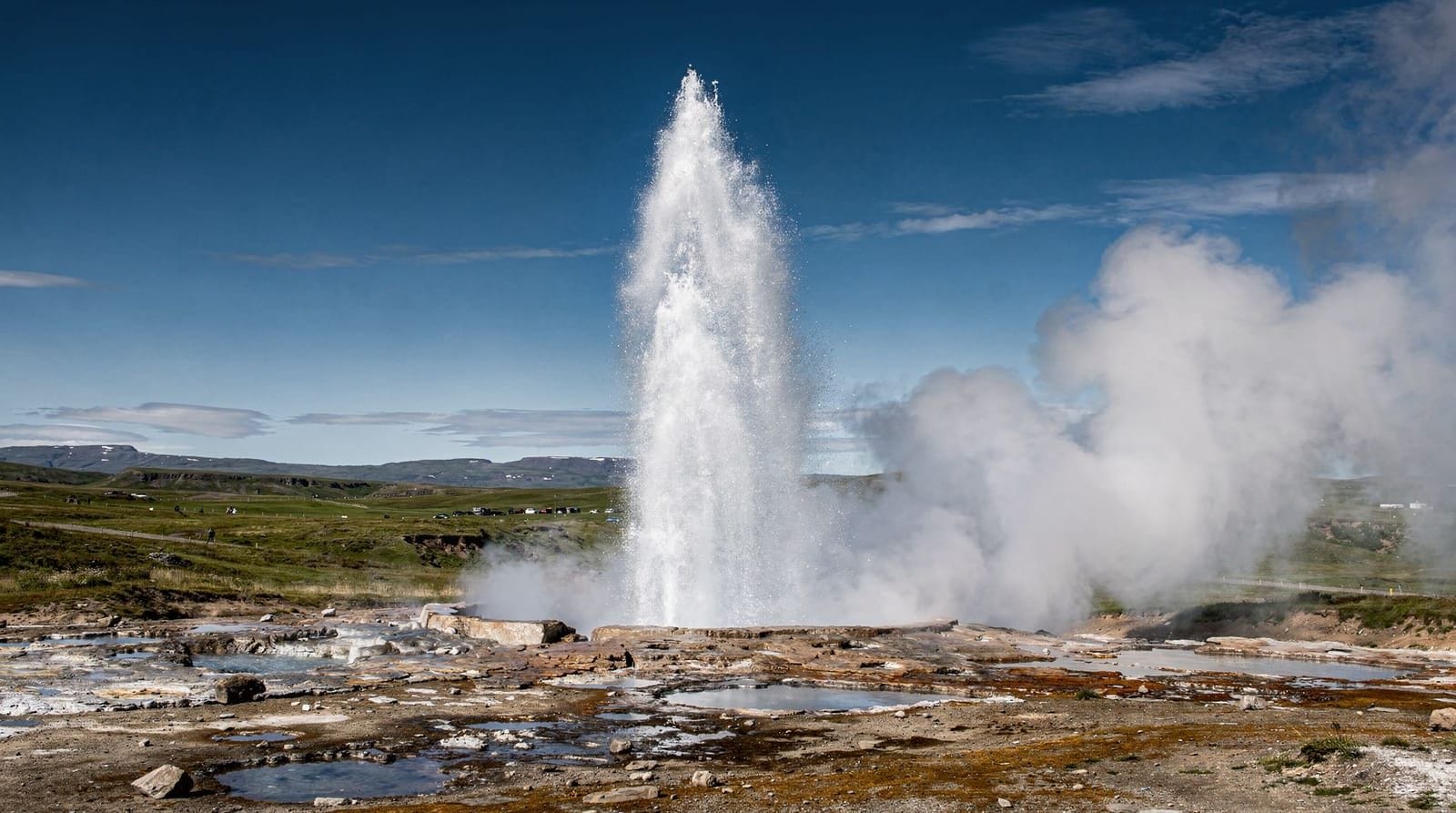
Geysir geothermal area: Allow 45–60 minutes. The original Geysir (namesake for all geysers worldwide) rarely erupts anymore. Strokkur, 50 m away, erupts reliably every 5–10 minutes to 15–30 m height. The surrounding field has boiling mud pots and steam vents — stay on the marked paths. The Geysir Center next door has an overpriced cafeteria and gift shop; Lindin Restaurant 1 km toward Gullfoss is better value for lunch.
Gullfoss waterfall: Allow 45 minutes. The path to the lower viewing platform is short and paved; the upper platform requires a short uphill walk. Both give dramatic views of the 32 m double cascade. Spray can be heavy in summer — bring a waterproof layer. The falls are illuminated by afternoon light in summer (2–4 PM is particularly good). In winter, ice formations around the edges are extraordinary.
Kerið crater (optional add-on): Allow 20–30 minutes. A 3,000-year-old explosion crater with a lake 15 m below the rim. The circuit path around the rim takes 10–15 minutes. The site is smaller than photographs suggest but genuinely colorful (red lava walls, teal water). ISK 700 entry fee applies.
Alternatives and extensions
Golden Circle plus Secret Lagoon: Adding a soak at the Secret Lagoon in Flúðir costs ISK 3,200 per person and adds about 90 minutes to the day. The lagoon is directly on the Golden Circle route, making it a natural add-on. See our golden circle and secret lagoon tour review.
Golden Circle plus Blue Lagoon: The two sites are on opposite sides of Reykjavik and combining them in one day is inefficient unless you are flying out of Keflavik afterward. Better to separate them into two days.
Golden Circle self-drive: For independent travelers, the golden circle day trip guide has everything you need to plan a self-guided circuit.
Booking and logistics
Most operators offer free cancellation up to 24 hours before departure. Book at least three to five days ahead in peak season (June–August); in winter, one to two days usually suffices.
Hotel pickup: Most Reykjavik operators offer hotel pickup within the city center. Hotels outside the central zone may require walking to a designated bus stop. Confirm this at booking.
Start times: Standard departures are 8 AM–9 AM. Tours return by 5–7 PM. Some operators offer afternoon tours (leaving 1 PM) — these cover the same sites but with better afternoon light at Gullfoss.
What to wear: Layered clothing at all times of year. Waterproof jacket essential at Gullfoss (spray zone). Non-slip shoes for the Geysir boardwalk. In winter, thermal base layers and waterproof boots.
What guides won’t tell you: the honest visitor experience
Crowds at peak season: July and August see the Golden Circle at its busiest. Geysir can have 300–400 people at the viewing area simultaneously. The Strokkur eruption every 5–10 minutes means the crowd cycles with each eruption — you wait, it erupts, everyone takes a photo, and then you wait again. Arrive at Geysir before 9 AM or after 6 PM to avoid the densest crowds.
Gullfoss parking fills by 10 AM on summer Saturdays. Tour buses park on a separate lot; the walk to the falls is 5–10 minutes from the main car park. The waterfall is big enough that crowds disperse along the viewing walkways.
Þingvellir is the least crowded of the three main sites, even in peak season. The park is large and visitors spread out across the trails.
Guide quality variability: Large-coach operators employ guides with varying quality. The best guides turn the tectonic geology at Þingvellir into a genuinely engaging story — the rift valley is widening at 2 cm per year, which is slow but measurable. The worst guides provide minimal commentary and focus on logistics. Small-group operators attract more experienced guides partly because smaller groups require more individual engagement.
The Strokkur timing disappointment: Strokkur erupts every 5–10 minutes, but the eruption itself lasts 2–3 seconds. Many visitors expect more. It erupts, you photograph it, and then it is over. Budget accordingly — plan for 20–30 minutes at the Geysir area to catch two or three eruptions from a good angle.
Weather at Gullfoss: The waterfall generates significant spray in its immediate vicinity. On windy days, this spray can travel 30–50 m and soak anyone in the lower viewing area. A waterproof jacket or poncho is not optional — it is essential at Gullfoss regardless of whether it is raining.
Golden Circle by season
| Season | Conditions | What’s different |
|---|---|---|
| Summer (Jun–Aug) | Long daylight, mild temps | Biggest crowds; consider an afternoon or evening departure |
| Autumn (Sep–Oct) | Cooler, shorter days | Fewer buses at Geysir; good light for photos at Gullfoss |
| Winter (Nov–Feb) | Snow possible, short daylight | Guided tours have an edge in bad weather; northern lights possible on the return leg |
| Spring (Mar–May) | Variable, thawing | Moderate crowds; waterfalls run high with snowmelt |
Extending the loop: Brúarfoss and beyond
Travelers who have already done the standard three stops sometimes look for a way to see more of the same area without a second full day. Brúarfoss, a narrow turquoise waterfall near Flúðir, sits a short detour from the main Golden Circle route and is far less visited than Gullfoss — worth asking your operator about if it’s on their itinerary, since not all tours include it. Combining the circuit with a stop at Kerið crater or Þingvellir on a separate, slower day is also a good option if your first pass through felt rushed.
For travelers who want a hot spring added to the same day rather than a separate detour, see our Golden Circle and Secret Lagoon tour review, which covers the logistics of combining the circuit with a soak at Flúðir.
Frequently asked questions about the Golden Circle day tour
Which is better: large coach or small group tour?
Small group is better in almost every scenario. You spend more time at each site, the guide can respond to questions, and the overall pace is less rushed. The premium is typically ISK 5,000–10,000 per person.
Is the Golden Circle suitable for children?
Yes — all three main sites have easy walking paths with no technical difficulty. Þingvellir has a visitor center that children find engaging. Strokkur erupting is reliably exciting for kids. Bring snacks and waterproofs.
Can I combine the Golden Circle and the South Coast in one day?
Technically possible but exhausting — the combined route is roughly 400 km. Operators offer it, but you end up rushing both. Unless you have limited days in Iceland, splitting them is the better choice.
What is the best season for the Golden Circle?
All seasons work. Summer offers midnight sun and green landscapes; winter offers snow and the chance of northern lights on the return. Shoulder seasons (April–May and September–October) have fewer crowds and moderate weather.
Can I do the Golden Circle without a tour in winter?
Yes, if the roads are clear. Check road conditions at road.is before driving. The main Ring Road and Routes 35/37 are prioritized for plowing. In heavy snowstorms, tour operators make the call to cancel or adjust routes — a genuine advantage of booking guided over self-driving in severe weather.
How much time should I budget in total?
A full guided tour runs 8–9 hours door to door, including pickup, driving, and three main stops. Self-driving with a similar pace takes about the same, though you control how long you linger at each site — worth knowing if you want extra time at Þingvellir’s trails or a longer lunch at Friðheimar.
Is Kerið crater worth the extra entry fee?
At ISK 700 for a 20–30 minute stop, most visitors find it worthwhile — the red lava walls and teal lake are more colorful in person than in photos, even though the site itself is compact. If your tour doesn’t already include it, it’s an easy add for very little cost and time.